AI search poisoning is planting false or harmful content online so AI answers repeat it.
This guide is for anyone who asks a chatbot or an AI search tool for answers, such as a phone number, a product or the news. If your business has a website, it also helps you see how someone could put false claims about you in front of customers.
In short
- AI search tools read web pages and sum them up, so they can repeat what bad pages say.
- Scammers and propaganda groups plant pages so AI answers show their fake numbers, links or claims.
- A confident, tidy answer is not proof that it is true.
- Check phone numbers, links and big claims on the official site before you act.
What you will learn
- Explain AI search poisoning in one sentence.
- Spot the signs that an AI answer may have been poisoned.
- Check a phone number or link before you trust it.
- Ask what your business does if false claims about it appear.
- AI answer box (AI search)
- a search tool or chatbot that reads web pages and writes you a short answer.
- Planted pages (poisoning)
- web pages made on purpose to push false or harmful content into answers.
- Source link (citation)
- a link an AI answer shows to say where its information came from.
What is AI search poisoning?
Think of a helpful guide in a strange town who reads every signpost and tells you the way. If someone puts up a hundred fake signs overnight, the guide may send you the wrong way, and still sound sure.
AI search tools work a little like that guide. When you ask a question, many of them look at web pages and write a short answer from what they find. AI search poisoning is when someone fills the web with pages made to steer those answers.
The aim varies. A scammer may want a fake support number to appear when you ask how to contact a firm.[2] A propaganda group may publish millions of copies of the same false story, hoping AI tools treat it as normal. This mass copying is sometimes called LLM grooming.[1]
It is close to an older trick called SEO poisoning, where people game ordinary search results. The difference is that an AI answer can blend a bad page into one smooth reply, so the warning signs are harder to see.
Where the comparison stops working: a fake signpost stands in one place. Planted web pages can be copied across many sites and languages, and can be changed at any time.
Why does it matter?
People often act on AI answers straight away, such as calling a number or clicking a link. A well-known list of AI security risks warns that people can trust AI output too much and fail to check it.[3]
If you use AI to find things at home
What could happen: you ask for a support number and reach a scammer who asks for your card details.
Check this: get phone numbers from the company's own website or your bill, not from an AI answer.
If you run a business
What could happen: fake pages put a scam number next to your name, and your customers call it.
Check this: ask a few AI tools how to contact you, and see what they say.
If you are a student or researcher
What could happen: an AI summary repeats a false story from a network of copycat sites.
Check this: open the source links and see who wrote them before you quote anything.
What does it look like?
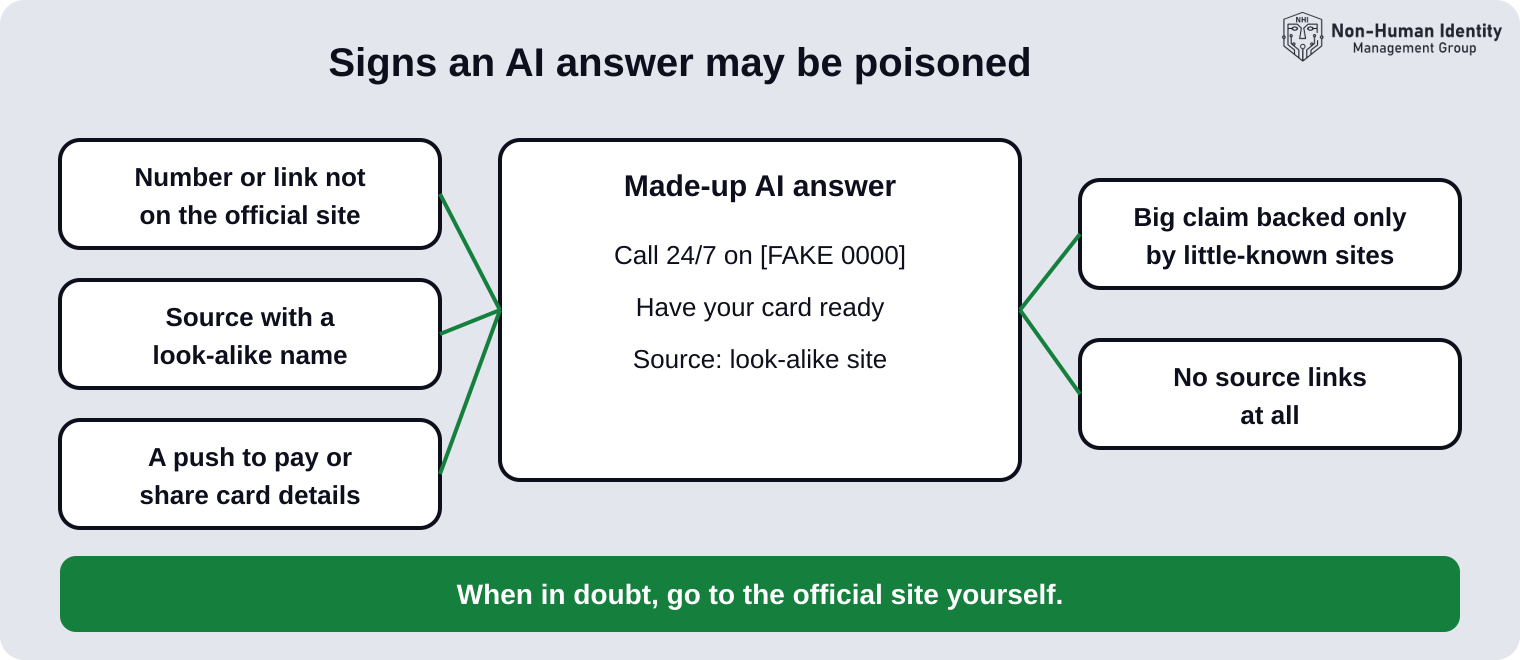
Here is a made-up AI answer of the kind that has misled people. The company and the details are invented.
Example only. All values are made up.
You asked: Example Cruises customer service number

AI answer:
  You can reach Example Cruises 24/7 on
  [FAKE NUMBER 0000 000 0000].                    (1)
  Have your card ready to confirm your booking.   (2)
  Source: example-cruise-help.example.com         (3)
- In a real message, this line would show a phone number taken from a planted page, not from the company.
- A push to share payment details on the call.
- The source is a help site with a look-alike name, not the company's own website.
Why this is risky: the answer sounds calm and sure, so it is easy to call without checking. People have reported reaching scammers this way, and Google said it was aware of the problem.[2]
The safer way: treat the AI answer as a lead, not the final word. Find the number on the company's own website, your booking email or your bill, and use that one.
How does it work?
Here is the general pattern in plain steps, to help you spot it rather than copy it.
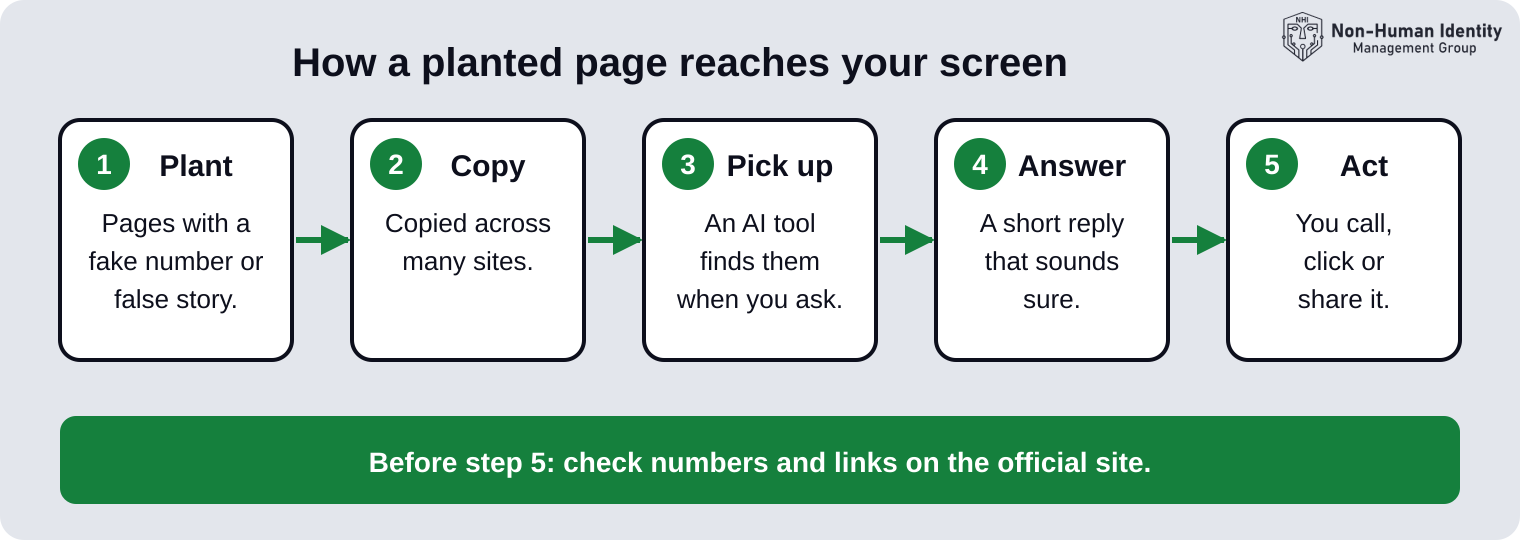
- The planting. Someone publishes pages with the claim they want repeated, such as a fake number or a false story.
- The volume. They copy those pages across many sites, or use tricks that search rules ban, such as showing search tools different content from people.[4]
- The pick-up. An AI search tool finds those pages when someone asks a matching question.
- The answer. The tool blends what it found into a short, confident reply, sometimes with a source link.
- The action. The reader calls the number, clicks the link or repeats the claim.
Size matters. One study of a Moscow-based network called Pravda counted about 3.6 million articles in 2024. When researchers tested 10 chatbots, the false stories came back in about a third of answers.[1] Results like this depend on the questions asked and change as tools are updated.
A worked example
Yara Yilmaz has booked a holiday and wants to change her flight. She asks an AI search tool on her phone for the airline's customer service number. It gives her one straight away.
She rings it. A friendly man answers with the airline's name. He says the change will cost a fee and asks for her card number to "confirm her identity".
Something feels off. The airline already has her card, so why would it need it again? Yara remembers the idea of fake signposts. The answer came from an AI tool, not from the airline itself.
She says she will call back, and hangs up. She opens the airline's own app and finds the contact page. The number there is different.
She calls that number instead. The real airline changes her flight and confirms it has not asked her for card details by phone.
Yara tells her neighbour, Bodhi Fairweather, who runs a small garage. Bodhi is curious, so he asks two AI tools how to contact his garage. One shows his correct number. The other shows an old address from a directory site.
Bodhi updates his own website and his business listings so they match. He also adds a clear contact page. He knows this will not stop every bad page, but it gives AI tools a clearer, official source to find.
Yara now has one rule. AI answers help her find things, but numbers and links come from the official site.
Myths and mistakes
| What people think | What is true |
|---|---|
| If an AI tool says it, it has been checked. | AI tools summarise what they find. They can repeat false pages and sound sure doing it.[3] |
| A source link means the answer is right. | The link shows where the answer came from, not whether that page is honest. Open it and see who runs it. |
| Only small or unknown chatbots get fooled. | Testing of 10 chatbots found them repeating planted false stories.[1] |
| This is the same as the AI making things up. | Not quite. A made-up answer is a mistake by the tool. Poisoning is someone feeding it bad content on purpose. |
| Asking twice will catch the problem. | The same poisoned pages may come up again. Check with the official source instead. |
What can I do this week?
- Save the official contact details of your bank, energy supplier and phone company.
- Open the source links in an AI answer before you act on it.
- Tell your family not to give card details to anyone they rang from an AI answer.
- If you run a business, ask two AI tools how to contact you and fix any listings that are wrong.
Checklist
- Phone numbers come from the official site, an app, a bill or a booking email.
- Links that ask you to log in or pay are opened from the official site, not from an answer.
- Big news claims are checked against at least one well-known news source.
- Source links are opened and the owner of the site is checked.
- Nobody shares card details on a call they started from an AI answer.
- Business contact details match across your website and listings.
- Bad answers are reported to the AI tool using its feedback button.
Common questions
Can I trust phone numbers from AI search?
Treat them with care. People have reported reaching scammers through numbers shown in AI answers.[2] Take numbers from the company's own website, app, bill or booking email instead. If a caller asks for card details or a code, hang up and call the official number.
Is AI search poisoning the same as an AI hallucination?
No. A hallucination is the AI tool making something up by mistake. Poisoning is a person deliberately planting false content so the tool repeats it. Both can give you a wrong answer that sounds right, so the same habit helps: check the official source.
Is this the same as data poisoning?
They are related. Data poisoning usually means tampering with the material a model learns from. AI search poisoning often targets the web pages a tool reads when it answers you. Some planted content may do both over time. See Data Poisoning for Beginners.
What do search companies do about it?
They have rules against tricks like showing search tools different content from people, mass-produced pages and hacked content.[4] They also act against bad results when they find them. No filter catches everything, so your own checks still matter.
What should I do if I was caught out?
Act quickly. If you shared card details, call your bank on the number on your card. Change any password you gave away. Report the scam through your country's official reporting service. See Online Scams for Beginners for more help.
Where next?
Ready for the detail? Read the practitioner guide: LLM Grooming and AI Search Poisoning. It goes further into how influence networks work, how security teams test AI answers and how organisations respond when they are targeted.
Also useful:
- AI Targeted Cloaking Guide
- Malvertising and SEO Poisoning Guide
- AI Search Engines for Beginners
- AI Hallucinations for Beginners
- Data Poisoning for Beginners
Related NHI Mgmt Group resources: AI Hallucination Business Risk Guide · Phone Scams for Beginners
Key terms
- AI search poisoning
- Planting content that AI search tools read, so they give attacker-chosen answers such as fake numbers or false claims.
- LLM grooming
- Publishing the same false claims at huge volume so AI models treat them as normal or credible.
- SEO poisoning
- Gaming search rankings so harmful pages appear near or above real ones.
- Misinformation
- False or misleading information, often shared by people who believe it is true.
- Hallucination
- An AI answer that sounds right but is wrong or made up.
- Data poisoning
- Tampering with the material an AI model learns from, to change how it behaves.
Sources and further reading
- A well-funded Moscow-based global 'news' network has infected Western artificial intelligence tools worldwide with Russian propaganda. NewsGuard Reality Check, NewsGuard, 2025. https://www.newsguardrealitycheck.com/p/a-well-funded-moscow-based-global, accessed 28 Nov 2026.
- Google AI Overviews led users astray, some phone numbers are scams: report. Android Central, 18 August 2025 (news report citing user reports and The Washington Post). https://www.androidcentral.com/apps-software/ai/google-ai-overviews-led-users-astray-some-phone-numbers-are-scams-report, accessed 28 Nov 2026.
- LLM09:2025 Misinformation. OWASP Top 10 for LLM Applications, OWASP GenAI Security Project, 2025. https://genai.owasp.org/llmrisk/llm092025-misinformation/, accessed 28 Nov 2026.
- Spam policies for Google web search. Google Search Central, Google. https://developers.google.com/search/docs/essentials/spam-policies, accessed 28 Nov 2026.