An online scam is a trick, by message, call or website, to get your money or personal details.
This guide is for anyone who has ever wondered, "Is this message real?" You do not need any technical knowledge to use it.
In short
- Most scams pretend to be someone you trust, such as your bank, a delivery firm or the tax office.
- Warning signs are a problem or prize, pressure to act now, and a request to pay in an unusual way.
- If in doubt, stop. Contact the company using details you find yourself, not the ones in the message.
- If you paid or shared bank details, call your bank straight away, then report the scam.
What you will learn
- Spot the common signs of a scam message, call or website.
- Check whether a message is genuine without using its links.
- Explain why scammers rush you.
- Report a scam and know what to do if you were caught out.
- Fake email (phishing)
- a message that pretends to be from someone you trust, to trick you into clicking, paying or sharing.
- Fake text or call (smishing and vishing)
- the same trick sent by text message or made by phone.
What is an online scam?
Think of a fake shop front that pops up on the high street for a week. The sign looks right and the staff are friendly. But once you have paid, the shop is gone. Many online scams work the same way.
A scammer pretends to be a business, a person or an official body you would trust. They reach you by email, text, phone call, social media or a fake website.
Then they give you a reason to act. It might be a parcel fee, a refund, a fine, a prize or a worried "friend" who needs money. The aim is to get your money, your bank details or your passwords.
Most scams play on feelings such as fear, hope or hurry. When we feel rushed, we check less.
Where the comparison stops working: a fake shop on a real street has an address you could go back to. Online, a scammer can copy a real company's logo and wording, then vanish and start again under a new name.
Why does it matter?
Scams cost people a great deal of money. In 2024, people in the US told the Federal Trade Commission they lost more than 12.5 billion dollars to fraud. Email was the most common way scammers made contact, followed by phone calls and texts.[4]
If you shop online
What could happen: a fake shop or delivery text takes your card details, and payments you did not make appear.
Check this: track parcels in the shop's own app or website, not through links in texts.
If you run a small business
What could happen: an email that looks like a supplier asks you to pay an invoice into a new bank account.
Check this: confirm any change of bank details by calling the supplier on a number you already have.
If you help an older relative
What could happen: a caller says they are from the bank and talks them into moving money to a "safe account".
Check this: agree a family rule: hang up, then call the bank on the number on the card.
What does it look like?
Example only. All values are made up.
From: FakeParcel                           (1)
FakeParcel: We could not deliver your
parcel. A fee of 0.00 is due.              (2)
Pay within 24 hours or it will be
returned:                                  (3)
https://fakeparcel.example.invalid/pay     (4)
- A name you might trust, such as a delivery firm.
- A small problem that seems easy to fix with a small payment.
- A deadline to rush you.
- In a real message, this line would hold a link to a fake page that asks for your card details.
Why this is risky: the fee is small, so it feels safe to pay. But the page is built to collect your full card details, which can then be used for much bigger payments.
The safer way: do not tap the link. If you are expecting a parcel, check it in the delivery firm's own app or website. Then report the text.[2]
How does it work?
This is a simple view so you can spot a scam. It is not a guide to running one.
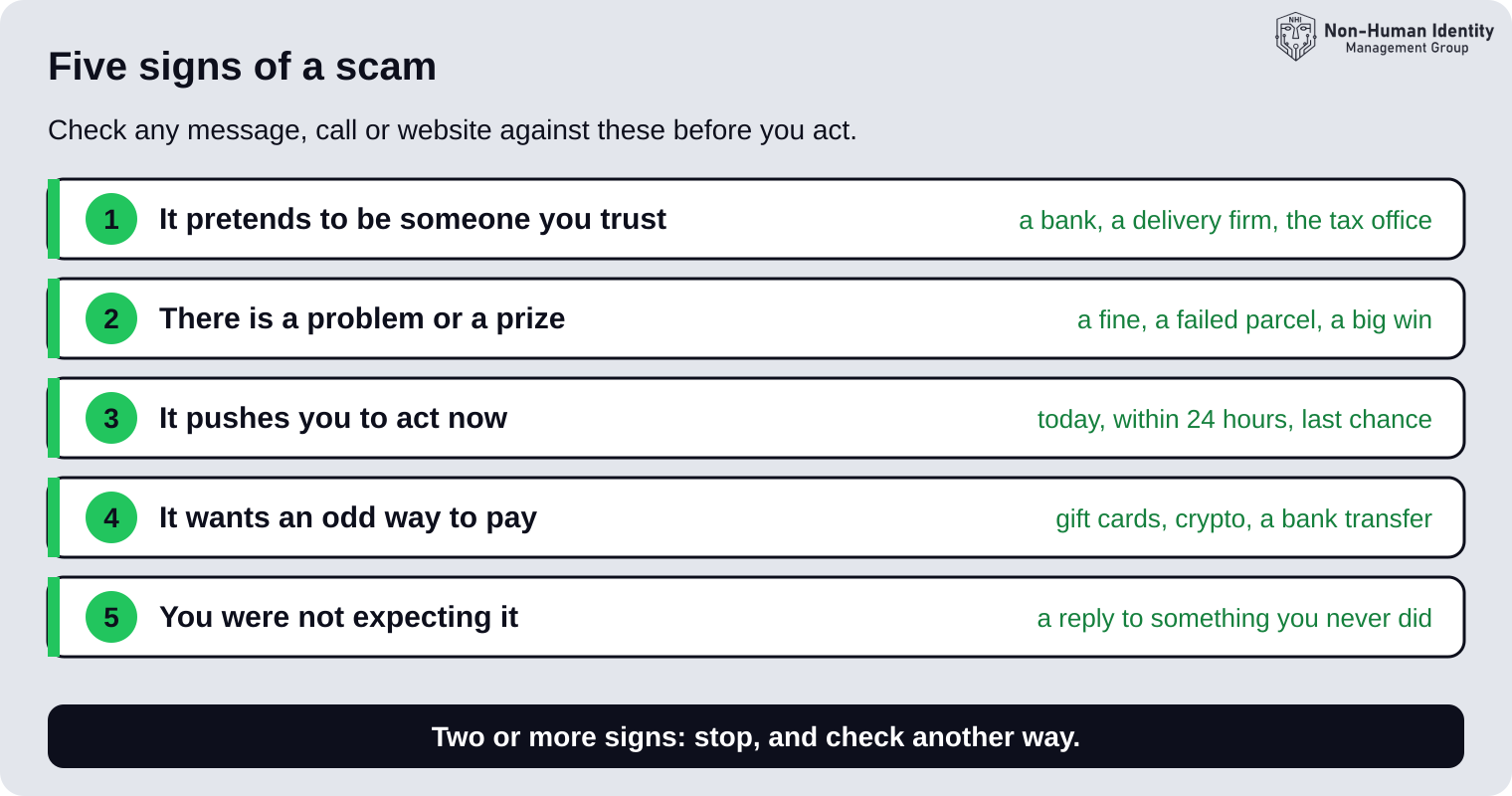
- They pretend to be someone you trust. Scammers copy the names and logos of banks, shops, delivery firms and government bodies.[3]
- They give you a reason to act. There is a problem to fix, such as a failed delivery, or a prize to claim.[3]
- They rush you. Words like "within 24 hours" or "immediately" leave you less time to think. They may also try to make you panic, or feel hopeful or curious.[1]
- They ask for money or details. They may ask you to pay by gift card, cryptocurrency or bank transfer, because that money is hard to get back. Honest firms give you time to decide.[3]
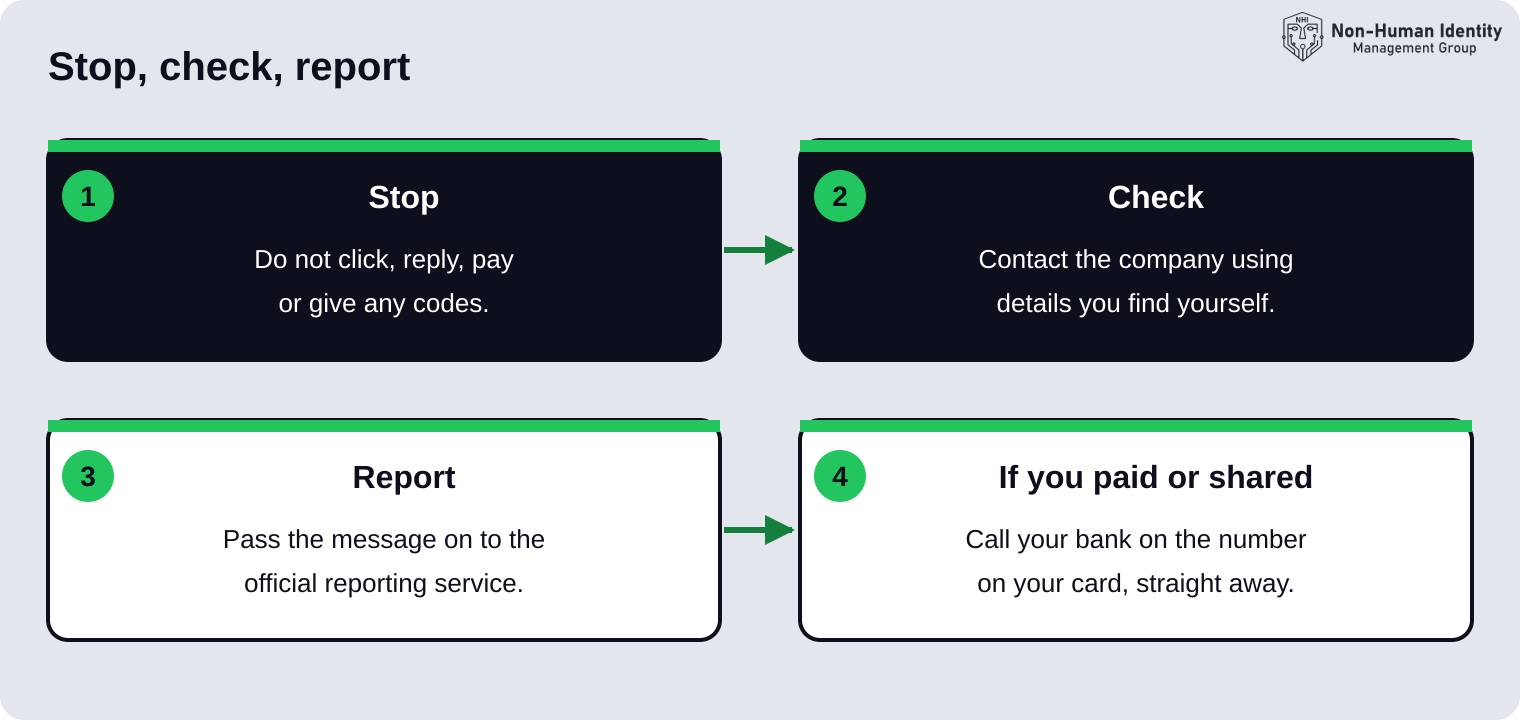
- You can break the chain. Stop, and contact the company using the details on its official website, not the ones in the message.[1]
A worked example
This story is made up to show how it can happen.
Imran Siddiqui is a bus driver in Leicester. He has ordered a new pair of trainers online and is waiting for them to arrive.
On his break, a text comes in. It says a delivery firm could not drop off his parcel, and a small fee is due within 24 hours. The link opens a page that looks just like the firm's real website.
Imran is expecting a parcel, so it feels right. He types in his card number and the code on the back. The page then asks for a code from his banking app.
That last request makes him stop. Why would a parcel fee need a bank code? He closes the page and does not enter it.
He opens the shop's own app instead. His parcel is still on its way, and no fee is due. The text was a scam.
Imran calls his bank using the number on the back of his card. The bank cancels the card and sends him a new one. No money has gone. The bank also tells him to watch his statements for the next few weeks.
Before his break ends, he reports the text using the official scam reporting service and deletes it.[2]
What made the difference: Imran noticed something odd and stopped, even after he had started. Then he called his bank quickly, on a number he trusted.
Myths and mistakes
| What people think | What is true |
|---|---|
| Only careless people fall for scams. | Scams are designed to catch busy people at the wrong moment. Anyone can be caught out. |
| Scam messages are always full of spelling mistakes. | Some are. Many now look polished and use real logos, so check the request, not the spelling. |
| If the caller knows my name and address, they must be genuine. | Criminals use information about you that they find online or from data leaks.[2] |
| My bank might email me to confirm my details. | UK advice says your bank will not ask for personal information by email or call you to confirm account details.[1] |
| It is too late to do anything once I have paid. | Call your bank straight away. The sooner they know, the more they can try to do. |
What can I do this week?
- Save your bank's fraud number from the back of your card in your phone contacts.
- Track parcels and check accounts only through official apps or websites you typed in yourself.
- Agree a family code word for any money request that claims to come from a relative.
- Turn on extra sign-in checks for your email, so a stolen password alone is less useful.
- Bookmark the official scam reporting page for your country.
Checklist
- I do not click links in unexpected messages about payments, parcels or accounts.
- I check messages by contacting the company on details I find myself.
- I never share codes from my bank or apps with anyone who contacts me.
- I am wary of anyone asking me to pay by gift card, crypto or bank transfer.
- I take my time, even when a message says it is urgent.
- I know how to report a scam message, call or website.
- I would call my bank straight away if I paid or shared bank details.
Common questions
How can I tell if a website is fake?
Look at how you got there. If you followed a link in a message, treat the site with care, however real it looks. Type the company's address yourself or use its app. Be wary of prices that seem too good to be true and odd ways to pay.
What should I do if I clicked a scam link?
Do not enter anything more. If you typed a password, change it from a trusted device and turn on extra sign-in checks. If you shared card or bank details, call your bank now on the number on your card. Then report the message.
Where do I report a scam?
In the UK, the National Cyber Security Centre explains how to report scam emails, texts, calls and websites.[2] If you lost money, report it to Report Fraud in England, Wales and Northern Ireland, or to Police Scotland.[5] In the US, report it to the Federal Trade Commission.
Why do scammers ask for gift cards or crypto?
Because that money is fast to move and hard to get back. US consumer advice says never to pay anyone who insists you can only pay by gift card, cryptocurrency, wire transfer or a payment app.[3] A genuine company or official body is unlikely to insist on this.
Can a phone call be a scam even if the number looks right?
Yes. Scammers can fake the number that shows on your screen, which is called spoofing. If a call worries you, hang up. Then call the company back on a number you find yourself, ideally from a different phone.
Where next?
Ready for the detail? Read the practitioner guide: Impersonation Scams Guide. It goes further into the main impersonation scripts, the stop, hang up, call back habit, and helping relatives, customers and staff.
Also useful:
- Phishing for Beginners
- Remote Access Scams for Beginners
- Payment Fraud for Beginners
- Identity Theft for Beginners
Related NHI Mgmt Group resources: Callback Phishing (TOAD) Guide · Fake Renewal and Refund Scams Guide · Charity and Disaster Scams Guide
Key terms
- Phishing
- A fake message that pretends to come from someone you trust, to trick you into clicking, paying or sharing details.
- Smishing
- Phishing sent by text message.
- Vishing
- Phishing done by phone call, where the caller pretends to be someone you trust.
- Tricking people, rather than computers, into giving access, money or information.
- Spoofing
- Faking a phone number, email address or website so it looks like it comes from someone else.
- A scam where you are tricked into sending money from your own account to a criminal.
Sources and further reading
- Spot scams: recognise the signs. National Cyber Security Centre (NCSC). https://www.ncsc.gov.uk/collection/phishing-scams/spot-scams, accessed 28 Nov 2026.
- Phishing: spot and report scam emails, texts, websites and calls. National Cyber Security Centre (NCSC). https://www.ncsc.gov.uk/collection/phishing-scams, accessed 28 Nov 2026.
- How To Avoid a Scam. Federal Trade Commission (FTC), Consumer Advice. https://consumer.ftc.gov/articles/how-avoid-scam, accessed 28 Nov 2026.
- New FTC Data Show a Big Jump in Reported Losses to Fraud to $12.5 Billion in 2024. Federal Trade Commission (FTC), press release, March 2025. https://www.ftc.gov/news-events/news/press-releases/2025/03/new-ftc-data-show-big-jump-reported-losses-fraud-125-billion-2024, accessed 28 Nov 2026.
- Report Fraud service goes live. Report Fraud (City of London Police), 4 December 2025. https://www.reportfraud.police.uk/news/report-fraud-service-goes-live/, accessed 27 Nov 2026.