A phone scam is a call or text from a criminal pretending to be someone you trust.
This guide is for anyone with a phone who wants to know how these scams work and how to check a call. Scam calls are often called vishing (voice phishing), and scam texts smishing (SMS phishing).
In short
- The name or number on your screen can be faked, so it does not prove who is calling.
- Scammers pose as your bank, the police, a company or even a relative, and they rush you.
- Requests to move money, share a code or pay by gift card or crypto are strong warning signs.
- Hang up, then call back on a number you already trust, such as the one on your bank card.
What you will learn
- Explain why a familiar number on your screen can still be a scam.
- Spot the pressure tricks used in scam calls and texts.
- Check a call safely by calling back on a number you trust.
- Know who to tell if something has already gone wrong.
- Faked caller name or number (caller ID spoofing)
- when a caller makes your phone show a name or number that is not really theirs.
- Scam call (vishing)
- a phone call that tries to trick you into giving money or information.
- Scam text (smishing)
- a text message that tries to do the same, often with a link.
What is a phone scam?
Think of the return address on the back of an envelope. Anyone can write any address there, and the post office still delivers the letter. The number on your phone screen can work in much the same way.
Scammers can make any name or number show up when they call. This is called caller ID spoofing.[1][2] They may show your bank's real number, a local number or a government office.[3]
Then they tell a story. Your account is under attack. You owe a fine. A parcel is stuck. A relative is in trouble. The story is there to make you act before you think.
Some scammers now use AI tools to copy a person's voice from a short clip, such as a video posted online.[4] So even a voice you know is not proof on its own.
Where the comparison stops working: you can open a letter later. A call happens live, with someone pushing you to decide now.
Why does it matter?
Phone scams can cost people their savings, and money sent by bank transfer can be hard to get back.[1] In 2024 the FBI received 17,367 reports of government impersonation scams in the US, with losses of over $405 million.[7]
If you bank by phone or online
What could happen: a caller who seems to be your bank talks you into moving money to a "safe account" they control.
Check this: treat any request to move money to a new or "safe" account as a warning sign.[5]
If you help an older relative
What could happen: a caller claiming to be you, or a grandchild, asks them for urgent money.
Check this: agree a family habit: hang up and call the person back on their usual number.
If you answer phones at work
What could happen: a caller posing as IT support asks for your password or a sign-in code.
Check this: find out how your IT team will really contact you, and how to check a caller.
What does it look like?
Here is a made-up scam call, written out as a script, followed by a scam text.
Example only. All values are made up.
Caller ID: FakeBank Fraud Team  0000 000 0000      (1)
"This is the fraud team at FakeBank. We have
 stopped a payment from your account."             (2)
"Your account is not safe. You must act now."      (3)
"Move your money to this safe account:
 EXAMPLE-SAFE-0000."                               (4)
"Please read me the code we just texted you."      (5)
Text: FakeParcel: fee due. Pay at example.invalid  (6)
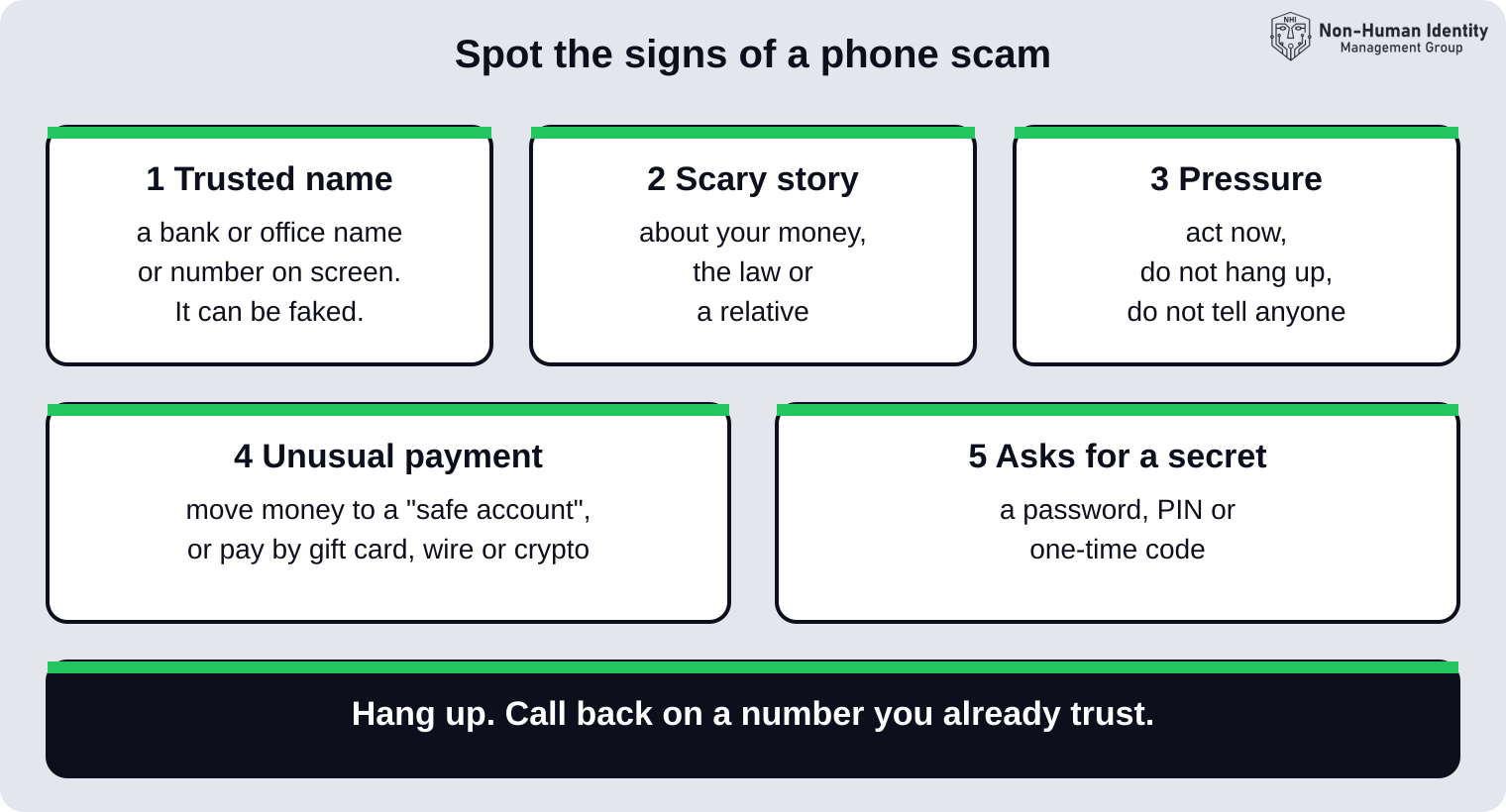
- The name and number look like your bank's. They can be faked.
- A scary story, so you stop thinking about who is calling.
- Pressure to act straight away.
- A request to move money to a "safe" account. In a real message, this line would contain an account the scammer controls.
- A request for a one-time code. That code is meant for you alone.
- A scam text with an urgent fee and a link to a fake site.
Why this is risky: each line pushes you to act on the caller's word, using details you cannot check during the call.
The safer way: hang up. Then call your bank on the number on the back of your card or on its website.
How does it work?
This is a simple view so you can spot it. It is not a guide to doing it.
- They pick a disguise. They choose who to pretend to be, such as a bank, a delivery firm, the police or a family member.
- They fake the caller ID. Your screen shows a name or number you trust.[2]
- They tell an urgent story. They say something bad will happen unless you act now.[1]
- They ask for money or a secret. They want a transfer, gift cards, crypto, a PIN or a sign-in code. These payment methods are hard to reverse.[1]
- They keep you on the line. They may say not to tell anyone, or not to hang up, so you cannot check their story.
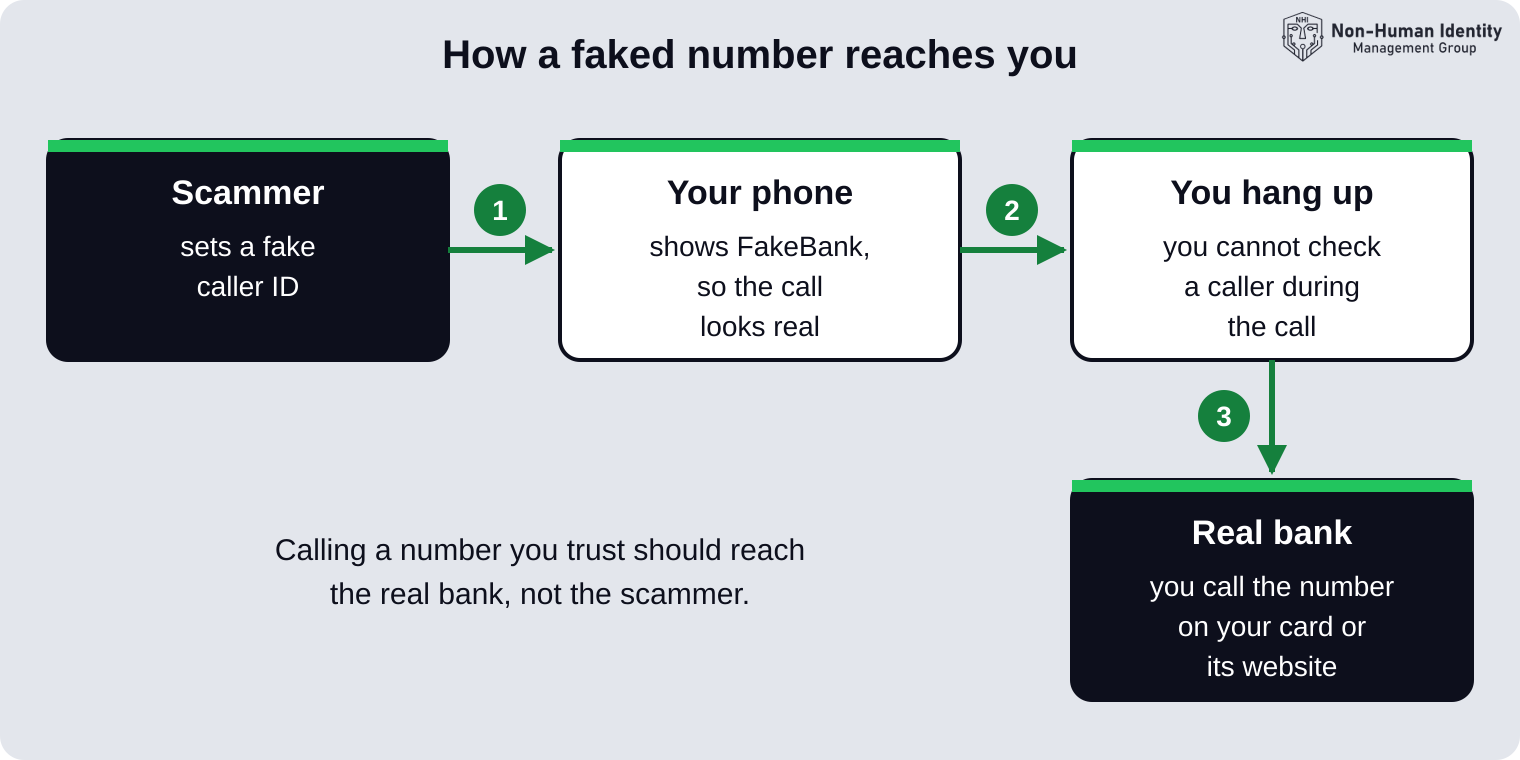
Phone companies in some countries now check caller IDs on parts of their networks, and UK networks block some calls that falsely use bank numbers.[2][3] These checks help, but some faked calls still get through.
A worked example
This story is made up to show how it can happen.
Kwame Mensah is a retired bus driver in Bristol. One Thursday his landline rings. The screen shows his bank's name and the number on the back of his card.
A calm voice says she is from the bank's fraud team. Someone has tried to take money from his account, she says. To keep his money safe, he must move it to a new account today. She reads out his name and address, which makes her sound real.
Then she asks him to read out a code the bank has just texted him. Kwame pauses. His daughter told him that banks do not ask for those codes.
He says he will call back. The caller gets cross and says his money will be gone in an hour. That pressure makes Kwame more suspicious, not less. He hangs up.
He uses his mobile, not the landline, to call the number on his card. The real bank checks his account. There was no fraud alert. The bank adds a note to his account and tells him to report the call.
That afternoon he reports it to Report Fraud, the UK fraud reporting service.[6] His money did not move.
What made the difference: Kwame did not trust the number on his screen, and he checked by calling a number he already knew.
Myths and mistakes
| What people think | What is true |
|---|---|
| If the screen shows my bank's number, it is my bank. | Caller names and numbers can be faked. Hang up and call the number on your card.[2] |
| The caller knew my name and address, so they must be real. | Those details are often stolen in data leaks. Knowing them proves nothing. |
| Pressing a button to "stop calls" will remove me from the list. | It may lead to more calls. Just hang up.[1][2] |
| I would know my own relative's voice. | AI can copy a voice from a short clip. Call them back on a number you know.[4] |
| A real official might need payment in gift cards. | The FTC says anyone who insists you can only pay that way is a scammer.[1] |
What can I do this week?
- Save your bank's and phone company's real numbers, taken from your card or bill, in your contacts.
- Agree a simple rule with your family: if someone calls asking for money, hang up and call them back.
- Turn on your phone's spam call filter or silence unknown callers, if it has one.
- Tell an older relative about the "safe account" trick and the code trick.
Checklist
- I know a name or number on my screen can be faked.
- I hang up and call back on a number I already trust.
- I do not read out PINs, passwords or one-time codes to callers.
- I treat a request to move money to a "safe account" as a scam sign.
- I do not pay anyone by gift card or crypto because a caller told me to.
- I do not tap links in unexpected texts about fees, parcels or fines.
- I know where to report a scam where I live.
Common questions
What is the difference between vishing and smishing?
Vishing is a scam phone call, and smishing is a scam text message. Both use a trusted-looking name and an urgent story. Vishing works by talking you into acting. Smishing usually pushes you to tap a link to a fake website or call a fake number.
How can a scammer show my bank's real number?
The phone system lets the caller set what your screen shows, and scammers abuse that. It is called caller ID spoofing. Phone networks are adding checks, but some fake calls still get through, so the number alone is not proof.[2][3]
What should I do if I already paid or shared a code?
Call your bank straight away on the number on your card, and tell them what happened. If you paid by gift card or another payment service, contact that company too. Then change any password you shared and report the scam.[1]
Where do I report a scam call in the UK?
Report it to Report Fraud if you live in England, Wales or Northern Ireland. It replaced Action Fraud in December 2025. In Scotland, contact Police Scotland. Tell your bank too if money or account details were involved.[6]
Should I just stop answering unknown numbers?
It helps. The US phone regulator advises not answering calls from unknown numbers, and hanging up if you do. Remember that a scam call can also show a known number, so the call-back check still matters.[2]
Where next?
Ready for the detail? Read the practitioner guide: Vishing and Smishing Guide. It goes further into help desk checks, protecting staff from scam calls and texts, and verifying high-risk payment requests.
Also useful:
- Phishing for Beginners
- Remote Access Scams for Beginners
- Deepfakes and AI Fraud for Beginners
- SIM Swap Fraud for Beginners
Related NHI Mgmt Group resources: Impersonation Scams Guide · Verification Code Scams Guide · What to Do If You Have Been Scammed Guide
Key terms
- Vishing
- A scam phone call that tries to persuade you to give money, information or access.
- Smishing
- Phishing sent by text message instead of email, often with a link to a fake site.
- Caller ID spoofing
- Faking the name or number shown on your phone so a call seems to come from someone you trust.
- Voice cloning
- Using AI to make speech that sounds like a real person's voice.
- Using lies, urgency and fake authority to get a person to share information or take a risky action.
- A scam where you are tricked into sending the money yourself, for example to a "safe account".
Sources and further reading
- Phone Scams. US Federal Trade Commission (FTC), Consumer Advice. https://consumer.ftc.gov/articles/phone-scams, accessed 28 Nov 2026.
- Caller ID Spoofing. US Federal Communications Commission (FCC), Consumer Guides. https://www.fcc.gov/consumers/guides/spoofing-and-caller-id, accessed 28 Nov 2026.
- Tackling scam calls and texts. Ofcom. https://www.ofcom.org.uk/phones-and-broadband/scam-calls-and-messages/tackling-scam-calls-and-texts, accessed 28 Nov 2026.
- Scammers use AI to enhance their family emergency schemes. US Federal Trade Commission (FTC), Consumer Alert, March 2023. https://consumer.ftc.gov/consumer-alerts/2023/03/scammers-use-ai-enhance-their-family-emergency-schemes, accessed 28 Nov 2026.
- General advice (Stop, Challenge, Protect; quick checks on "safe account" requests and sharing codes). Take Five to Stop Fraud, UK Finance. https://www.takefive-stopfraud.org.uk/advice/general-advice/, accessed 28 Nov 2026.
- Report Fraud service goes live. Report Fraud (City of London Police), 4 December 2025. https://www.reportfraud.police.uk/news/report-fraud-service-goes-live/, accessed 27 Nov 2026. See also: Report Fraud: new service from City of London Police, GOV.UK. https://www.gov.uk/government/news/report-fraud-new-service-from-city-of-london-police, accessed 28 Nov 2026.
- Internet Crime Report 2024. Federal Bureau of Investigation, Internet Crime Complaint Center (IC3), April 2025. https://www.ic3.gov/AnnualReport/Reports/2024_IC3Report.pdf, accessed 28 Nov 2026.