Certified Ethical Hacker (CEH) is an exam-based certificate showing you know how attackers work and how to test safely.
This guide is for students, career changers and anyone who has seen CEH in a job advert. It explains what the certificate covers, how you qualify, and what it does and does not prove.
In short
- CEH is run by EC-Council, a private training and certification company.
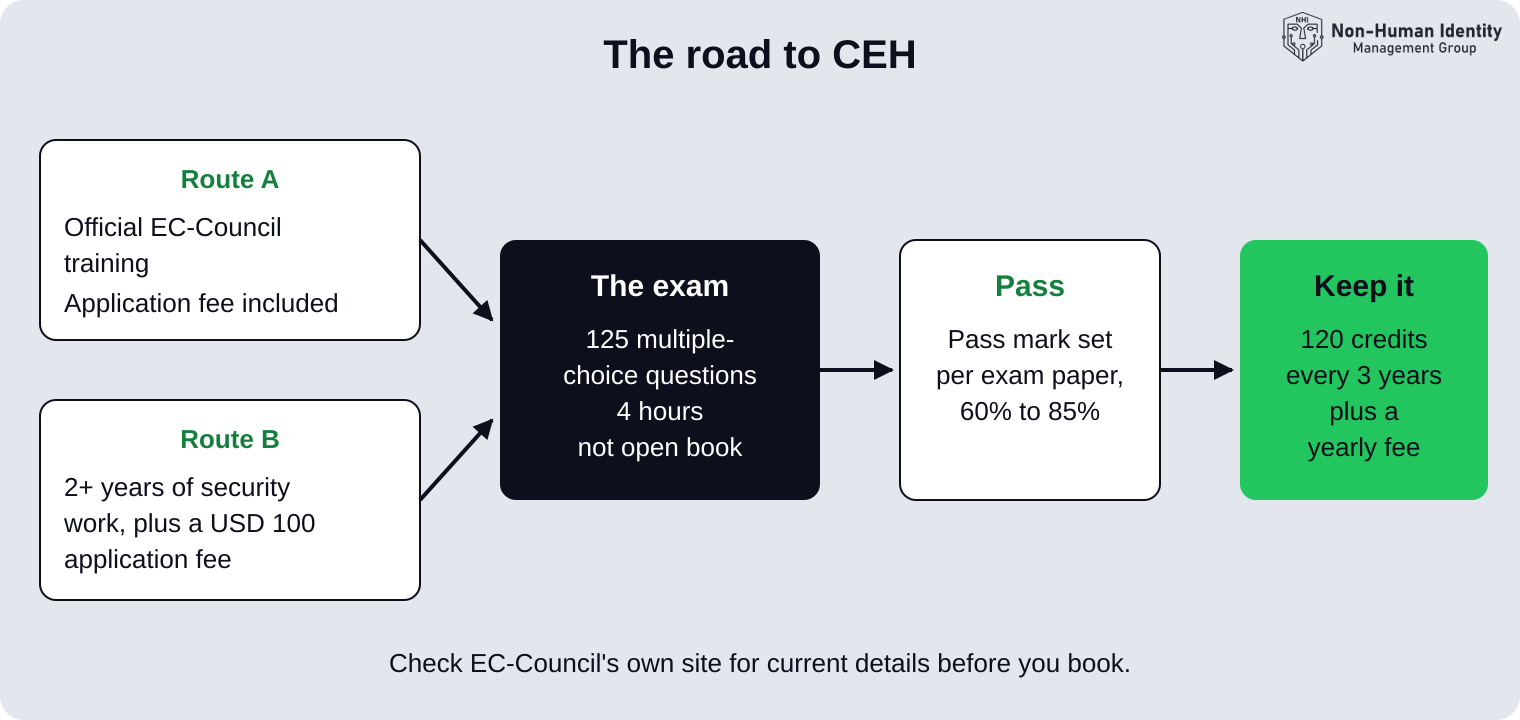
- The main exam is 125 multiple-choice questions in four hours, so it tests knowledge rather than hands-on skill.
- You qualify through official training or two years of security work experience plus an application fee.
- Some employers ask for it by name, so check the adverts for the jobs you want before you pay.
What you will learn
- Explain what ethical hacking is and what CEH tests.
- Check which route lets you sit the exam.
- Explain what a multiple-choice certificate shows an employer, and what it does not.
- Ask the right questions before paying for any course.
- Permitted hacking (ethical hacking)
- testing systems for weaknesses with the owner's written permission, so they can be fixed.
- Certificate (certification)
- a credential you earn by passing an exam set by an outside body.
What is CEH?
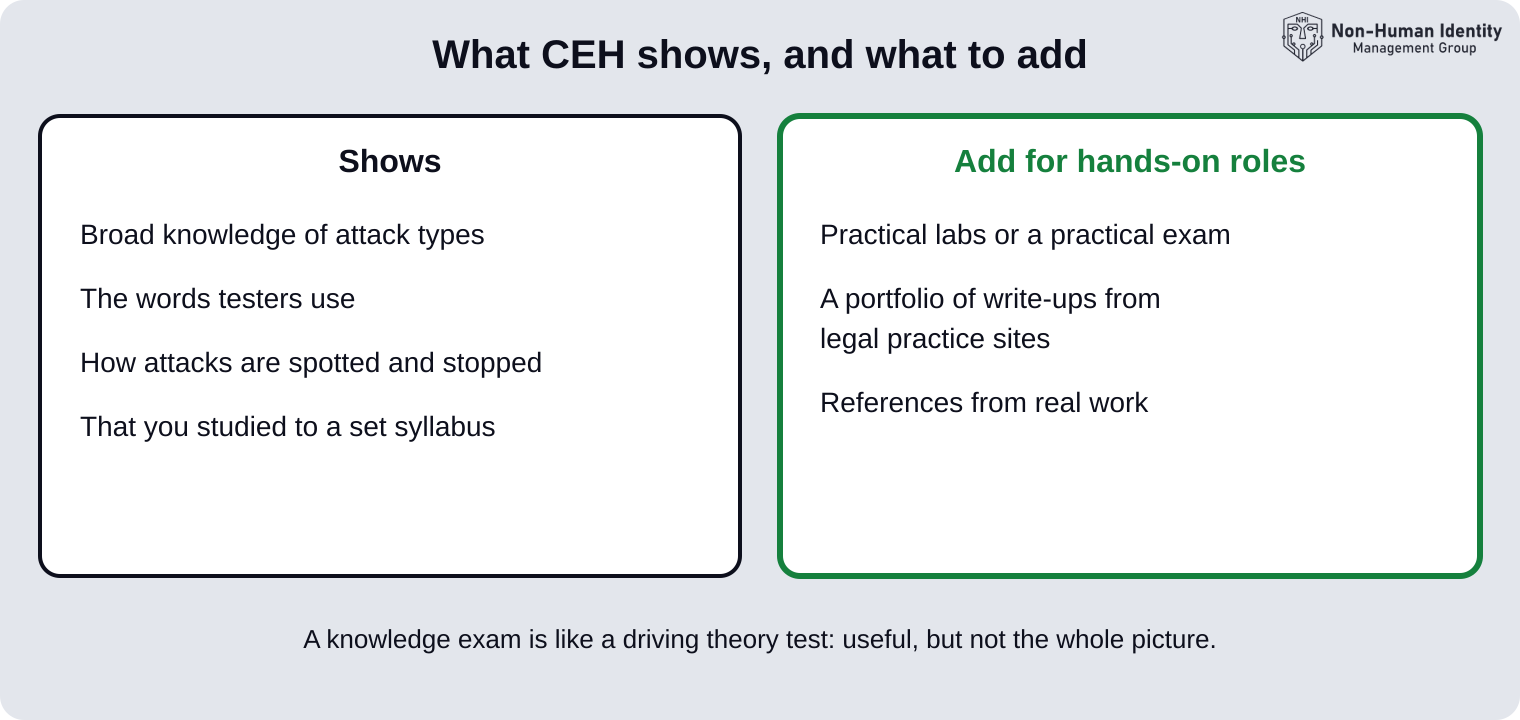
Think of the theory part of a driving test. It shows you know the rules of the road and the signs. It does not show you can drive in heavy traffic.
CEH works in a similar way for security testing. Ethical hackers test systems with the owner's permission, to find weak spots before criminals do. The CEH exam checks that you know the main ways attackers work and how each one is spotted and stopped.
EC-Council's current course, version 13, is built around 20 learning modules and 221 hands-on labs.[2] It says these cover more than 550 attack techniques.[2] The exam itself is multiple choice.[1]
Where the comparison stops working: a driving licence is a legal must. CEH is a choice. No law says you need it to work in security, though some jobs and contracts ask for it.
Why does it matter?
Certificates help people who are new to a field get past the first screening of a job application. CEH is one of the names that often appears in adverts. It also costs real money, so it is worth knowing what you get.
If you are changing career
What could happen: you pay for a course before checking whether the jobs you want ask for it.
Check this: read 10 adverts for your target job and count how many name CEH.
If you are a student
What could happen: you cannot use the work experience route yet, so the only way in is paid official training.
Check this: ask your college whether it is an official training partner or has discounts.
If you hire people
What could happen: you treat a knowledge exam as proof that someone can test a network alone.
Check this: add a practical task or a portfolio review to the interview.
What does it look like?
Here is a made-up planning card a learner might fill in before booking.
Example only. All values are made up.
CEH plan for: EXAMPLE learner
Jobs I want:        junior security analyst
Adverts naming CEH: 3 of 10                  (1)
My route:           official training         (2)
Exam:               125 questions, 4 hours   (3)
Pass mark:          set per exam paper        (4)
After passing:      120 credits in 3 years   (5)
- In a real file, this line would hold your own count from real adverts.
- The other route is two years of security work plus an application fee.
- Multiple choice and not open book.
- EC-Council says pass marks range from 60% to 85%, depending on the exam paper.[1]
- You keep the certificate by earning learning credits and paying a yearly fee.
Why this is risky: if only a few adverts name CEH, the money might be better spent elsewhere.
The safer way: decide with real adverts in front of you. Compare CEH with other starter certificates before you pay.
How does it work?
- Choose a route. You can take official EC-Council training, which includes the application fee. Or you can show at least two years of security work and pay a USD 100 fee that is not refunded.[1]
- Study. The course spans 20 modules on many attack types.[2] Our practitioner guide lists them, from scanning networks to web apps and cloud.
- Sit the exam. The exam has 125 multiple-choice questions over four hours, and it is not open book.[1] EC-Council's own pages differ on where you can sit it, so check the options when you book.[1]
- Pass. There is no single pass mark, because each version of the paper has its own, set between 60% and 85%.[1]
- Keep it current. The certificate lasts three years. To renew, you earn 120 learning credits in that time and pay a yearly fee of USD 80.[3] If you miss this, it can be suspended and then taken away.[3]
How is CEH seen? Views differ, so here is our balanced take. CEH shows broad knowledge of attack types and their names. That helps in roles that need to recognise attacks, such as security analysts. It shows less about hands-on skill, because the main exam is multiple choice. Employers hiring hands-on testers often look for practical exams or a portfolio as well. We suggest treating CEH as one piece of evidence, not the whole case.
A worked example
Quinn Rosen works in a hotel's IT help desk and wants to move into security. A friend says, "Get CEH, everyone asks for it."
Before paying, Quinn talks to Dario Nakamura, a security team lead she met at a local meetup. Dario asks one question: "Which job do you want next?"
Quinn wants to be a junior security analyst. She reads ten local adverts for that job. Three name CEH, five name another starter certificate, and two ask for no certificate at all.
Dario explains the driving theory test idea. CEH would show she knows the attack types an analyst needs to spot. It would not, on its own, show she can investigate an alert.
Quinn checks her route. She has some IT experience, but under two years in a security role. So she would need official training to qualify. She asks her employer about training funds and finds there is a yearly budget she can use.
She also starts a free home lab and writes short notes on what she learns. Dario says these notes will help in interviews whatever she decides.
In the end Quinn books the course, because the training budget covers most of it and three target adverts name it. She notes the renewal rule in her diary, so the certificate does not lapse in three years.
Myths and mistakes
| What people think | What is true |
|---|---|
| CEH makes you a hacker. | It tests knowledge in a multiple-choice exam. Hands-on skill comes from practice.[1] |
| Anyone can just book the exam. | You need official training or two years of security work plus an application fee.[1] |
| Once you pass, it is yours for life. | You need 120 credits every three years and a yearly fee, or it can be suspended.[3] |
| Every security job asks for CEH. | Some do, many do not. Check adverts for the job you want. |
| Learning hacking means you can test any system. | Testing without the owner's written permission can be a crime. Practise only on your own lab or sites built for practice. |
What can I do this week?
- Read ten adverts for the job you want and count how many name CEH.
- Check which route you would use: official training or two years of security work.
- Read the official exam page yourself, as details can change.
- Compare CEH with one other starter certificate on cost and what it tests.
- Set up a simple home lab, so you build hands-on skill whatever you choose.
Checklist
- I know which job I want CEH for.
- I have checked real adverts for that job.
- I know which route lets me sit the exam.
- I have read the current exam details on EC-Council's own site.
- I know the renewal rules and yearly fee.
- I have a plan for hands-on practice as well.
- I only practise hacking on systems I own or have written permission to test.
Common questions
Is CEH good for beginners?
It can be, if jobs you want ask for it. It gives a broad map of attack types and the words testers use. But without two years of security work you need official training, which adds cost. Check adverts and compare it with other starter certificates first.
Is the CEH exam hands-on?
No, the main exam is not hands-on. It is 125 multiple-choice questions over four hours. The course includes labs, and the practitioner guide explains EC-Council's separate practical exam. Employers hiring hands-on testers often look for practical proof as well.
How long does CEH last?
Three years at a time. To keep it, you earn 120 learning credits within each three-year period and pay a yearly fee. If you miss the credits, EC-Council can suspend the certificate and later take it away.
CEH or Security+: which first?
Choose the one your target job asks for most. Security+ is a broad starter certificate covering many areas. CEH focuses on how attackers work. Read real adverts for your target role, then see our comparison of the two. See CEH vs Security+.
Is ethical hacking legal?
Yes, when the owner of the system has given clear written permission first. Testing without permission can be a crime, even if you mean well. Practise on your own lab or on websites made for legal practice.
Where next?
Ready for the detail? Read the practitioner guide: CEH Certification Guide. It goes further into the full module list, the optional practical exam and study planning.
Also useful:
- Cyber Security Certifications for Beginners
- CEH vs Security+
- Penetration Testing for Beginners
- OSCP Certification Guide
Related NHI Mgmt Group resources: Penetration Tester for Beginners · SOC Analyst Career Guide · Career Change into Cyber Security Guide
Key terms
- Ethical Hacking
- Testing systems for weaknesses with the owner's permission, so they can be fixed.
- Ethical Hacker
- A security specialist who tests systems with permission to find weak spots before criminals do.
- Penetration Testing
- An approved test that tries to break in the way a real attacker would, to show what needs fixing.
- Reconnaissance
- Gathering information about a target before acting.
- Tricking a person into giving away information or access.
- Continuing Professional Education
- Learning that professionals record to keep a certificate current.
Sources and further reading
- Certified Ethical Hacker (CEH) certification: exam details, eligibility and FAQ. EC-Council. https://cert.eccouncil.org/certified-ethical-hacker.html, accessed 28 Nov 2026.
- Certified Ethical Hacker (CEH) v13 course page. EC-Council. https://www.eccouncil.org/train-certify/certified-ethical-hacker-ceh/, accessed 28 Nov 2026.
- EC-Council Continuing Education (ECE) policy. EC-Council. https://cert.eccouncil.org/ece-policy.html, accessed 28 Nov 2026.