A penetration tester is a person hired to try to break into systems, with permission, to find weak spots.
This guide is for anyone curious about "ethical hacking" as a job, or thinking about it as a career. You do not need a technical background to read it. If your organisation ever pays for a security test, this is the person doing the work.
In short
- A penetration tester, or pen tester, tests systems the way an attacker might, so the owner can fix weak spots first.
- Written permission and an agreed scope come before any testing. Without them, the same actions can be a crime.
- Much of the job is planning and report writing, not just testing.
- A test gives a snapshot. It adds to regular security checks rather than replacing them.
What you will learn
- Explain what a penetration tester does in one sentence.
- Spot the main stages of a penetration test.
- Explain why permission and scope matter so much.
- Ask good questions about a testing job or a test you are buying.
- Weak spot (vulnerability)
- a flaw in a system that an attacker could use.
- The agreed limits (scope)
- exactly which systems may be tested, how and when.
- The ground rules (rules of engagement)
- the written agreement on what testers may and may not do.
What is a penetration tester?
Think of a locksmith you hire to try your own locks. You invite them in, tell them which doors to test, and they show you which locks are weak.
A penetration tester does the same for computer systems. They use the same kinds of methods an attacker might, to see how far someone could get.[1] The test is called a penetration test, or pen test.
The aim is to find a vulnerability, a weak spot an attacker could use, before a real attacker does. The tester then explains each problem and how serious it is, and suggests fixes.[1]
Testers work on websites, company networks, cloud services, mobile apps and sometimes buildings and staff. Some work inside one company. Many work for testing firms and visit lots of different clients.
Where the comparison stops working: a locksmith can see every lock at once. A computer system changes all the time, so a test shows how things looked during those days, not how they will look later.
Why does it matter?
A pen test shows an organisation how an attacker might see it, and checks whether its own weak-spot checks are working.[1] For the tester, permission is everything.
If you want to become a tester
What could happen: you practise on systems you do not own and break the law without meaning to.
Check this: practise only on your own equipment or on legal training sites built for it.
If you are buying a test for your organisation
What could happen: the scope misses your most important system, so the report looks good but tells you little.
Check this: agree in writing what will be tested, by whom, and when.
If you work in IT support
What could happen: the test sets off alarms and you treat the testers as real attackers, or real attackers as testers.
Check this: ask who knows the test dates and how to confirm a tester is genuine.
What does it look like?
Before any testing starts, both sides agree a short summary of the job. Here is a made-up one.
Example only. All values are made up.
TEST AGREEMENT  EXAMPLE-0000
Client:     Example Council (FAKE)
In scope:   bookings.example.com, staff portal         (1)
Not in scope: payroll system, staff phones              (2)
Dates:      Mon to Thu, 09:00 to 17:00                  (3)
Signed by:  Head of IT, EXAMPLE NAME                    (4)
Stop and call if: anything goes down or real data seen  (5)
- In a real file, this line would list each system the tester may touch.
- Systems that must be left alone.
- When testing may happen, so staff know what to expect.
- Written permission from someone with the authority to give it.
- What to do if something goes wrong or sensitive data turns up.
Why this is risky: testing without a signed agreement, or outside its limits, can break the law. In the UK, getting into a computer when you know you are not allowed to is a crime.[4] It can also break systems the client relies on.
The safer way: get the scope and permission in writing first. Stick to it, and stop and call the client if anything unexpected happens.
How does it work?
Each firm has its own method, but a test usually follows stages like these.
- Scope and permission. The client and tester agree what will be tested, how, when and why. The client's risk owners and technical staff should take part.[1]
- Research. The tester learns how the systems in scope fit together.
- Test. They look for weak spots and, within the agreed limits, check whether each one could really be used.
- Report. They write up each problem, how serious it is and how to fix it.[1]
- Fix and retest. The client decides what to fix and when. A retest can confirm the fixes worked.
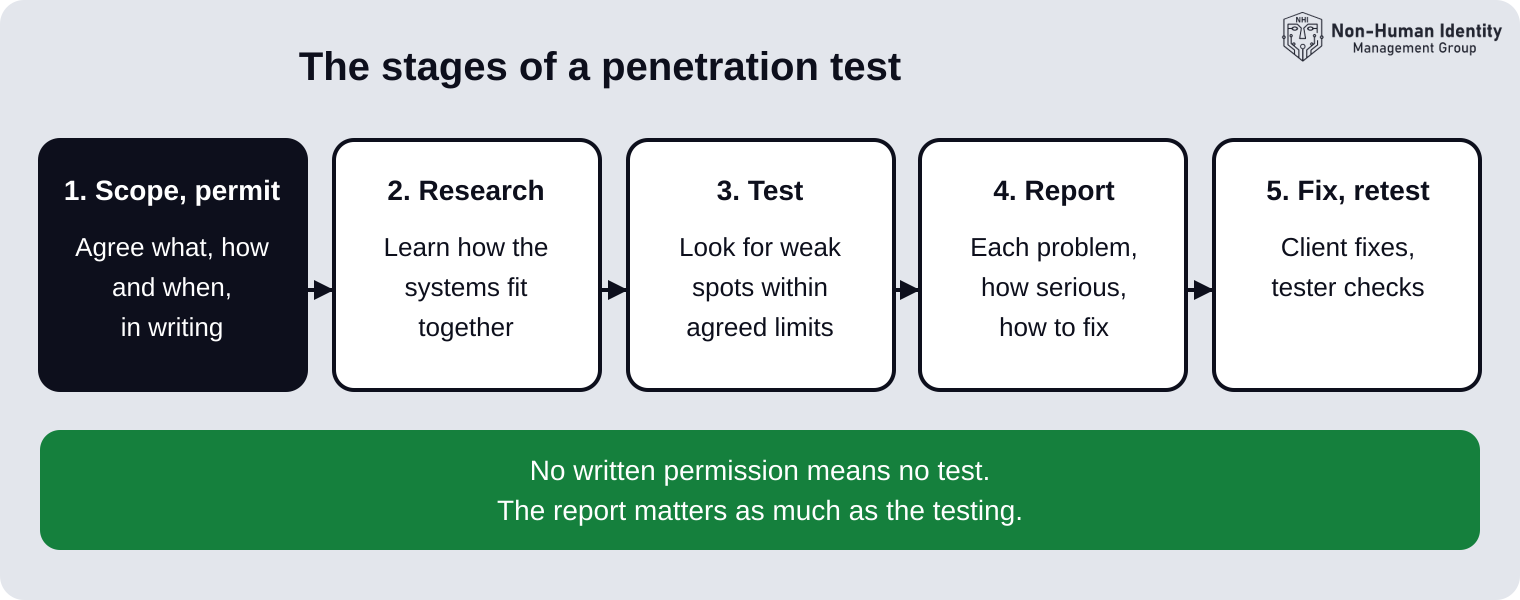
The report is a big part of the job. A good report explains problems in plain words for managers and in detail for the people who fix them. The client, not the tester, decides which risks to accept and which fixes to make.[1]
A pen test is different from an automatic scan, which only lists possible weak spots. It is also different from a red team exercise. That is a longer, usually secret test of how well the whole organisation spots and handles an attack.
Some testing is formally checked. In the UK, a government scheme approves firms to test systems for government bodies and other key services.[2] Industry bodies also run practical exams for testers.[3]
A worked example
Nikos Papadopoulos is a penetration tester at a small, fictional testing firm. This week his client is Wrenfield Council, also fictional.
On Monday morning he checks the signed agreement with Paula Schmitt, the council's IT manager. Two systems are in scope: the public bookings website and the staff portal. Payroll is out. Nikos thinks of the hired locksmith: test only the doors you were shown.
For two days he studies how the bookings site works and tests it carefully. He finds that a page meant for staff can be reached without logging in. He notes it, takes screenshots and moves on.
On Wednesday something unexpected happens. A test on the staff portal shows a list of real staff names. The agreement says to stop and call, so he does. Paula thanks him and asks him not to open any more records. He does not.
Thursday is mostly writing. Nikos explains each problem in two ways. One version is short and plain, for the council's managers. The other is detailed, for the web team who will fix it.
The next week he talks Paula's team through the report. They agree to fix the staff page first. A month later Nikos retests it and confirms the fix works.
Paula says the most useful part was not the clever testing. It was the clear report and the phone call on Wednesday.
Myths and mistakes
| What people think | What is true |
|---|---|
| Pen testers can test anything they like. | They test only what the written agreement allows, during agreed times. |
| It is all hacking and no paperwork. | Planning and report writing take a large share of the time. |
| A clean test means you are safe. | A test is a snapshot of the systems in scope. Regular checks still matter.[1] |
| Practising on any website is fine if you mean well. | Getting into systems without permission can be a crime. Use your own kit or legal practice sites. |
| A pen test and a vulnerability scan are the same. | A scan lists possible weak spots. A tester checks which ones could really be used, and explains the risk. |
What can I do this week?
- Read our Penetration Testing for Beginners guide.
- Read two penetration tester job adverts and note the skills they ask for.
- Learn the basics of how websites and networks talk to each other.
- Find a legal practice platform built for learners, and read its rules first.
Checklist
- I can explain what a penetration tester does in one sentence.
- I know that written permission and scope come before any test.
- I practise only on my own equipment or legal training sites.
- I can name the main stages of a test.
- I know a pen test is not the same as a scan or a red team exercise.
- I have checked official sources for pay, not just job boards.
- I have a plan for one first learning step.
Common questions
Is penetration testing legal?
Yes, when the owner of the system has given clear permission and the tester stays within it. The same actions without permission can be a crime. In the UK, getting into a computer you know you are not allowed to use is an offence.[4] Always get permission in writing.
Do I need a degree to become a pen tester?
Not always. Some testers have degrees, others come from IT support, networking or software jobs. Practical exams from industry bodies can show your skills to employers.[3] A record of legal practice and clear write-ups also helps.
How is a pen tester different from a red teamer?
A pen tester usually looks for as many weak spots as possible in an agreed set of systems. A red teamer runs a longer, often secret exercise to test how well the whole organisation spots and responds. See Red Teaming for Beginners.
How much does a penetration tester earn?
Pay varies by country, sector and experience, so we do not quote a figure here. Use official sources. In the US, the closest official page is the government's job outlook for information security analysts.[5] In the UK, see the National Careers Service.[6]
What is bug bounty hunting?
It is a related way to test, where a company invites outsiders to report weak spots, often for a reward. The company's published rules give the permission and set the limits. See Bug Bounties for Beginners.
Where next?
Ready for the detail? Read the practitioner guide: Penetration Tester Career Guide. It goes further into ethics and legal permission, core skills and tools, certifications and how testers progress.
Also useful:
- Penetration Testing for Beginners
- Red Teaming for Beginners
- Penetration Tester Interview Questions
- Bug Bounty vs Penetration Testing
- Incident Responder for Beginners
Related NHI Mgmt Group resources: Cybersecurity Careers Guide · Red Team vs Penetration Test vs Vulnerability Scan · Red Team Rules of Engagement Template
Key terms
- Penetration testing
- An allowed test that tries to use weak spots the way a real attacker would.
- Vulnerability
- A flaw in code, settings or design that could be abused.
- Rules of engagement
- The written agreement on what testers may and may not do, including scope and timing.
- Vulnerability scanning
- Automatic checks of systems for known weak spots.
- Exploit
- A method that takes advantage of a weak spot to get in or cause harm.
- Red teaming
- A realistic, usually secret exercise that tests how well a whole organisation spots and handles an attack.
Sources and further reading
- Penetration testing. National Cyber Security Centre (UK). https://www.ncsc.gov.uk/guidance/penetration-testing, accessed 28 Nov 2026.
- CHECK penetration testing. National Cyber Security Centre (UK). https://www.ncsc.gov.uk/information/check-penetration-testing, accessed 28 Nov 2026.
- CREST Registered Penetration Tester (CRT). CREST. https://www.crest-approved.org/certification-careers/crest-certifications/crest-registered-penetration-tester/, accessed 28 Nov 2026.
- Computer Misuse Act 1990, section 1: unauthorised access to computer material. legislation.gov.uk, The National Archives. https://www.legislation.gov.uk/ukpga/1990/18/section/1, accessed 28 Nov 2026.
- Information Security Analysts, Occupational Outlook Handbook. US Bureau of Labor Statistics, last modified 27 August 2026. https://www.bls.gov/ooh/computer-and-information-technology/information-security-analysts.htm, accessed 28 Nov 2026.
- Explore careers. National Careers Service (England). https://nationalcareers.service.gov.uk/explore-careers, accessed 28 Nov 2026.