China's PIPL is the national law on how organisations collect, use and share people's personal information.
This guide is for students, newcomers and small firms that deal with customers, staff or partners in China. You do not need a legal background. If your business sells to people in China, or sends their details abroad, this law may apply to you even if you have no office there.
In short
- PIPL stands for Personal Information Protection Law. It has applied in mainland China since 1 November 2021.
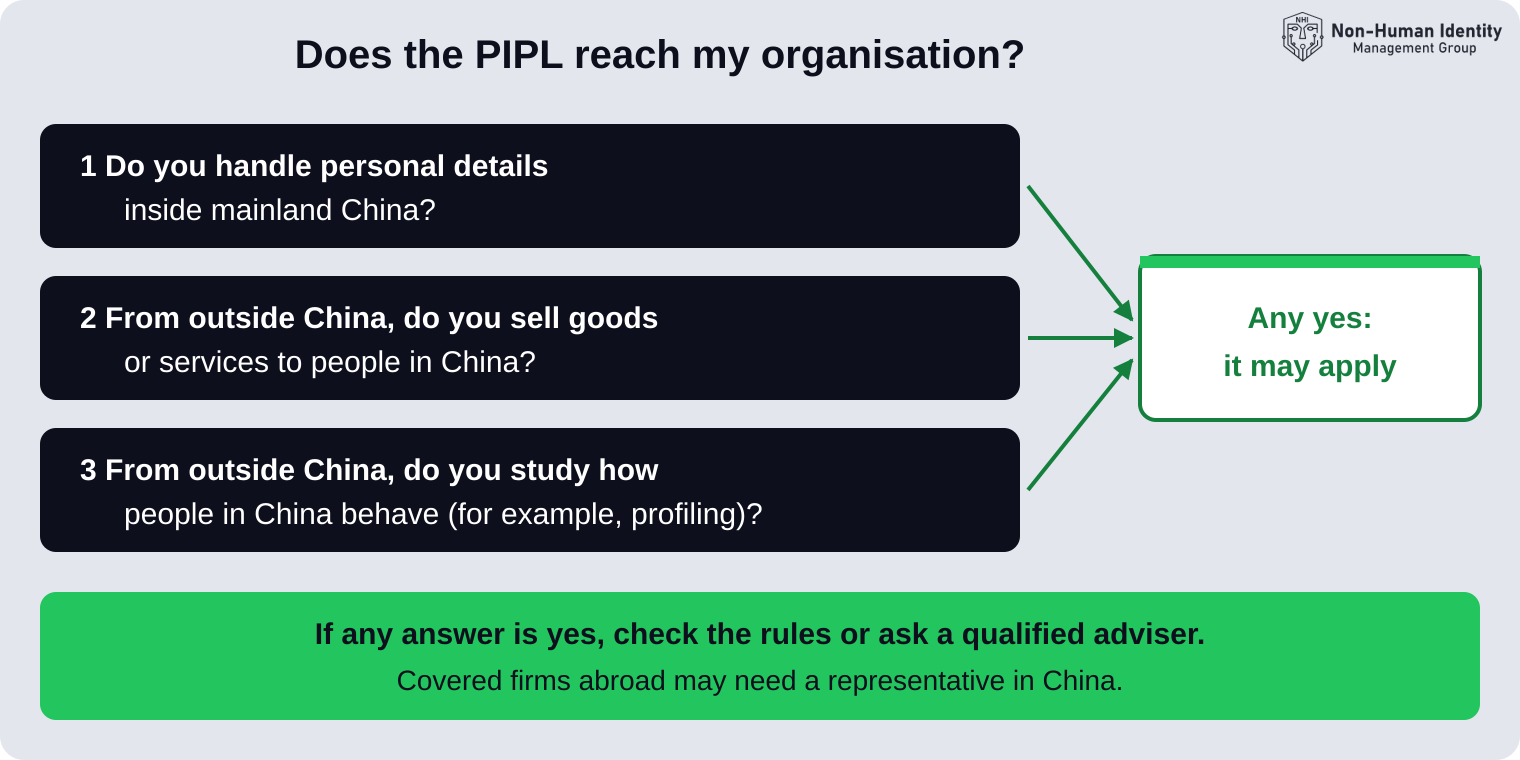
- It can reach firms outside China that sell to people in China or study their behaviour.
- Organisations need a lawful reason to use personal details, and some uses need a person's separate, specific agreement.
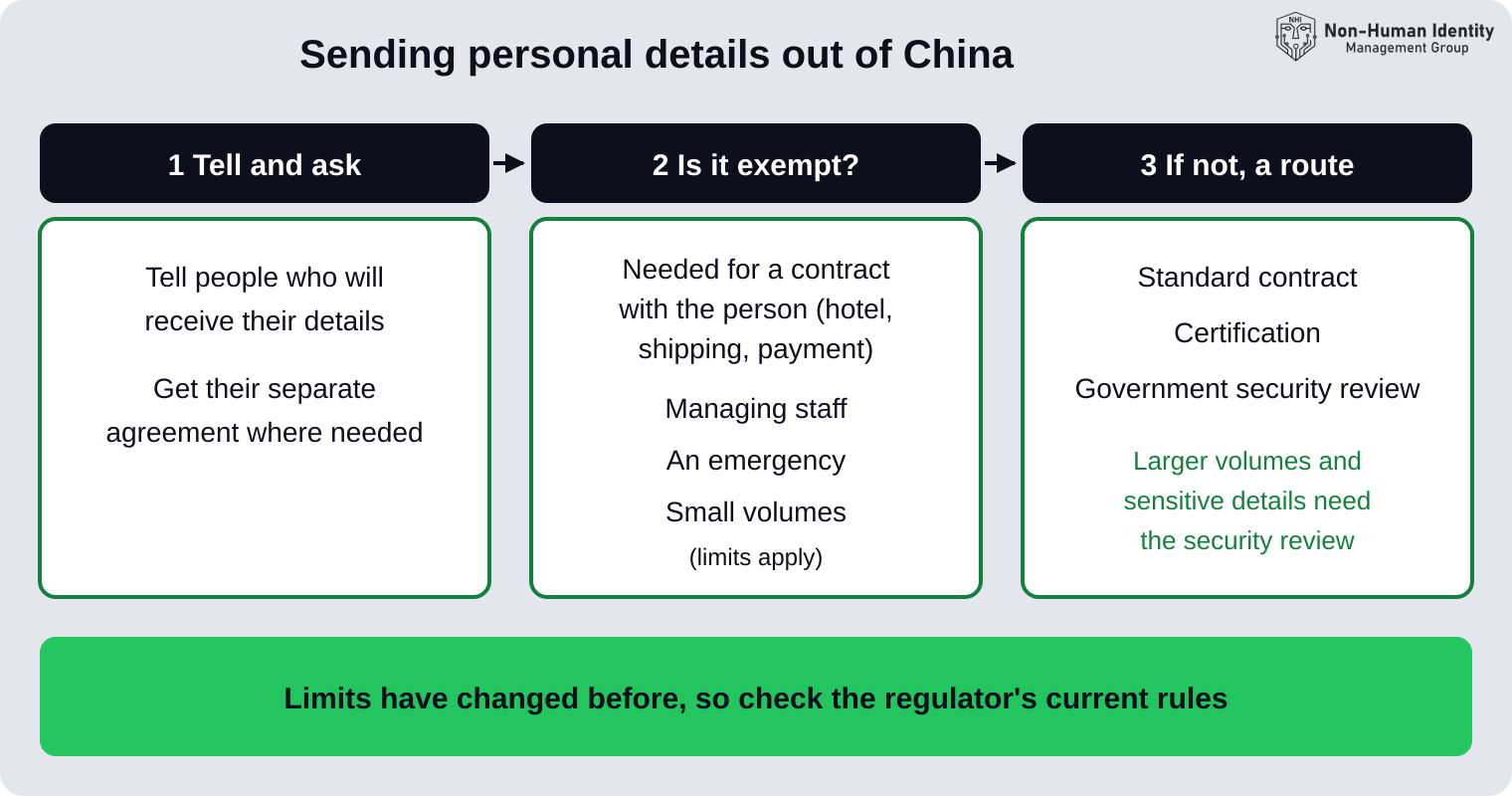
- Sending personal details out of China has its own rules, with exemptions for some everyday cases.
What you will learn
- Explain what the PIPL is and who it covers.
- Spot when an activity may need a person's separate agreement.
- Explain the basic idea behind the rules for sending data out of China.
- Ask the right questions before your team shares data from China.
Status: correct as at 28 November 2026, based on the law's text and rules published by the Cyberspace Administration of China. Laws change; check the official text.
This guide explains the topic in general terms and is not legal advice.
- Personal details (personal information)
- any recorded information that relates to a person who is, or could be, identified.
- Organisation in charge (personal information handler)
- the organisation that decides why and how personal details are used.
- Sending data abroad (cross-border transfer)
- moving personal details collected in China to people or systems outside it.
What is China's PIPL?
Think of a set of house rules for handling people's details, with a customs desk at the border. Inside, you follow the rules on what you collect and why. When details leave the country, they pass through a check.
The PIPL is China's main privacy law. It was passed in August 2021 and came into force on 1 November 2021.[1][2] It covers almost anything done with personal details. That runs from collecting and storing them to sharing and deleting them.[1] Details that have been made truly anonymous, so nobody can be identified, fall outside it.
The organisation in charge of the details is called a personal information handler. It is much like a "controller" in Europe's GDPR. The main regulator is the Cyberspace Administration of China, often shortened to CAC.
Where the comparison stops working: a customs desk checks goods once, at the border. The PIPL also applies while the details are still in China, and it can reach firms abroad that never set foot there.
Why does it matter?
Many firms touch Chinese customers' details without noticing, through online shops, apps and partners. The law can apply to a firm abroad that sells to people in China. It can also apply if the firm studies how they behave.[1]
If you run a small business that sells online
What could happen: you ship to customers in China and copy their details into tools based elsewhere without checking the rules.
Check this: list where Chinese customers' details are stored and who outside China can see them.
If you are a student or new to privacy work
What could happen: you assume China's rules are a copy of the GDPR and give advice that misses key differences.
Check this: learn the lawful reasons the PIPL allows, and when separate agreement is needed.
Next: GDPR for Beginners
If you manage staff in China
What could happen: staff records are shared with head office abroad with no clear notice to employees.
Check this: ask HR what staff are told about where their records go.
What does it look like?
Here is a made-up "Am I affected?" card. A small firm might fill it in before it talks to an adviser.
Example only. All values are made up.
Firm: Example Trading Ltd (no office in China)
[x] We sell to people living in China            (1)
[x] We collect names, phone numbers, addresses   (2)
[ ] We collect health, face or bank details      (3)
[x] Order data is copied to our UK systems       (4)
[ ] We profile customers to target adverts       (5)
Customers in China this year: about 0,000 (fake)
- Selling to people in China can bring a firm abroad under the law.
- Ordinary personal details. The firm needs a lawful reason to use them.
- These would be sensitive details. They need extra care and often a separate yes.
- Copying details out of China is a transfer. Check if an exemption applies.
- Studying how people behave can also bring a firm under the law.
Why this is risky: a firm with no office in China may think the law does not reach it. So it skips notices and checks.
The safer way: fill in a card like this. Then check the official rules, or ask an adviser, before you rely on an exemption.
How does it work?
- Have a lawful reason. The law lists a small number of reasons for using personal details. Consent is one. Others include carrying out a contract with the person and meeting a legal duty.[1] Unlike the GDPR, there is no general "legitimate interests" reason.
- Tell people clearly. Where you rely on consent, it must be freely given, explicit and informed. If your purpose changes, you ask again.[1]
- Take extra care with sensitive details. These include face and fingerprint data, religion, health, bank accounts, location tracking and any details of children under 14. They need a clear need and stronger protection.[1]
- Get separate agreement for some uses. "Separate consent" means a specific yes for one action, not a line buried in a privacy notice. Sending details abroad is one case that needs it, with details of who will receive them.[1]
- Use an approved route to send details abroad. The law sets three main routes: a government security review, a certification, or a standard contract issued by the regulator.[1] Since March 2024, some everyday transfers are exempt, as figure 2 shows.[3]
- Respect people's rights. People can ask to see, copy, correct or delete their details. Organisations should also delete details once the purpose is done.[1]
A worked example
Darius Strand runs Heron Removals, a UK firm that moves families between countries. This year it starts moving families from Shanghai to London, working with a local partner in China.
The partner collects each family's names, phone numbers and home addresses. It sends them to Heron's booking system in the UK. Darius's colleague, Farah Zamora, looks after the firm's privacy notices.
Farah asks three questions. Is Heron offering a service to people in China? Yes, so the law may apply. Is the data sensitive? Not yet, but a customer once sent a scan of a medical letter about moving a wheelchair. Farah makes a note that health details need extra care and separate agreement. Does the transfer need a special route? The details are needed to carry out the removal contract the family signed. Since March 2024, transfers needed to perform a contract with the person, such as shipping, can be exempt from the three routes.[3]
Farah does not stop there. She updates the booking form. It now tells families that their details go to the UK, who gets them, and how to ask for a copy or deletion. She asks the partner to stop sending documents Heron does not need. She also books a call with a qualified adviser to confirm the exemption and whether Heron needs a representative in China.
A real case shows the stakes. In July 2022 the Cyberspace Administration of China fined the ride-hailing firm DiDi more than 8 billion yuan under China's data laws, including the PIPL.[4]
Myths and mistakes
| What people think | What is true |
|---|---|
| We have no office in China, so the PIPL does not apply. | It can reach firms abroad that offer goods or services to people in China, or analyse their behaviour. |
| It is just China's copy of the GDPR. | The ideas are similar, but there is no general "legitimate interests" reason, and separate agreement is needed more often. |
| A tick box in our privacy notice covers everything. | Some uses, such as sending details abroad, need a separate, specific yes. |
| Any transfer out of China needs a government review. | Since March 2024, some everyday transfers are exempt. Larger volumes and sensitive details face stricter routes. |
| Anonymous data and disguised data are the same. | Only truly anonymous data falls outside the law. Data with names swapped for codes can still count. |
What can I do this week?
- List any customers, staff or partners in China whose details you hold.
- Write down where those details are stored and who outside China can see them.
- Mark any sensitive details, such as health, face, bank or children's details.
- Read your privacy notice as a customer in China would. Does it say where data goes?
- Check the regulator's current transfer rules, or book time with a qualified adviser.
Checklist
- We know whether we offer goods or services to people in China.
- Each use of personal details has a lawful reason written down.
- Sensitive details are listed and get extra protection.
- We know which uses need separate agreement.
- Every transfer out of China has a checked exemption or an approved route.
- People can easily ask to see, copy, correct or delete their details.
- Details are deleted when the purpose is done.
- We have checked whether we need a representative in China.
Common questions
Does the PIPL apply to Hong Kong?
No, it covers mainland China. Hong Kong and Macau have their own privacy laws. But a firm in Hong Kong can still be covered. That happens if it sells to people on the mainland or studies how they behave.
What counts as sensitive personal information?
These are details that could easily harm someone's dignity, safety or money if leaked. The law lists face and fingerprint data, religion, specific identity status, health, bank accounts, location tracking and any details of children under 14.[1]
How big are the fines?
For serious cases, fines can reach 50 million yuan or 5% of the previous year's turnover. Regulators can also suspend a service. The people responsible can be fined and barred from senior roles for a time.[1]
Do firms abroad need someone in China?
Often, yes. Covered firms outside China must set up an office there or name a local representative. They must also report that contact to the regulator.[1] An adviser can confirm whether this applies to you.
Has the PIPL been changed since 2021?
Not the law itself. The public record shows no changes to its text.[2] The detail has grown through newer rules, such as the 2024 rules on data leaving China. That is why thresholds in older articles may be out of date.
Where next?
Ready for the detail? Read the practitioner guide: China PIPL Guide. It goes further into each lawful reason and consent type, the full timeline of newer rules, compliance audits and penalties.
Also useful:
- China Cross-Border Data Transfers
- International Data Transfers for Beginners
- Data Protection Laws Around the World for Beginners
- Consent for Beginners
Related NHI Mgmt Group resources: China Data Laws Compared · China Personal Information Protection Compliance Audits · International Data Transfers Map
Key terms
- PIPL
- China's Personal Information Protection Law, in force since 1 November 2021.
- Personal information
- Recorded information that relates to a person who is, or could be, identified.
- Sensitive personal information
- Details that could easily cause harm if leaked, such as health, face or bank data.
- Consent
- A person's free, informed and clear agreement to a use of their details.
- Cross-border transfer
- Moving personal details from one country to people or systems in another.
- Data controller
- The organisation that decides why and how personal details are used. The PIPL calls it a handler.
Sources and further reading
- Translation: Personal Information Protection Law of the People's Republic of China (effective 1 November 2021), see Articles 3, 4, 13, 14, 28, 38, 39, 44 to 47, 53, 66 and 74. DigiChina, Stanford University. https://digichina.stanford.edu/work/translation-personal-information-protection-law-of-the-peoples-republic-of-china-effective-nov-1-2021/, accessed 28 Nov 2026.
- Personal Information Protection Law (legislative record). NPC Observer. https://npcobserver.com/legislation/personal-information-protection-law/, accessed 28 Nov 2026.
- Provisions on Promoting and Regulating Cross-Border Data Flows (Chinese), see Articles 5, 7 and 8. Cyberspace Administration of China, 22 March 2024. https://www.cac.gov.cn/2024-03/22/c_1712776611775634.htm, accessed 28 Nov 2026.
- Translation: Chinese Authorities Announce $1.2B Fine in DiDi Case, Describe 'Despicable' Data Abuses. DigiChina, Stanford University, July 2022. https://digichina.stanford.edu/work/translation-chinese-authorities-announce-2b-fine-in-didi-case-describe-despicable-data-abuses, accessed 28 Nov 2026.