Data protection laws are rules on how organisations collect, use and protect information about people.
This guide is for anyone in a business that holds details about customers or staff. If you sell online abroad, more than one country's rules may apply to you.
In short
- Most countries now have a data protection law. A United Nations count found 137 of 194 countries had one.[1]
- A law can apply because of where your customers are, not only where your business is.
- Most share the same core ideas: be open, collect only what you need, keep it safe.
- List where your customers live, then check each country's regulator.
What you will learn
- Explain what a data protection law does in one sentence.
- Spot when a foreign law may apply to a small business.
- Check which countries your customers and staff are in.
- Ask the right questions of a supplier or adviser.
Status: correct as at 28 November 2026, from the official sources listed at the end. Laws change, so check the official text. This guide is general and is not legal advice.
- Information about a person (personal data)
- anything that can be linked to a real, identifiable person, such as a name, email or location.
- Privacy watchdog (regulator)
- the public body that explains a country's law and can act when it is broken.
- Applies across borders (extraterritorial)
- when a country's law can cover a business based somewhere else.
What are data protection laws around the world?
Think of food labels. Every country wants honest labels on food, but each one sets its own exact rules. Data protection laws are like that: the core idea is similar, but the details change from country to country.
A data protection law sets rules for any organisation that handles personal data, which means information about a living person. That covers names, email addresses, phone numbers, photos and where someone is.
Most of these laws ask for the same few things. Tell people what you collect and why. Collect only what you need. Keep it safe. Let people see, correct or delete their data. Report serious leaks.
The big difference is in the details. Each law has its own rules on who it covers, what counts as sensitive and how fast you must report a leak.
Where the comparison stops working: a food maker sees each label it prints. With data, you may not notice you have customers in a new country, so a law can apply before you know it.
Why does it matter?
These laws now cover most of the world.[1] Getting them wrong can lead to complaints, fines and lost trust.
If you sell online
What could happen: you take orders from another country and its law applies to you without you knowing.
Check this: list the countries your customers live in.
Next: GDPR for Beginners
If you manage staff
What could happen: staff records held in one country but used by a team abroad fall under two sets of rules.
Check this: ask where your HR and payroll systems store their data.
If you are a customer
What could happen: you do not know you can ask a company what it holds about you.
Check this: read the privacy notice of one company you use often.
What does it look like?
Example only. All values are made up.
Am I affected? Quick check for EXAMPLE Shop Ltd
[x] We are based in: the UK                          (1)
[x] We sell to people in: Ireland, France            (2)
[x] We also sell to people in: California, US        (3)
[x] We keep: names, addresses, emails, order history (4)
[ ] We keep health details or children's data        (5)
[ ] We send customer data to: FAKE-Cloud (0000)      (6)
- Your home country's law is the starting point. For a UK firm, that is the UK's own version of the GDPR.
- Selling to people in the EU can bring the EU's GDPR into play as well.
- Some US state laws, such as California's, can apply to larger firms or firms with many customers there.
- These are all personal data, so the rules cover them.
- Sensitive data usually comes with stricter rules. If you tick this box, take advice.
- Sending data to a supplier in another country can bring extra transfer rules.
Why this is risky: a business that only thinks about its home country can miss the other laws that cover the same customer list.
The safer way: fill in a checklist like this once a year, then read the regulator's guidance for each country you ticked.
How does it work?
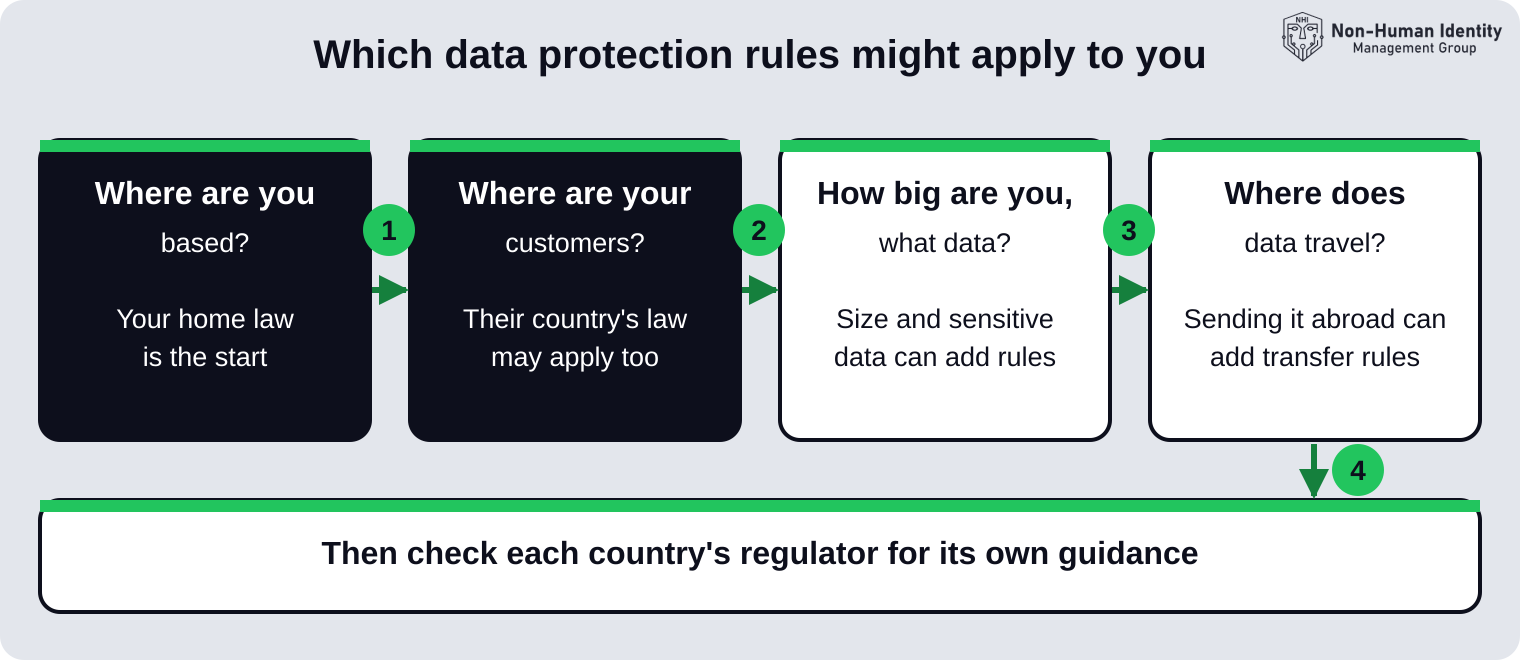
You can work out which rules may apply with five simple questions.
- Where is your business based? Your home country's law usually applies to you first.
- Where are the people whose data you use? The EU's law can reach a business outside the EU. That happens if it sells to people in the EU, or tracks what they do online.[2]
- How big are you, and how much data do you handle? Some laws only cover firms over a certain size. California's law, for example, covers businesses that pass at least one test on income or the amount of Californians' data they handle.[4]
- What kind of data is it? Health details, children's data and money details often have extra rules.
- Where does the data travel? Sending data to a supplier abroad can bring transfer rules. Some countries are approved by others as having similar protection.[3]
Not every country works the same way. The UK has its own version of the EU law, and a UK firm with EU customers may need to follow both.[3] The US has no single nationwide privacy law for consumers on the internet.[5] Instead, rules come from individual states, such as California, and from laws for certain sectors.
A worked example
This story is made up to show how it can work.
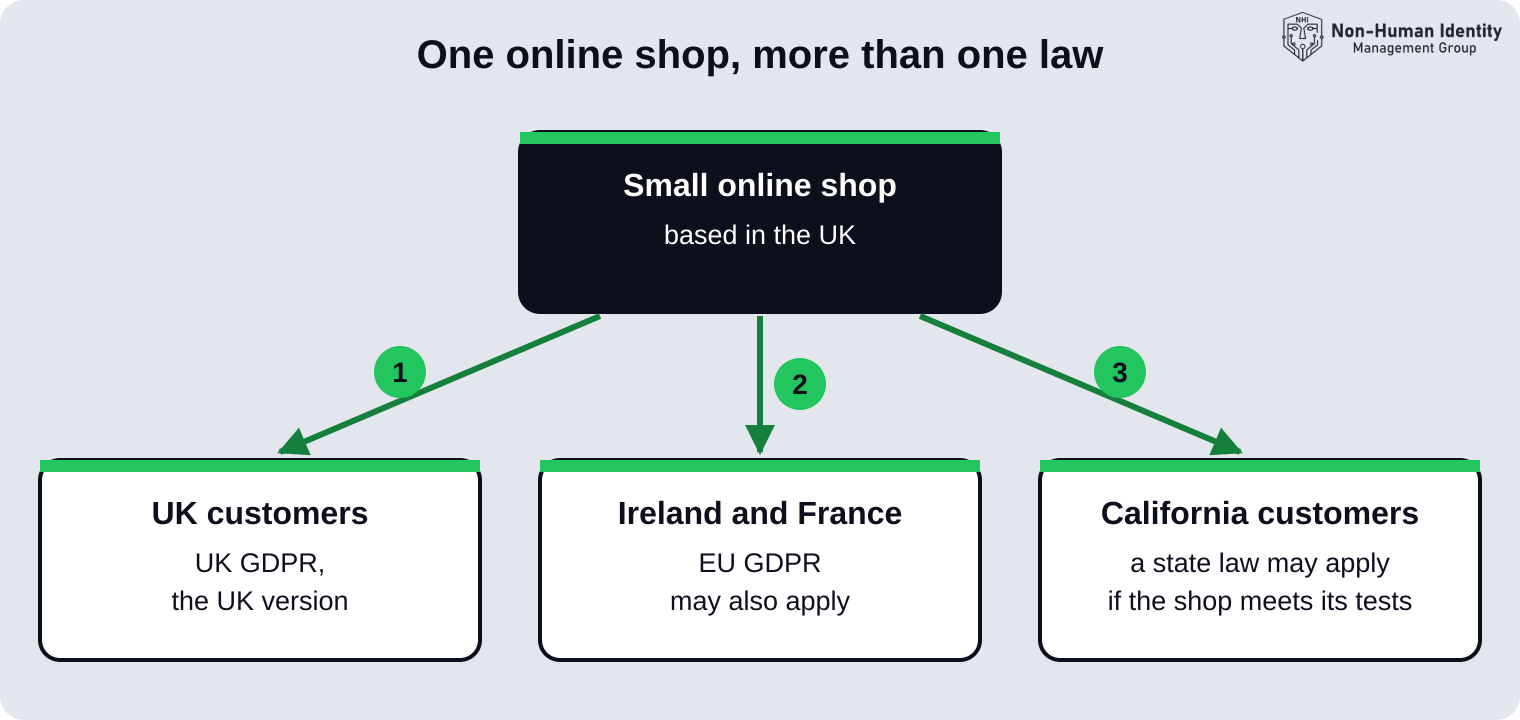
Niamh O'Connor runs a small online shop from Bristol. She sells hand-made candles. Most of her customers are in the UK, but her sales in Ireland and France have grown fast this year.
A friend asks her which privacy law she follows. Niamh says the UK one, because that is where she lives. Then she wonders whether that is the whole story.
She looks at the UK privacy watchdog's website. It says the EU's law may also apply to a UK business that sells to people in the EU. It even gives an example of a UK firm selling to customers in Ireland.
Niamh makes a simple list. She writes down where her customers live, what she keeps about them and which apps store it. Her shop platform, her email tool and her delivery firm all hold customer details.
She sees she has a few orders from California too. She checks the California Attorney General's page. The law there covers businesses that pass at least one test on size or data. Her small shop does not pass any of them, based on the figures she has.
Niamh updates her privacy notice to say who she shares data with and why. She asks her shop platform where it stores data. Then she books a short call with an adviser about whether she needs someone to represent her in the EU.
What made the difference: Niamh asked where her customers were, not just where she was.
Myths and mistakes
| What people think | What is true |
|---|---|
| Only my own country's law applies to me. | A law can apply because of where your customers are. The EU's law is a well-known example.[2] |
| Small businesses are exempt from privacy laws. | Some laws have size limits, but many apply to any business that handles personal data. Check each law. |
| If every law is a bit different, I cannot follow them all. | Most share the same basics. Getting those right covers a lot of ground. |
| Business emails are not personal data. | An email like [email protected] points to a real person, so it usually counts.[2] |
| Using a big cloud supplier means it handles the law for me. | You stay responsible for the data you collect. Check what your supplier does and where it stores data. |
What can I do this week?
- Write down the countries your customers and staff live in.
- List the apps and suppliers that hold their details.
- Read your own privacy notice and check it still matches what you do.
- Find the privacy watchdog for each country on your list.
- Ask each main supplier where it stores your data.
Checklist
- I know which countries my customers and staff are in.
- I know what personal data my business keeps.
- I know which suppliers hold that data, and in which countries.
- I have checked whether a foreign law might apply to me.
- My privacy notice says what I collect, why and who I share it with.
- I know how to answer a customer who asks to see their data.
- I know who to call if data leaks.
Common questions
How many countries have data protection laws?
Most of them. A United Nations trade and development body counted 137 of 194 countries with laws to protect data and privacy. The share is lower in the least developed countries. Laws keep being added and changed, so check the latest count.[1]
Does the GDPR apply to a business outside Europe?
It can. The EU's law can reach a business outside the EU. That happens if it offers goods or services to people in the EU, or watches how they behave online. Being based elsewhere does not by itself take you out of scope.[2]
Is the UK GDPR the same as the EU GDPR?
They are close but separate. The UK kept its own version after leaving the EU. A UK business selling to people in the EU may need to follow both, and may need a representative based in the EU.[3]
Does the US have a privacy law like the GDPR?
Not one single law. The US government's audit office says there is no full nationwide internet privacy law. Rules come from states, such as California, and from laws for certain sectors, such as health.[5][4]
Where can I get help for my country?
Start with your country's privacy watchdog. Most publish plain guides for small firms. For hard questions, such as health data or sending data abroad, a qualified adviser is the safer route. This guide is a starting point, not legal advice.
Where next?
Ready for the detail? Read the practitioner guide: Global Privacy Regulatory Map. It goes further into each major law at a glance, rules for sending data across borders, and breach reporting deadlines.
Also useful:
- GDPR for Beginners
- UK GDPR for Beginners
- US Privacy Laws for Beginners
- Data Breach Notification for Beginners
- Cyber and Privacy Regulator Directory
Related NHI Mgmt Group resources: CCPA and CPRA · Brazil LGPD Guide · India DPDP Act Guide · UK GDPR vs EU GDPR
Key terms
- Personal data
- Any information that can be linked to an identified or identifiable person.
- Data protection
- The rules and safeguards that control how information about people is collected, used and kept safe.
- GDPR
- The EU's main data protection law, which can also reach businesses outside the EU.
- UK GDPR
- The UK's own version of the GDPR, used alongside the UK Data Protection Act 2018.
- CCPA
- California's consumer privacy law, which gives residents rights over the data businesses hold about them.
- Privacy notice
- A plain statement telling people what data you collect, why, and who you share it with.
- Adequacy decision
- A formal finding that another country protects data well enough for data to be sent there more easily.
Sources and further reading
- Data Protection and Privacy Legislation Worldwide. UN Trade and Development (UNCTAD). https://unctad.org/page/data-protection-and-privacy-legislation-worldwide, accessed 28 Nov 2026.
- Data protection basics (Data Protection Guide for Small Business). European Data Protection Board (EDPB). https://www.edpb.europa.eu/sme-data-protection-guide/data-protection-basics_en, accessed 28 Nov 2026.
- Overview: Data protection and the EU. Information Commissioner's Office (ICO). https://ico.org.uk/for-organisations/data-protection-and-the-eu/overview-data-protection-and-the-eu/, accessed 28 Nov 2026.
- California Consumer Privacy Act (CCPA). State of California Department of Justice, Office of the Attorney General, updated 28 August 2026. https://oag.ca.gov/privacy/ccpa, accessed 28 Nov 2026.
- Internet Privacy: Additional Federal Authority Could Enhance Consumer Protection and Provide Flexibility (GAO-19-52). US Government Accountability Office, January 2019, with status notes. https://www.gao.gov/products/gao-19-52, accessed 28 Nov 2026.