An international data transfer is when personal data is sent to, or opened by, an organisation in another country.
This guide is for small business owners, people buying online software and anyone new to privacy work. You do not need to post files abroad to be affected: if you use a cloud app, a payroll service or an overseas helpdesk, personal data may already be crossing borders.
In short
- In the EU and the UK, personal data can leave the country only along an approved route.
- The easiest route is a country on the official approved list. This is called an adequacy decision.
- For other countries, the usual route is approved contract wording, plus a check that the data stays protected.
- Letting someone abroad view your data counts too, not just sending files.
What you will learn
- Explain what counts as an international data transfer.
- Spot the everyday tools that quietly send data abroad.
- Check which route a supplier relies on.
- Ask the right questions before you sign up to an overseas service.
Status: correct as at 28 November 2026, based on the European Commission's adequacy and contract clause pages and the UK Information Commissioner's Office (ICO) guide to international transfers. Laws change; check the official text.
This guide explains the topic in general terms and is not legal advice.
- Approved country (adequacy)
- a country that regulators have officially judged to protect personal data well enough.
- Approved contract wording (standard contractual clauses)
- ready-made contract terms, approved by the regulator, that a sender and receiver sign.
- Information about people (personal data)
- anything that can identify a living person, like a name, email or customer number.
What is an international data transfer?
Think of sending a parcel abroad. You can send it, but it must pass customs, and some places need extra paperwork first.
Personal data works in a similar way. Laws such as the EU and UK GDPR (the main data protection law) protect people's information at home. Once the data leaves for another country, that care could be lost. So the law asks the sender to use an approved route.
A transfer is not only emailing a file. The UK regulator says it also includes making data accessible to a separate organisation abroad.[3] So an overseas support team logging in to look at your customer list can count, even if no file moves.
Where the comparison stops working: a parcel crosses one border once. Data can be copied, stored in several countries and viewed from anywhere, often without anyone noticing.
Why does it matter?
Most small firms use online services run from other countries. If the route is missing, the transfer may break the law, and people's data may sit where they have fewer rights.
If you run a small business
What could happen: your booking app stores customer details abroad, and you never checked how.
Check this: ask each supplier where data is stored and who can see it.
If you buy software for your team
What could happen: you sign up to a free trial that sends staff data overseas with no agreed terms.
Check this: look for a data protection agreement before you upload real data.
Next: GDPR for Beginners
If you are new to privacy work
What could happen: you are asked "can we use this tool?" and do not know where to start.
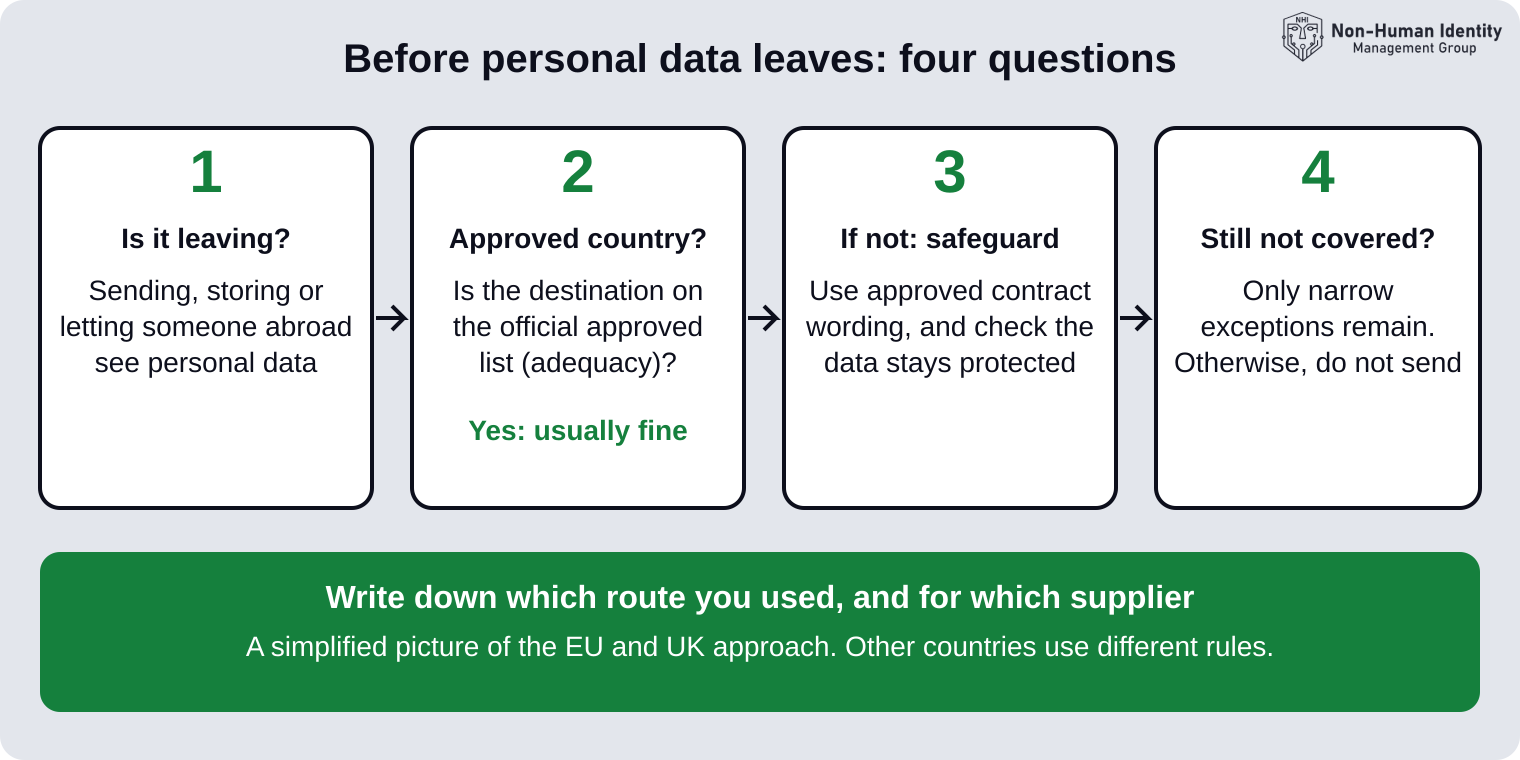
Check this: work through the four questions in Figure 1 and write down the answer.
What does it look like?
Here is a made-up "Am I affected?" checklist that a small firm might fill in for one supplier.
Example only. All values are made up.
Supplier:       Example Payroll Ltd (example.com)
Data involved:  staff names, bank details      (1)
Stored where:   servers in Country A           (2)
Seen by:        support team in Country B      (3)
Route used:     ??? not yet checked            (4)
- In a real file, this line would list the types of personal data shared.
- Storing data in another country is a transfer.
- A support team that can log in from abroad also counts, even if data is stored at home.
- Each country in lines 2 and 3 needs an approved route.
Why this is risky: there are two countries and no known route. If either lacks one, the firm may be sending data without legal cover.
The safer way: ask the supplier which route it uses for each country, keep their answer and review it each year.
How does it work?
In the EU and the UK, the checks follow the same broad order.
- Spot the transfer. Personal data is sent to, stored by or opened by a separate organisation in another country. Small and rare transfers count too.[3]
- Check the approved list. The European Commission keeps a list of countries it has judged to protect data well enough. This is called an adequacy decision. For these countries, data can flow without extra safeguards.[1] The UK keeps its own list.[3]
- If not listed, add a safeguard. The usual one is standard contractual clauses, which are pre-approved contract terms.[2] The UK uses its own versions.[3]
- Check the data stays protected. In the UK, a firm using a safeguard must do a transfer risk assessment. This is a check that protection is not much lower once the data arrives.[3]
- Last resort. If nothing else fits, there are a few narrow exceptions for special cases. If none of them applies, the transfer should not go ahead.[3]
The United States is a special case. EU adequacy covers only US firms that have joined a scheme called the EU-US Data Privacy Framework.[1] So "the US" is not on the list as a whole. You need to check that the firm itself has joined.
A worked example
Petra Wojcik runs Teal Joinery, a small kitchen-fitting firm with eight staff. She wants a new online tool to plan jobs and store customer addresses.
The cheapest tool looks great. Before she uploads anything, she asks three questions. Where is the data stored? Who can see it? Which route do you use?
The supplier replies that data is stored in Ireland, which is inside the EU. But its weekend helpdesk is run by a partner company in another country. That helpdesk can open customer records to fix problems.
Petra realises this is still a transfer, even though the files stay in Ireland. She checks the approved list. The helpdesk's country is not on it.
She asks the supplier how it covers this. It sends her its data protection agreement. The agreement says it uses standard contractual clauses with the helpdesk partner. It also says the supplier has checked that the data stays protected there.
Petra is not a lawyer, so she asks her accountant's privacy adviser to glance at it. The adviser says it looks like the normal approach. Petra saves a copy of the agreement in a folder called "suppliers and data". She adds a line to her list: tool name, countries, route, date checked.
A year later the supplier emails to say it is moving its helpdesk. Petra opens her list, sees the old answer and asks the same three questions again.
Myths and mistakes
| What people think | What is true |
|---|---|
| If the servers are in Europe, there is no transfer. | Someone abroad who can view the data may still count as a transfer. |
| Any US company is covered. | EU adequacy for the US covers only firms that have joined the Data Privacy Framework. |
| Small or one-off transfers do not matter. | The UK regulator says the rules apply even to small, infrequent transfers. |
| Signing the contract clauses is the end of it. | In the UK, you also check the data stays protected once it arrives. |
| The supplier handles all of this. | The sender is responsible for choosing a route. Ask, and keep the answer. |
What can I do this week?
- List the online tools your business uses that hold customer or staff details.
- Ask each supplier where data is stored and who can view it from abroad.
- Find each supplier's data protection agreement and save a copy.
- Check any US supplier has joined the Data Privacy Framework, or uses contract clauses.
- Write the answers in one simple list with the date you checked.
Checklist
- I know which tools hold personal data.
- I know which countries each tool stores data in.
- I know if anyone abroad can view the data.
- I know which route each supplier uses.
- I have a copy of each data protection agreement.
- I review the list at least once a year, or when a supplier changes.
- I know who to ask for advice when an answer is unclear.
Common questions
Does using a cloud service count as a transfer?
Often, yes. If the service stores your customers' details in another country, or its staff abroad can open them, that is usually a transfer. Ask the supplier where data is kept and who can view it, then check which route they use for each country.
Is sending data to the UK from the EU allowed?
Yes. The European Commission has an adequacy decision for the UK, renewed in December 2025.[1] That means personal data can flow from the EU to the UK without extra safeguards. Other UK GDPR rules still apply once the data arrives.
Can I just ask customers for permission instead?
Rarely. Consent is one of the narrow exceptions, meant for cases where no approved country or safeguard fits. It is not a normal way to cover a supplier you use every day. Ask a privacy adviser before relying on it.
Do other countries have transfer rules too?
Yes, many do, and the rules differ from place to place. China, for example, has its own system. If you send data from outside the EU or the UK, check the local rules. See China Cross-Border Data Transfers and Data Protection Laws Around the World for Beginners.
Does this apply to software, not just people?
Yes. Software accounts, app connections and AI tools that let a service abroad reach personal data can create a transfer just as an exported file does. So list your connected apps, not only the files your staff send by hand.
Where next?
Ready for the detail? Read the practitioner guide: International Data Transfers Map. It goes further into how each major country controls transfers, the tools each one uses and their current status.
Also useful:
- EU-US Data Privacy Framework Guide
- GDPR for Beginners
- UK GDPR for Beginners
- Data Protection Laws Around the World for Beginners
Related NHI Mgmt Group resources: UK GDPR vs EU GDPR · Data Privacy for Beginners · China Cross-Border Data Transfers
Key terms
- International data transfer
- Sending personal data to, or letting it be viewed by, an organisation in another country.
- Personal data
- Any information that can identify a living person.
- GDPR
- The European law on how organisations handle information about people. The UK has its own version.
- Adequacy decision
- An official ruling that another country protects personal data well enough for it to be sent there freely.
- Standard contractual clauses
- Ready-made contract terms, approved by the regulator, that the sender and receiver sign before data moves.
- Transfer risk assessment
- A check that personal data will still be well protected once it reaches another country.
Sources and further reading
- Adequacy decisions: how the EU determines if a non-EU country has an adequate level of data protection (GDPR Article 45). European Commission. https://commission.europa.eu/law/law-topic/data-protection/international-dimension-data-protection/adequacy-decisions_en, accessed 28 Nov 2026.
- Standard contractual clauses (SCC). European Commission. https://commission.europa.eu/law/law-topic/data-protection/international-dimension-data-protection/standard-contractual-clauses-scc_en, accessed 28 Nov 2026.
- International transfers: a guide (UK GDPR Articles 44 to 49, IDTA and Addendum). Information Commissioner's Office. https://ico.org.uk/for-organisations/uk-gdpr-guidance-and-resources/international-transfers/international-transfers-a-guide/, accessed 28 Nov 2026.