CMMC is the US Department of Defense's check that its suppliers protect defence information properly.
This guide is for owners and staff of small firms that sell to the US defence sector, directly or through a bigger company. You do not need to be a security expert to be affected: if your firm handles defence contract information, CMMC may decide whether you can win the work.
In short
- CMMC applies to firms that hold US defence contract information, including small subcontractors.
- There are three levels. The contract says which one you need, based on the information you will handle.
- Level 1 means 15 basic security rules and a yearly self-check. Level 2 means 110 rules and, for many firms, an outside assessor.
- Results go into a US government system, and a senior person at your firm must confirm them each year.
What you will learn
- Explain what CMMC is in one sentence.
- Spot which kind of defence information your firm holds.
- Check which CMMC level a contract asks for.
- Ask the right first questions of your customer or adviser.
Status: correct as at 28 November 2026, based on the CMMC Program rule and the related defence contract rule, both published in the US Federal Register. Laws change; check the official text.
This guide explains the topic in general terms and is not legal advice.
- Contract information (FCI)
- information made for or given by the US government under a contract, not meant for the public.
- Sensitive defence information (CUI)
- information the US government says must be protected, even though it is not classified.
- Outside assessor (C3PAO)
- an approved company that checks your security and records the result.
What is CMMC?
Think of a food hygiene inspection. A supermarket will only stock your food if your kitchen passes. The inspector checks a set list of things, and your result decides whether you can sell.
CMMC works the same way for defence suppliers. It is run by the US Department of Defense, the part of the US government in charge of the armed forces.
It checks that suppliers protect two kinds of information. The first is Federal Contract Information (FCI). These are contract details that are not public. The second is Controlled Unclassified Information (CUI). This is more sensitive, such as some technical drawings. The government says it must be protected.[1]
The rule behind CMMC took effect on 16 December 2024.[1] A second rule puts CMMC into defence contracts. It took effect on 10 November 2025.[2]
Where the comparison stops working: a food inspector visits every kitchen. With CMMC, many firms check themselves, and an outside visit is needed only for some contracts.
Why does it matter?
If a contract asks for a CMMC level and you do not have it, you may not be able to win that contract. This applies down the supply chain, so it can reach small firms too.
If you own a small supplier
What could happen: a main customer asks for your CMMC status, and you have none to show.
Check this: ask your customers which level their contracts will need, and when.
If you look after IT for a small firm
What could happen: defence drawings sit in shared folders and personal email, so the area to protect grows.
Check this: find every place defence information is kept or sent.
Next: CMMC Scoping Guide
If you are a manager or director
What could happen: you confirm the firm meets the rules when it does not.
Check this: see the evidence before you confirm anything.
What does it look like?
Here is a made-up "Am I affected?" checklist for a small supplier.
Example only. All values are made up.
AM I AFFECTED BY CMMC?  Firm: EXAMPLE Parts Ltd
[x] We work on a US defence contract or subcontract  (1)
[x] We receive contract details that are not public  (2)
[ ] We receive drawings marked as controlled         (3)
[x] The order says: CMMC Level 1 (Self)              (4)
Contract ref: FAKE-0000-EXAMPLE
Next check due: 01/01/2000                           (5)
- You work on defence work, directly or through a bigger firm.
- This is Federal Contract Information, which points to Level 1 at least.
- If ticked, you would hold sensitive information, which points to Level 2 or higher.
- The level the contract asks for. In a real file, this line would contain the wording from the order.
- Results must be confirmed again each year.
Why this is risky: many small firms do not know what information they hold. So they guess the level, and the guess may be wrong.
The safer way: ask your customer which level applies. Then list where the information lives before you start any checks.
How does it work?
The contract sets the level. Each level has its own set of rules and its own kind of check.[1]
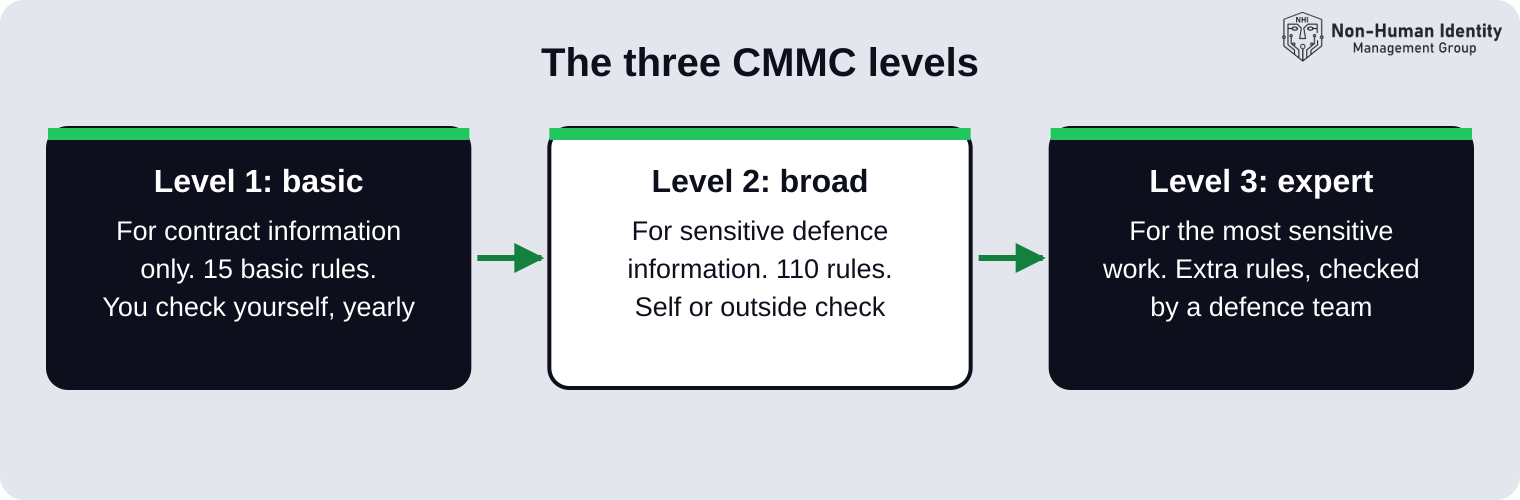
- Level 1 is the basic level. It covers 15 basic security rules for contract information. You check yourself once a year. Every rule must be fully met.
- Level 2 is the broad level. It covers 110 rules from a US government security checklist for sensitive information. Some contracts allow a self-check. Others need an approved outside assessor. Either way, it is repeated every three years.
- Level 3 is the expert level. It adds 24 more rules for the most sensitive work. A Department of Defense team does the check. You need a passed outside Level 2 check first.
- You record the result. Results go into a US government system called SPRS. A senior person at your firm confirms them every year.
- Gaps can sometimes wait a short time. At Levels 2 and 3, a few gaps may go on a written plan. They must be fixed within 180 days. At Level 1, no gaps are allowed.
CMMC is being brought in over four phases across three years. Each phase starts a year after the one before. Phase 1, from 10 November 2025, starts with self-checks. Later phases add outside checks.[1][2]
A worked example
This story is made up to show how it can happen.
Tanya Morales owns a machine shop with twelve staff in Ohio. She makes metal brackets for a larger firm that builds parts for the US Army.
One morning her customer emails all its suppliers. New orders will need a CMMC level, and each supplier must say which level it holds. Tanya has never heard of CMMC.
She calls her contact at the customer and asks one question: which level will my orders need? The answer is Level 1 for now. Her orders hold contract details, such as part numbers and delivery dates. They do not hold controlled drawings.
Tanya asks her part-time IT helper, Jamal, to list where the order details go. They find them in email, on the office PC and on a shared drive. They also find an old laptop that nobody uses but that still has copies.
They work through the 15 Level 1 rules together. Each staff member gets their own login. The old laptop is wiped. Visitors no longer use the office PC. Updates and virus protection are switched on everywhere.
When each rule is met, Tanya records the self-check in the government system. As owner, she confirms it is true. She puts a yearly reminder in her diary.
A month later, her customer says a new project may involve controlled drawings. Tanya now knows that could mean Level 2. She starts asking about it early, before the order arrives.
What made the difference: Tanya asked her customer which level applied before doing anything else.
Myths and mistakes
| What people think | What is true |
|---|---|
| CMMC is only for big defence companies. | It can apply to subcontractors of any size that handle defence contract information. |
| Every supplier needs an outside assessor. | Not always. Level 1 is a self-check. Some Level 2 contracts also allow a self-check.[1] |
| We can meet most of the Level 1 rules and fix the rest later. | At Level 1, every rule must be fully met. Gap plans are allowed only at Levels 2 and 3, for a short time.[1] |
| Once we pass, we are done. | A senior person must confirm the result every year. Levels 2 and 3 are checked again every three years. |
| Signing the yearly confirmation is just paperwork. | It is a formal statement to the US government. Make sure the evidence backs it up. |
What can I do this week?
- Ask each defence customer which CMMC level your work will need.
- List where contract information is kept, sent and printed.
- Check whether you receive any drawings or files marked as controlled.
- Choose one person to lead the work and keep the evidence.
- Read the official CMMC pages from the Department of Defense before paying for outside help.
Checklist
- We know which CMMC level each contract needs.
- We know whether we hold contract information, sensitive information or both.
- We have a list of every place that information is kept.
- Each person has their own login, and old devices are wiped.
- We have worked through every rule for our level.
- Our result is recorded in the government system.
- A senior person has seen the evidence before confirming.
- We have a reminder for the yearly confirmation.
Common questions
What does a small defence supplier have to do for CMMC?
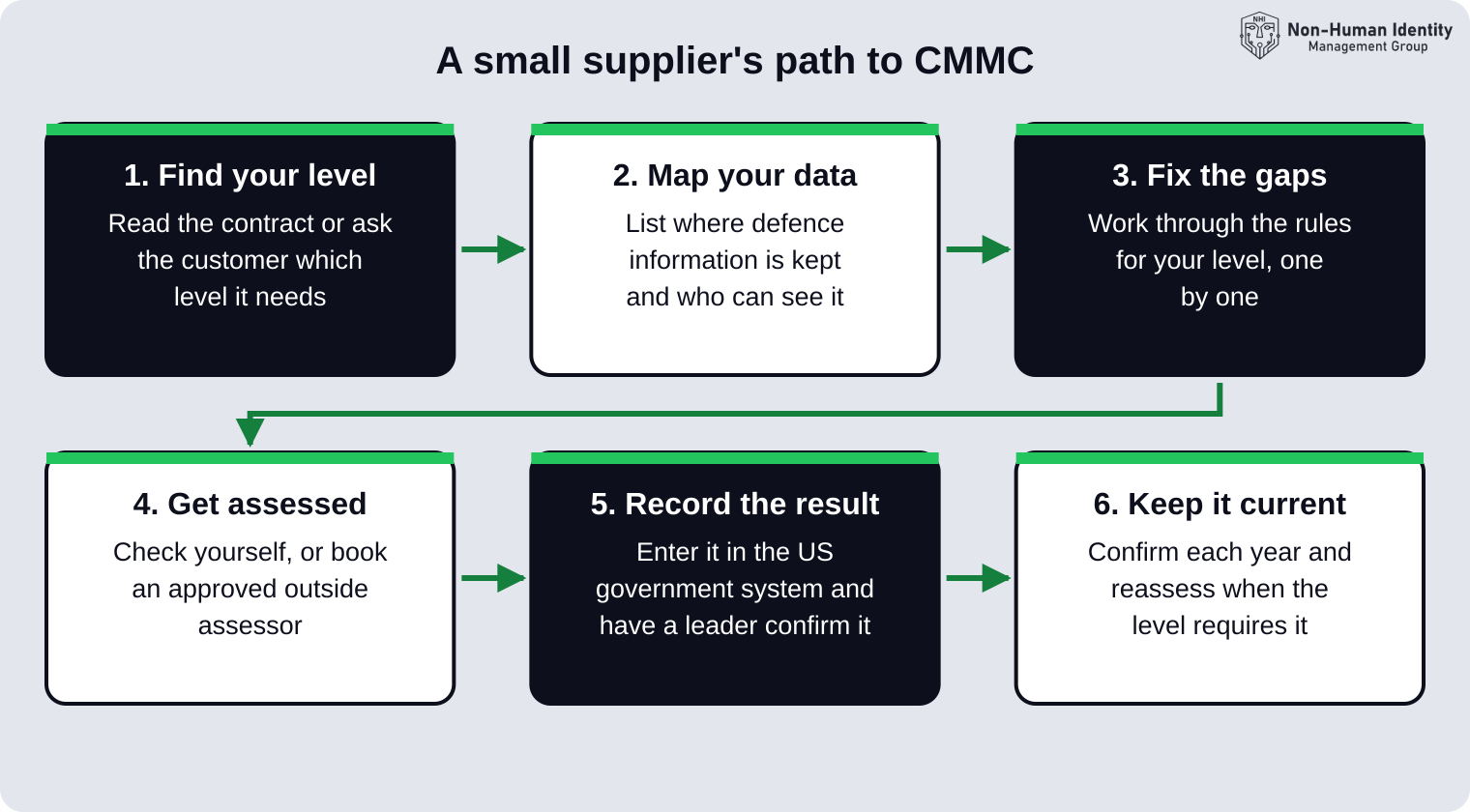
First, find out which level your contracts need. Then find where defence information is kept, meet every rule for that level, and complete the right check. Record the result in the government system, and have a senior person confirm it each year.
How do I know which level I need?
The contract or your customer tells you. In general, firms that only hold contract information need Level 1. Firms that hold sensitive defence information need Level 2. Level 3 is for a smaller set of the most sensitive work.
Is CMMC only for US companies?
No. It follows the contract, not the country. A firm outside the US that works on US defence contracts, or supplies a firm that does, may be asked for a CMMC level too. Check with your customer.
Where do the 110 Level 2 rules come from?
They come from a US government security guide for protecting sensitive unclassified information in companies. The practitioner guide linked below explains that guide and how it ties in to CMMC.
Where next?
Ready for the detail? Read the practitioner guide: NIST SP 800-171 and CMMC 2.0 Guide. It goes further into the Level 2 rules, scoring and gap plans, and how to scope an assessment.
Also useful:
- CMMC Level 1 vs Level 2 vs Level 3
- CUI Guide
- Cyber Security Frameworks for Beginners
- FedRAMP for Beginners
Related NHI Mgmt Group resources: CMMC Level 2 Readiness Checklist · CMMC C3PAO and RPO Selection · DFARS 252.204-7012 Guide
Key terms
- CMMC
- Cybersecurity Maturity Model Certification, the US Department of Defense programme that checks how contractors protect contract information.
- Federal Contract Information
- Information made for or given by the US government under a contract that is not meant for the public.
- Controlled Unclassified Information
- Sensitive government information that is not classified but must still be protected.
- NIST SP 800-171
- A US government security guide for protecting sensitive unclassified information in companies, used for CMMC Level 2.
- C3PAO
- An approved outside company that carries out CMMC Level 2 assessments.
- SPRS
- Supplier Performance Risk System, the US Department of Defense system where contractors record security assessment scores.
- Plan of Action and Milestones
- A written plan listing security gaps still to fix and when each will be fixed.
Sources and further reading
- Cybersecurity Maturity Model Certification (CMMC) Program, final rule (32 CFR Part 170), 89 FR 83092. US Department of Defense, Federal Register, 15 October 2024, effective 16 December 2024. https://www.federalregister.gov/documents/2024/10/15/2024-22905/cybersecurity-maturity-model-certification-cmmc-program, accessed 28 Nov 2026.
- Defense Federal Acquisition Regulation Supplement: Assessing Contractor Implementation of Cybersecurity Requirements (DFARS Case 2019-D041), final rule. US Department of Defense, Federal Register, 10 September 2025, effective 10 November 2025. https://www.federalregister.gov/documents/2025/09/10/2025-17359/defense-federal-acquisition-regulation-supplement-assessing-contractor-implementation-of-cybersecurity-requirements, accessed 28 Nov 2026.