FedRAMP is the US government's security check for cloud services that federal agencies want to use.
This guide is for anyone new to the topic, such as a founder, salesperson or new compliance hire at a software company. If your company sells online software and a US federal agency wants to buy it, this check is likely to come up.
In short
- FedRAMP checks that a cloud service is secure enough to hold US federal information.
- It is run by the General Services Administration, a US government agency that handles buying for government.
- One check can be reused by many agencies, so each agency does not start from zero.
- The programme is changing in 2026 and 2027, so check the official FedRAMP site before you plan.
What you will learn
- Explain what FedRAMP is in one sentence.
- Check whether your software is likely to need it.
- Spot the main steps from first contact to staying listed.
- Ask better questions before you promise anything to a buyer.
Status: correct as at 28 November 2026, based on the official FedRAMP website and the US government's 2024 FedRAMP policy memo. Rules change; check the official text.
This guide explains the topic in general terms and is not legal advice.
- Online software (cloud service)
- software you use over the internet, run on someone else's computers.
- Independent checker (assessor)
- an outside firm that tests whether a service meets the security rules.
- Permission to use (authorisation)
- an agency's own formal decision that it accepts the risk of using a service.
What is FedRAMP?
Think of a safety inspection that a whole chain of shops agrees to trust. The product is checked once. Then any shop in the chain can sell it. FedRAMP works the same way for online software sold to the US national government.
FedRAMP is short for the Federal Risk and Authorization Management Program. A US law from December 2022 put it in the General Services Administration. That agency buys things for the rest of government.[1] It covers online services that hold or handle an agency's data.[1]
A service that passes goes on the FedRAMP Marketplace. This is a public list of services that have passed.[2] Agencies should then trust that check and not do it again, as long as they use the service in the way it was checked for.[1]
Where the comparison stops working: a shop check is often done once. FedRAMP expects the firm to keep showing it is safe, month after month, while it stays on the list.
Why does it matter?
For many US federal buyers, a cloud service without FedRAMP is hard or slow to buy. The work involved is large, so it pays to understand it early.
If you run a software company
What could happen: you win interest from an agency, then find the security work takes far longer than the sale.
Check this: ask whether the buyer needs FedRAMP before you set a start date.
Next: FedRAMP Guide
If you work in sales
What could happen: you tell a buyer the product is "FedRAMP ready" when it is not listed.
Check this: look the product up on the FedRAMP Marketplace before you say anything.
If you are new to compliance work
What could happen: you plan around old rules that the programme is replacing.
Check this: read the dates on the official FedRAMP timeline page.
What does it look like?
Here is a simple "Am I affected?" card. It is a starting point for a conversation, not a final answer.
Example only. All values are made up.
AM I AFFECTED?  (company: Example Software Ltd)
[x] We sell online software, not a boxed product   (1)
[x] A US federal agency wants to use it            (2)
[x] It would hold the agency's information         (3)
[ ] A state or city council is the buyer           (4)
Result: FedRAMP is likely to come up. Ask the buyer.
- FedRAMP is about cloud services that run over the internet.
- The programme is for federal agencies, the national government.
- Holding or handling federal information is what brings a service into scope.
- State and local buyers often use other schemes, such as GovRAMP, so check what they ask for.
Why this is risky: guessing the answer can mean months of work you did not need, or a lost deal you could have won.
The safer way: ask the buyer in writing what security approval they need. Then check the official FedRAMP site.
How does it work?
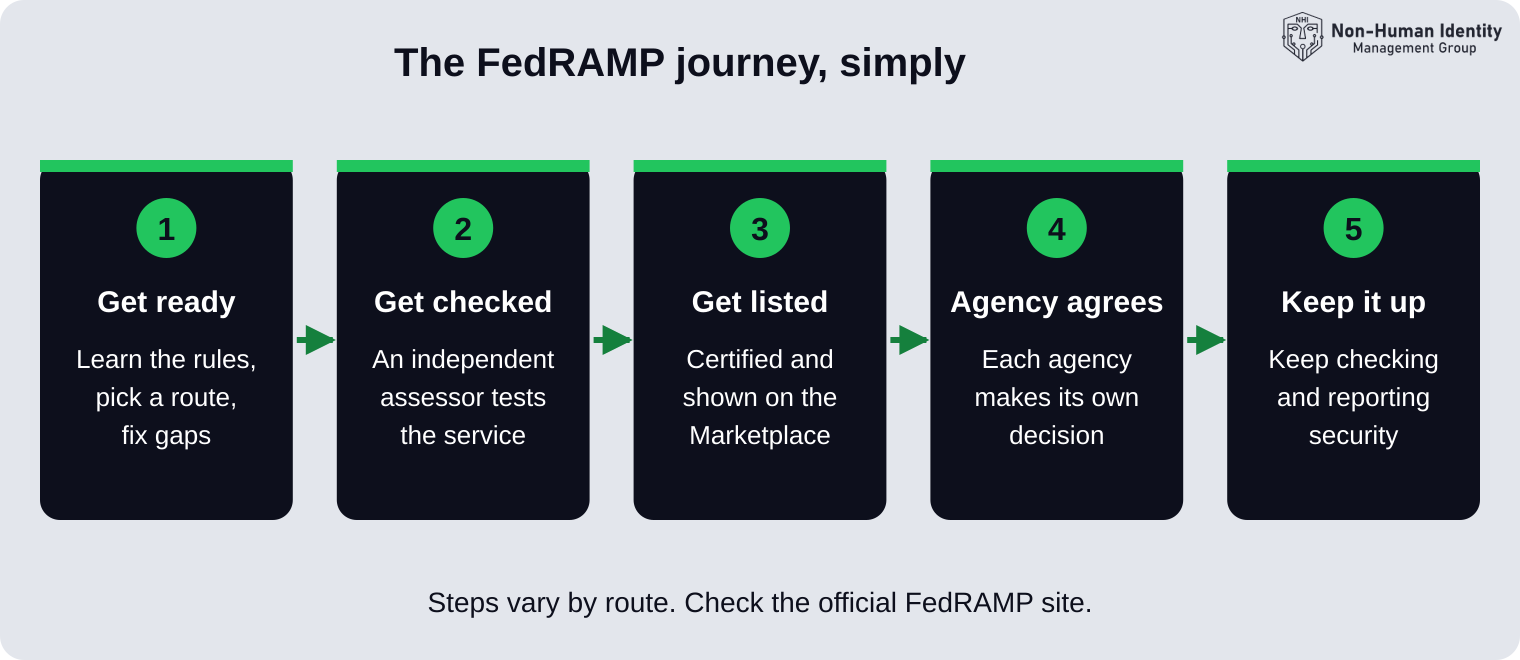
The details depend on the route your company takes. In plain terms, most journeys follow these steps.
- Get ready. The company learns the rules, picks a route and fixes gaps. FedRAMP's site points newcomers to a getting-started section.[3]
- Get checked. An independent assessor, an outside firm recognised by FedRAMP, tests the service against the security rules.[2]
- Get listed. If the service passes, it is certified and appears on the FedRAMP Marketplace.[2]
- Agency agrees. Each agency still makes its own decision to use the service, called an authority to operate.[1]
- Keep it up. The company keeps checking and reporting its security, called continuous monitoring, for as long as it is listed.[1]
There are two main routes in 2026. The older one, called Rev5, often needs an agency to back the service from the start. The newer one, called FedRAMP 20x, leans on automated checks and does not depend on that backing.[3] FedRAMP plans to stop taking new Rev5 applications on 11 June 2027.[4]
On 28 November 2026 the Marketplace listed 564 certified services, 41 of them through 20x.[2]
A worked example
This story is made up to show how it can happen.
Ezra Young runs a small company that makes online booking software. A US federal agency emails him. It wants to use his tool to book rooms for staff training.
Ezra is excited. Then the agency's buyer asks one question: "Is it FedRAMP certified?" Ezra has heard the word but is not sure what it means.
He does three things before replying. First, he checks the FedRAMP Marketplace. His product is not on it, and neither is the hosting company he uses. Second, he asks the buyer in writing what information the tool would hold. The answer is staff names and work email addresses, so it is federal information. Third, he reads the official timeline. He sees that the rules are changing and that new applications on the older route are due to close in June 2027.
He replies honestly. He tells the buyer the product is not certified yet and asks what route the agency would accept. He also asks whether the agency could use a certified product in the meantime.
Then he books time with an adviser who knows the programme. Together they list the gaps: how staff sign in, how changes are tracked and how problems are reported. Ezra sets a realistic plan rather than a date he cannot keep.
What made the difference: Ezra checked the facts and was honest with the buyer before promising anything.
Myths and mistakes
| What people think | What is true |
|---|---|
| Once you pass, you are done. | Certification is the start. The company keeps monitoring and reporting for as long as it is listed.[1] |
| FedRAMP certification means every agency must buy from you. | Each agency still decides for itself whether to use a service.[1] |
| Our hosting company is certified, so we are too. | Your service needs its own certification. A certified host helps, but it covers only its own part. |
| "FedRAMP Ready" is the first step for new companies. | FedRAMP stopped taking Ready submissions on 28 July 2026 and points new companies to 20x instead.[4] |
| FedRAMP covers state and city buyers too. | It is for federal agencies. State and local buyers often use their own schemes, so ask what they need. |
What can I do this week?
- Ask each government buyer, in writing, what security check they need.
- Look up your product and your hosting company on the FedRAMP Marketplace.
- Read the dates on the official FedRAMP timeline page.
- Write down what information your software would hold for an agency.
- Agree that no one in sales calls the product FedRAMP certified until it is listed.
Checklist
- I know whether our buyer is a federal agency or a state or local body.
- I know what information our software would hold for that buyer.
- I have checked the FedRAMP Marketplace for our product and our host.
- I have read the current dates on the official FedRAMP timeline.
- Our sales team does not claim FedRAMP status we do not have.
- I know certification needs ongoing monitoring, not a one-off effort.
Common questions
Does my software company need FedRAMP?
Probably, if a US federal agency wants to use your online software and it would hold the agency's information. If your buyers are businesses, or state and local bodies, FedRAMP may not apply. Ask each buyer in writing what approval they need, then check the official site.
Who runs FedRAMP?
The General Services Administration, a US government agency, runs it. A law passed in December 2022 placed the programme there. A government policy memo from July 2024 sets out how agencies should use it.[1]
What is FedRAMP 20x?
It is the newer route through FedRAMP. It relies more on automated checks of how a service is run, and less on long written documents. It does not depend on an agency backing the service first. The older Rev5 route is due to close to new applications in June 2027.[3][4]
How do I check whether a product is FedRAMP certified?
Search for it on the FedRAMP Marketplace. It is the official public list of certified services, the agencies using them and the recognised assessors. A product that is not listed there should not be described as certified.[2]
Where next?
Ready for the detail? Read the practitioner guide: FedRAMP Guide. It goes further into certification classes and paths, how assessments work under Rev5 and 20x, and what continuous monitoring involves.
Also useful:
Related NHI Mgmt Group resources: FedRAMP 20x vs FedRAMP Rev 5 · Cyber Security Compliance for Beginners · Cloud Security Frameworks Compared
Key terms
- FedRAMP
- The US government programme that checks the security of cloud services used by federal agencies.
- FedRAMP Marketplace
- The official public list of certified cloud services, the agencies using them and the recognised assessors.
- An agency's formal decision to accept the risk of running or using a system.
- Third-party assessment organisation (3PAO)
- An independent firm that tests a cloud service against the security rules.
- Continuous monitoring
- Checking security all the time, not just once, and acting on what you find.
- Cloud service provider
- A company that runs software or computing services that customers use over the internet.
- FISMA
- The US law that makes each federal agency responsible for securing its own systems.
Sources and further reading
- M-24-15, Modernizing the Federal Risk and Authorization Management Program (FedRAMP). Office of Management and Budget, Executive Office of the President, 25 July 2024 (implements the FedRAMP Authorization Act, December 2022). https://www.whitehouse.gov/wp-content/uploads/2024/07/M-24-15-Modernizing-the-Federal-Risk-and-Authorization-Management-Program.pdf, accessed 28 Nov 2026.
- FedRAMP home page and Marketplace (certified services, authorising agencies and recognised assessors; counts as shown on 28 Nov 2026). FedRAMP, US General Services Administration. https://www.fedramp.gov/, accessed 28 Nov 2026.
- From Foundation to Implementation. FedRAMP, 8 October 2026; and FedRAMP Providers, Consolidated Rules for 2026. https://www.fedramp.gov/2026-10-08-from-foundation-to-implementation/ and https://www.fedramp.gov/2026/providers/, accessed 28 Nov 2026.
- Important Dates, Consolidated Rules for 2026. FedRAMP. https://www.fedramp.gov/2026/timeline/, accessed 28 Nov 2026.