A cyber security framework is an organised set of good practices for protecting your systems and data.
This guide is for anyone who keeps hearing framework names at work and wants to know what they are. You do not need to be technical to be affected: customers, insurers and regulators often ask which framework your organisation follows.
In short
- A framework is a structured list of good security practice. It helps you see what to do and in what order.
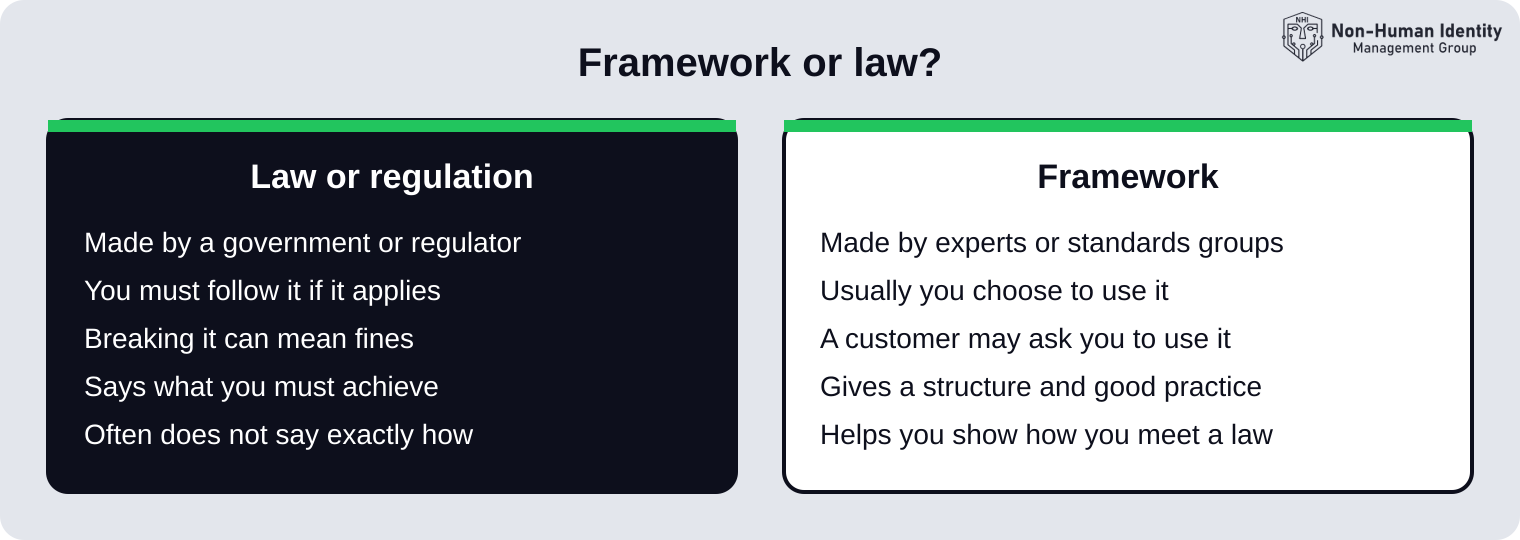
- A law is different. If it applies to you, you must follow it, and breaking it can lead to penalties.
- Most frameworks are voluntary, but a customer or contract can make one a requirement.
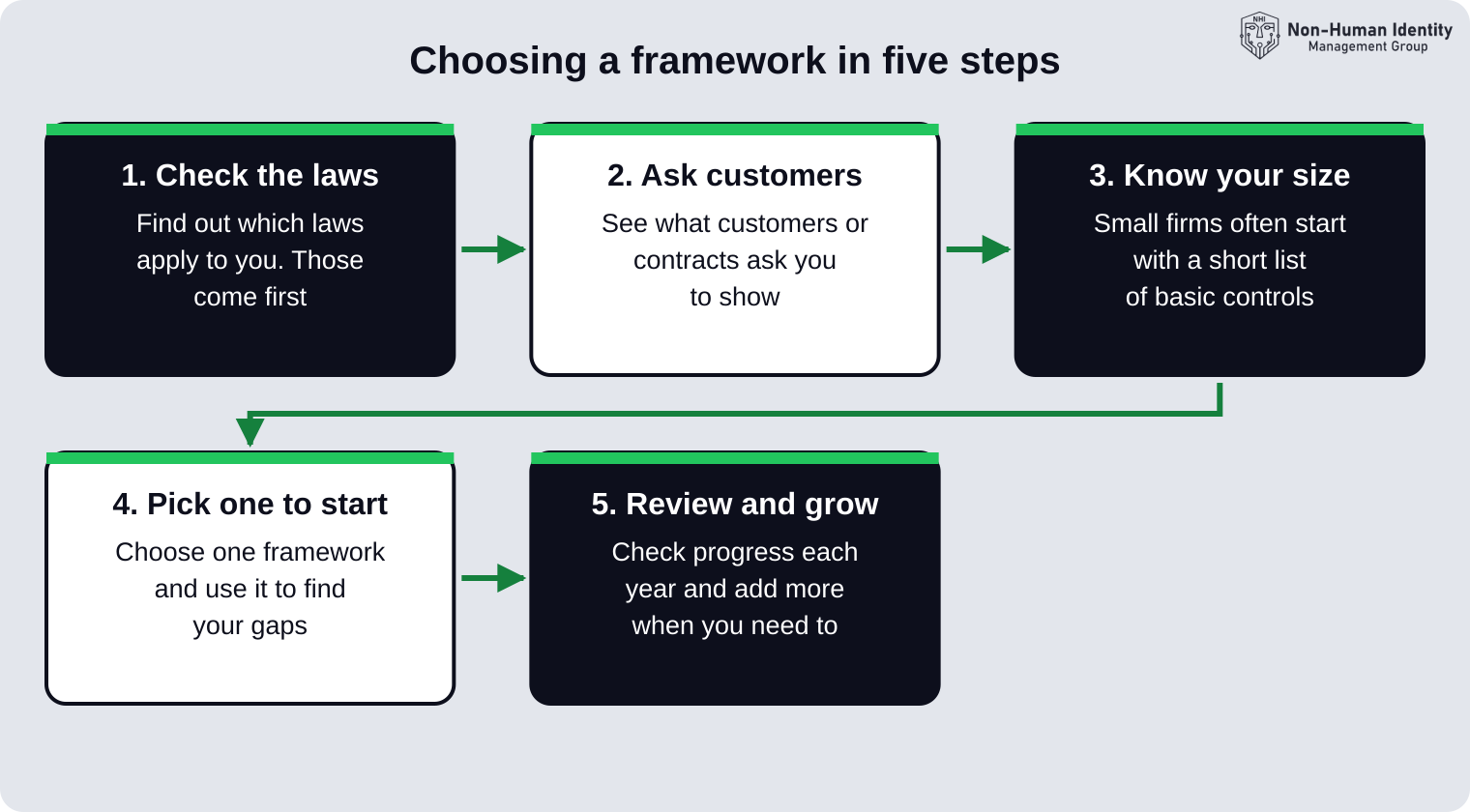
- There is no single best framework. Start with the laws and customer demands that apply, then pick one framework that fits your size.
What you will learn
- Explain what a cyber security framework is in one sentence.
- Spot the difference between a framework and a law.
- Name a few common frameworks and what each is good for.
- Ask the right questions before choosing one.
- Good-practice guide (framework)
- an organised set of security practices you can follow and measure yourself against.
- Safety measure (control)
- one thing you do to reduce a risk, such as turning on updates.
- Outside check (certification)
- an independent review that confirms you meet a standard.
What is a cyber security framework?
Think of a good cookbook. It shows a tested way to make a meal, step by step. Nobody fines you for skipping a step, but following it makes a good result much more likely.
A cyber security framework does the same for protecting an organisation. It lists the things to look after, such as passwords, updates and backups, and puts them in a sensible order. Each item on the list is often called a control, which means one safety measure.
A law is more like food safety rules. If they apply to your kitchen, you must follow them. An inspector can act if you do not. Laws often say what you must achieve, but not exactly how. Frameworks help with the "how".
Some frameworks offer certification, an outside check that confirms you meet them. Others are used only as a guide.
Where the comparison stops working: a cookbook is for one meal. A framework is for a whole organisation, and it is never finished, because risks and systems keep changing.
Why does it matter?
Without a framework, security work can be a random list of fixes. A framework gives a shared map, so everyone can see what is done and what is missing.
If you run a small business
What could happen: a big customer asks for proof of security, and you have nothing to show.
Check this: ask your main customers which framework or certificate they expect.
If you are new to IT or security work
What could happen: you hear framework names in every meeting and cannot tell them apart.
Check this: ask which framework your team uses, and read its short summary.
If you are a manager
What could happen: the team chases a framework while missing a law the firm must follow.
Check this: list the laws that apply first, then choose a framework to help meet them.
What does it look like?
Here is a made-up card a small firm might fill in to sort out what applies to it.
Example only. All values are made up.
WHAT APPLIES TO US?   Firm: EXAMPLE Accounts Ltd
LAWS (must follow)
  Data protection law: YES, we hold client data   (1)
FRAMEWORKS (chosen or asked for)
  Customer asks for: basic UK certificate         (2)
  Our guide for planning: one general framework   (3)
CERTIFICATES
  Target: FAKE-CERT-0000, due 01/01/2000          (4)
- A law applies because of what the firm does. It is not a choice.
- A customer has made one framework a condition of doing business.
- A framework the firm chose to organise its own work.
- In a real file, this line would contain the certificate name and renewal date.
Why this is risky: many firms mix up the two lists. Then they treat a law as optional, or chase frameworks nobody asked for.
The safer way: keep laws and frameworks in separate lists. Fill the law list first.
How does it work?
Most frameworks follow a similar pattern, whatever their size.
- Know what you have. List your systems, data and suppliers.
- Compare against the list. Go through the framework and mark what you already do.
- Fix the gaps. Start with the gaps that matter most to your business.
- Keep evidence. Write down what you did, so you can show it later.
- Review regularly. Check again each year, and after big changes.
Here are four common frameworks, from short to broad. Each one suits a different need.
- Cyber Essentials is a UK government-backed scheme with five basic controls, such as firewalls and security updates. The Plus level adds hands-on testing.[4]
- The CIS Controls are 18 ranked groups of security actions from a non-profit group.[3]
- The NIST Cybersecurity Framework is a US government guide for organisations of any size. It can be adopted voluntarily, and it does not say exactly how to reach each outcome.[1]
- ISO 27001 is an international standard for running security as a managed system. Certification is optional.[2]
A worked example
This story is made up to show how it can happen.
Ade Adeyemi runs a small accountancy firm in Bristol with six staff. A new client, a large housing company, sends him a supplier form. One question asks: "Which security framework do you follow?"
Ade searches online and finds a long list of names. Some articles say he needs all of them. He feels lost.
He starts with the laws. His firm holds clients' personal and money details, so UK data protection law applies. That is not optional.
Next he rings the client and asks what they need. They say a basic UK certificate is enough for a firm his size. He looks up Cyber Essentials and sees it has five controls. That feels like the right first step.
Ade works through the five controls with his IT supplier. They turn on automatic updates and remove an old admin account. They also check the firewall settings on the office router.
The firm passes and gets its certificate. Ade answers the supplier form with the certificate name and date.
A year later the firm has grown. Ade starts using a broader framework as a planning guide, to look at backups, training and suppliers. He adds one area at a time.
What made the difference: Ade sorted out the law first, then asked the customer, then picked one framework that fitted his size.
Myths and mistakes
| What people think | What is true |
|---|---|
| A framework is a law. | Most frameworks are voluntary. A law, or a contract, can still make one a requirement for you. |
| Following a framework means we meet the law. | It helps a lot, but laws can have their own duties, such as reporting incidents. Check each law too. |
| We need every framework. | Most small firms start with one. Many frameworks overlap, so one done well covers a lot. |
| A certificate means we are secure. | It shows you met the standard on the day of the check. Security still needs ongoing care. |
| The biggest framework is the best one. | The best one fits your size, your risks and what your customers ask for. |
What can I do this week?
- List the laws that apply to you, such as data protection law.
- Ask your two biggest customers what they expect you to show.
- Find out if your team already uses a framework.
- Read a short summary of one framework that fits your size.
Checklist
- I can explain the difference between a framework and a law.
- We have a list of laws that apply to us.
- We know what our main customers ask us to show.
- We have chosen one framework to start with.
- We have compared our current work against it and listed the gaps.
- We keep evidence of what we have done.
- We review our progress at least once a year.
Common questions
Which cyber security framework should I use?
Start with what you must do: the laws that apply and what customers ask for. Then pick one framework that fits your size. Small UK firms often start with Cyber Essentials. Larger firms often use broader frameworks, or an international standard that can be certified.
Is a framework the same as a standard?
Nearly. People often use the words loosely. A standard is usually a formal document from a standards body, sometimes with certification. A framework is a broader structure of good practice. Some are both.
Do frameworks cost money?
Many are free to read, such as the NIST Cybersecurity Framework and the CIS Controls. Some standards must be bought. Certification usually has a fee for the outside check, which often depends on the size of your organisation.
Can one framework help with several laws?
Yes, often. Many laws ask for similar basics, such as access control, updates and incident plans. A framework helps you do these once and show the evidence to different people. Each law may still add its own duties.
Where next?
Ready for the detail? Read the practitioner guide: Cybersecurity Frameworks Compared Guide. It goes further into how the main frameworks differ in effort and assurance, how they map to each other, and how to combine them.
Also useful:
- NIST Cybersecurity Framework for Beginners
- ISO 27001 for Beginners
- CIS Controls for Beginners
- Cyber Essentials for Beginners
- Cyber Security Compliance for Beginners
Related NHI Mgmt Group resources: Cyber Essentials vs ISO 27001 · SOC 2 vs ISO 27001 vs PCI DSS · CMMC for Beginners
Key terms
- Security framework
- An organised set of security practices that helps an organisation plan, measure and improve its protection.
- Security control
- One safety measure that reduces a risk, such as updates, backups or access rules.
- NIST Cybersecurity Framework
- A voluntary US government guide that groups security outcomes so any organisation can manage cyber risk.
- ISO 27001
- An international standard for running information security as a managed system, which can be certified.
- CIS Controls
- A ranked set of 18 groups of practical security actions.
- Cyber Essentials
- A UK government-backed certification covering five basic technical controls.
Sources and further reading
- The NIST Cybersecurity Framework (CSF) 2.0 (NIST CSWP 29). National Institute of Standards and Technology (NIST), 26 February 2024. https://nvlpubs.nist.gov/nistpubs/CSWP/NIST.CSWP.29.pdf, accessed 28 Nov 2026.
- ISO/IEC 27001: Information security management systems. International Organization for Standardization (ISO). https://www.iso.org/isoiec-27001-information-security.html, accessed 28 Nov 2026.
- CIS Critical Security Controls, version 8.1. Center for Internet Security (CIS). https://www.cisecurity.org/controls, accessed 28 Nov 2026.
- Cyber Essentials: overview. National Cyber Security Centre (NCSC). https://www.ncsc.gov.uk/cyberessentials/overview, accessed 28 Nov 2026.