A compliance obligations register is a list of the rules an organisation must follow, with an owner for each.
This guide is for students, new compliance and IT staff, and small business owners who have been asked to "keep a register". You do not need a legal background to start one: it is a table that links each rule to a task, a person and some proof.
In short
- An obligations register lists the laws, contracts and standards that apply to you.
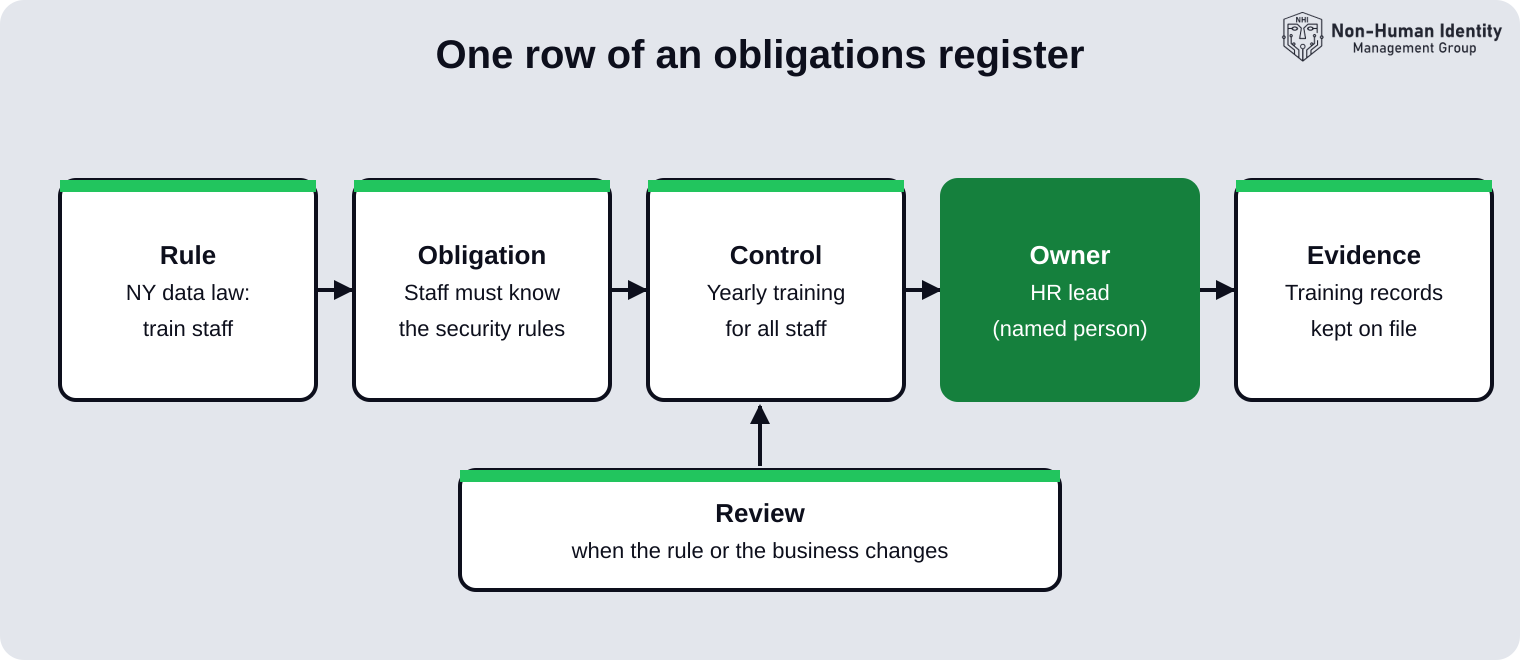
- Each row turns a rule into a plain duty, a control that meets it, a named owner and the evidence.
- It helps you show regulators and customers that you know your duties and meet them.
- It needs a review whenever a rule changes or the business changes.
What you will learn
- Explain what an obligations register is and why firms keep one.
- Spot the five things every row should hold.
- Check that each duty has a named owner and proof.
- Tell an obligations register apart from a risk register.
Status: correct as at 28 November 2026, based on the New York State Senate law text, ICO guidance and the ISO standard page. Laws change; check the official text.
This guide explains the topic in general terms and is not legal advice.
- A duty you must meet (compliance obligation)
- something a law, contract or standard says your organisation must do.
- Protection or process (control)
- the thing you do to meet a duty, such as yearly staff training.
- Proof (evidence)
- records that show the control is really in place and working.
What is a compliance obligations register?
Think of a household bills planner. It lists every bill, when each one is due and who in the house pays it. Nothing is missed because everything sits in one place. An obligations register does the same for the rules an organisation must follow.
Each rule becomes a row. The row says what the rule asks for in plain words. It names the control that meets it, the person who owns it and the proof that it is done.
The rules can come from many places: data protection law, industry rules, customer contracts or a standard the firm has signed up to.
Where the comparison stops working: a bill has a clear amount and date. Many rules are vaguer, such as "keep reasonable security". Someone has to turn them into clear tasks first.
Why does it matter?
Data laws often expect you to show how you comply, not only to comply. The UK data regulator says you must be able to give evidence of the steps you take.[2] A register is a simple way to hold that evidence in one place.
If you are new to compliance work
What could happen: a duty in a customer contract is missed because nobody wrote it down.
Check this: ask where contract security clauses are recorded, and by whom.
If you run a small business
What could happen: a regulator or customer asks how you meet a rule, and the answer lives in one person's head.
Check this: list the three or four laws and contracts that matter most to you.
If you look after IT
What could happen: a duty such as "control who has access" is assigned to IT, but nobody tells you.
Check this: ask to see the rows you own and the evidence expected for each.
What does it look like?
Here are three made-up rows from a small firm's register.
Example only. All values are made up.
Firm: EXAMPLE Shop Ltd (example.com)
Source        Duty in plain words       Control             Owner        Evidence
NY data law   Train staff on security   Yearly training     HR lead      Training records
Contract 0000 Report breaches in 24h    Incident plan       (none)  (1)  (none)  (2)
NY data law   Delete data not needed    Yearly clean-up     Data lead    Deletion log
Last review: 2024-01-01 (3)
- A customer contract asks for fast breach reports, but no person owns the task.
- There is no proof the incident plan would meet the 24-hour promise.
- The register has not been reviewed for a long time.
Why this is risky: a duty without an owner tends to be missed. A register that is not reviewed can drift away from the real rules.
The safer way: give every row an owner and an evidence item. Set a review date and keep it.
How does it work?
- Find the sources. List the laws, rules, contracts and standards that apply. An international standard for compliance management calls these your full range of compliance obligations.[3]
- Break each source into duties. Turn long legal text into short plain duties. For example, New York's data law lists steps such as training staff and deleting data that is no longer needed.[1]
- Link each duty to a control. Write down what the firm does to meet it.
- Name an owner. Pick one person, not a team, who makes sure the control works.
- Record the evidence. Say what proof shows the control is working, and where it is kept.
- Review it. Check the register when a rule changes, a contract is signed or the business changes. New York's law also expects the security programme to be updated as the business changes.[1]
An obligations register is a sister to a risk register. The risk register lists what could go wrong. The obligations register lists what you must do. Many firms link the two, so a missed duty shows up as a risk.
Some duties apply to the accounts that software uses, called non-human identities (NHIs). These include service accounts, API keys and certificates. A duty such as "control who has access" should cover them as well as staff.
A worked example
Bea Lomax has just joined a small online shop as its office manager. The shop sells to customers in New York. A new business customer asks for proof that the shop "meets its data protection duties".
Bea asks Odile Strand, a part-time compliance adviser, where to start. Odile suggests a simple register in a spreadsheet with five columns: source, duty, control, owner and evidence.
They start with the New York data law, because it lists clear examples. Odile reads out the steps. Bea turns each one into a short plain duty: train staff, check suppliers, delete data that is no longer needed, and so on.
Next they add the new customer's contract. It asks the shop to report any breach within 24 hours. Bea adds a row, but nobody owns the incident plan. The shop owner agrees to take it on and test the plan.
For each row, Bea asks the owner what proof they have. Training records exist. Supplier checks are only in old emails, so Odile helps her make a simple supplier list instead.
After two weeks, the register has fourteen rows. Two still have gaps, and both have a date to fix them. Bea sends the customer a short summary.
She also puts a review in the calendar every six months. She adds a note to update the register whenever the shop signs a new contract.
Myths and mistakes
| What people think | What is true |
|---|---|
| Only big companies need a register. | Any firm with data laws or contracts to meet can use one. A small firm's register can be a short spreadsheet. |
| Copying the law into a table is enough. | Each rule needs to become a plain duty with a control, an owner and proof. |
| A team can own a duty. | Name one person. When everyone owns a duty, it tends to fall through the gaps. |
| It is the same as a risk register. | A risk register lists what could go wrong. An obligations register lists what you must do. They work well together. |
| Once it is written, it is done. | Rules, contracts and the business change. The register needs regular reviews. |
What can I do this week?
- List the main laws, contracts and standards that apply to your organisation.
- Pick one and break it into three to five plain duties.
- Add a control, an owner and an evidence item for each duty.
- Ask each owner if they agree and where the proof is kept.
- Set a review date in the calendar.
Checklist
- The register lists every main law, contract and standard that applies.
- Each rule is broken into plain duties.
- Each duty is linked to a control.
- Each duty has one named owner who knows about it.
- Each duty has evidence, and you know where it is kept.
- Gaps have a fix date.
- Access duties cover accounts used by software as well as people.
- The register is reviewed on a set date and after big changes.
Common questions
Do I need special software for an obligations register?
No. A spreadsheet works well for a small organisation. Larger firms often move to compliance tools as the number of rules grows. What matters most is that each row has a clear duty, an owner, evidence and a review date.
What goes in each row?
Each row needs five things. These are the source, the duty in plain words, the control, the owner and the evidence. Many firms also add a review date, a status and notes on gaps.
How is it different from a risk register?
A risk register lists things that could go wrong, how likely they are and how bad they would be. An obligations register lists the duties you must meet. Linking them helps, because a missed duty is itself a risk.
How often should we review it?
Set a regular date, such as every six or twelve months, and stick to it. Also review it when a law changes, you sign a new contract or the business changes, for example by entering a new country.
Who should own the register itself?
Usually one person in compliance, legal or operations keeps it up to date. Each row still has its own owner. The register owner makes sure rows are reviewed and gaps are chased, not that every duty is done by them.
Where next?
Ready for the detail? Read the practitioner guide: Compliance Obligations Register Template. It goes further into the register fields, roles, how to break rules into duties, more worked rows and how to watch for rule changes.
Also useful:
- Risk Register Template
- Compliance Calendar Template
- Cyber Security Compliance for Beginners
- Reasonable Security for Beginners
Related NHI Mgmt Group resources: GRC Analyst for Beginners · Compliance Automation Guide · Non-Human Identities for Beginners
Key terms
- Obligations register
- A kept-up list of the legal, regulatory and contract duties an organisation must meet, each with an owner, controls and evidence.
- Compliance obligation
- A requirement an organisation must meet, often coming from a law, rule or standard.
- Security control
- A measure that lowers the chance or harm of misuse, such as access checks or training.
- Control owner
- The person accountable for a control working as intended and for its evidence.
- Risk register
- A list of risks with their likelihood, impact, owner and planned response.
- Accountability
- The data protection principle that you must be able to show how you comply, with evidence.
- Regulatory change monitoring
- Keeping track of new or changed rules that could affect what you must do.
Sources and further reading
- New York General Business Law § 899-BB: Data security protections. New York State Senate. https://www.nysenate.gov/legislation/laws/GBS/899-BB, accessed 28 Nov 2026.
- Guide to accountability and governance. Information Commissioner's Office (ICO). https://ico.org.uk/for-organisations/uk-gdpr-guidance-and-resources/accountability-and-governance/guide-to-accountability-and-governance/, accessed 28 Nov 2026.
- ISO 37301:2021 Compliance management systems: Requirements with guidance for use. International Organization for Standardization (ISO), April 2021. https://www.iso.org/standard/75080.html, accessed 28 Nov 2026.