A GRC analyst helps an organisation set security rules, track its risks and prove the rules are followed.
This guide is for anyone curious about a security job that is more about people, paperwork and judgement than code. You do not need a technical background to read it. If your company has ever answered a customer's security questionnaire, a GRC analyst was probably behind it.
In short
- GRC stands for governance, risk and compliance: setting the rules, weighing the risks and checking the rules are met.
- Most of the day is talking to teams, keeping a list of risks up to date and collecting proof that safeguards work.
- Clear writing, organisation and curiosity matter as much as deep technical skill at the start.
- People come in from audit, IT support, legal, finance, project work and degrees. Entry-level risk analyst jobs are often GRC jobs.
What you will learn
- Explain what a GRC analyst does in one sentence.
- Spot the main steps in handling a security risk.
- Check which skills you already have that the job uses.
- Ask good questions about a GRC job before you apply.
- List of things that could go wrong (risk register)
- a shared list of risks, who owns each one and what is being done about it.
- Safeguard (control)
- a step or setting that lowers a risk, such as a second login check.
- Proof (evidence)
- records that show a safeguard is really in place and working.
What is a GRC analyst?
Think of a fire safety officer in a large office. They do not fight fires. They make sure there are rules, that alarms are tested and that someone writes the tests down.
A GRC analyst does a similar job for computer security. GRC is short for governance, risk and compliance. Governance means the rules and who is in charge. Risk means what could go wrong and how bad it would be. Compliance means checking that the organisation meets its own rules and any laws or standards it must follow.
In practice, the analyst keeps a risk register, a shared list of things that could go wrong. They help teams choose controls (safeguards that lower a risk). Then they collect proof that those safeguards work. Checking how well safeguards work is a core task in this kind of role.[3]
The aim is not paperwork for its own sake. Good risk work should help the business reach its goals safely.[1]
Where the comparison stops working: fire risks change slowly and you can often see them. Computer risks change quickly, and many are invisible until someone checks.
Why does it matter?
Leaders cannot fix every risk at once. GRC work helps them see which risks matter most, so time and money go where they help. For many people, it is also a way into security that builds on skills from other jobs.
If you work in audit, finance or legal
What could happen: you assume security jobs need coding, and miss a role that uses your skills in checking and writing.
Check this: read three GRC analyst job adverts and mark the tasks you already do.
If you run a small business
What could happen: a big customer sends a security questionnaire, and nobody knows who should answer it.
Check this: keep a short list of your main risks and what you do about each one.
If you are new to IT work
What could happen: you are asked for "evidence" for an audit and do not know what counts.
Check this: ask your GRC team what proof they need and how often.
What does it look like?
A lot of a GRC analyst's work happens in a risk register. Here is a made-up entry, as it might appear in a spreadsheet or GRC tool.
Example only. All values are made up.
RISK 0000-EXAMPLE
Risk:      Ex-staff keep access to the shared files    (1)
Owner:     Head of IT (FAKE NAME)                       (2)
Likely:    Medium    Impact: High                       (3)
Control:   Remove access on leaving day                 (4)
Evidence:  (none attached)                              (5)
Next review: 00/00/0000
- What could go wrong, in plain words.
- The person who must make sure it is handled. In a real file, this line would contain the owner's job title.
- A rough score of how likely it is and how bad it would be.
- The safeguard the team agreed on.
- The proof box. Here it is empty, so nobody can show the safeguard works.
Why this is risky: the register says a safeguard exists, but there is no proof. If an auditor asks, or a former worker still has access, the entry gives false comfort.
The safer way: attach proof, such as a monthly report of leavers checked against active accounts. Then set a date to look again.
How does it work?
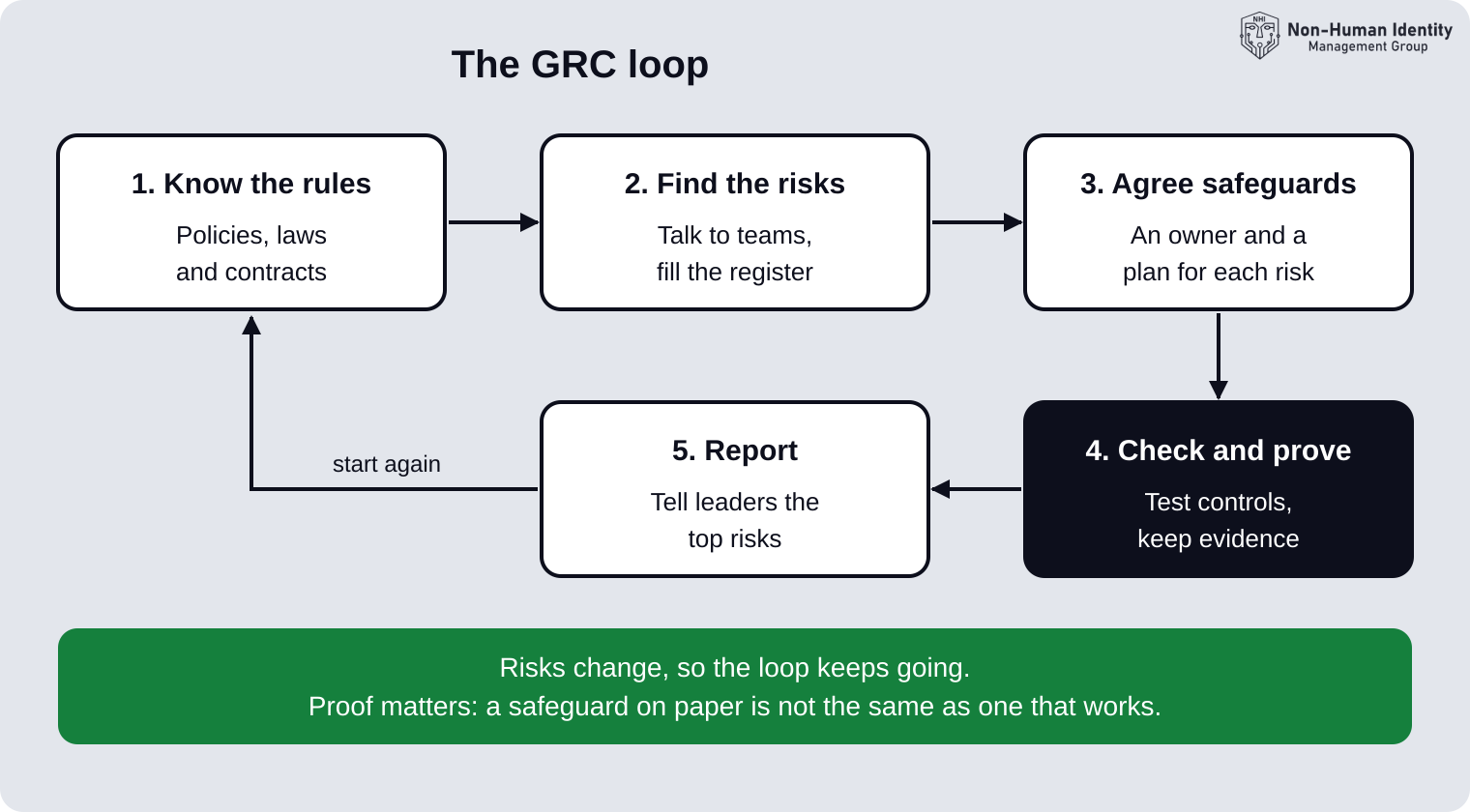
Every organisation does this a little differently, but the work often follows a loop like this one.
- Know the rules. The analyst helps write or update security policies (the written rules staff must follow) and notes which laws, contracts or standards apply.
- Find the risks. They talk to teams and record what could go wrong in the risk register. This step is called a risk assessment.
- Agree safeguards. Each risk gets an owner and a plan, which might be a new control or a decision to accept the risk for now.
- Check and collect proof. The analyst tests whether controls really work and keeps the evidence.[3]
- Report and repeat. They give leaders a clear summary of the biggest risks, and then the loop starts again because risks change.
Many teams map their work to a published framework (a set of good practices). One widely used example is a free US government framework that helps organisations understand and manage security risk.[2] You do not need to learn these frameworks in detail on your first day.
In a bigger team, a junior analyst often handles evidence and questionnaires. More experienced colleagues lead audits, advise leaders and own larger risk decisions. Senior risk roles, such as a cyber risk manager, grow out of this work.
A worked example
Gareth Llewellyn is six months into his first GRC analyst job at Ashby Building Society, a fictional lender. Before this, he worked in the internal audit team.
His Monday starts with the risk register. Three reviews are due this week. One is the entry about former staff keeping access to shared files.
Gareth thinks of the fire safety officer. Has the alarm been tested, and is the test written down? The entry says access is removed on the leaving day. But the proof box is empty.
He emails the IT team and asks for last month's leavers report. It arrives the next morning. Two of the eight leavers still have active accounts.
Gareth does not blame anyone. He records what he found, in plain words. He raises the risk score and asks the IT lead to remove the two accounts. He also suggests a small fix: HR sends IT an automatic notice on each leaving day.
On Wednesday he answers a security questionnaire from a business partner. He uses the policies and evidence already on file, so it takes an afternoon, not a week.
On Friday he writes a short note for the risk committee. It explains the leaver gap, the fix and the date for the next check.
A month later, the leavers report shows no active accounts for people who have gone, in the records he checked. The committee lowers the risk score again.
Myths and mistakes
| What people think | What is true |
|---|---|
| GRC is just ticking boxes. | Good GRC work helps leaders make better choices about real risks.[1] |
| You need to be a programmer. | Most of the job is reading, asking, writing and checking. Some technical knowledge helps, and it grows on the job. |
| Passing an audit means you are secure. | An audit checks a sample at one point in time. Risks can still change the next day. |
| A policy on paper is enough. | A rule only helps if it is followed and someone can show proof. |
| Every risk must be fixed. | Some risks are accepted for a time, as long as an owner agrees and it is written down. |
What can I do this week?
- Read three GRC analyst job adverts and list the tasks they share.
- Write a mini risk register for your own home: three risks, an owner and one safeguard each.
- Read our Governance, Risk and Compliance for Beginners guide.
- Ask someone in audit, risk or compliance what a normal week looks like.
Checklist
- I can explain what governance, risk and compliance each mean.
- I know what a risk register, a control and evidence are.
- I have looked at real job adverts for the role.
- I can point to times I wrote clearly or kept good records.
- I have checked official sources for pay, not just job boards.
- I know the difference between a GRC analyst and an auditor.
- I have a plan for one first learning step.
Common questions
Do I need a technical background to start in GRC?
Not always. Many GRC analysts start in audit, legal, finance or project roles. You do need to learn how systems and accounts work over time, so you can ask the right questions. Short courses and time with IT teams help you build that knowledge on the job.
What is the difference between a GRC analyst and an auditor?
A GRC analyst works inside the team that runs the safeguards and helps improve them. An auditor checks them, often from outside or from a separate team, and must stay independent. The skills overlap, and some people move between the two. See What does a security auditor do? A beginner's guide.
How much does a GRC analyst earn?
Pay varies a lot by country, sector and experience, so we do not quote a figure here. Use official sources. In the US, see the government's job outlook page for information security analysts.[4] In the UK, see the National Careers Service.[5]
Is a risk analyst the same as a GRC analyst?
Often, at entry level. Many risk analyst jobs involve the same tasks: keeping the risk register, scoring risks and tracking fixes. Job titles vary between employers, so read the duties, not just the title. Senior risk roles focus more on advising leaders and putting risks into money terms.
Where can a GRC analyst job lead?
Several paths. Analysts often move into senior GRC, audit, cyber risk management, privacy or security leadership roles. The work teaches how a whole organisation handles risk, which helps in most senior jobs. See Cyber Risk Manager Career Guide.
Where next?
Ready for the detail? Read the practitioner guide: GRC Analyst Career Guide. It goes further into the skills employers test, the frameworks analysts use, certifications and how people progress.
Also useful:
- Governance, Risk and Compliance for Beginners
- Cyber Risk Management for Beginners
- Cyber Risk Quantification for Beginners
- Third Party Risk Management for Beginners
- ISC2 CGRC Certification Guide
- IAM Engineer for Beginners
Related NHI Mgmt Group resources: Cybersecurity Careers Guide · Career Change into Cyber Security Guide · NHI Governance for Beginners
Key terms
- Compliance
- Meeting the rules, laws, contracts and standards an organisation has agreed to follow.
- Risk register
- A shared list of risks, their owners and what is being done about each one.
- Risk assessment
- Working out what could go wrong, how likely it is and how much harm it would do.
- Risk appetite
- How much risk leaders are willing to accept to reach their goals.
- Security control
- A safeguard, such as a rule, process or setting, that lowers a security risk.
- Security policy
- A written rule that says how staff and systems must handle security.
- Audit evidence
- Records that show a safeguard is in place and working.
Sources and further reading
- Risk management. National Cyber Security Centre (UK). https://www.ncsc.gov.uk/collection/risk-management, accessed 28 Nov 2026.
- Cybersecurity Framework (CSF 2.0). US National Institute of Standards and Technology, last modified 18 November 2026. https://www.nist.gov/cyberframework, accessed 28 Nov 2026.
- NICE Framework, Security Control Assessment work role (task: assess the effectiveness of security controls). CISA National Initiative for Cybersecurity Careers and Studies. https://niccs.cisa.gov/tools/nice-framework/work-role/security-control-assessment, accessed 28 Nov 2026.
- Information Security Analysts, Occupational Outlook Handbook. US Bureau of Labor Statistics, last modified 27 August 2026. https://www.bls.gov/ooh/computer-and-information-technology/information-security-analysts.htm, accessed 28 Nov 2026.
- Explore careers. National Careers Service (England). https://nationalcareers.service.gov.uk/explore-careers, accessed 28 Nov 2026.