Reasonable security means protecting data as well as a careful organisation of your size and type would.
This guide is for business owners, staff and students who keep meeting the phrase in laws and contracts and want to know what it means in practice. You do not need to be a lawyer to be affected: if your business keeps customer details, the duty can apply to you.
In short
- Many data laws say "reasonable" or "appropriate" security but do not give a full list of what to do.
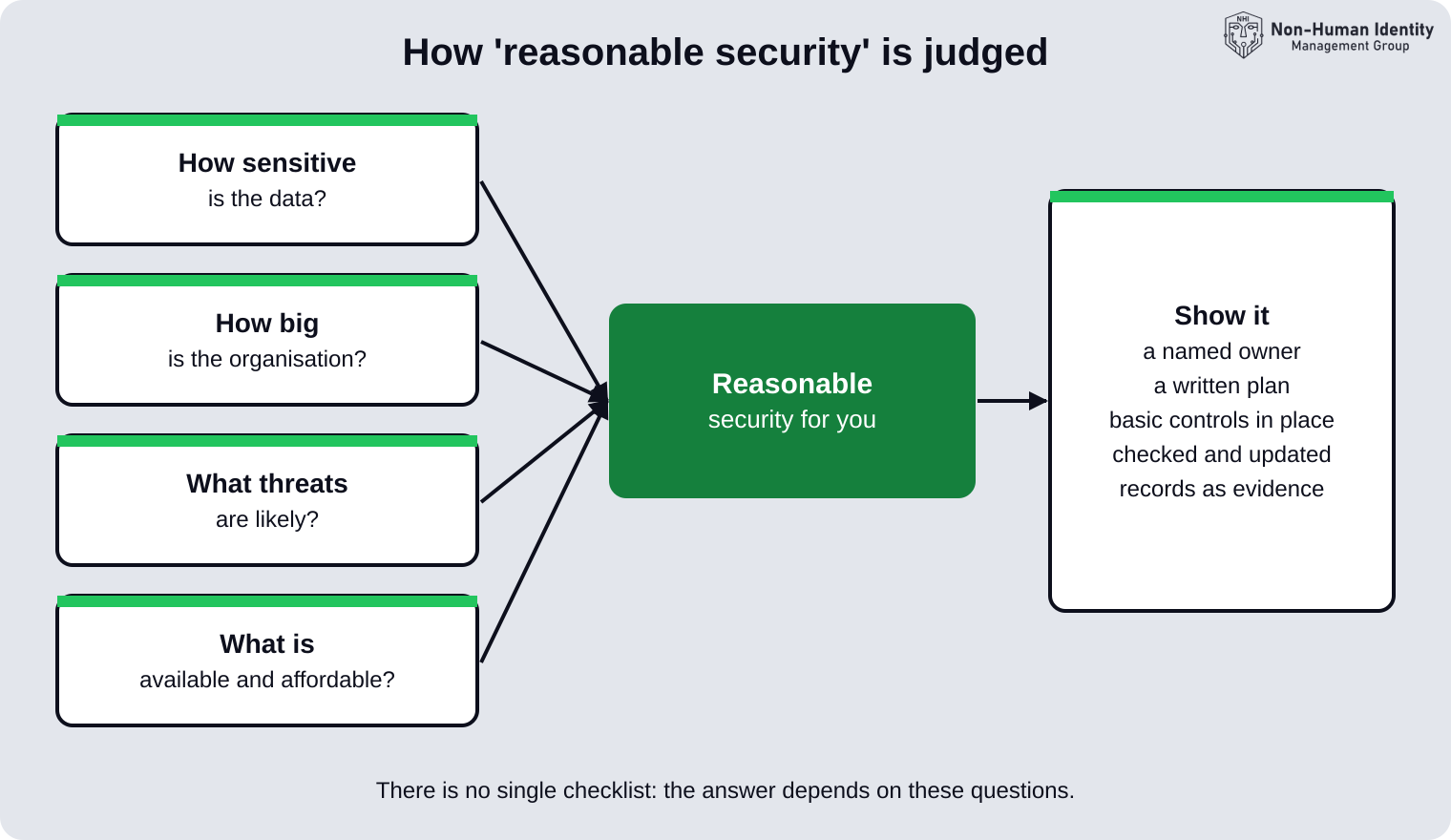
- What counts as reasonable depends on how sensitive the data is, how big you are and what threats you face.
- US regulators have brought many cases where firms missed basics such as a second sign-in check or watching for attacks.
- You show reasonable security with a named owner, a written plan, basic controls and records that prove them.
What you will learn
- Explain what "reasonable security" means in plain words.
- Spot the questions a regulator is likely to ask after a breach.
- Check whether your business has the basics regulators expect.
- Ask the right people for evidence that the basics are in place.
Status: correct as at 28 November 2026, based on the US Federal Trade Commission, New York and California law texts and UK regulator guidance. Laws change; check the official text.
This guide explains the topic in general terms and is not legal advice.
- Careful enough (reasonable security)
- the level of protection the law expects, judged against your size, your data and your risks.
- Protection measure (control)
- one thing you do to lower a risk, such as a second sign-in check.
- Proof (evidence)
- records that show a control is really in place and working.
What is reasonable security?
Think of a shop owner keeping the floor safe for customers. No law lists every mop and warning sign. If someone slips, people ask one question: did the owner do what a careful shop owner would do?
Reasonable security works the same way for data. Many laws say an organisation must use "reasonable" or "appropriate" security, then stop there. The idea is that a small café and a big bank face different risks, so one fixed list would not fit both.
So the answer depends on your situation. A useful way to think about it is four questions. How sensitive is the data? How big and complex is the organisation? Which attacks are likely? And what protections are available at a sensible cost?
Where the comparison stops working: a slippery floor is easy to see. Security gaps are often hidden until something goes wrong, so you also need records that show you took care before anything happened.
Why does it matter?
The phrase is in many data laws. Regulators use it to judge firms after a breach. Missing the basics can lead to an order and years of outside checks.
If you run a small business
What could happen: after a break-in, a regulator asks what security you had. You have nothing written down.
Check this: write down what customer data you keep and who looks after keeping it safe.
If you look after IT
What could happen: an account with only a password lets an attacker in. The regulator then asks why.
Check this: list the systems that hold customer data. Make sure each has a second sign-in check.
If you are a manager or director
What could happen: your website says "bank-level security". The systems do not match the claim.
Check this: ask someone to check each public security claim against the facts.
What does it look like?
Here is a made-up "Could we show it?" card a small firm might fill in.
Example only. All values are made up.
Firm: EXAMPLE Travel Ltd (example.com)       Staff: 12
Named person in charge of security            yes
List of the customer data we keep             yes
Second sign-in check on email and booking     no    (1)
Someone watches for odd sign-ins              no    (2)
Old customer records deleted when not needed  no    (3)
Suppliers asked how they protect our data     yes
Website security claims checked for accuracy  no    (4)
- Staff sign in with a password only.
- Nobody looks at sign-in records. A break-in could go unnoticed.
- Records from ten years ago are still kept "just in case".
- The website promises "military-grade protection". Nobody has checked it.
Why this is risky: these are basic gaps. The US consumer regulator has pointed to gaps like them in its cases.[2][3] A claim that does not match reality can be a problem on its own.
The safer way: turn on the second sign-in check. Ask someone to review sign-in records. Delete data you no longer need. Make your claims match the facts.
How does it work?
There is no single reasonable security law. The idea turns up in several places.
- Laws set the duty. California law says a business holding personal information about California residents must keep reasonable security suited to the type of information.[4] UK data protection law asks for security that is "appropriate" to the risk.[6]
- Some laws give examples. New York's data law lists the kinds of steps that count. These include naming someone to run the security programme, training staff, checking suppliers and deleting data that is no longer needed.[5]
- Size is taken into account. New York says a small business meets the duty if its protection is reasonable for its size, its activities and how sensitive its data is.[5] The UK regulator says there is no "one size fits all" answer.[6]
- Regulators judge after the event. In the US, the Federal Trade Commission (FTC) can act against "unfair or deceptive" business practices.[1] It has used this power in data security cases, and it has drawn lessons from more than 80 of them for businesses.[2]
- Orders spell out the fixes. In 2025 the FTC finalised an order against the web hosting firm GoDaddy. It said the firm had failed to use a second sign-in check and to watch for threats. The order requires a full security programme and checks by an independent assessor.[3]
The FTC notes that its settlements apply only to the firms involved. Even so, it says other businesses can learn from them, because most of the problems were basic ones.[2]
The same thinking covers the accounts that software uses, not only staff accounts. These are called non-human identities (NHIs): service accounts, API keys, tokens and certificates that let programs connect to each other. A careful firm knows which ones it has and who owns each one.
A worked example
Elif Grover runs a small online travel agency with twelve staff. A new business customer sends her a contract. One line says her firm must "maintain reasonable security" for the customer's staff details.
Elif is not sure what she is signing up to. She asks Freya Quist, a consultant who helps small firms with security a few days a month.
Freya explains it with the shop floor picture. "Nobody gives you a full list. The question is whether a careful firm like yours took sensible steps, and whether you can show it."
They sit down with a simple card like the one above. Most answers are fine, but four are not. Email and the booking system use passwords only. Nobody reviews sign-in records. Old customer files go back years. And the website promises "military-grade protection".
Over a month they work through the gaps. Freya turns on the second sign-in check for every account. She sets up a weekly email that lists unusual sign-ins, and Elif's office manager reads it. They delete records the firm no longer needs, following the retention rules that apply to it.
Elif rewrites the website line to say what the firm really does. Then she writes a two-page security plan that names herself as the owner and lists the controls.
When the customer asks for evidence, Elif sends the plan and a short summary. She also adds a yearly reminder to review the plan, because what counts as reasonable can change over time.
Myths and mistakes
| What people think | What is true |
|---|---|
| Reasonable means perfect. | No law expects you to stop every attack. It expects sensible steps for your situation, and proof you took them. |
| Small firms are exempt. | Size is taken into account, but small firms still need protection that fits their data and risks.[5] |
| If we have not been breached, we are fine. | Regulators look at what you had in place. Gaps can matter even before anything goes wrong. |
| Buying a security tool makes us reasonable. | A tool helps only if it is set up, used and checked. Records of that are part of the proof. |
| Our website can say whatever sounds reassuring. | A security claim that does not match reality can lead to action on its own.[3] |
What can I do this week?
- Write down what personal data you keep and why you keep it.
- Name one person who is in charge of security.
- Turn on the second sign-in check for email and any system holding customer data.
- Read the free FTC guide for business and tick off the lessons you already follow.
- Compare every security claim on your website with what is really in place.
Checklist
- A named person owns security.
- You know what personal data you keep and where it lives.
- There is a short written security plan.
- A second sign-in check is on for email and customer systems.
- Someone reviews sign-in records or alerts.
- Staff get basic security training.
- Suppliers who handle your data are asked how they protect it.
- Data you no longer need is deleted safely.
- Public security claims match reality.
- The plan is reviewed at least once a year.
Common questions
Is there an official list of what counts as reasonable?
Not one single list. Some laws, such as New York's, give examples of the steps that count. US regulators also publish lessons from their cases. Together they show common basics, but you still need to fit them to your own data and risks.
Does reasonable security apply outside the US?
Yes, under other words. UK and EU data protection law asks for "appropriate" security, judged against the risk. The idea is the same: no fixed list, sensible steps that fit your situation, and the ability to show what you did.
Who decides if our security was reasonable?
Usually a regulator, and sometimes a court, after a complaint or a breach. They look at what you knew, what you had in place and what a careful firm like yours would have done. Good records make that easier to show.
Is reasonable security the same as compliance?
Not quite. Compliance means meeting specific rules. Reasonable security is a broader judgement about whether your protection fits your risks. A firm can tick a checklist and still miss an obvious gap, so it helps to think about both.
What should we do first?
Start with what you hold and who owns security. Then cover the basics regulators often mention: a second sign-in check, watching for odd activity, deleting old data and checking suppliers. Write it down, because records are your proof.
Where next?
Ready for the detail? Read the practitioner guide: FTC Act Section 5 Data Security Guide. It goes further into who the FTC can act against, what its orders require, how penalties work and how the duty applies to non-human identities.
Also useful:
- Reasonable Security
- GLBA and the FTC Safeguards Rule for Beginners
- Cyber Security Compliance for Beginners
- Third Party Risk Management for Beginners
Related NHI Mgmt Group resources: Compliance vs Security · Non-Human Identities for Beginners · UK GDPR for Beginners
Key terms
- Reasonable security
- The level of protection an organisation is expected to use, in proportion to its data, risks and size.
- Section 5 enforcement
- The route the US FTC uses to act against unfair or deceptive business practices, including weak security and false security claims.
- Consent order
- A formal agreement with a regulator that sets the fixes and checks a firm must carry out.
- Information security programme
- A written, owned plan of the controls a firm uses to protect information, reviewed over time.
- Administrative safeguards
- The people and process side of security, such as training, rules and checks on suppliers.
- Security control
- A measure that lowers the chance or harm of misuse, such as a second sign-in check.
Sources and further reading
- 15 U.S. Code § 45 (Federal Trade Commission Act, Section 5): Unfair methods of competition unlawful; prevention by Commission. Legal Information Institute, Cornell Law School. https://www.law.cornell.edu/uscode/text/15/45, accessed 28 Nov 2026.
- Start with Security: A Guide for Business. Federal Trade Commission, June 2015 (updated August 2023). https://www.ftc.gov/business-guidance/resources/start-security-guide-business, accessed 28 Nov 2026.
- FTC Finalizes Order with GoDaddy over Data Security Failures. Federal Trade Commission, 21 May 2025. https://www.ftc.gov/news-events/news/press-releases/2025/05/ftc-finalizes-order-godaddy-over-data-security-failures, accessed 28 Nov 2026.
- California Civil Code § 1798.81.5. Justia US Law (text of the California code). https://law.justia.com/codes/california/code-civ/division-3/part-4/title-1-81/section-1798-81-5/, accessed 28 Nov 2026.
- New York General Business Law § 899-BB: Data security protections. New York State Senate. https://www.nysenate.gov/legislation/laws/GBS/899-BB, accessed 28 Nov 2026.
- A guide to data security. Information Commissioner's Office (ICO). https://ico.org.uk/for-organisations/uk-gdpr-guidance-and-resources/security/a-guide-to-data-security/, accessed 28 Nov 2026.