A crypto bridge is a service that moves digital money from one blockchain to another.
This guide is for anyone who has heard about huge crypto thefts and wondered why "bridges" keep coming up. You do not need to own any crypto. If you hold coins on more than one network, or you work near crypto, bridge risk can reach you.
In short
- Blockchains cannot talk to each other on their own, so bridges carry value between them.
- Many bridges lock the real coins in one place and hand out stand-in coins on the other network.
- That locked pile can be very large, which makes a bridge an attractive target.
- Thieves have mostly gone after the keys that approve transfers, or after flaws in the bridge's code.
What you will learn
- Explain what a crypto bridge does in one sentence.
- Spot why a bridge holds so much value in one place.
- Explain how the Ronin theft happened, in plain words.
- Check a few things before you trust a bridge with your coins.
- Shared record (blockchain)
- a public list of payments, copied across many computers.
- Stand-in coin (wrapped token)
- a coin on one network that stands for a real coin locked on another.
- Approver (validator)
- a computer, run by a person or firm, that signs off transfers on the bridge.
What is a crypto bridge?
Think of a cloakroom at a busy venue. You hand in your coat and get a ticket. While the coat stays on the rail, the ticket is what you carry around.
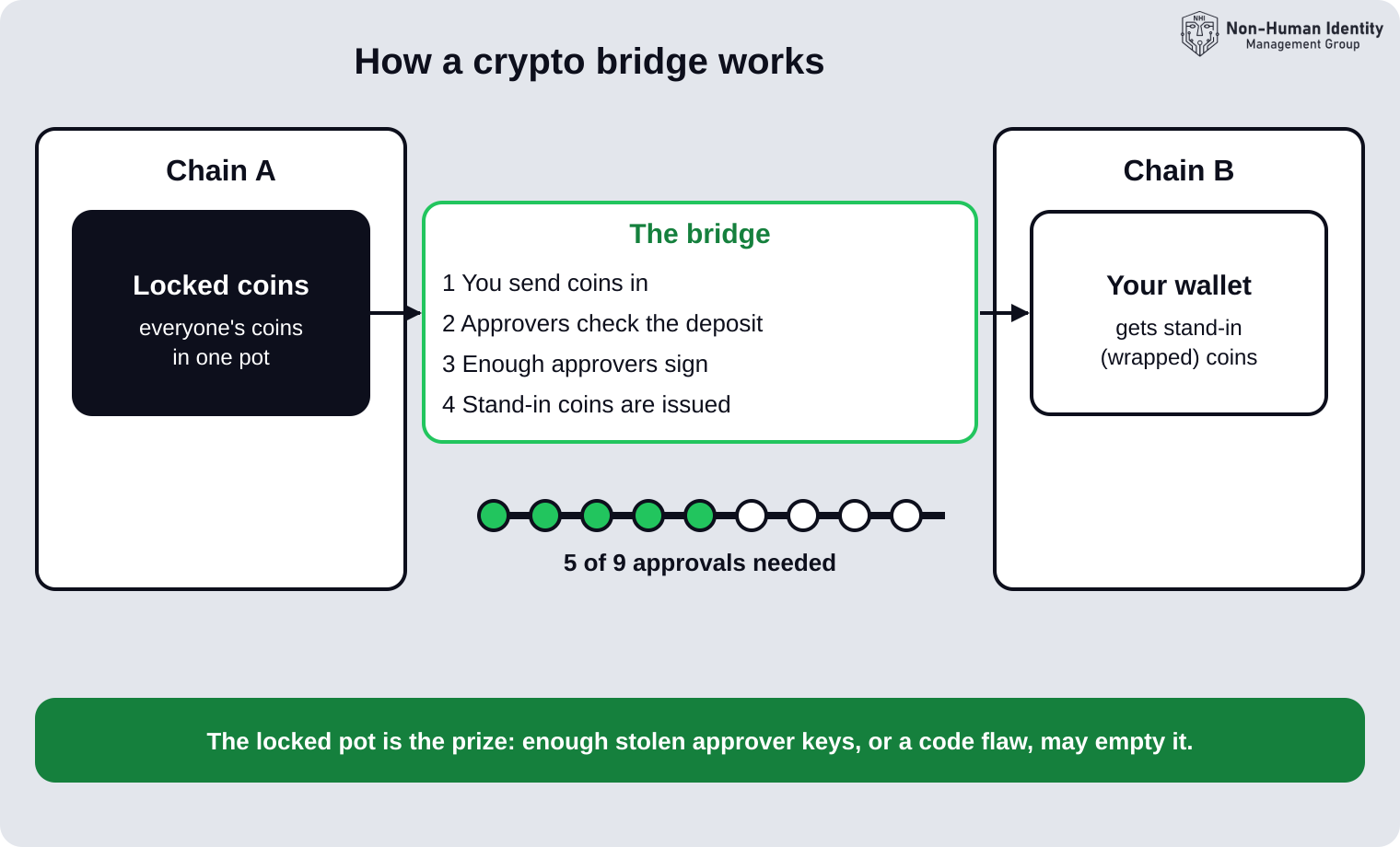
A bridge works in a similar way. Say you hold coins on one blockchain, such as Ethereum, and want to use them on another network. You send your coins to the bridge, which locks them up. The bridge then gives you a matching wrapped token on the other network, a stand-in coin worth the same amount.[1]
When you want to go back, you hand in the wrapped token. The bridge destroys it and releases your original coins. Some bridges work slightly differently, but this "lock and issue" pattern is common.[1]
Where the comparison stops working: a cloakroom has a person you can see, and a short queue. A bridge is run by code and by a small group of approvers you never meet. It can also hold coins for many thousands of people at once.
Why does it matter?
A bridge keeps everyone's locked coins in one pot. If someone can trick the bridge into releasing that pot, every wrapped token linked to it may lose its backing. The Ethereum project's own guide warns that a single flaw in a bridge's code can expose the funds.[1]
If you hold crypto on more than one network
What could happen: your wrapped tokens may lose much of their value if the bridge behind them is drained.
Check this: find out which bridge issued the tokens you hold, and how it is run.
If you are a student or new to security
What could happen: you may assume blockchain thefts are clever code tricks, and miss that many start with stolen keys or phishing.
Check this: when you read about a theft, ask "whose keys approved the transfer?"
If you work at a crypto firm
What could happen: one staff member who falls for a fake message could give an attacker a path to the bridge's signing keys.
Check this: list who holds approver keys, where they are kept and what each key can sign.
What does it look like?
Here is a made-up summary of one bridge transfer, as a wallet app might show it.
Example only. All values are made up.
Bridge transfer   EXAMPLE-BRIDGE
From network:     Chain A
You send:         1.0 FAKE-COIN                 (1)
Locked at:        FAKE-ADDR-0000-VAULT          (2)
Approved by:      5 of 9 approvers              (3)
To network:       Chain B
You receive:      1.0 wFAKE-COIN                (4)
Status:           complete
- The coins you send into the bridge.
- The bridge's vault, where everyone's coins are locked. In a real screen, this line would contain the vault's public address.
- How many approvers had to sign before the transfer went through.
- The wrapped stand-in coin you get on the other network.
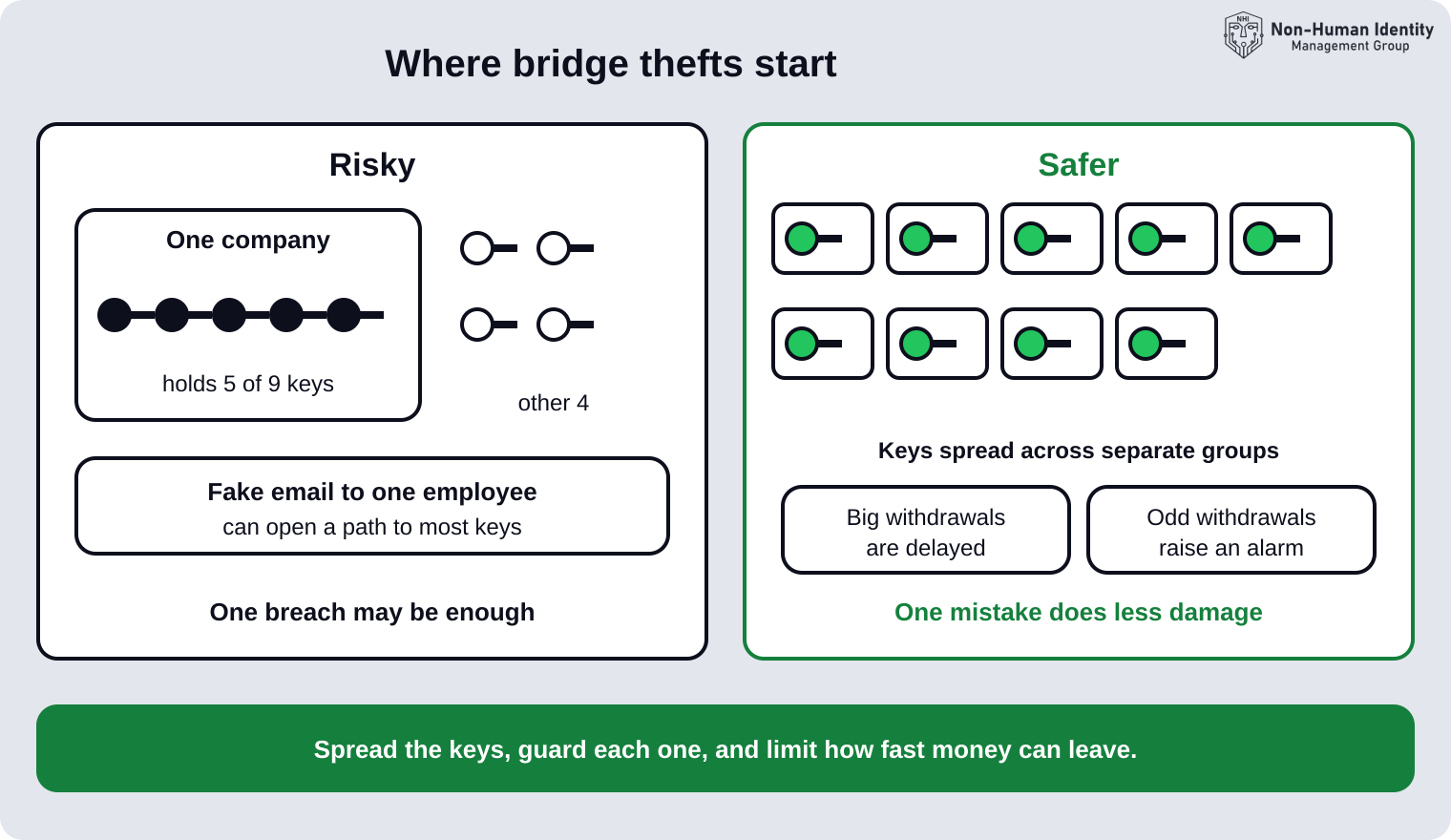
Why this is risky: the vault in line 2 holds many people's coins. An attacker with enough approver keys may be able to sign fake withdrawals.
The safer way: approval is spread across many separate parties. Each key is well guarded, and only a set amount can leave at once.
How does it work?
Bridges differ, but many follow these steps.
- You send coins in. Your coins go to the bridge's vault on the first network. A smart contract, a program that runs on the blockchain, locks them.
- Approvers watch. A group of approvers, called validators, see the deposit and check it.
- Enough approvers sign. When the agreed number have signed, the bridge accepts the transfer.
- Stand-in coins are issued. A contract on the second network creates matching wrapped tokens for you.
- The return trip reverses it. You hand back the wrapped tokens. They are destroyed and your original coins are released.
Ethereum's guide splits bridges into two broad types. Some rely on an outside group of approvers to vouch for transfers, so users must trust that group. Others try to rely only on the two blockchains themselves.[1] Both can fail, in different ways.
Two common ways bridges have been robbed
- Stolen approver keys. Each approver signs with a private key, a secret code that proves the signature is genuine. If an attacker gets enough of these keys, fake withdrawals can look approved.
- A flaw in the code. If the bridge's contract checks messages wrongly, it may accept a withdrawal nobody approved.
The approver keys are held by computers and software, not typed in by a person each time. That makes them non-human identities (NHIs): digital identities, and the credentials behind them, that let machines and software act without a person present. Like a staff member's password, they need an owner, a safe store and a review.
The Ronin theft in plain words
The Ronin bridge served the game Axie Infinity. It was run by a firm called Sky Mavis. The firm says that on 23 March 2022 an attacker took 173,600 ether and 25.5 million USDC, a dollar-linked coin.[2] The theft was not spotted until 29 March.[2]
The bridge had nine approvers. The attacker gained control of five keys, which was enough to approve withdrawals. According to Sky Mavis, one employee was tricked by targeted fake messages, known as spear-phishing. Four keys were reached that way. A fifth came through an old arrangement whose access had not been removed when it was no longer needed.[2]
The FBI linked the theft of 620 million US dollars in ether to North Korean hacking groups.[3] The lesson for beginners is simple. The code was not the weak point. The keys, and the people with access to them, were.
Another bridge, Nomad, lost funds in 2022 for a different reason. Its own analysis says a bug let the bridge accept messages it had never checked.[4]
A worked example
Petra Sorensen is a nurse who started saving in crypto two years ago. A friend tells her about a game on a newer network. To play, she needs coins there.
She finds a bridge in a search result and almost uses it. Then she remembers a guide that said fake bridge sites are a common trick. She types the address of the game's own help page instead, and follows its link to the bridge it recommends.
Before sending anything, Petra checks three things. First, who runs the approver keys? The bridge's documents list nine approvers, and she sees that most belong to one company. Second, has the bridge been audited, and has it ever been robbed? Third, can she move a small amount first?
She sends a small test amount. The wrapped coins arrive. She then moves only what she needs for the game, not her savings.
A month later, her colleague Farah Rosen asks why Petra did not move everything. Petra explains the cloakroom idea. The coins she bridged are now tickets. If the bridge's vault were emptied, those tickets might be worth far less.
Farah holds wrapped coins too. She checks which bridge issued them and finds it is one she has never heard of. She decides to swap them back to the original coins on their home network.
Neither of them can make a bridge safe. What they can do is limit how much they leave in one, and choose with care.
Myths and mistakes
| What people think | What is true |
|---|---|
| Blockchains are secure, so bridges are too. | A bridge adds its own code and its own approvers. Each is a new place where things can go wrong.[1] |
| Wrapped coins are the same as the real coins. | They are stand-ins. Their value depends on the bridge still holding the locked coins behind them. |
| Bridge thefts are always clever code attacks. | Some are. Ronin started with a tricked employee and approver keys that were too easy to reach.[2] |
| Nine approvers means nine separate locks. | Only if the keys are held by truly separate parties. If one firm holds most of them, one breach can be enough. |
| Searching for a bridge's name is a safe way to find it. | Fake sites copy popular services. Follow a link from the official project page instead. |
What can I do this week?
- List any wrapped tokens you hold and note which bridge issued each one.
- Read the help pages of one bridge you use and find out who runs its approver keys.
- Bookmark the official links to any bridge you use, so you do not rely on search results.
- Move only what you need across a bridge, and try a small amount first.
- Read our Crypto Scams for Beginners guide to spot fake bridge and wallet sites.
Checklist
- I can explain what a crypto bridge does in one sentence.
- I know that wrapped tokens depend on coins locked somewhere else.
- I know which bridge issued any wrapped tokens I hold.
- I have checked how many approvers a bridge uses and who runs them.
- I reach bridges through official links, not search adverts.
- I test with a small amount before a larger transfer.
- I do not leave more in bridged tokens than I need.
Common questions
Why do bridges get robbed so often?
Because they hold a lot in one place. A bridge locks the coins of everyone who uses it, so a single weakness can expose a very large pot. Attackers have targeted both the approver keys and flaws in the bridge's code, as the Ronin and Nomad cases show.
Do I need a bridge to use crypto?
Not always. If you keep your coins on one network, you may never need one. Some exchanges also let you buy coins directly on the network you want, which avoids a bridge. Bridges matter most when you move coins between networks yourself.
What happens to my wrapped tokens if a bridge is hacked?
Their value can fall sharply. A wrapped token is a promise that real coins are locked behind it. If those coins are stolen, the promise may not be kept. Whether users are repaid depends on the operator, so it is not something to rely on.
Who stole the money from the Ronin bridge?
The FBI linked the theft to hacking groups tied to North Korea.[3] Sky Mavis, which ran the bridge, says the attacker reached five of the nine approver keys. Most were reached through a fake message sent to one employee.[2]
Can stolen bridge funds be traced?
Often, yes, at least in part. Blockchain payments are public, so investigators can follow the money. Thieves try to hide the trail with mixing services. The US Treasury said one such mixer laundered more than 96 million dollars from a 2022 bridge theft.[5]
Where next?
Ready for the detail? Read the practitioner guide: Cross-chain bridge security. It goes further into bridge trust models, how operators protect signer keys, loss-limiting controls and how to assess a bridge before using it.
Also useful:
- Multisig Wallets for Beginners
- Smart Contract Security for Beginners
- Crypto exchange breaches
- Cryptocurrency Laundering by Cybercriminals
Related NHI Mgmt Group resources: Crypto Wallets and Keys for Beginners · Non-Human Identities for Beginners · Blockchain and Distributed Ledger Security Guide
Key terms
- Cross-chain bridge
- A service that moves value or messages from one blockchain to another.
- Blockchain
- A shared record of transactions, copied across many computers, that is very hard to change once written.
- Wrapped token
- A stand-in coin on one network that represents a coin locked on another.
- Smart contract
- A program stored on a blockchain that runs automatically when its conditions are met.
- Validator
- A computer that checks and signs off transactions; on a bridge, one of the approvers.
- Private key
- A secret code that proves a signature or payment is genuine; whoever holds it can sign.
- Spear-phishing
- A fake message aimed at one person or group, written to trick them into giving access.
Sources and further reading
- Blockchain bridges (developer documentation). ethereum.org. https://ethereum.org/en/developers/docs/bridges/, accessed 28 Nov 2026.
- Back to Building: Ronin Security Breach Postmortem. Ronin (Sky Mavis), 2022. https://roninchain.com/blog/posts/back-to-building-ronin-security-breach-6513cc78a5edc1001b03c364, accessed 28 Nov 2026.
- FBI Statement on Attribution of Malicious Cyber Activity Posed by the Democratic People's Republic of Korea. Federal Bureau of Investigation, 2022. https://www.fbi.gov/news/press-releases/fbi-statement-on-attribution-of-malicious-cyber-activity-posed-by-the-democratic-peoples-republic-of-korea, accessed 28 Nov 2026.
- Nomad Bridge Hack: Root Cause Analysis. Nomad, 5 August 2022. https://medium.com/nomad-xyz-blog/nomad-bridge-hack-root-cause-analysis-875ad2e5aacd, accessed 28 Nov 2026.
- U.S. Treasury Sanctions Notorious Virtual Currency Mixer Tornado Cash. US Department of the Treasury, 8 August 2022. https://home.treasury.gov/news/press-releases/jy0916, accessed 28 Nov 2026. (These sanctions were removed on 21 March 2025: Tornado Cash Delisting, US Treasury.)