A romance or investment scam is when a stranger wins your trust online, then talks you into sending money.
This guide is for anyone who meets people or hears about investments online, and for anyone worried about a friend or relative. Being targeted says nothing about how clever you are. These scams are run by people who do this every day.
In short
- The scammer builds a friendship or romance first, often over weeks, before money comes up.
- Many of these scams end in a fake investment, often in crypto, that seems to grow on screen.
- When you try to take money out, new fees appear, and the money is often gone.
- Do not send money or invest on the advice of someone you have only met online.
What you will learn
- Explain how these scams build trust before asking for money.
- Spot the warning signs in messages and investment offers.
- Check an investment firm before you pay anything.
- Know what to do and who to tell if money has already gone.
- Fake love story (romance scam)
- a scam where a criminal uses a false online identity to win your affection, then asks for money.
- Fake money-making offer (investment scam)
- a scam that talks you into putting money into an investment that is fake or rigged.
- Digital money (cryptocurrency)
- money that exists only online, such as Bitcoin, and is hard to get back once sent.
What is a romance or investment scam?
Think of a stage set in a theatre. From the seats, the house looks solid and real. Walk behind it and there is nothing there but wood and paint.
In a romance scam, the scammer builds that stage set around a fake person. They use a false name and stolen photos, and they keep in touch every day.[1][2] They often say they cannot meet, perhaps because they work abroad.[1] Then a problem comes up, and they ask for money.
In an investment scam, the fake is an investment. You are shown a website or app that looks like a real trading platform. It shows your money growing. But the site is fake, and so are the gains.[3]
The two often join up. Someone you met online, as a friend or partner, offers to help you start investing, often in cryptocurrency.[1] This mix is sometimes called "pig butchering", because the scammer builds trust slowly before taking as much as they can.
Where the comparison stops working: a stage set is built for one evening. These scams can run for months, and the scammer changes the story as they go.
Why does it matter?
Losses can be very large, because people are often persuaded to keep paying in. People in the US reported losing over 6.5 billion US dollars to investment fraud in a single year, according to the FBI.[4]
If you use dating apps or social media
What could happen: a new match moves you to a private chat app, becomes close fast, then mentions money or investing.
Check this: search for their profile photo online to see if it appears under other names.[1]
If you are thinking about investing
What could happen: an advert or contact offers high, safe returns through a platform that is not real.
Check this: in the UK, look the firm up on the FCA's Firm Checker and Warning List before paying.[5]
If you are worried about a relative
What could happen: they send savings to an online partner they have never met, and feel too embarrassed to say so.
Check this: ask gently, without blame, whether anyone online has asked them for money.
What does it look like?
Here is a made-up chat, a few weeks after two people matched online.
Example only. All values are made up.
"Alex": Good morning, my love. I dreamt of you again.  (1)
"Alex": My video camera is broken, so no call today.   (2)
"Alex": My uncle taught me crypto trading. I made a
        lot this month. Let me help you start.         (3)
"Alex": Use this site: invest.example.invalid          (4)
App: Balance 0000.00 FAKE-COIN  (+40% this week)       (5)
App: To withdraw, pay a release fee first.             (6)
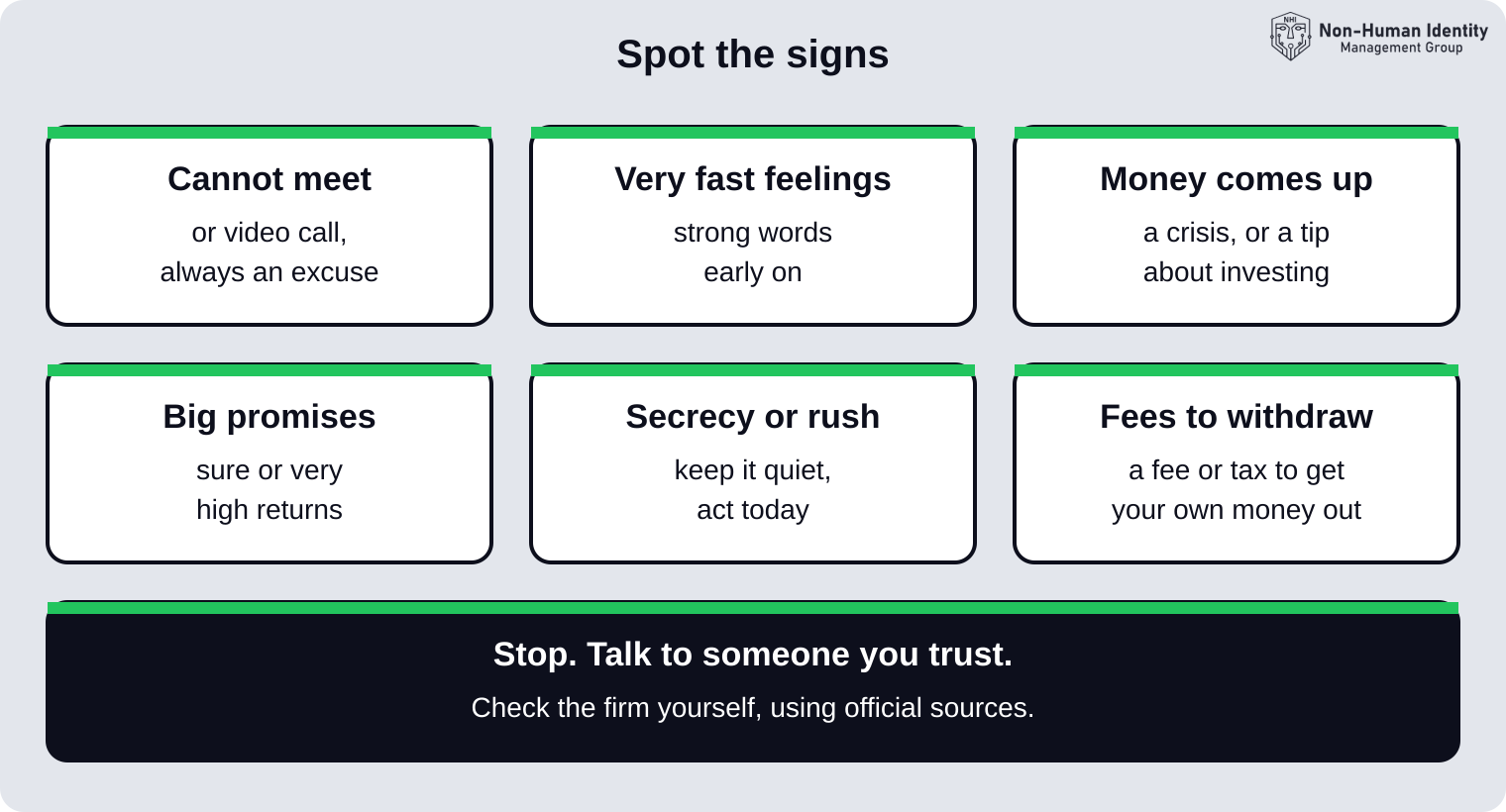
- Strong feelings, very early on.
- An excuse to avoid a video call or meeting.
- Talk of easy profits from someone you have not met.
- A link to a trading site you have not heard of. In a real message, this line would contain a fake site that looks professional.
- A balance that grows fast. The numbers are only text on a screen.
- A fee or "tax" before you can take money out.
Why this is risky: each step builds trust, so by the time money is asked for, saying no feels hard.
The safer way: do not invest through anyone you have only met online. Check any firm yourself, using official sources.
How does it work?
This is a simple view so you can spot it. It is not a guide to doing it.
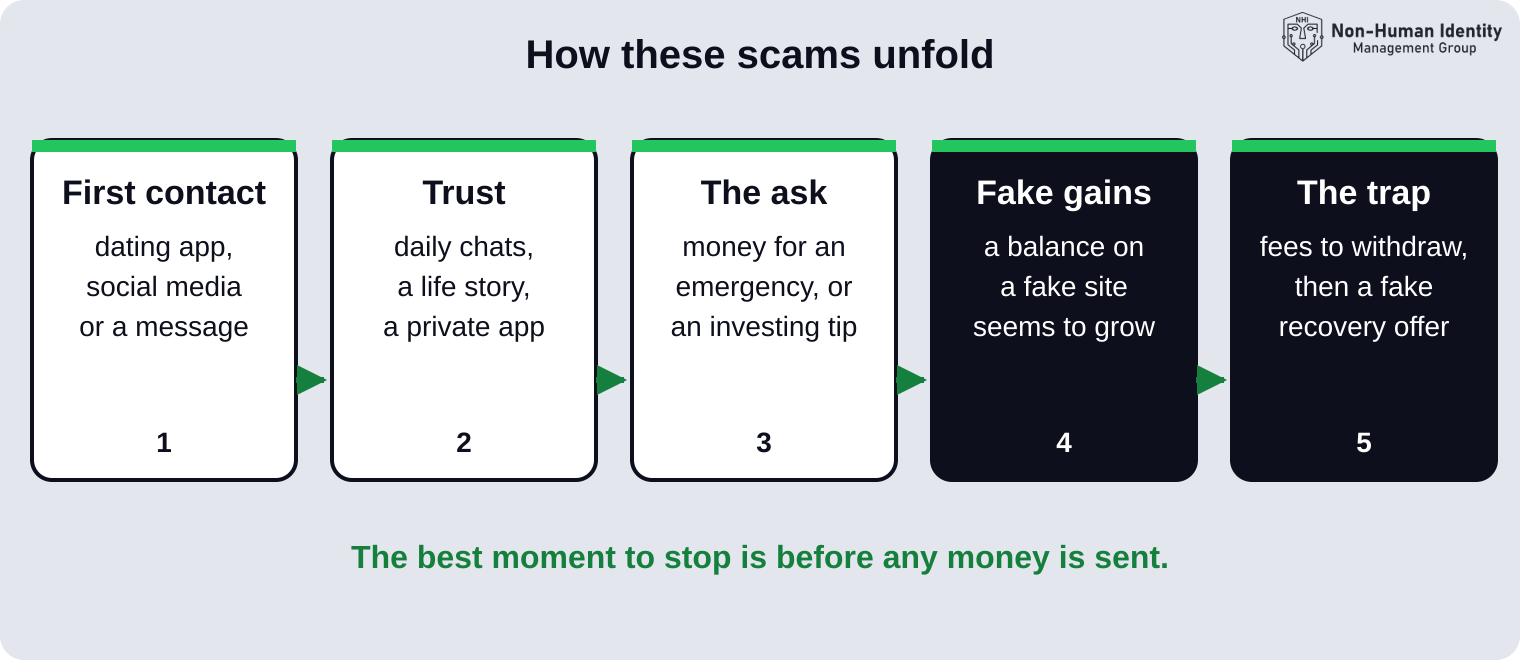
- First contact. A stranger gets in touch on a dating app, on social media or by message.
- Building trust. They chat often and share a life story. They may ask to move to a private chat app.
- The ask. They need money for an emergency or travel, or they offer to share their investing "secret".[1]
- The fake gains. A small first deposit seems to grow, so you put in more.[3]
- The trap closes. You cannot withdraw, or only if you pay high fees.[3] Later, a "recovery" firm may offer to get your money back for a fee. That is often another scam.[5]
A worked example
This story is made up to show how it can happen.
Lucy Fairbairn is a widowed teacher in Durham. She joins a dating app and matches with "Alex", who says he is an engineer working on an oil rig abroad.
Alex messages every morning and every night. He is kind and funny. After a week he asks to move to a private chat app. Video calls never work, because the signal on the rig is poor, he says.
After six weeks, Alex mentions his crypto trading. He shows her screenshots of big gains. He offers to help her try with a small amount. Lucy pays in a little through the site he sends. The balance grows every day.
Two weeks later she has paid in more. She wants to take some out to fix her car. The site says she must first pay a "release fee". Alex tells her to pay it quickly, before the offer ends.
Lucy feels uneasy and tells her friend Amira. Amira asks two questions. Has she ever seen Alex on video? Has she checked the site? Together they search the platform's name and find warnings about it. They search Alex's photo too. It belongs to a man with a different name.
Lucy stops replying. She calls her bank on the number on her card, and she reports it to Report Fraud, the UK fraud reporting service.[6] She does not pay the fee.
What made the difference: Lucy talked to someone she trusted before sending more money.
Myths and mistakes
| What people think | What is true |
|---|---|
| Only lonely or gullible people fall for these. | Anyone can be targeted. Scammers are skilled and patient, and they adapt the story to each person. |
| The app shows my money growing, so the investment is real. | A fake site can show any number. What matters is whether you can take your money out.[3] |
| I just need to pay one more fee to get my money back. | Fees to withdraw are a common sign of a scam. Stop paying and get advice.[3] |
| A company offering to recover my lost money can help. | These "recovery" offers are often a second scam aimed at the same people.[5] |
| A promise of high, safe returns means low risk. | The FTC warns that promises of sure profits or big returns are a sign of a scam.[3] |
What can I do this week?
- Make a personal rule: you do not send money or invest because someone you met online suggests it.
- Learn to do a reverse image search. It shows where else a photo is used online.
- If you invest, bookmark the official checker for your country, such as the FCA's Firm Checker in the UK.
- Talk to an older relative or friend about these scams, without blame.
Checklist
- I do not send money to anyone I have only met online or by phone.[2]
- I do not take investment advice from online friends or matches.
- I check any investment firm myself, using official sources.
- I am wary of promises of sure or unusually high returns.
- I treat fees to withdraw my own money as a warning sign.
- I talk to someone I trust before sending money.
- I know where to report a scam and that recovery offers can be scams too.
Common questions
How can I tell if an online match is real?
Look for a pattern, not one clue. Warning signs include strong feelings very early, excuses to avoid video calls or meeting, and any talk of money. Search their photo online, and be wary if it appears under another name.[1]
How do I check an investment firm in the UK?
Use the FCA's Firm Checker and Warning List on the FCA's own website. Use only the contact details shown there, because scammers sometimes copy the names of real firms.[5] Be wary of any firm that contacted you out of the blue.
I have already sent money. What should I do?
Stop sending money and stop contact with the person. Call your bank straight away on the number on your card. In the UK, report it to Report Fraud, and tell the FCA if it was an investment.[5][6] Report the profile to the app or site too.[1]
Can I get my money back?
Sometimes, but it is not certain. Acting fast gives your bank the best chance. Money sent as crypto, gift cards or wire transfers is often hard to recover.[1] Be wary of anyone who offers to recover it for a fee.[5]
What if someone I love will not believe it is a scam?
Stay calm and keep talking. Blame can make people less willing to talk about it. Ask questions, such as whether they have ever seen the person on video, and offer to check the firm together.
Where next?
Ready for the detail? Read the practitioner guide: Romance and Investment Scam Awareness Guide. It goes further into checking an investment before you pay, helping a loved one who may be a victim, and the steps to take once money has gone.
Also useful:
- Cryptocurrency Scam Awareness Guide
- Payment Fraud for Beginners
- Social Engineering for Beginners
- Deepfakes and AI Fraud for Beginners
Related NHI Mgmt Group resources: What to Do If You Have Been Scammed Guide · Consumer Reporting Routes Map · Crypto Scam and Drainer Guide
Key terms
- Romance fraud
- A scam where someone uses a false online identity to build trust, then exploits it for money.
- Investment fraud
- A scam that persuades you to put money into a fake or rigged investment.
- Pig butchering
- A long scam where trust is built over time before the victim is persuaded to send money or assets.
- Crypto romance scam
- A scam that uses a fake relationship to lead someone into sending cryptocurrency.
- A scam where you are tricked into sending the money yourself.
- Using lies, urgency and fake authority to get a person to share information or take a risky action.
Sources and further reading
- What To Know About Romance Scams. US Federal Trade Commission (FTC), Consumer Advice. https://consumer.ftc.gov/articles/what-know-about-romance-scams, accessed 28 Nov 2026.
- Romance Scams. Federal Bureau of Investigation (FBI), Scams and Safety. https://www.fbi.gov/how-we-can-help-you/scams-and-safety/common-frauds-and-scams/romance-scams, accessed 28 Nov 2026.
- What To Know About Cryptocurrency and Scams. US Federal Trade Commission (FTC), Consumer Advice. https://consumer.ftc.gov/articles/what-know-about-cryptocurrency-and-scams, accessed 28 Nov 2026.
- Internet Crime Report 2024 (investment fraud: 47,919 complaints, losses of $6,570,639,864). Federal Bureau of Investigation, Internet Crime Complaint Center (IC3), April 2025. https://www.ic3.gov/AnnualReport/Reports/2024_IC3Report.pdf, accessed 28 Nov 2026.
- How to avoid investment scams (ScamSmart). Financial Conduct Authority (FCA). https://www.fca.org.uk/scamsmart/how-avoid-investment-scams, accessed 28 Nov 2026.
- Report Fraud service goes live. Report Fraud (City of London Police), 4 December 2025. https://www.reportfraud.police.uk/news/report-fraud-service-goes-live/, accessed 27 Nov 2026. See also: Report Fraud: new service from City of London Police, GOV.UK. https://www.gov.uk/government/news/report-fraud-new-service-from-city-of-london-police, accessed 28 Nov 2026.