Cyber crisis management is how leaders make decisions and keep people informed when a cyber attack threatens the whole organisation.
This guide is for managers, board members, owners and anyone who may be called into the room when things go badly wrong. You do not need to be technical to play your part: in a crisis, most of the leadership work is about decisions, people and messages, not computers.
In short
- Technical teams fix the systems. The crisis team decides what the organisation does and says while that happens.
- Agree in advance who decides, who speaks and how you will talk if email and chat are down.
- Tell staff early and often, so they hear it from you before the news or customers.
- Practise once a year with a simple exercise, then fix what the practice shows.
What you will learn
- Explain how crisis management differs from fixing the computers.
- Spot the decisions leaders need to make in the first hours.
- Check that your team can talk if normal systems are down.
- Ask your board the right questions before an attack.
- The leaders' group (crisis team)
- a small group of senior people who make the big calls during a serious attack.
- Backup way to talk (out-of-band channel)
- a way to talk that does not rely on the systems that may have been attacked.
- First short message (holding statement)
- a brief, prepared message that says what you know and when you will say more.
What is cyber crisis management?
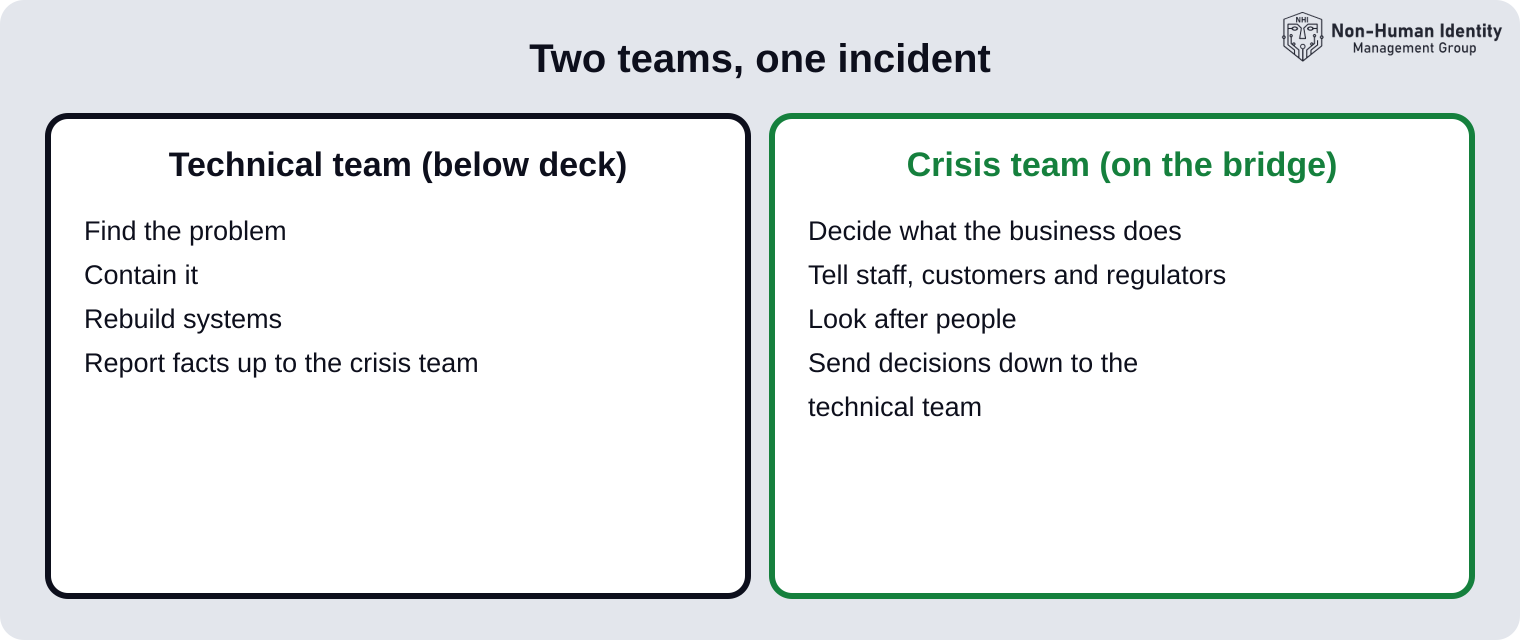
Think of a ship in a storm. The engineers work below deck to keep the engines going. Up on the bridge, the captain decides the course and speaks to the crew and the passengers.
In a cyber attack, the technical team is below deck. They find the problem, stop it spreading and rebuild the systems. That work is called incident response.
The crisis team is on the bridge. They decide what the business does while the technical fix goes on. Do we close a service? What do we tell customers? Who calls the regulator? Who looks after staff?
Not every cyber incident is a crisis. It becomes one when it threatens the whole organisation: its money, its customers, its reputation or its ability to work.
Where the comparison stops working: a ship has one captain. A cyber crisis team is usually a small group, and leaders often need to decide before they have all the facts.
Why does it matter?
When nobody knows who decides, time is lost and messages clash. The UK's national cyber security agency warns that crisis decisions are weaker when people are unsure of their part.[1]
If you sit on a board
What could happen: you are asked to approve taking the website offline, with no idea what it will cost or who else must agree.
Check this: ask whether the big decisions already have named owners in the plan.
If you run a small business
What could happen: your email is down, so you cannot reach your staff, your IT provider or your insurer.
Check this: keep a printed contact list and agree a backup way to talk.
If you look after communications
What could happen: staff read about the attack on social media before you have told them anything.
Check this: have a short first message ready to adapt and send.
What does it look like?
Here is a made-up first-hour card. A crisis team might keep a printed copy in a drawer, ready for the day it is needed.
Example only. All values are made up.
CRISIS CARD: Example Ltd (keep a printed copy)
Who leads:        Managing director, deputy: finance head  (1)
Where we meet:    Video call on the backup phone app      (2)
Who can switch off customer systems:  Head of IT          (3)
Who speaks for us: Office manager only                    (4)
First call list:  IT provider, insurer, bank, lawyer      (5)
Next update:      every 2 hours, even if nothing changed  (6)
- One named leader, plus a deputy for nights and holidays.
- A meeting place that does not depend on the company email.
- A big decision with an owner agreed in advance.
- One voice, so customers and press get the same story.
- In a real file, this line would contain names and how to reach each one.
- A regular rhythm keeps people calm, even when news is thin.
Why this is risky: with no card, the first hour is lost. People spend it working out who is in charge and how to reach each other.
The safer way: agree the card in a calm week, print it, and check it each time staff or suppliers change.
How does it work?
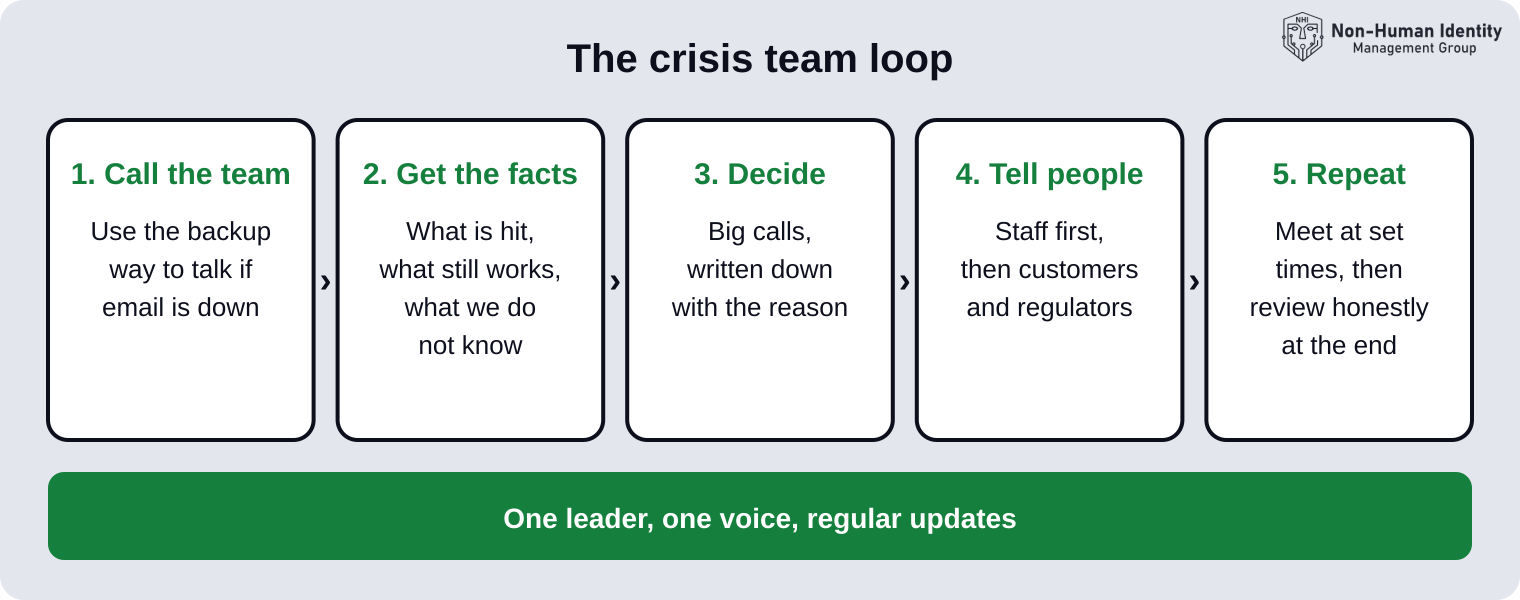
Most crisis teams follow a simple loop, again and again, until things are back to normal.
- Call the team. The technical lead raises the alarm. The crisis leader calls the group together, using the backup way to talk if needed.
- Get the facts. Ask what is affected, what is still working and what you do not know yet.
- Decide. Make the big calls, such as closing a service, calling in outside help or telling a regulator. Write each one down, with the reason.
- Tell people. Staff first, then customers, partners and, where required, regulators.[1]
- Look after people. Long attacks are tiring. Plan rest, cover and support for staff.
- Repeat, then review. Meet at set times. When it is over, hold an honest review and fix what went wrong.
A worked example
Amara Vance is the managing director of Hazel Opticians, a fictional chain of six shops. Mira Whitlock is the office manager.
At 7am on a Tuesday, the IT provider calls Amara. The booking system is locked, and a ransom note is on the main computer. Email is down too.
Amara thinks of the ship. The IT provider works below deck, and she needs to be on the bridge. She opens the crisis card from her desk drawer.
She calls the team together on the backup phone app. Mira, the finance head and the IT provider join. They agree three things first.
The shops will open, but take bookings on paper. The finance head will call the insurer, who sends an incident response firm. Mira will speak for the company and nobody else will.
By 9am Mira has sent a short message to all staff by text. It says what has happened, what to do at the counter and when the next update will come.
The IT team finds that customer records may have been copied. Amara takes advice from the insurer's lawyer on who must be told, and Mira prepares a plain message for customers.
The team meets every three hours. Each decision goes in a simple log. On day four the booking system is back.
A week later they review what happened. The backup phone app worked well. But two shop managers were not on the contact list, so it is updated.
Real organisations face the same problems. When the British Library was attacked in 2023, its crisis team met by WhatsApp video call because email was unavailable.[3]
Myths and mistakes
| What people think | What is true |
|---|---|
| A cyber attack is an IT problem. | The fix is technical, but the big decisions are about money, customers and staff. Those belong to leaders. |
| We will plan it on the day. | On the day, time and facts are short. Agree roles and key decisions in advance.[1] |
| We will email everyone. | Email may be one of the systems that is down, or being watched. Have a backup way to talk. |
| Say nothing until we know everything. | Silence lets rumours fill the gap. Say what you know, what you are doing and when you will update. |
| Our plan is written, so we are ready. | Plans that are never practised often fail. A short exercise shows the gaps.[1] |
What can I do this week?
- Name a crisis leader and a deputy, and write them down.
- List the three biggest decisions you might face, and who can make each one.
- Agree a backup way to talk that does not use company email.
- Print a contact list for your team, IT provider, insurer and bank.
- Draft a short first message for staff that you could adapt on the day.
Checklist
- We have a named crisis leader and deputy.
- Big decisions, such as switching off key systems, have agreed owners.
- We have a backup way to talk if email and chat are down.
- A printed contact list is kept up to date and stored safely.
- One person is named to speak for the organisation.
- A first message for staff and customers is drafted.
- We keep a log of decisions and the reasons for them.
- We practise at least once a year and act on what we learn.
Common questions
What is the difference between incident response and crisis management?
Incident response is the tech work. It finds, stops and fixes the attack. Crisis management is the leaders' work around it. It decides what the business does, who is told and how staff are looked after. Small incidents need only the first. Big ones need both.
Who should be on a crisis team?
Keep it small. Start with a leader, plus one person each for tech, for messages, and for money or legal points. Bring in others, such as HR, when a choice needs them. Each person should have a named deputy.
What does the board need to do?
The board is answerable in the end, so it should make sure a plan exists and is practised.[1] During an attack, it backs the crisis leader and makes the calls only it can make. It should not try to run the tech work itself.
How do we practise without a real attack?
Run a tabletop exercise. This is a short meeting where the team talks through a made-up attack. The UK cyber security agency has a free tool for this, called Exercise in a Box. It has ready-made stories, and you do not need to be an expert to use it.[2]
Is there a standard for crisis management?
Yes. An international standard from 2022 gives advice on how to get ready to handle a crisis. It covers leaders, decisions, messages and training.[4] It is not only for cyber attacks, and you do not need it to get started.
Where next?
Ready for the detail? Read the practitioner guide: Crisis Management Guide. It goes further into command structures, decisions to agree in advance and backup ways to talk when email and chat are compromised.
Also useful:
- Incident Response for Beginners
- Incident Communications for Beginners
- Incident Response Drills for Beginners
- Business Continuity and Disaster Recovery for Beginners
- Cyber Crisis Board Update Template
Related NHI Mgmt Group resources: Briefing the Board During a Cyber Incident · Employee Communications During a Cyber Incident · Tabletop Exercise Guide
Key terms
- Incident response
- The technical work of finding, stopping and recovering from an attack.
- Crisis team
- A small group of leaders who make the big decisions during a serious attack.
- Incident commander
- The person who leads and coordinates the response to an incident.
- Out-of-band
- Using a separate channel that does not rely on the systems under attack.
- Holding statement
- A short first message that says what is known and when more will follow.
- Business continuity
- Keeping the most important work going while systems are down.
- Tabletop exercise
- A practice meeting where a team talks through a made-up attack.
Sources and further reading
- Cyber Security Toolkit for Boards: Planning your response to cyber incidents. National Cyber Security Centre (NCSC). https://www.ncsc.gov.uk/collection/board-toolkit/planning-your-response-to-cyber-incidents, accessed 28 Nov 2026.
- Exercise in a Box. National Cyber Security Centre (NCSC). https://www.ncsc.gov.uk/information/exercise-in-a-box, accessed 28 Nov 2026.
- Learning Lessons From the Cyber-Attack: British Library cyber incident review. British Library, 8 March 2024. https://www.bl.uk/home/british-library-cyber-incident-review-8-march-2024.pdf, accessed 28 Nov 2026.
- ISO 22361:2022 Security and resilience, Crisis management, Guidelines. International Organization for Standardization (ISO), October 2022. https://www.iso.org/standard/50267.html, accessed 28 Nov 2026.