Cyber incident reporting is the legal or regulatory duty to tell a government body, regulator or other named party about a serious cyber attack or security failure within a set deadline.
This guide is for newcomers, students, career changers and managers who want to understand why organisations have to report some cyber incidents, who they report to and how the deadlines work. It explains the idea in plain English, walks through what happens after an incident is spotted, and gives a worked example. It covers a few well-known rules as examples, and links to our detailed guides on each rule rather than repeating them.
By the end of this guide you will be able to:
- Explain what cyber incident reporting is and why it exists.
- Understand the difference between reporting an incident and notifying people about a data breach.
- Describe how a reporting clock starts and the typical stages of a report.
- Identify the first steps to get your organisation ready.
Status: correct as at 27 November 2026, based on EUR-Lex, the European Commission, CISA, the SEC and the FDIC. Laws change; check the official text.
This guide explains the topic in general terms and is not legal advice.
Key takeaways
- Several rules can apply at once. One incident might need reports under a cyber security law, a data protection law and a sector or stock market rule, each with its own deadline.
- Deadlines are short and measured in hours. Common clocks include 24, 36 and 72 hours, and four business days for some public company disclosures.
- The clock usually starts when you become aware or decide. Each rule defines its own trigger, such as becoming aware of a significant incident or deciding that an incident is material.
- Reports are often staged. A short early warning comes first, with fuller details and a final report later.
- Preparation decides whether you meet the deadline. Knowing in advance which rules apply, who decides and who sends the report saves hours you will not have during an incident.
What it is, in plain English
A cyber incident is an event that harms, or could harm, the security of your systems or data, such as ransomware, a hacked account or a major outage caused by an attack. Most incidents are handled inside the organisation. Some, because they are serious or affect important services, must also be reported to an outside body.
Governments ask for these reports for three main reasons: to help the victim, to warn others about the same attack, and to see the bigger picture of threats to a country or sector. For example, the EU's NIS2 Directive requires medium and large organisations in covered sectors to notify national authorities of significant incidents.[2]
A helpful comparison is a road traffic accident. A small scrape in a car park is between you and the other driver. A serious crash on a motorway must be reported to the police, partly so they can deal with it and partly so others can be warned and roads made safer. Where the analogy breaks down: a car crash is obvious at once, while a cyber incident can take days to understand, so many rules ask for a quick first warning and fuller details later.
It helps to separate two ideas that are often mixed up:
- Incident reporting means telling an authority, such as a national cyber security team or a sector regulator, about a serious incident.
- Data breach notification means telling a data protection regulator, and sometimes the affected people, when personal data is involved. Under the GDPR, this goes to the supervisory authority within 72 hours where feasible, and to affected people when the risk to them is high.[6] Our Data Breach Notification for Beginners covers this in detail.
The same incident can trigger both.
Why it matters to you
- If you run a small business: you may not be covered by sector cyber laws, but data protection breach rules apply to almost every organisation that holds personal data. Your suppliers and customers may also require you to tell them about incidents in their contracts.
- If you are new to a security job: you may be the first to spot an incident. Knowing that a clock might start helps you escalate quickly instead of waiting until you are certain.
- If you are a manager: decisions about whether an incident is reportable often sit with senior staff and legal advisers. Missing a deadline can bring regulatory action on top of the incident itself.
The clocks are short. Under NIS2, an early warning is due within 24 hours of becoming aware of a significant incident, and a fuller notification within 72 hours.[3] US banking organisations must notify their regulator no later than 36 hours after determining that a qualifying incident has occurred.[5] These deadlines include nights and weekends, so they are hard to meet without a plan.
How it works, step by step
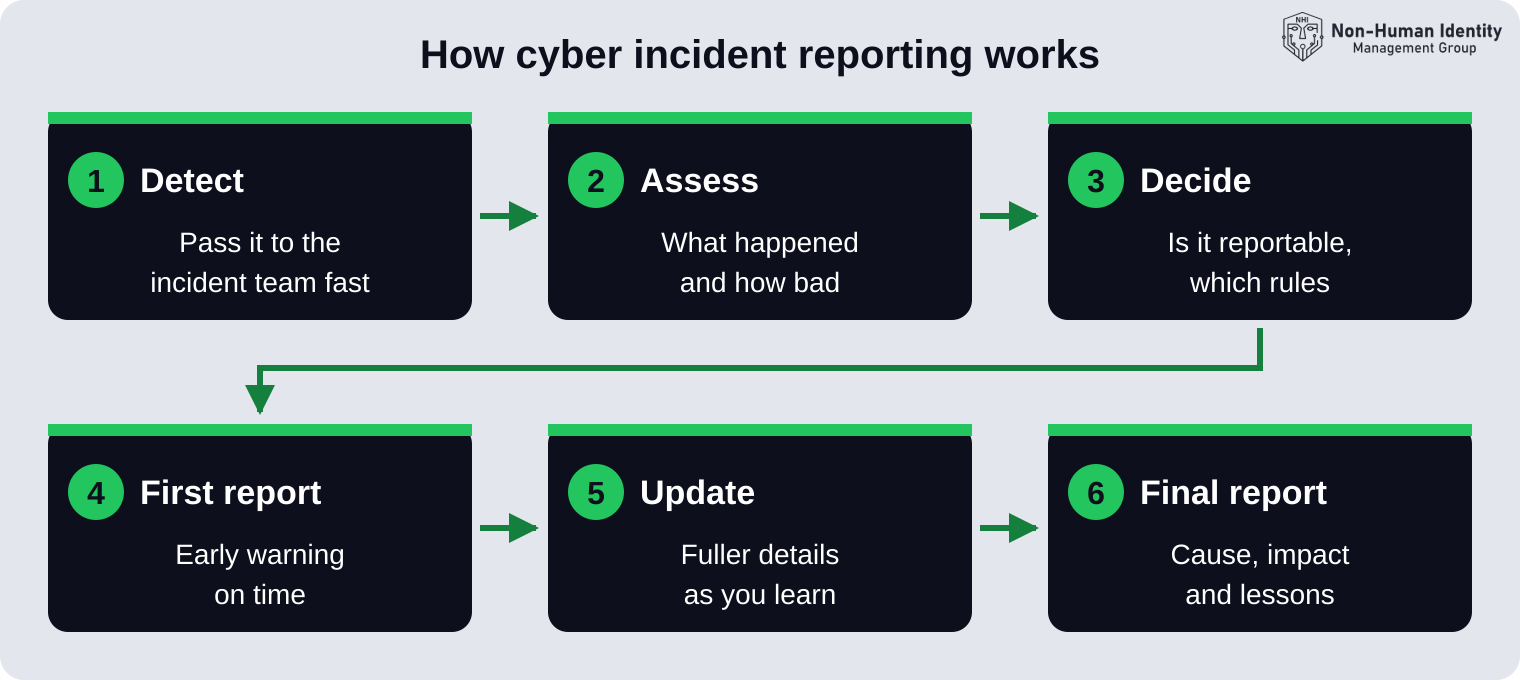
Each rule has its own words, but the process usually looks like this.
- Detect and escalate. Someone notices something wrong, such as alerts, encrypted files or a supplier warning, and passes it to the incident response team straight away.
- Assess. The team works out what happened, which systems and data are affected, and how bad the impact is or could become.
- Decide if it is reportable. The team checks each rule that might apply against its threshold. NIS2, for example, treats an incident as significant if it has caused or could cause severe operational disruption or financial loss, or considerable damage to others.[3] The clock for many rules starts around this point.
- Send the first report. A short early warning or initial notice goes to the right body using its official channel.
- Update. As more is learnt, a fuller report follows, and further updates if the authority asks.
- Final report and lessons. A final report describes the cause, the impact and what was done. Under NIS2, this is due no later than one month after the incident notification.[3]
Examples of reporting rules
The table shows a few well-known rules as examples. It is not a full list; our Cyber Incident Reporting Requirements Map covers many more.
| Rule | Who it covers | Report to | Deadline |
|---|---|---|---|
| NIS2 Directive, Directive (EU) 2022/2555, Article 23 | Organisations in covered sectors in the EU, under each country's national law | National CSIRT or competent authority | Early warning within 24 hours of becoming aware; notification within 72 hours; final report within one month of the notification.[3] |
| GDPR, Article 33 | Organisations that decide how personal data is used (controllers) | Data protection supervisory authority | Without undue delay and, where feasible, within 72 hours of becoming aware, unless the breach is unlikely to result in a risk to people.[6] |
| US bank computer-security incident notification rule | US banking organisations supervised by the FDIC, Federal Reserve or OCC | Their federal banking regulator | As soon as possible and no later than 36 hours after determining a notification incident has occurred.[5] |
| SEC Form 8-K Item 1.05 | US public companies registered with the SEC | The public, through an SEC filing | Generally within four business days of deciding an incident is material.[4] |
| CIRCIA | Covered US critical infrastructure organisations, once CISA's final rule takes effect | CISA | 72 hours for covered cyber incidents; 24 hours after a ransom payment.[1] |
Useful distinctions
- "Becoming aware" is not the same as the attack starting. Most clocks run from when you become aware of, or determine, a reportable incident, not from when the attacker first got in. That does not mean you can delay looking: regulators expect prompt assessment.
- Not every rule is in force yet. CISA's CIRCIA page says organisations are not required to submit reports until its final rule takes effect, and it encourages voluntary reporting until then.[1] Check CISA's site for the current position.
- Public disclosure is different from a confidential report. An SEC Form 8-K is a public filing for investors.[4] Reports to a national cyber team are usually not published.
- Suppliers can have duties to their customers. Under the US bank rule, a bank service provider must tell affected bank customers as soon as possible when an incident materially disrupts its services for four or more hours.[5]
- Reporting does not replace telling people. NIS2 also asks organisations to inform the recipients of their services, without undue delay, about significant incidents likely to affect those services.[3]
A worked example
Northgate Water Services is a fictional company that runs water treatment software for several towns in an EU country. It is covered by that country's NIS2 law. On a Saturday at 07:00, Leila, the on-call engineer, sees that the customer billing system is encrypted and a ransom note has appeared.
- 07:15, escalate: Leila follows the incident plan and calls the incident manager, Marco. She does not wait to understand everything first.
- 09:30, assess and decide: the team finds the billing system and customer records are affected, but water treatment controls are on a separate network and still working. Marco and the legal adviser agree this is likely a significant incident under NIS2, and that customer personal data may have been taken, so the GDPR may also apply. They log the time they became aware and their reasoning.
- Same day, first reports: Marco submits a short early warning to the national CSIRT through its official portal, saying the cause is suspected to be a criminal attack. The data protection officer starts the separate GDPR assessment for the data protection authority.
- Within 72 hours, update: Northgate sends the fuller NIS2 notification with an initial assessment and the indicators of compromise it has found, and decides with its advisers whether customers need to be told.
- Within a month, final report: the final report explains how the attackers got in, what was affected and what has changed.
Things did not go perfectly. The team lost an hour finding the CSIRT portal login, so afterwards Marco adds the reporting contacts and credentials to the incident plan, stored securely and checked each quarter. Meeting the deadlines did not make the incident less serious, but it brought in outside help early and avoided a second problem with the regulator.
Myths and misunderstandings
| What people think | What is true |
|---|---|
| We only need to report if personal data was stolen. | Cyber security laws such as NIS2 focus on disruption and damage, so an incident with no personal data can still be reportable.[3] |
| We should wait until we know everything before reporting. | Many rules expect a short first report early and allow fuller details later.[3] |
| One report covers every rule. | Different laws can need separate reports to different bodies, with different deadlines and content. |
| The 72-hour clock starts when the attack began. | Most clocks start when you become aware of, or determine, a reportable incident.[6] |
| Small companies never have to report. | Data protection breach rules apply to organisations of all sizes, and contracts may add duties to tell customers or partners. |
Key terms
- Significant incident
- A security or operational event that crosses a regulatory threshold for reporting, for example under NIS2.
- Early warning
- The requirement to notify regulators quickly, with limited detail, after becoming aware of a significant incident.
- CSIRT
- A computer security incident response team; under NIS2, each country has national CSIRTs that receive incident reports.
- NIS2 Directive
- The EU's cyber security law for essential and important organisations, covering risk management, incident reporting and governance.
- Personal data breach
- A security incident that leads to accidental or unlawful destruction, loss, change, disclosure of or access to personal data.
- 72-hour breach notification
- The rule that certain personal data breaches must be reported to the regulator within 72 hours of becoming aware, where feasible.
- Materiality determination
- The process of deciding whether a security incident is important enough to investors to require disclosure.
- Form 8-K Item 1.05
- The SEC disclosure item requiring US public companies to report a material cyber security incident.
- CIRCIA
- The US Cyber Incident Reporting for Critical Infrastructure Act, which will require covered organisations to report certain incidents and ransom payments to CISA.
- Ransom payment
- Money paid to an attacker to regain access, stop data being released or recover stolen systems.
Common questions
Who do we report a cyber incident to?
It depends on the rule. Under NIS2 it is the national CSIRT or competent authority.[3] For personal data breaches it is the data protection authority.[6] Sector regulators, such as banking supervisors, may have their own channels.[5]
What if we miss the deadline?
Report as soon as you can and explain why. The GDPR, for example, expects reasons for the delay when a notification comes after 72 hours.[6] A late report is better than none.
Do we have to report ransomware payments?
Some rules ask for this. CIRCIA, for example, includes a 24-hour report after a ransom payment once CISA's final rule takes effect.[1] Check the rules that apply to you, and take legal advice before any payment.
Do we report incidents that turn out to be minor?
Only if they meet a rule's threshold. Under the GDPR, you must still keep a record of every personal data breach, including those you do not report.[6]
Can a public company delay disclosure?
Under the SEC rules, disclosure can be delayed if the US Attorney General decides immediate disclosure would pose a substantial risk to national security or public safety.[4]
Do AI incidents count?
An attack on an AI system is still a cyber incident if it meets a rule's threshold. Some new AI laws add their own incident duties; see the AI Incident Reporting Guide.
First steps
Three things you can do this week:
- List the rules that may apply. Note your sector, the countries you operate in, whether you hold personal data and whether you are a listed company. Ask your legal or compliance contact to confirm the list.
- Write down who decides and who sends. Name the person who decides whether an incident is reportable, a deputy, and who submits each report.
- Save the contact details. Record each authority's reporting portal or channel in your incident plan, and store any logins securely where the on-call team can reach them.
Checklist
- We know which reporting rules apply to us, and the list has been checked by someone with legal or compliance knowledge.
- Each rule's deadline and starting trigger is written in our incident plan.
- Named people, with deputies, decide and submit reports, including at weekends.
- Reporting channels and logins are stored securely and tested.
- Our incident log records the time we became aware and the reasons for each decision.
- We have short templates for a first report and a fuller update.
- Contracts with key suppliers say how quickly they must tell us about incidents.
- We practise a reporting decision in an exercise at least once a year.
Simple measures that show progress: the time from detection to the reporting decision in exercises, the share of reports sent within the deadline, and whether contact details were correct when last tested.
Check your understanding
1. What is the difference between incident reporting and data breach notification?
Answer: incident reporting tells an authority about a serious cyber incident; data breach notification tells a data protection regulator, and sometimes affected people, when personal data is involved.
2. Under NIS2, what are the first two deadlines?
Answer: an early warning within 24 hours and an incident notification within 72 hours of becoming aware of a significant incident.
3. Can one incident need more than one report?
Answer: yes. Different laws can apply to the same incident, each with its own recipient and deadline.
4. Why record the time you became aware of an incident?
Answer: because most reporting clocks start from that point, and regulators may ask you to show when and how you made your decisions.
Suggested learning pathway
- Start with the basics of handling incidents: Incident Response for Beginners.
- Learn about telling people when data is breached: Data Breach Notification for Beginners.
- Understand the EU cyber law behind many reports: NIS2 for Beginners.
- Compare reporting rules across countries and sectors: Cyber Incident Reporting Requirements Map.
- Go deeper on the EU rule: NIS2 Article 23 Incident Reporting.
- For US banks: US Bank Computer-Security Incident Notification Rule.
- For US credit unions: NCUA Cyber Incident Notification Rule Guide.
- For US public companies: SEC Cybersecurity Disclosure Rules Guide.
Standards and references
- Cyber Incident Reporting for Critical Infrastructure Act of 2022 (CIRCIA). Cybersecurity and Infrastructure Security Agency (CISA). https://www.cisa.gov/topics/cyber-threats-and-advisories/information-sharing/cyber-incident-reporting-critical-infrastructure-act-2022-circia, accessed 27 Nov 2026.
- NIS2 Directive: securing network and information systems. European Commission, last updated 2 July 2026. https://digital-strategy.ec.europa.eu/en/policies/nis2-directive, accessed 27 Nov 2026.
- Directive (EU) 2022/2555 of the European Parliament and of the Council of 14 December 2022 on measures for a high common level of cybersecurity across the Union (NIS 2 Directive), Article 23. EUR-Lex. https://eur-lex.europa.eu/legal-content/EN/TXT/HTML/?uri=CELEX:32022L2555, accessed 27 Nov 2026.
- SEC Adopts Rules on Cybersecurity Risk Management, Strategy, Governance, and Incident Disclosure by Public Companies, press release 2023-139, 26 July 2023. US Securities and Exchange Commission. https://www.sec.gov/newsroom/press-releases/2023-139, accessed 27 Nov 2026.
- Computer-Security Incident Notification Final Rule, Financial Institution Letter FIL-74-2021. Federal Deposit Insurance Corporation (FDIC). https://www.fdic.gov/news/financial-institution-letters/2021/fil21074.html, accessed 27 Nov 2026.
- Regulation (EU) 2016/679 (General Data Protection Regulation), Articles 33 and 34. EUR-Lex. https://eur-lex.europa.eu/legal-content/EN/TXT/HTML/?uri=CELEX:32016R0679, accessed 27 Nov 2026.
Related NHI Mgmt Group resources: Incident Response Plan Template · EU Incident Reporting Clocks · CIRCIA Incident Reporting Guide