Data breach notification is the legal duty to tell a regulator, and sometimes the people affected, when personal information has been lost, stolen, changed or exposed.
This guide is for newcomers, career changers, students and managers who are not privacy specialists. It explains in plain English what counts as a breach, who you may have to tell, how fast the clocks run under the main laws, and how a small team can be ready before anything goes wrong. It focuses on the EU and UK GDPR, with short notes on the United States and UK charities, and links to deeper guides for each.
By the end of this guide you will be able to:
- Explain what a personal data breach is and why it is not only about hackers.
- Understand the difference between telling the regulator and telling the people affected.
- Describe the main notification clocks, including the 72 hours under GDPR.
- Identify the first steps to get your organisation ready.
Status: correct as at 27 November 2026, based on the GDPR text on EUR-Lex, ICO guidance, HHS guidance and Charity Commission guidance. Laws change; check the official text.
This guide explains the topic in general terms and is not legal advice.
Key takeaways
- A breach is wider than a hack. An email sent to the wrong person, a lost laptop or data you can no longer reach can all be personal data breaches.
- There are two audiences. Under GDPR you tell the regulator unless the breach is unlikely to cause risk to people, and you tell the people affected when the risk to them is high.
- The GDPR clock is 72 hours. It starts when you become aware of the breach, not when the investigation ends, and you can send details in stages.
- Every breach is recorded. Even breaches you decide not to report should be written down with your reasons.
- Other laws have other clocks. US state laws, the US health privacy rule and UK charity rules each set their own triggers and deadlines, so you need to know which apply to you.
What it is, in plain English
Personal data is any information about a person who can be identified, such as a name, an email address, an account number or a location.[1] A personal data breach is, in the words of the GDPR, a breach of security leading to the accidental or unlawful destruction, loss, alteration, unauthorised disclosure of, or access to, personal data.[1]
The European Data Protection Board (EDPB), which brings EU regulators together, groups breaches into three kinds:[3]
- Confidentiality breach: someone sees data they should not, for example a stolen customer list.
- Integrity breach: data is changed without permission, for example altered bank details.
- Availability breach: data is lost or cannot be reached, for example files locked by ransomware with no working backup.
Breach notification is what you do next: decide whether the breach must be reported, then tell the right people within the time the law allows. Under GDPR the organisation that decides why and how data is used, the controller, carries this duty. A processor, such as a payroll or cloud provider working for the controller, must tell the controller without undue delay.[1]
Think of it like a car accident. If you damage someone else's car, you stop, you report it where the law says you must, and you tell the owner so they can protect themselves. Where the analogy breaks down: in a data breach the "owners" are often thousands of people who cannot see the damage, so you have to judge the risk to them on their behalf.
Why it matters to you
- If you run a small business: GDPR applies whatever your size. A missed deadline can mean a fine, and a clear, honest notice helps customers protect themselves and keeps their trust.
- If you are new to a security job: you may be the first person to spot a breach. Knowing that the clock starts at awareness, and who to escalate to, is one of the most useful things you can bring.
- If you are a manager: the decision to report usually needs you. You will be asked whether the breach was reported, when and why, so a recorded decision matters as much as the notice itself.
The penalties are real. Under the EU GDPR, failing to meet the breach notification duties falls in the band of fines of up to 10 million euros or 2% of worldwide annual turnover, whichever is higher.[1] The UK Information Commissioner's Office (ICO) says that failing to notify a reportable breach can bring a fine of up to £8.7 million or 2% of global turnover.[2] People can also complain to a regulator and claim compensation for damage caused by an infringement.[1]
How it works, step by step
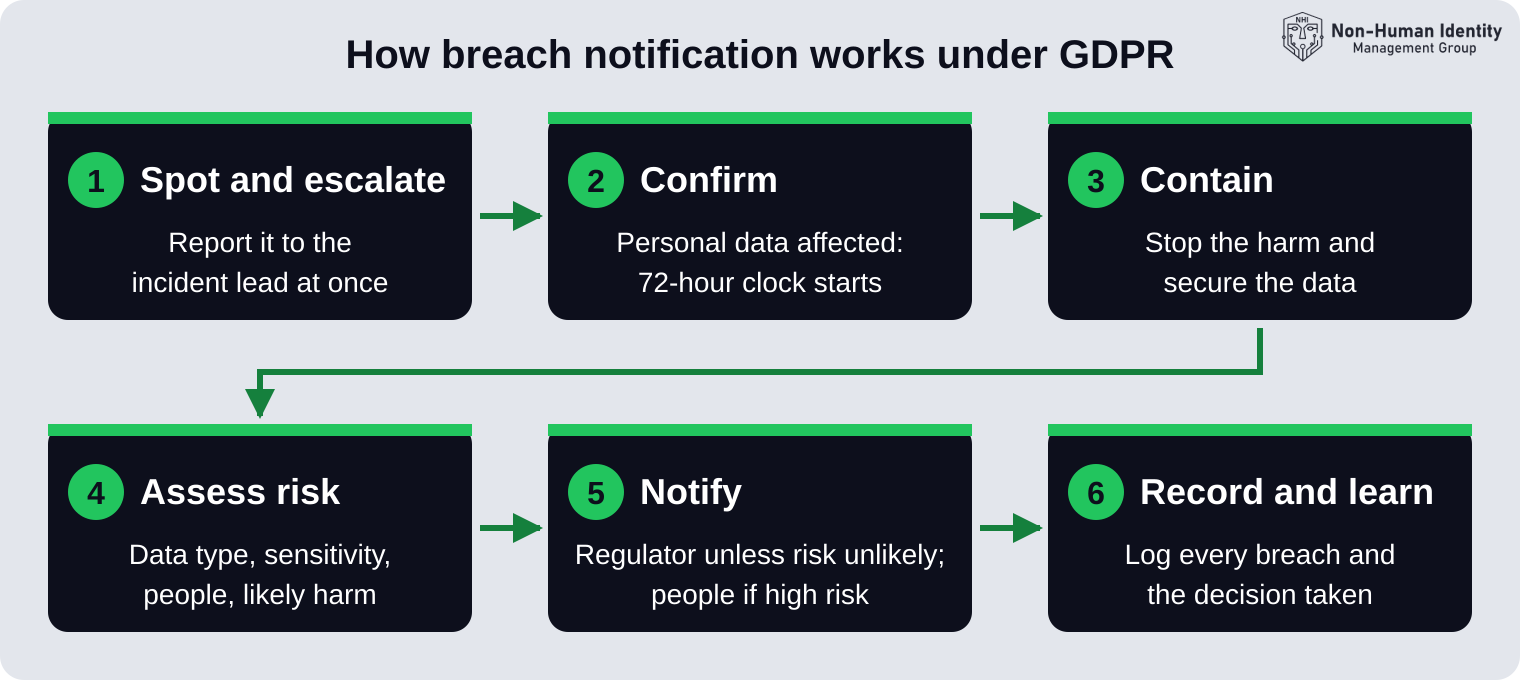
The steps below follow the GDPR, which the UK applies in a near-identical form as the UK GDPR. Other laws use similar stages with different triggers and clocks.
- Spot and escalate. Someone notices something wrong: a misdirected email, a lost phone or an alert from a security tool. They report it straight away to the person or team named in your incident plan.
- Confirm and start the clock. A short investigation checks whether personal data is involved. The EDPB says you become aware when you have a reasonable degree of certainty that a security incident has compromised personal data.[3] From that moment the 72-hour clock runs.[1]
- Contain. Stop the harm getting worse: recall the email, disable the stolen account, change passwords, restore from backup.
- Assess the risk to people. Ask what data was involved, how sensitive it is, how many people are affected, how easily they can be identified and how badly they could be hurt. The EDPB lists these as the main factors and says that if in doubt, you should notify.[3]
- Tell the regulator, if required. Unless the breach is unlikely to result in a risk to people, notify the supervisory authority without undue delay and, where feasible, within 72 hours. If you are late, give reasons for the delay. The notice describes what happened, roughly how many people and records, a contact point, the likely consequences and what you are doing about it.[1] If you do not yet know everything, you can provide information in phases.[2]
- Tell the people affected, if the risk is high. Where the breach is likely to result in a high risk to them, tell them without undue delay, in clear language, with practical advice such as resetting a password.[1][2] This is not needed if, for example, the data was encrypted so that it cannot be read by whoever has it.[1]
- Record and learn. Write down every breach, its effects and what you did, including breaches you decided not to report and why.[1][2] Then fix the cause.
Different laws, different clocks
The table gives a beginner's view of four common regimes. Each has more detail and exceptions in its own guide, linked in the learning pathway.
| Regime | Who must tell | Who is told | Main deadline |
|---|---|---|---|
| EU GDPR and UK GDPR | The controller (a processor tells the controller) | Supervisory authority (in the UK, the ICO); people affected if high risk | Regulator: without undue delay and, where feasible, within 72 hours of awareness. People: without undue delay.[1][2] |
| US HIPAA Breach Notification Rule (health data) | Covered entities, such as health providers and health plans; business associates tell the covered entity | People affected; the US Department of Health and Human Services (HHS); media if more than 500 residents of a state are affected | People: no later than 60 days after discovery. HHS: within 60 days if 500 or more people are affected, otherwise in an annual report.[4] |
| US state breach laws | Businesses and, in most states, government bodies | Residents affected, and in some states a regulator | Set by each state. All 50 states, the District of Columbia, Guam, Puerto Rico and the US Virgin Islands have such laws.[5] |
| Charity Commission for England and Wales | Charity trustees | The Charity Commission, through its serious incident report | Promptly, as soon as reasonably possible after the charity becomes aware.[6] |
One incident can trigger several of these at once. A UK charity that loses donor data, for example, may need to think about the ICO under the UK GDPR and the Charity Commission, whose guidance lists significant data breaches as incidents trustees should report.[6] Security incidents at important service providers may also fall under cyber incident reporting laws, which the Cyber Incident Reporting for Beginners guide covers.
A worked example
Greenleaf Physio is a fictional clinic in Leeds with 12 staff and about 3,000 patients. On a Thursday at 4pm, Dan on reception emails the week's appointment list, with patient names, phone numbers and treatment notes, to a supplier with a similar email address instead of the clinic's own practice manager.
- Thursday 4.20pm, spot and escalate: Dan notices the wrong address and tells Aisha, the practice manager, who leads on incidents.
- Thursday 4.45pm, confirm: Aisha checks the sent email. It contains health information about 140 patients. She records the time: the clinic is now aware, and the 72-hour clock has started.
- Thursday 5pm, contain: Aisha phones the supplier, who agrees to delete the email and confirm in writing. The confirmation arrives on Friday morning.
- Friday, assess: treatment notes are health data, which the law treats as especially sensitive. Even with the supplier's written confirmation, Aisha cannot rule out that the email was read or forwarded, so she decides the breach is not unlikely to result in a risk. She reports it to the ICO on Friday afternoon, well within 72 hours, explaining what happened and what the supplier confirmed.
- Friday, tell patients? Because the recipient is a known business that has confirmed deletion, Aisha judges the risk to patients is not high and records her reasons. Her notes say she will tell patients if anything new suggests the data was misused.
- Next week, learn: the clinic turns off email address autocomplete for external addresses and starts sending patient lists only through its booking system.
This may not be the end of it: the ICO may ask questions, and a different decision on telling patients could be reasonable. What the clinic can show is that it acted quickly, reported within the clock and recorded why it made each decision.
Myths and misunderstandings
| What people think | What is true |
|---|---|
| A breach means we were hacked. | Most definitions include accidents: a wrong recipient, a lost device or data you can no longer reach.[2] |
| Every breach must be reported to the regulator. | Under GDPR, not if it is unlikely to result in a risk to people. You still record it and your reasons.[1] |
| The 72 hours start when the investigation is finished. | They start when you become aware, meaning reasonably certain that personal data has been compromised.[3] |
| We must have every detail before we notify. | You can notify on time and send further information in phases, without undue delay.[2] |
| If we report to the regulator, we must also write to everyone affected. | Telling individuals is a separate test: under GDPR it applies where the risk to them is high.[1] |
| Our cloud provider handles notification for us. | A processor must tell you; under GDPR the decision and the notice to the regulator are the controller's duty.[1] |
Key terms
- Personal data
- Information that can identify a person directly or indirectly, such as a name, account number, device identifier or location history.
- Personal data breach
- A security incident that leads to accidental or unlawful destruction, loss, alteration, unauthorised disclosure of, or access to, personal data.
- Breach notification
- The process of deciding on, documenting and reporting a data breach to regulators and the people affected.
- Data controller
- The organisation that decides why personal data is collected and how it is used, and which stays accountable for it.
- Data processor
- An organisation that handles personal data on behalf of a controller, under the controller's instructions.
- A public regulator that enforces GDPR in its country, reviews breach notifications and can issue fines.
- Data subject
- The identified or identifiable person that personal data relates to.
- Special category data
- Sensitive personal data, such as health or biometric data, that the law protects more strongly because misuse can cause greater harm.
- Protected health information (PHI)
- Health information that can identify a person and is covered by the US HIPAA rules.
- Incident response plan
- A written set of steps, roles and contacts for handling a security incident from detection to recovery.
Common questions
Does the 72-hour clock include weekends?
The GDPR sets 72 hours from awareness and says nothing about pausing for weekends, so we suggest planning as though the clock runs continuously. Make sure someone can make the reporting decision outside office hours.[1]
What if we are not sure whether to report?
Use the risk factors: type of data, sensitivity, number of people, how easy they are to identify and how serious the harm could be. The EDPB advises erring on the side of caution and notifying when in doubt.[3] The ICO also offers a self-assessment tool on its report a breach pages.[2]
We use a supplier who had the breach. Who reports?
Under GDPR the supplier, as processor, must tell you without undue delay, and you, as controller, decide on and make any notification.[1] A good contract says how fast the supplier will tell you and what details it will give.
Does encryption mean we do not have to tell anyone?
It can mean you do not have to tell individuals, where the data was unintelligible to anyone not authorised to see it.[1] HHS treats properly encrypted health data in a similar way.[4] It depends on the key staying safe, and you still record the breach.
What should a notice to customers say?
What happened, the likely consequences, what you have done and what they can do, and who to contact, in clear language.[2] The Customer Breach Notification Letter Template gives a starting structure.
We operate in several countries. Which law applies?
Often more than one. Each country or state can have its own rules and clocks, so map them in advance. The Breach Notification Laws by Country Guide is a good next step.
First steps
Three things you can do this week:
- Name the people. Decide who staff report a suspected breach to, who decides whether to notify, and who stands in when they are away. Put the names somewhere everyone can find them.
- Know your regulators. Write down which regulators and laws apply to you (for example the ICO, HHS, a state attorney general or the Charity Commission) and bookmark their reporting pages.
- Start a breach log. Create a simple register with the date found, what happened, the data and people involved, the decision and the reasons. A sensible start is the Data Breach Register Template.
Checklist
- Staff know that wrong recipients, lost devices and lost access can be breaches, and how to report them.
- We have a named breach lead and a deputy who can act at weekends.
- We know which laws and regulators apply to the data we hold.
- We record the time we became aware of each breach.
- We have a simple way to assess risk to people, using sensitivity, volume and likely harm.
- We keep a breach register, including breaches we chose not to report.
- Our supplier contracts say how quickly suppliers must tell us about a breach.
- We have a draft customer notice and a draft regulator notice ready to adapt.
Simple measures that show progress: the time from discovery to escalation, the time from awareness to the reporting decision, the share of breaches with a recorded decision, and the share of suppliers with a breach notice clause in their contract.
Check your understanding
1. Is an email sent to the wrong person a personal data breach?
Answer: it can be. Unauthorised disclosure of personal data is a breach even when it is an accident.
2. When does the GDPR 72-hour clock start?
Answer: when the controller becomes aware, meaning it has a reasonable degree of certainty that personal data has been compromised.
3. What is the test for telling the people affected under GDPR?
Answer: the breach is likely to result in a high risk to their rights and freedoms.
4. Why record a breach you decided not to report?
Answer: GDPR requires a record of all breaches, and the record shows the regulator why you made your decision.
Suggested learning pathway
- Start with the basics of personal information in Data Privacy for Beginners.
- For the law behind most of this page, read GDPR for Beginners.
- For what happens around the notice, read Incident Response for Beginners.
- For reporting security incidents to cyber regulators, read Cyber Incident Reporting for Beginners.
- For the full practitioner view of the GDPR duties, see the GDPR Articles 33 and 34 Breach Notification Guide.
- For real regulator scenarios, see EDPB Breach Notification Examples.
- For a side-by-side task list, use the Data Breach Notification Checklist.
- For US health data, see the HIPAA Breach Notification Rule Guide.
- For charities in England and Wales, see the Charity Serious Incident Reporting for Cyber Incidents Guide.
Standards and references
- Regulation (EU) 2016/679 (General Data Protection Regulation), Articles 4, 33, 34, 77, 82 and 83. European Parliament and Council, 27 April 2016, EUR-Lex. https://eur-lex.europa.eu/legal-content/EN/TXT/HTML/?uri=CELEX:32016R0679, accessed 27 Nov 2026.
- Personal data breaches: a guide. Information Commissioner's Office (ICO). https://ico.org.uk/for-organisations/report-a-breach/personal-data-breach/personal-data-breaches-a-guide/, accessed 27 Nov 2026.
- Guidelines 9/2022 on personal data breach notification under GDPR, version 2.0. European Data Protection Board, adopted 28 March 2023. https://www.edpb.europa.eu/system/files/2023-04/edpb_guidelines_202209_personal_data_breach_notification_v2.0_en.pdf, accessed 27 Nov 2026.
- Breach Notification Rule. US Department of Health and Human Services (HHS). https://www.hhs.gov/hipaa/for-professionals/breach-notification/index.html, accessed 27 Nov 2026.
- Security Breach Notification Laws. National Conference of State Legislatures (NCSL). https://www.ncsl.org/technology-and-communication/security-breach-notification-laws, accessed 27 Nov 2026.
- How to report a serious incident in your charity. Charity Commission for England and Wales, GOV.UK, last updated 16 January 2026. https://www.gov.uk/guidance/how-to-report-a-serious-incident-in-your-charity, accessed 27 Nov 2026.
Related NHI Mgmt Group resources: Breach Notification Logistics · Data Breach Tabletop Exercise · Data Loss vs Data Breach vs Data Leak