Data sovereignty is the idea that data is subject to the laws of the country or region that has power over it, and those laws decide how it must be handled and who can force access to it.
It is close to, but not the same as, data residency, which is simply where data is physically stored and processed. This guide is for newcomers, students, career changers and managers who keep hearing about "sovereign cloud" and want to know what it actually means. It explains the ideas in plain English, shows how organisations decide where data should live, walks through a worked example and links to the deeper practitioner guides.
By the end of this guide you will be able to:
- Explain the difference between data sovereignty, data residency and data localisation.
- Understand why storing data in a country does not on its own decide who can reach it.
- Describe the main tools: transfer rules, sovereign cloud offerings, encryption keys and contracts.
- Identify first steps to map where your own data lives.
Status: correct as at 27 November 2026, based on the GDPR text on EUR-Lex, European Commission adequacy pages, US Department of Justice CLOUD Act material and NCSC guidance. Laws change; check the official text.
This guide explains the topic in general terms and is not legal advice.
Key takeaways
- Location and control are different questions. Residency asks where data sits; sovereignty asks whose laws apply and who can be ordered to hand it over.
- A provider's home country can matter as much as the data centre's. US law, for example, can require a US provider to disclose data in its control even when it is stored abroad.
- Moving personal data out of the EU or UK has rules. Transfers need a legal route, such as an adequacy decision or standard contractual clauses.
- Who holds the keys and who can log in matters. Encryption keys you control, and limits on which provider staff can access systems, are the practical levers.
- Start with a map. You cannot make sovereignty decisions until you know which data you hold, where it goes and who can reach it.
What it is, in plain English
Three terms are often mixed up:
- Data residency: where data is stored and processed, for example "our files are in a data centre in Frankfurt".
- Data localisation: a rule that certain data must stay inside a country or region rather than moving freely across borders.
- Data sovereignty: the wider question of which country's laws govern the data, including who can lawfully demand access to it.
Think of a safe deposit box. Residency is which bank branch the box is in. Sovereignty is which courts can order the bank to open it, and that depends on where the bank is based as well as where the branch is. Where the analogy breaks down: data is copied far more easily than a box is moved. Backups, logs, support tools and staff in other countries can all touch it, so "where it is" often has several answers at once.
The UK National Cyber Security Centre (NCSC) puts the practical questions simply: know which countries your data is stored, processed and managed from, which legal jurisdictions apply, including the provider's own legal base, and in what circumstances authorities could access your data without your consent.[5]
Why it matters to you
- If you run a small business: customers and partners increasingly ask where their data is kept. Being able to answer clearly can win contracts, and moving personal data abroad without a legal route can break data protection law.
- If you are new to a security job: you will meet sovereignty in cloud reviews, supplier questionnaires and audits. Knowing that residency is only part of the answer helps you ask better questions.
- If you are a manager: choosing a cloud provider is partly a legal decision. The answer affects which regulators you deal with, what you put in contracts and what you tell customers.
Two pieces of law show why this is more than geography. Under the EU General Data Protection Regulation (GDPR), any transfer of personal data to a country outside the EU is allowed only if the conditions in Chapter V are met, so that the protection the GDPR gives is not undermined.[1] And in the United States, the CLOUD Act, passed in March 2018, amended US law so that providers must disclose data "within such provider's possession, custody, or control" whether it is stored inside or outside the United States, when served with valid legal process.[3][4] The US Department of Justice says the change settled a disagreement exposed by a court case about data held on a server in Ireland.[4]
How it works, step by step
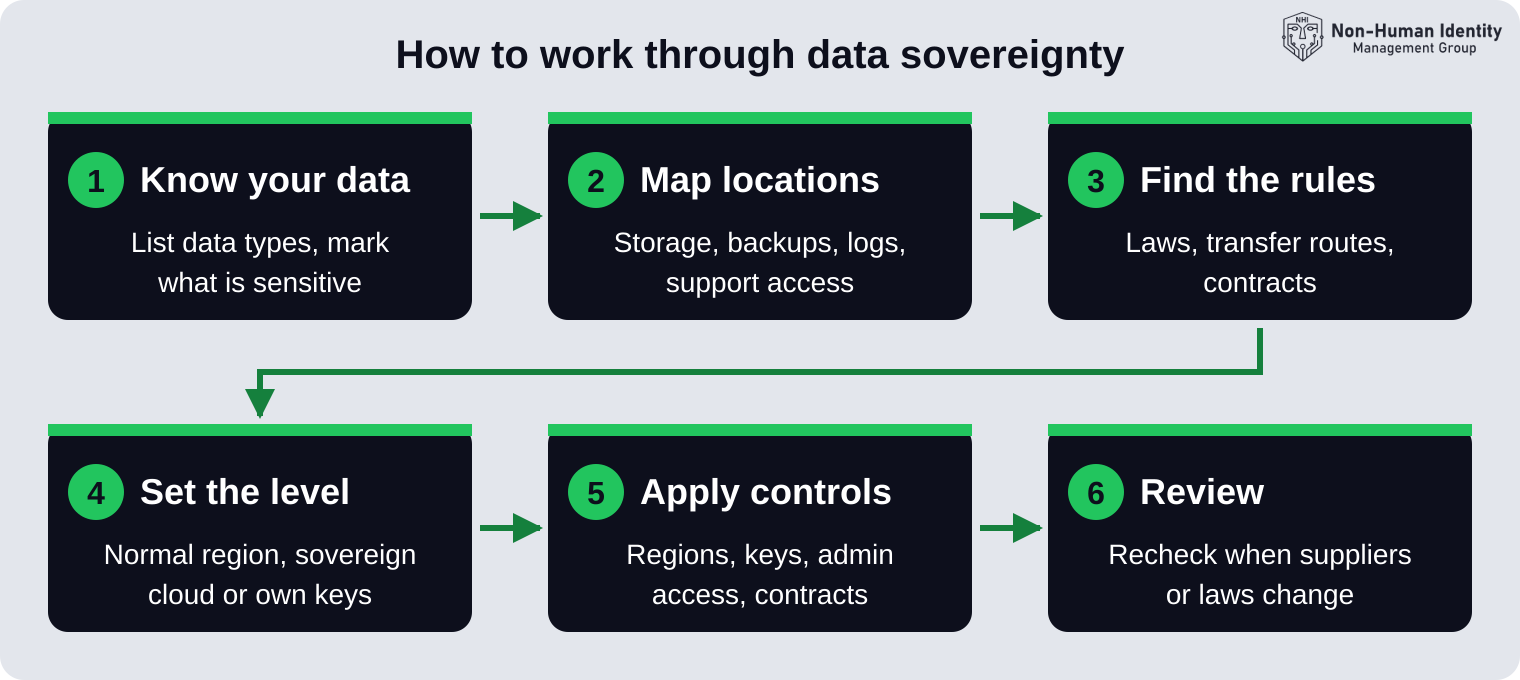
Organisations usually work through sovereignty in the same order, whatever their size.
- Know your data. List the main types of data you hold, such as customer records, staff files, health data or payment data, and mark which are personal or sensitive.
- Map where it lives and travels. For each system, note where data is stored, where backups and logs go, and where support staff or suppliers access it from. The NCSC suggests asking providers for a complete list of countries where your data is stored and processed.[5]
- Find the rules that apply. Check data protection law, sector rules and customer contracts. Under the GDPR, a transfer can rely on an adequacy decision (the European Commission has found the destination's protection adequate) or, without one, on appropriate safeguards such as standard contractual clauses (SCCs).[1][2]
- Decide the level of control you need. Most data can sit in a normal cloud region. Some may need a specific region, a sovereign cloud offering or keys held outside the provider.
- Apply the controls. Choose regions, set policies that stop data being created elsewhere, control encryption keys, limit who can sign in to admin consoles, and put location commitments into contracts.
- Check and keep checking. Review the map when you add a supplier, switch on a new feature or when the law changes. Ask providers to tell you about changes to locations.[5]
Common tools, side by side
| Tool | What it does | What it does not do on its own |
|---|---|---|
| Choosing a cloud region | Keeps stored data in a chosen country or area (residency). | Change which laws apply to the provider itself. |
| Adequacy decision | Lets personal data flow from the EU to a recognised country without further safeguards.[2] | Remove your other GDPR duties, such as security and transparency. |
| Standard contractual clauses | Provide a contract-based safeguard for transfers where there is no adequacy decision.[1] | Change the destination country's laws on government access. |
| Customer-controlled encryption keys | Mean the provider needs your key to read the data in readable form. | Help if the key is stored with, or used by, the same provider without limits. |
| Sovereign cloud offering | Adds limits on location, operating staff and legal structure for a set of services. | Replace your own access control, logging and contracts. |
Examples of sovereign cloud offerings
Large cloud providers now describe dedicated offerings for sovereignty needs. They are listed alphabetically and only as examples; the order is not a ranking, and each has its own practitioner guide.
- Amazon Web Services (AWS) European Sovereign Cloud: AWS describes it as physically and logically separate from other AWS Regions, with its first region in Brandenburg, Germany, infrastructure entirely within the EU, and day-to-day control limited to EU residents located in the EU.[6] See the AWS European Sovereign Cloud Guide.
- Google Cloud Assured Workloads: Google describes it as setting up a data and access boundary for sensitive workloads, including regional data boundaries such as the EU Data Boundary, limits on which support staff can access data, and control packages for specific regulations.[7] Availability: Google notes that Assured Support needs Enhanced or Premium Support.[7] See the Assured Workloads and Sovereign Controls Guide.
- Microsoft Azure Government: Microsoft describes it as a dedicated cloud using physically isolated datacentres and networks located only in the US, with contractual commitments to store customer data in the US and limit access to systems that process it to screened US persons.[8] Availability: Microsoft says it is for US federal, state and local government and their partners, with eligibility validated.[8] See the Azure Government and Sovereign Cloud Guide.
A worked example
Northway Learning is a fictional online tutoring company based in Dublin, with 60 staff and students across the EU. A school group asks, before signing a contract, "Where is our pupils' data kept, and who can access it?" Nobody is sure, so Maria, the operations lead, works through the steps with Tom from IT.
- Know the data: pupil names, ages, lesson recordings and progress notes. All of it is personal data, and some of it relates to children.
- Map it: the main app runs in an EU cloud region. But Tom finds that lesson recordings are sent to a transcription service hosted outside the EU, and the help desk tool's support team works from another continent.
- Find the rules: the transcription transfer needs a GDPR transfer route. The supplier offers standard contractual clauses, which Maria checks are signed. The school group's contract asks for storage in the EU.
- Set the level: Maria decides that a normal EU region is enough for the main app, but recordings should not leave the EU at all.
- Apply controls: Tom switches to an EU-hosted transcription option, restricts the cloud account so new storage can only be created in EU regions, and limits who can see recordings in the help desk tool.
- Review: Maria adds a "where is the data?" question to the supplier checklist and puts a review in the diary for six months' time.
Northway can now give the school group a clear, honest answer, including the fact that its cloud provider is a non-EU company and what that means. It has reduced the transfers it makes rather than removed every legal question, and Maria records the remaining ones for the data protection lead to review.
Myths and misunderstandings
| What people think | What is true |
|---|---|
| If the data centre is in our country, the data is sovereign. | Location is residency. The provider's legal base and who can access the systems also matter.[5] |
| Data sovereignty and data residency are the same thing. | Residency is where data is stored. Sovereignty is whose laws apply and who can compel access. |
| GDPR bans sending personal data outside Europe. | It allows transfers when the Chapter V conditions are met, for example an adequacy decision or appropriate safeguards.[1] |
| Encrypting data solves sovereignty. | It helps only if the keys are controlled so that the provider, or anyone who can compel it, cannot simply use them. |
| Only governments need to care. | Any organisation that holds personal data, serves regulated sectors or answers customer questionnaires will meet these questions. |
| Once we have chosen a region, we are done. | Backups, logs, new features and suppliers can move data elsewhere, so the map needs regular review. |
Key terms
- Data sovereignty
- The principle that data is subject to the laws of a particular jurisdiction, which decide how it must be handled and who can compel access to it.
- Data residency
- Where data is physically stored and processed, often a requirement that it stays in a specific country or region.
- Data localisation
- A rule that certain categories of data must be stored or processed inside a defined jurisdiction.
- Cross-border data transfer
- Moving personal data from one jurisdiction to another, which privacy laws may regulate even when it happens through a supplier.
- Adequacy decision
- A formal finding by the European Commission that a country outside the EU protects personal data to an adequate level, allowing transfers to it.
- Standard contractual clauses (SCCs)
- Approved contract terms used to allow personal data transfers to countries without an adequacy decision.
- CLOUD Act
- A US law under which certain providers can be required to produce data in their control, including data held outside the United States, subject to legal process.
- Sovereign cloud
- A cloud service designed to keep data, operations and governance within a defined jurisdiction or control boundary.
- Hold your own key (HYOK)
- A key custody model in which the organisation keeps independent control of encryption keys outside the provider's environment.
- Encryption key management
- Creating, storing, rotating, distributing, revoking and retiring the keys that protect data, and controlling who can use them.
Common questions
What is the difference between data sovereignty and data residency?
Residency is where data is stored and processed. Sovereignty is which country's laws govern it and who can lawfully demand access. Data can be resident in one country and still be reachable under another country's law.
Can a US company's European data centre be reached by US authorities?
The CLOUD Act lets US authorities require providers to disclose data in their possession, custody or control wherever it is stored, through legal process.[4] How that plays out for a given provider and service is a legal question, which is why some providers set up separate structures for sovereign offerings.
Which countries can EU organisations send personal data to freely?
Those covered by a European Commission adequacy decision. The list includes, for example, Japan, Switzerland, the United Kingdom and, for organisations in the EU-US Data Privacy Framework, the United States.[2] The list changes, so check the Commission's page.
Do we need a sovereign cloud?
Most organisations do not need one for all their data. A sensible start is to map your data and rules first; dedicated offerings tend to suit regulated or government work where contracts or law demand them.
Does sovereignty apply to logs and backups?
Yes. The NCSC points out that you should know where data and its derivatives, such as logs, are held and who can access them.[5]
How do encryption keys help?
If you control the keys and the provider cannot use them without you, the provider holds data it cannot read in plain form. The BYOK, HYOK and External Key Management Guide explains the options.
First steps
Three things you can do this week:
- List your top five systems that hold personal or sensitive data, and write down the country of storage for each.
- Ask each provider two questions: which countries is our data stored, processed or supported from, and will you tell us if that changes?
- Check your transfer routes. For any personal data leaving the EU or UK, note the legal route used, such as an adequacy decision or signed SCCs, and flag any gaps to whoever leads on data protection.
Checklist
- We know which data types we hold and which are personal or sensitive.
- We have a map of where each main system stores data, backups and logs.
- We know where suppliers' support staff access our data from.
- Each transfer of personal data out of the EU or UK has a recorded legal route.
- Cloud accounts are set so new data can only be created in approved regions.
- We know who controls the encryption keys for our most sensitive data.
- Contracts include location commitments and a duty to tell us of changes.
- The map is reviewed at least yearly and when suppliers change.
Simple measures that show progress: the share of systems with a known storage location, the number of transfers without a recorded legal route (aim for zero), the share of key suppliers with location commitments in their contracts, and the number of storage resources found outside approved regions.
Check your understanding
1. A company keeps all its files in a Paris data centre run by a non-EU provider. Is that the full sovereignty answer?
Answer: no. That is residency. The provider's legal base and who can access the systems also affect which laws can reach the data.
2. Name two GDPR routes for transferring personal data outside the EU.
Answer: an adequacy decision for the destination country, or appropriate safeguards such as standard contractual clauses.
3. Why do logs and backups matter for sovereignty?
Answer: they are copies or derivatives of data and can be stored or accessed in other countries, so they need to be on the map.
4. When does customer-controlled encryption help with sovereignty?
Answer: when the provider cannot use the keys without the customer, so it cannot read the data in plain form.
Suggested learning pathway
- Start with Data Privacy for Beginners for the basics of personal information.
- Read GDPR for Beginners for the law behind most transfer rules.
- Read Cloud Security for Beginners for how cloud responsibilities are shared.
- Read Key Management for Beginners for who holds the keys.
- For the full practitioner view, see the Data Sovereignty and Residency Guide.
- For the wider idea of controlling your technology, see Data Sovereignty vs Digital Sovereignty.
- For transfer contracts, see the Standard Contractual Clauses (SCCs) Guide.
- For how providers' European options line up, see the EU Sovereign Cloud Options Compared Guide.
Standards and references
- Regulation (EU) 2016/679 (General Data Protection Regulation), Articles 44 to 46. European Parliament and Council, 27 April 2016, EUR-Lex. https://eur-lex.europa.eu/legal-content/EN/TXT/HTML/?uri=CELEX:32016R0679, accessed 27 Nov 2026.
- Adequacy decisions. European Commission. https://commission.europa.eu/law/law-topic/data-protection/international-dimension-data-protection/adequacy-decisions_en, accessed 27 Nov 2026.
- CLOUD Act Resources. US Department of Justice, Criminal Division. https://www.justice.gov/criminal/cloud-act-resources, accessed 27 Nov 2026.
- Promoting Public Safety, Privacy, and the Rule of Law Around the World: The Purpose and Impact of the CLOUD Act (white paper). US Department of Justice, April 2019. https://www.justice.gov/opa/press-release/file/1153446/download, accessed 27 Nov 2026.
- Cloud security guidance, Principle 2: Asset protection and resilience. National Cyber Security Centre (NCSC). https://www.ncsc.gov.uk/collection/cloud/the-cloud-security-principles/principle-2-asset-protection-and-resilience, accessed 27 Nov 2026.
- AWS European Sovereign Cloud. Amazon Web Services. https://aws.eu/, accessed 27 Nov 2026.
- Assured Workloads overview. Google Cloud documentation, Google. https://docs.cloud.google.com/assured-workloads/docs/overview, accessed 27 Nov 2026.
- What is Azure Government? Microsoft Learn, Microsoft. https://learn.microsoft.com/en-us/azure/azure-government/documentation-government-welcome, accessed 27 Nov 2026.
Related NHI Mgmt Group resources: International Data Transfers Map · Transfer Impact Assessment (TIA) Template · Cloud Customer-Managed Keys and BYOK/HYOK Decision Guide