A data protection impact assessment (DPIA) is a written check of a plan's privacy risks, done before it starts.
This guide is for anyone asked to "do a DPIA" for the first time, or who wants to know what one is. You do not need to be a lawyer: if your team plans a new app, camera or tracking tool that uses people's details, a DPIA may be needed.
In short
- A DPIA looks at how a new plan could harm people through the use of their personal details.
- Under UK and EU data protection law, you must do one before work starts if the plan is likely to be high risk.
- It covers what you will do, why you need it, the risks to people and the steps that reduce them.
- If a high risk remains after those steps, you must talk to the regulator before you start.
What you will learn
- Explain what a DPIA is in one sentence.
- Spot the signs that a plan needs a DPIA.
- Check the four things every DPIA should cover.
- Ask the right questions before a new project goes live.
Status: correct as at 28 November 2026, based on the UK regulator's (ICO) DPIA guidance and the official text of the GDPR. Laws change; check the official text.
This guide explains the topic in general terms and is not legal advice.
- Personal details (personal data)
- any information that can identify a living person, such as a name, photo or location.
- Privacy risk check (DPIA)
- a written look at how a plan could harm people, and how to reduce that harm.
- Privacy regulator (supervisory authority)
- the public body that enforces data protection law, such as the ICO in the UK.
What is a DPIA?
Think of a teacher planning a school trip. Before the coach leaves, the teacher writes a risk check. Where could children get hurt, and what will we do about it?
A DPIA works the same way for personal details. Before a new project starts, you write down what data it will use and how that could harm people. Then you plan steps to make the harm less likely or less serious.
The UK regulator describes a DPIA as a process that helps you analyse, spot and reduce the data protection risks of a project.[1] The focus is harm to the people whose data you use, not harm to your business.
A DPIA is not a one-off form. It is a living record that you look at again if the project changes.[1]
Where the comparison stops working: a trip risk check is often a school rule. A DPIA is a legal duty for plans that are likely to be high risk, and the regulator can ask to see it.
Why does it matter?
A DPIA is the moment to fix a privacy problem cheaply, while the plan is still on paper.
If you run a small business
What could happen: you buy a new camera or tracking tool, and later learn you needed a DPIA first. The UK regulator says skipping a required DPIA can lead to enforcement action.[1]
Check this: ask whether anyone has looked at privacy before the next new system is bought.
Next: GDPR for Beginners
If you manage a project
What could happen: the DPIA is left until the week before launch. A risk turns up that needs a design change, and the launch slips.
Check this: put a short privacy screening question in your project start-up form.
Next: DPIA Template
If you are new to IT or security work
What could happen: you are asked to fill in the security part of a DPIA and paste in a list of certificates. That does not show who can reach the data.
Check this: list which staff and which software accounts can read or export the data.
What does it look like?
Here is a short "Do we need a DPIA?" screening card for a made-up project. Many teams fill in a card like this before deciding.
Example only. All values are made up.
DO WE NEED A DPIA? (screening card)
Project:  EXAMPLE staff app with live location (FAKE)
Personal data used?          Yes                (1)
Watching people over time?   Yes, during shifts (2)
People in a weaker position? Yes, our staff     (3)
New kind of technology?      No
Large numbers of people?     No, about 60 staff
Result:  2 signs found, DPIA NEEDED             (4)
Signed:  EXAMPLE Manager, date 00/00/0000
- Location can identify a person, so it counts as personal data.
- Tracking people over a period is one of the signs of high risk.
- Staff count as people in a weaker position, because they may find it hard to say no to their employer.
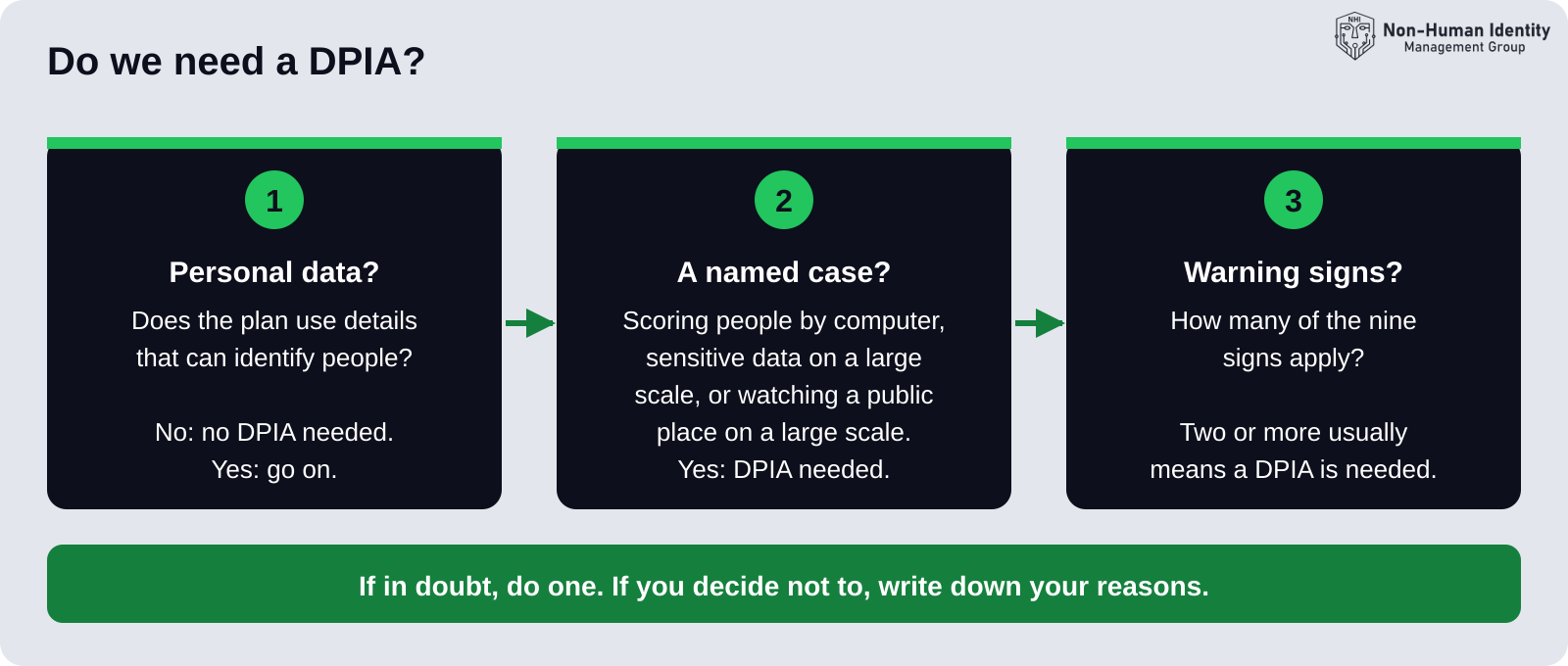
- Two or more signs usually means a DPIA is needed.
Why this is risky: many teams never fill in a card like this. They find out about the DPIA duty after the tool is live.
The safer way: screen every new or changed use of personal data, and keep the card even when the answer is "no DPIA needed".
How does it work?
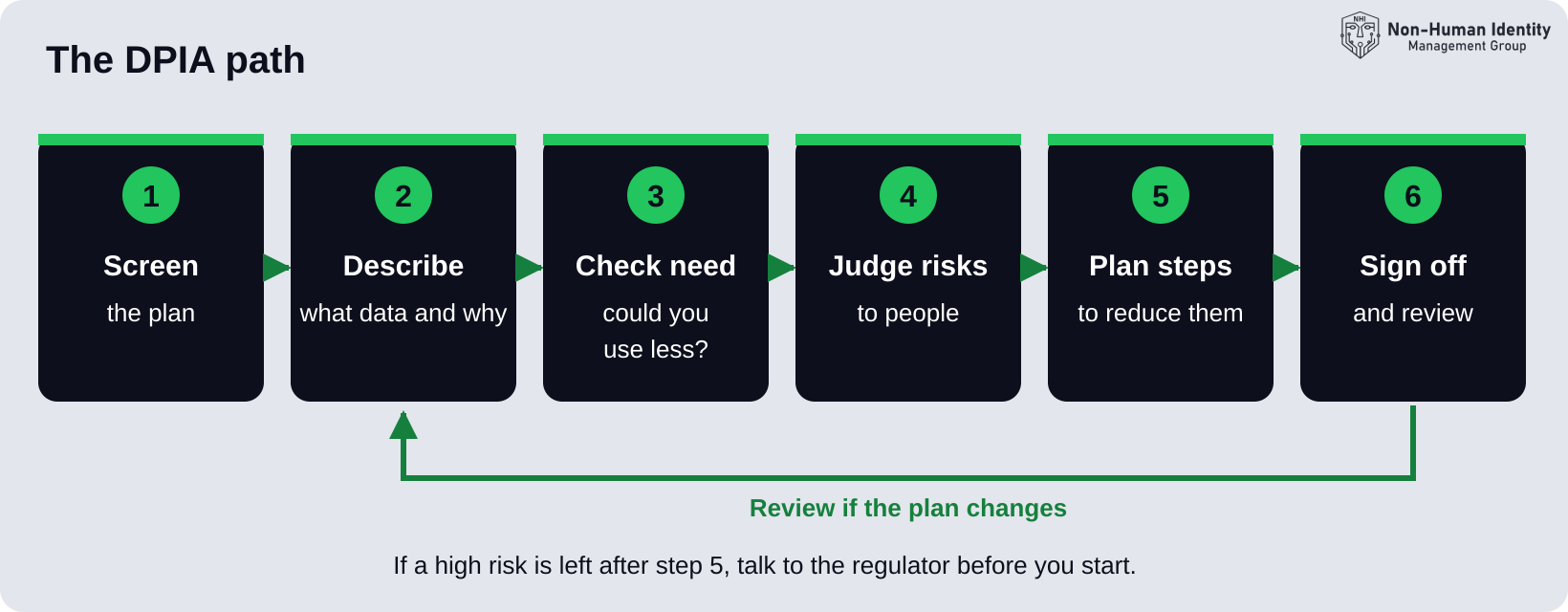
There is no single required form, but most DPIAs follow the same path.[1]
- Screen the plan. The law names three cases that always need a DPIA. One is scoring people by computer in ways that affect their lives. Another is using sensitive data, such as health records, on a large scale. The third is watching a public place on a large scale.[2] Beyond those, a European list gives nine warning signs. In most cases, two signs mean you need a DPIA.[2]
- Describe the plan. Write down what data you will collect, where it comes from, who sees it and how long you keep it.[3]
- Ask if you really need it. Check whether a gentler way would do the same job, and whether you can collect less.[3]
- Judge the risks to people. For each risk, think about how likely the harm is and how bad it would be.[5]
- Plan steps to reduce them. Note each step, who owns it and the risk that is left. A DPIA does not have to remove every risk.[1]
- Sign off, then review. Where it makes sense, ask the people affected, or people who speak for them, for their views.[5] Ask your data protection officer, if you have one, for advice.[3] If a high risk is left, talk to the regulator before you start.[4]
A worked example
Oakhaven Housing is a made-up housing association in the UK. It has 60 repair staff who drive vans between homes. The operations manager, Arjun Mehta, wants an app that shows each van on a live map.
Before buying, Arjun fills in a screening card. The app tracks where staff are during shifts. Staff are people in a weaker position, because it is hard to refuse a tool your employer asks you to use. That is two warning signs, so he starts a DPIA.
First he describes the plan. The app records location every few minutes. The supplier stores the data, and managers can see a map and a history.
Next he asks whether all of this is needed. The aim is to send the nearest van to an urgent repair. That needs live location during shifts, not after work. A full history for a year looks hard to justify.
He then lists the risks to people. Managers could use the history to watch staff closely. Tracking could carry on during lunch or after a shift. A stranger who got into the supplier's system could see where staff go.
Arjun agrees some steps. Tracking switches off outside shift hours. Only the duty planner sees the live map. History is kept for 30 days unless there is a complaint. The supplier must use strong sign-in, and each person or tool that can read the data has a named owner.
Arjun also asks the staff union for its views, as part of the DPIA. The company's data protection adviser reviews the record. With these steps in place, the risk left is not high, so there is no need to go to the regulator. Arjun sets a date to look at the DPIA again in a year, or sooner if the app changes.
Myths and mistakes
| What people think | What is true |
|---|---|
| A DPIA is paperwork you do after launch. | It must be done before the work starts, while the design can still change.[2] |
| Every project needs a full DPIA. | The legal duty applies where a plan is likely to be high risk. A short screening card shows why others do not need one. |
| A DPIA must remove all risk. | It should reduce risk and show that what is left is acceptable, given the benefits.[1] |
| Once signed, it is finished. | It is a living record. Look at it again when the data, the tools or the purpose change.[1] |
| The supplier did a DPIA, so we are covered. | The organisation that decides why and how the data is used is responsible for the DPIA. Suppliers should help. |
| A list of security certificates is enough for the security part. | Show who and what can actually reach the data, and how that access is checked. |
What can I do this week?
- Find out who in your organisation looks after DPIAs, such as a data protection officer or adviser.
- List any new tools that collect personal details and are being planned or bought now.
- Fill in a screening card for one of them.
- Read the UK regulator's DPIA guidance or your own country's version.
Checklist
- New projects that use personal data are screened before work starts.
- We keep the screening result, including "no DPIA needed" decisions and the reasons.
- Each DPIA describes the data, the purpose, who sees it and how long it is kept.
- Each DPIA asks whether a gentler way, or less data, would do the job.
- Risks to people are judged on how likely and how serious they are.
- Each step to reduce a risk has an owner and a date.
- Our data protection officer or adviser gives advice, and we record it.
- We know when we must go to the regulator before starting.
- Each DPIA has a review date.
Common questions
Who should write the DPIA?
The organisation that decides why and how the data is used is responsible for it. In practice, the project owner usually writes it, with help from IT, security and any supplier. A data protection officer, if you have one, should give advice, and that advice should be written down.[3]
What if we decide we do not need one?
That can be the right answer, but keep a short record of why. The UK regulator says that if you decide not to do a DPIA, you should document your reasons. It also says that if you are in any doubt, it recommends doing one.[2]
What happens if a high risk is left?
You must talk to the regulator before you start the work. This is called prior consultation. If the regulator thinks the plan would break the law, it has up to eight weeks to give written advice. That can be extended by six weeks for complex plans. Plan that time into your project.[4]
Is there a fine for skipping a DPIA?
Yes, there can be. The UK regulator says that failing to do a DPIA when one is required may lead to enforcement action. It quotes a fine of up to 8.7 million pounds, or 2 percent of yearly worldwide turnover if that is higher.[1]
Is a DPIA the same as a privacy impact assessment?
Nearly. A privacy impact assessment is a broader name used in many countries. A DPIA is the version set out in UK and EU data protection law, with a fixed list of things it must cover. A good privacy impact assessment can count as a DPIA if it covers that list.
Do AI tools need a DPIA?
Often they do. The UK regulator lists new technology, including AI, among the kinds of plans that may need a DPIA, especially when combined with another warning sign. See AI Impact Assessment vs DPIA vs FRIA for how the different checks fit together.[2]
Where next?
Ready for the detail? Read the practitioner guide: DPIA Guide: Running a Data Protection Impact Assessment. It goes further into the legal tests, a scoring matrix for risks, the national lists and how prior consultation works.
Also useful:
- A ready-made form: DPIA Template
- GDPR for Beginners
- For step 2, describing the data: Data Mapping and ROPA Guide
- For step 3, collecting less: Data Minimisation
Related NHI Mgmt Group resources: AI Impact Assessment vs DPIA vs FRIA · Insider Risk Programme DPIA Template · Data Privacy for Beginners
Key terms
- Data Protection Impact Assessment
- A written check, done before a plan starts, of how it could harm people through the use of their data.
- Personal data
- Information that can identify a living person, directly or indirectly.
- Special category data
- Sensitive personal data, such as health or biometric data, that the law protects more strongly.
- Data controller
- The organisation that decides why and how personal data is used, and is responsible for it.
- Data Protection Officer
- The person who advises an organisation on data protection, including on DPIAs.
- The public regulator that enforces data protection law, such as the ICO in the UK.
- Data minimisation
- Collecting and keeping only the personal data you really need for the purpose.
Sources and further reading
- What is a DPIA? Information Commissioner's Office (ICO), UK GDPR guidance and resources, Data protection impact assessments. https://ico.org.uk/for-organisations/uk-gdpr-guidance-and-resources/accountability-and-governance/data-protection-impact-assessments-dpias/what-is-a-dpia/, accessed 28 Nov 2026.
- When do we need to do a DPIA? Information Commissioner's Office (ICO): Article 35(1) and 35(3) cases, the ICO list under Article 35(4), and the nine criteria from the Article 29 Working Party guidelines (WP248 rev.01). https://ico.org.uk/for-organisations/uk-gdpr-guidance-and-resources/accountability-and-governance/data-protection-impact-assessments-dpias/when-do-we-need-to-do-a-dpia/, accessed 28 Nov 2026.
- Regulation (EU) 2016/679 (General Data Protection Regulation), Article 35: Data protection impact assessment, including 35(2) (advice of the data protection officer) and 35(7) (minimum content). Text as published at gdpr-info.eu. https://gdpr-info.eu/art-35-gdpr/, accessed 28 Nov 2026.
- Regulation (EU) 2016/679 (General Data Protection Regulation), Article 36: Prior consultation, including 36(2) (eight weeks, extendable by six). Text as published at gdpr-info.eu. https://gdpr-info.eu/art-36-gdpr/, accessed 28 Nov 2026.
- How do we do a DPIA? Information Commissioner's Office (ICO): process steps, likelihood and severity of harm, and seeking the views of individuals. https://ico.org.uk/for-organisations/uk-gdpr-guidance-and-resources/accountability-and-governance/data-protection-impact-assessments-dpias/how-do-we-do-a-dpia/, accessed 28 Nov 2026.