ISO/IEC 42001 is an international standard that sets out how an organisation should run a management system for the AI it builds, provides or uses, so that AI is handled responsibly and kept under control.
This guide is for newcomers, students, career changers and managers who keep seeing "ISO 42001" in tenders, supplier questionnaires and job adverts and want to know what it is. It explains the idea of a management system in plain English, how the standard is organised, how an organisation puts it into practice and what certification means. It does not reproduce the standard or replace a paid copy. When you are ready for more detail, the learning pathway at the end points to deeper guides.
By the end of this guide you will be able to:
- Explain what ISO/IEC 42001 is and who it is for.
- Understand what an AI management system is.
- Describe the main steps an organisation takes to adopt the standard.
- Identify how it differs from ISO 27001 and from AI laws.
Status: correct as at 27 November 2026, based on the IEC Webstore listing for ISO/IEC 42001:2023 (edition 1.0, published 18 December 2023). Standards are revised; check the official listing.
This guide explains the topic in general terms and is not legal advice.
Key takeaways
- It is about managing AI, not about one AI product. ISO/IEC 42001 sets requirements for an AI management system: the policies, roles, processes and checks around AI.
- It applies to any organisation that provides or uses AI. Size, sector and type do not matter.
- It follows the same shape as other ISO management standards. If you know ISO 27001, the clauses on context, leadership, planning, support, operation, evaluation and improvement will look familiar.
- Organisations can be certified against it. Independent certification bodies audit organisations, and a separate standard, ISO/IEC 42006, sets rules for those bodies.
- It is a voluntary standard, not a law. It can help an organisation organise its work on AI rules, but certification does not by itself show that a law has been met.
What it is, in plain English
A management system is the set of policies, roles, processes and records an organisation uses to reach a goal and keep improving. ISO/IEC 42001 applies that idea to artificial intelligence (AI). Its official title is "Information technology, Artificial intelligence, Management system", and it was prepared by ISO/IEC JTC 1/SC 42, the joint ISO and IEC committee for AI.[1][2]
The standard specifies requirements and gives guidance for establishing, implementing, maintaining and continually improving an AI management system within an organisation. It is meant for organisations that provide or use products or services that use AI systems, and it applies to any organisation regardless of size, type and nature.[1] Its aim is to help organisations develop, provide or use AI systems responsibly while pursuing their objectives and meeting applicable requirements.[1]
A helpful comparison is a restaurant's food safety system. The system does not cook any single dish. It sets out who is responsible, which risks to check (such as allergens or storage temperatures), what records to keep and how inspections and fixes happen. ISO/IEC 42001 does the same for AI: it does not tell you which model to use, but how to decide, check, record and improve the way AI is used. Where the analogy breaks down: food safety risks are well understood and stable, while AI systems can change as they are retrained or as people use them in new ways, so reviews need to happen more often.
Why it matters to you
- If you run a small business: customers increasingly ask how you control the AI tools you build or use. The standard gives you a recognised structure for answering, even if you never seek certification.
- If you are new to a security or compliance job: ISO/IEC 42001 is becoming a common reference in AI governance work, and its clauses mirror ISO 27001, which you may already be learning.
- If you are a manager: the standard makes leadership responsible for AI policy, roles and resources, so you will likely be asked to approve policies and review results.
AI brings risks that ordinary IT controls do not fully cover, such as unfair outcomes, results that are hard to explain, or systems that change behaviour over time. The standard's introduction says organisations can apply its requirements using a risk-based approach, and that the AI management system should be integrated with the organisation's existing processes and management structure.[2] That means AI governance becomes part of how the business already runs, rather than a separate project.
How it works, step by step
The standard follows the harmonised structure used by other ISO management system standards, which helps it sit alongside them.[2] Its requirements are in clauses 4 to 10, and it has four annexes.[2]
| Part | Title | In plain English |
|---|---|---|
| Clause 4 | Context of the organization | Understand your situation, who cares about your AI and what the system covers |
| Clause 5 | Leadership | Top management commits, sets an AI policy and assigns roles |
| Clause 6 | Planning | Assess AI risks and impacts, decide how to treat them, set objectives |
| Clause 7 | Support | Provide people, skills, awareness, communication and documents |
| Clause 8 | Operation | Carry out the plans and controls in day-to-day work |
| Clause 9 | Performance evaluation | Monitor, measure, audit internally and review with management |
| Clause 10 | Improvement | Fix problems and keep improving |
| Annex A | Reference control objectives and controls (normative) | A list of AI controls to choose from |
| Annex B | Implementation guidance for AI controls (normative) | How to put those controls in place |
| Annex C | Potential AI-related organizational objectives and risk sources (informative) | Examples of goals and risk sources to consider |
| Annex D | Use of the AI management system across domains or sectors (informative) | How it applies in different sectors |
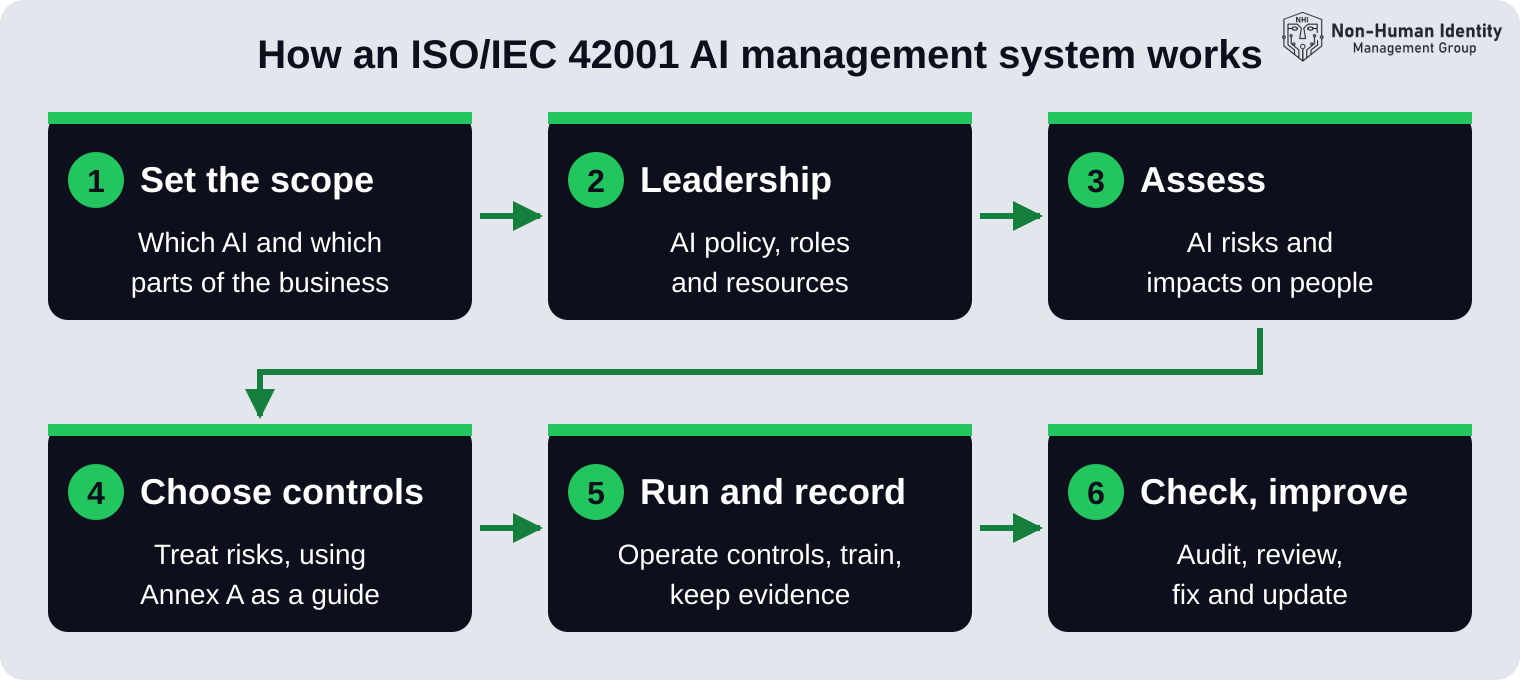
In practice, an organisation adopting the standard usually works through these steps:
- Set the scope. Decide which parts of the organisation and which AI systems the management system covers, and list the AI you build, provide or use.
- Get leadership on board. Top management agrees an AI policy, assigns roles and provides resources.
- Assess risks and impacts. Carry out an AI risk assessment and an AI system impact assessment, which looks at how an AI system could affect people and groups. Planning clause 6.1.4 is titled "AI system impact assessment".[2]
- Choose and apply controls. Decide how to treat each risk and pick suitable controls, using Annex A as a reference and Annex B for guidance.
- Run and record. Operate the controls in daily work, train people and keep evidence.
- Check and improve. Monitor results, run internal audits and management reviews, fix problems and update the system.
Useful distinctions
- ISO 42001 versus ISO 27001. ISO 27001 is about managing information security. ISO/IEC 42001 is about managing AI responsibly, which includes fairness, transparency and impacts on people as well as security. Because both use the same harmonised structure, many organisations run them together.[2] See ISO 42001 vs ISO 27001.
- ISO 42001 versus the NIST AI RMF. The NIST AI Risk Management Framework is voluntary US guidance for managing AI risk; ISO/IEC 42001 is an international standard with requirements that can be certified. See NIST AI RMF for Beginners.
- ISO 42001 versus EN 18286. EN 18286:2026, "Artificial intelligence, Quality management system for EU AI Act regulatory purposes", is a separate European standard. CEN and CENELEC describe it as the first harmonised European standard for AI Act purposes, focused on the quality management system needed for high-risk AI systems.[4] See the EN 18286 guide.
- Certifying organisations versus certifying auditors. ISO/IEC 42001 is what an organisation is audited against. ISO/IEC 42006:2025, published in July 2025, adds requirements for the bodies that audit and certify AI management systems, building on ISO/IEC 17021-1.[3]
A worked example
Brightwell Recruitment is a fictional agency with 90 staff. It uses an AI tool to sort job applications and has built a chatbot that answers candidates' questions. A large client asks whether Brightwell follows ISO/IEC 42001.
Amira, the operations director, leads a small team:
- Scope and inventory: they list every AI system in use. They find the sorting tool, the chatbot and three AI writing assistants that staff had started using without approval.
- Policy and roles: the managing director signs an AI policy. Amira is named owner of the management system, and each AI system gets a named owner.
- Risk and impact: the impact assessment for the sorting tool asks who could be harmed by a wrong result. The team decides a person must review every rejection before it is sent, and that the tool's results are checked each quarter for unfair patterns.
- Controls and records: unapproved writing assistants are replaced with one approved tool, staff are trained, and decisions and checks are logged.
- Review: after six months an internal audit finds that quarterly checks were missed once. The team records it as a nonconformity, fixes the reminder process and reports it at the management review.
Brightwell decides to wait a year before seeking certification, so it can show the system working over time. It can already show the client its policy, inventory, impact assessments and review records. None of this makes the AI tools free of mistakes or bias; it gives Brightwell a structured, repeatable way to find and deal with them.
Myths and misunderstandings
| What people think | What is true |
|---|---|
| ISO 42001 is only for companies that build AI. | It is for organisations that provide or use products or services that use AI systems.[1] |
| It is a law you must follow. | It is a voluntary international standard. Customers or contracts may ask for it, but it is not legislation. |
| Certification proves an AI system is safe and fair. | Certification shows the management system meets the standard's requirements when audited. It does not certify a specific AI system's results. |
| You must use every Annex A control. | Controls are chosen based on your risks and impacts. You record which ones you use and why. |
| If we have ISO 27001, we already meet ISO 42001. | The structure is shared, which helps, but ISO/IEC 42001 adds AI-specific requirements, such as AI system impact assessment.[2] |
Key terms
- AI management system (AIMS)
- The governance structure used to define accountability, monitor risk and control how AI is developed and operated.
- AI policy
- The rulebook that tells people and systems how AI may be built, used, monitored and governed inside an organisation.
- AI risk assessment
- The structured process of identifying, analysing and prioritising risks created by using AI systems.
- AI system impact assessment
- A structured review of the possible effects an AI system may have on people, processes, data and controls, before or during deployment.
- Risk treatment
- The planned response to a risk: avoiding, reducing, sharing or accepting it.
- Statement of Applicability
- A list of the controls an organisation has selected, excluded or adapted for its management system, with the reasons.
- Internal audit
- An independent check inside the organisation of whether the management system works as intended.
- Management review
- A planned review by top management of the management system, covering audit results, risks, performance and changes.
- Nonconformity
- A gap between a requirement and what the organisation actually does or can prove it does.
- Continual improvement
- The recurring activity of making the management system work better over time.
Common questions
Is it called ISO 42001 or ISO/IEC 42001?
Both names are used for the same standard. The full reference is ISO/IEC 42001:2023, because it was developed jointly by ISO and the IEC.[1]
When was it published?
The first edition was published on 18 December 2023.[1]
Can a small organisation use it?
Yes. The standard says it applies to any organisation, regardless of size, type and nature.[1] A small organisation can keep its management system simple and in proportion to its AI use.
Who issues ISO 42001 certificates?
Independent certification bodies, not ISO itself. ISO/IEC 42006:2025 sets extra requirements for bodies that audit and certify AI management systems.[3] We suggest checking that a certification body is accredited for ISO/IEC 42001 before you choose one.
Does ISO 42001 certification mean we meet the EU AI Act?
Not on its own. The EU AI Act sets its own legal requirements, and CEN and CENELEC describe EN 18286 as the harmonised standard focused on the quality management system for high-risk AI.[4] An existing ISO/IEC 42001 system can still help organise that work. See EU AI Act vs ISO/IEC 42001.
Where do identities and access fit?
AI systems and agents often run with their own accounts, keys and permissions. Recording who owns each AI system and what it can access fits naturally into the inventory, risk assessment and controls stages. See AI Agent Identity for Beginners.
First steps
Three things you can do this week:
- List your AI. Write down every AI system your organisation builds, provides or uses, including tools staff use on their own, with an owner for each.
- Find a sponsor. Ask a senior leader to own AI governance and agree who will draft an AI policy.
- Try one impact assessment. Pick the AI system that most affects people, such as one used in hiring or customer decisions, and write down who could be affected and how.
Checklist
- We know which AI systems we build, provide or use, and each has a named owner.
- We have decided what our AI management system covers.
- Top management has approved an AI policy.
- We have assessed the risks and impacts of our most important AI systems.
- We have chosen controls for those risks and recorded why.
- Staff who use or build AI have had suitable training.
- We check how our AI systems perform and keep records of the checks.
- Internal audits and management reviews are planned, and findings are fixed.
Check your understanding
1. What does ISO/IEC 42001 set requirements for?
Answer: an AI management system, the policies, roles, processes and checks an organisation uses to manage AI responsibly.
2. Does the standard apply only to companies that build AI?
Answer: no. It applies to organisations that provide or use products or services that use AI systems.
3. Which clauses hold the requirements?
Answer: clauses 4 to 10, from context of the organisation to improvement.
4. Does certification prove an AI system is fair and safe?
Answer: no. It shows the management system meets the standard when audited, not that every AI result is correct.
Suggested learning pathway
- Start with the wider topic in AI Governance for Beginners.
- For the risk side, read AI Risk Management for Beginners.
- For the sister standard on information security, read ISO 27001 for Beginners.
- For the law it often sits beside, read EU AI Act for Beginners.
- For the full practitioner view, see the ISO/IEC 42001 Guide.
- For the controls in detail, see the ISO/IEC 42001 Annex A Controls Guide.
- To check where you stand, use the ISO 42001 Readiness Checklist.
- For the EU quality management standard, see the EN 18286 guide.
Standards and references
- ISO/IEC 42001:2023, Information technology, Artificial intelligence, Management system (edition 1.0, 18 December 2023). IEC Webstore, International Electrotechnical Commission. https://webstore.iec.ch/en/publication/90574, accessed 27 Nov 2026.
- ISO/IEC 42001:2023 preview (foreword, introduction, scope and contents). ISO/IEC, via VDE Verlag. https://assets.vde-verlag.de/iec-normen/preview-pdf/info_isoiec42001%7Bed1.0%7Den.pdf, accessed 27 Nov 2026.
- ISO/IEC 42006:2025, Information technology, Artificial intelligence, Requirements for bodies providing audit and certification of artificial intelligence management systems (edition 1.0, 7 July 2025). IEC Webstore, International Electrotechnical Commission. https://webstore.iec.ch/en/publication/108460, accessed 27 Nov 2026.
- EN in the spotlight: AI quality management (EN 18286:2026). CEN and CENELEC, 31 July 2026. https://www.cencenelec.eu/news-events/news/2026/en-in-the-spotlight/2026-07-30-ai-quality-management/, accessed 27 Nov 2026.
Related NHI Mgmt Group resources: ISO 42001 vs ISO 27001 · NIST AI RMF vs ISO/IEC 42001 · ISO 42001 Certification Cost and Timeline Guide