Encryption law covers when governments can ask for scrambled data and where encryption products can be sent.
This guide is for members of the public, students and new developers who have heard about rows over encryption "backdoors" and want the plain facts. If you build or sell an app that encrypts data, these rules can affect where you sell it and what you may be asked to do.
In short
- Encryption scrambles data so only someone with the right key can read it. It protects banking, shopping and messages every day.
- Some laws let governments ask companies to help them read data, usually with a warrant and checks by a judge or watchdog.
- Some countries also control the export of encryption products, though many common products can be sent to most places.
- People disagree about whether firms should be made to build ways in. This guide explains the debate without taking a side.
What you will learn
- Explain the two main ways the law touches encryption.
- Spot the difference between a lawful request and a "backdoor".
- Check whether export rules may apply to software you share.
- Explain both sides of the encryption debate in plain words.
Status: correct as at 28 November 2026, based on UK, Australian and US government sources. Laws change; check the official text.
This guide explains the topic in general terms and is not legal advice.
- Scrambling data (encryption)
- turning readable data into a jumble that only the right key can turn back.
- Government access (lawful access)
- police or security services reading data under a legal power, such as a warrant.
- Hidden way in (backdoor)
- a secret route past normal security, built on purpose or by mistake.
What is encryption law?
Think of a locked filing cabinet in an office. With a warrant, police can ask the owner to open it. A harder question is whether the lock maker should be told to build a spare key into every cabinet it sells.
Encryption law asks the same questions about data. Messages, files and phones are often encrypted, which means scrambled so only someone with the right key can read them. Laws in this area mostly cover two things. First, when a government can ask a company to help it read data. Second, whether encryption products can be sent to other countries.
A backdoor is a hidden way past normal security. In this debate, the word usually means a way in built for governments.
Where the comparison stops working: a spare key for one cabinet affects one office. A way in built into an app could affect every person who uses that app, everywhere.
Why does it matter?
These rules shape the apps you use. In 2025, Apple said it could no longer offer one of its extra iCloud protections to new users in the UK.[5]
If you use encrypted apps
What could happen: a feature you rely on is changed or removed in your country.
Check this: read your app maker's own notices about what is protected where you live.
If you are learning to build software
What could happen: you share a tool that uses encryption without knowing export rules may apply.
Check this: read your country's official guidance before selling or shipping encryption abroad.
If you are studying law or policy
What could happen: you mix up a court-approved request with a general backdoor and misread the debate.
Check this: ask who approves each request, and what the company is actually asked to do.
What does it look like?
Here is a made-up "Am I affected?" card for a small app maker.
Example only. All values are made up.
Am I affected? EXAMPLE NOTES APP
[x] App encrypts users' notes          (1)
[x] We hold the keys on our servers    (2)
[ ] Users hold their own keys only     (3)
[x] We sell to customers abroad        (4)
[ ] We run a phone or messaging network
Contact for legal requests: FAKE-TEAM  (5)
- The app uses encryption, so these rules are worth reading.
- If the company holds the keys, it may be able to read data when legally asked.
- If only users hold the keys, the company may have little it can hand over.
- Selling abroad can bring export rules into play.
- In a real file, this line would contain the team who handles official requests.
Why this is risky: a firm that has not thought about this may be caught out by its first official request.
The safer way: know who holds your keys. Know which countries you sell to. Name who handles requests, and get legal advice before a request arrives.
How does it work?
Here is a simple picture of how a government request can reach a company in some countries.
- An investigation starts. Police or a security service want to see some data.
- They get legal approval. Usually this means a warrant or similar order, with checks by a judge or watchdog.
- They ask the company. The company hands over what it can read. What it can read depends on who holds the keys.
- Some laws go further. In the UK, a minister can order some firms to keep the ability to help, including removing protection they applied. A judge-like commissioner must approve the order.[1] Since June 2025, some firms can also be told to warn the government before certain changes to their services.[2]
- Other countries set different limits. Australia's government says its 2018 law cannot require firms to break encryption or build backdoors.[3] A US law says phone companies need not decrypt customers' messages, unless the company supplied the encryption and holds what it needs to decrypt.[4]
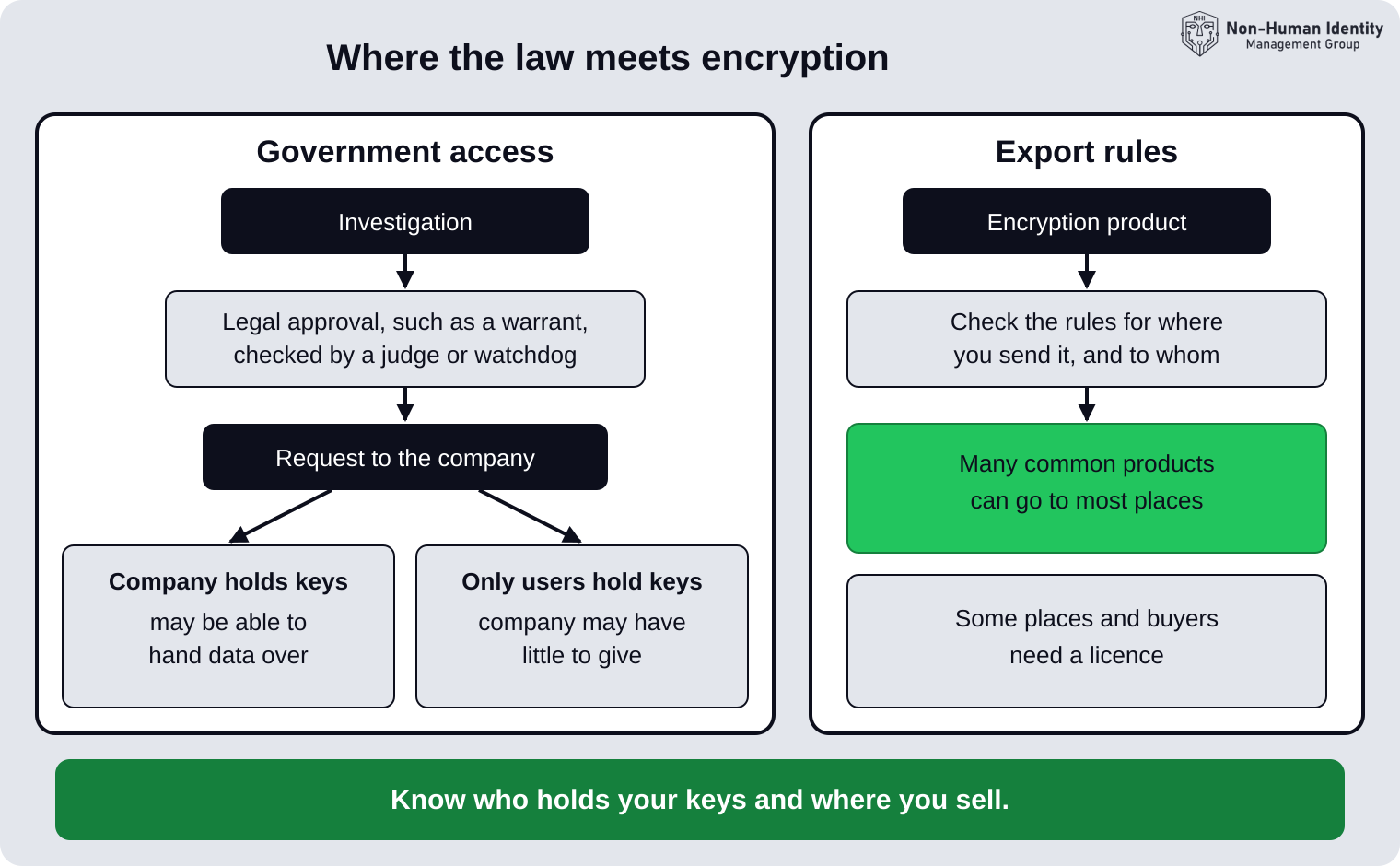
Export rules are the second area. In the US, encryption items are listed in export rules, partly through an agreement between many countries. Most encryption products can be exported to most places under a set exception. Some places and buyers still need a licence.[6]
Then there is the debate. Some people, often in law enforcement, say strong encryption can hide evidence of serious crime. Others, often in security and privacy, say a way in built for one group could be found and used by others. Both sides agree crime is real and security matters. They disagree on the trade-off.
A worked example
Hugo Achterberg is a computing student. For his final project, he builds a fictional notes app that encrypts each note. He wants to put it on an app store and sell it in several countries.
His tutor asks two questions. "Who holds the keys? And where will you sell it?"
Hugo thinks of the filing cabinet. In his first design, his server keeps a copy of every key, so users can reset forgotten passwords. That means he could read the notes if he had to. He would hold the spare key to every cabinet.
He changes the design. Each user's key is made on their phone, and his server never sees it. He adds a clear warning: if you lose your password, your notes cannot be recovered. He checks his idea with his tutor, who reminds him that design choices like this come with trade-offs for users.
Next, Hugo looks at selling abroad. Hugo studies in the US, so he reads the official US guidance on encryption exports. He learns that most products can go to most places under a set exception, but some places need a licence, and there can be paperwork. He makes a note to ask his university's legal team before he sells to anyone.
Last, Hugo writes a short page for users. It says what the app encrypts, who holds the keys and how he would respond to an official request.
His tutor marks the project well. Not because Hugo picked a side in the debate, but because he understood the questions.
Myths and mistakes
| What people think | What is true |
|---|---|
| Using encryption is suspicious. | Encryption protects everyday things such as banking, shopping and messages. |
| Police can read anything with a warrant. | A warrant lets them ask. What a company can hand over depends on who holds the keys. |
| Every country has the same rules. | Rules differ. Australia's government says its law cannot require firms to break encryption, while the UK can order some firms to keep the ability to remove protection.[1][3] |
| Export rules ban all strong encryption. | In the US, most encryption products can be exported to most places under a set exception.[6] |
| The debate has one right answer. | It is a trade-off between investigating crime and keeping data safe, and reasonable people disagree. |
What can I do this week?
- Check which of your apps use end-to-end encryption, where only you and the other person hold the keys.
- If you build software, write down who holds the keys and where you sell.
- Read your app makers' notices about features that differ by country.
- Read one official source from each side of the debate before forming a view.
Checklist
- I know what data my app or business encrypts.
- I know who holds the keys: us, our users or a supplier.
- I know which countries we sell or ship software to.
- I have read the official export guidance for my country.
- A named person handles official requests for data.
- We tell users plainly what we can and cannot read.
- We take legal advice before answering any official request.
Common questions
Is it legal to use encryption?
In many countries, yes, and it is part of everyday life: bank apps, online shops and messaging apps all use it. Rules differ between countries, so check the official rules where you live. Selling encryption products abroad can bring extra export rules.
What is an encryption backdoor?
A backdoor is a hidden way past normal security. In the encryption debate, it usually means a way for governments to read encrypted data. Critics say any such way in could also be found and used by criminals. Supporters say there must be some way to investigate serious crime.
Can the government make a company decrypt my messages?
Sometimes. It depends on the country and the company. A company can usually only hand over what it can read. If messages are end-to-end encrypted and only users hold the keys, the company may have little to give. Some laws let governments ask firms to keep the ability to help.[1]
Do export rules apply to open source code?
They can, depending on the country and the code. Export rules differ between countries and change over time, and some treat freely published code differently. Check your government's official export guidance before you publish or ship. See Encryption Export Controls Guide.
Why did a feature disappear from my app in one country?
Sometimes because of local law or a government request. In 2025 Apple said it could no longer offer one extra iCloud protection to new UK users. It said it hoped to offer it again.[5] Check your app maker's own notices for the reason.
Where next?
Ready for the detail? Read the practitioner guide: Encryption and Lawful Access Laws Compared. It goes further into how the UK, Australian, EU and US rules compare, with worked scenarios and compliance steps.
Also useful:
- Encryption for Beginners
- End to End Encryption for Beginners
- Backdoors for Beginners
- Encryption Export Controls Guide
Related NHI Mgmt Group resources: Encryption Guide · Encryption Policy Template · Computer Misuse Laws for Beginners
Key terms
- Encryption
- Turning readable data into a jumble that cannot be understood without the right key.
- Decryption
- Turning encrypted data back into readable form with the right key.
- End-to-end encryption
- Encryption where only the sender and receiver can read the message, not the service in between.
- Backdoor
- A hidden way past normal security checks.
- Export control
- Rules on which technologies can be sent to which countries and buyers.
- Lawful access
- Police or security services reading data under a legal power, such as a warrant.
Sources and further reading
- Investigatory Powers Act 2016, section 253: Technical capability notices. legislation.gov.uk, UK Government. https://www.legislation.gov.uk/ukpga/2016/25/section/253, accessed 28 Nov 2026.
- Investigatory Powers Act 2016, section 258A: Notification of proposed changes (inserted 20 June 2025 by the Investigatory Powers (Amendment) Act 2024). legislation.gov.uk, UK Government. https://www.legislation.gov.uk/ukpga/2016/25/section/258A, accessed 28 Nov 2026.
- Data encryption: the Assistance and Access Act 2018. Department of Home Affairs, Australian Government. https://www.homeaffairs.gov.au/about-us/our-portfolios/national-security/lawful-access-telecommunications/data-encryption, accessed 28 Nov 2026.
- 47 U.S. Code section 1002: Assistance capability requirements (Communications Assistance for Law Enforcement Act). Legal Information Institute, Cornell Law School. https://www.law.cornell.edu/uscode/text/47/1002, accessed 28 Nov 2026.
- Apple can no longer offer Advanced Data Protection in the United Kingdom to new users. Apple Support, Apple, 22 September 2025. https://support.apple.com/en-us/122234, accessed 28 Nov 2026.
- Encryption Controls. Bureau of Industry and Security, US Department of Commerce. https://www.bis.gov/learn-support/encryption-controls, accessed 28 Nov 2026.