An insider threat is harm caused by someone who has, or had, trusted access to an organisation.
This guide is for anyone who works in or runs an organisation and wants to understand insider risk without the jargon. You do not need a security background. Most insider problems start with ordinary access and ordinary mistakes, so simple habits make a real difference.
In short
- An insider is anyone with trusted access: staff, former staff, contractors and suppliers.
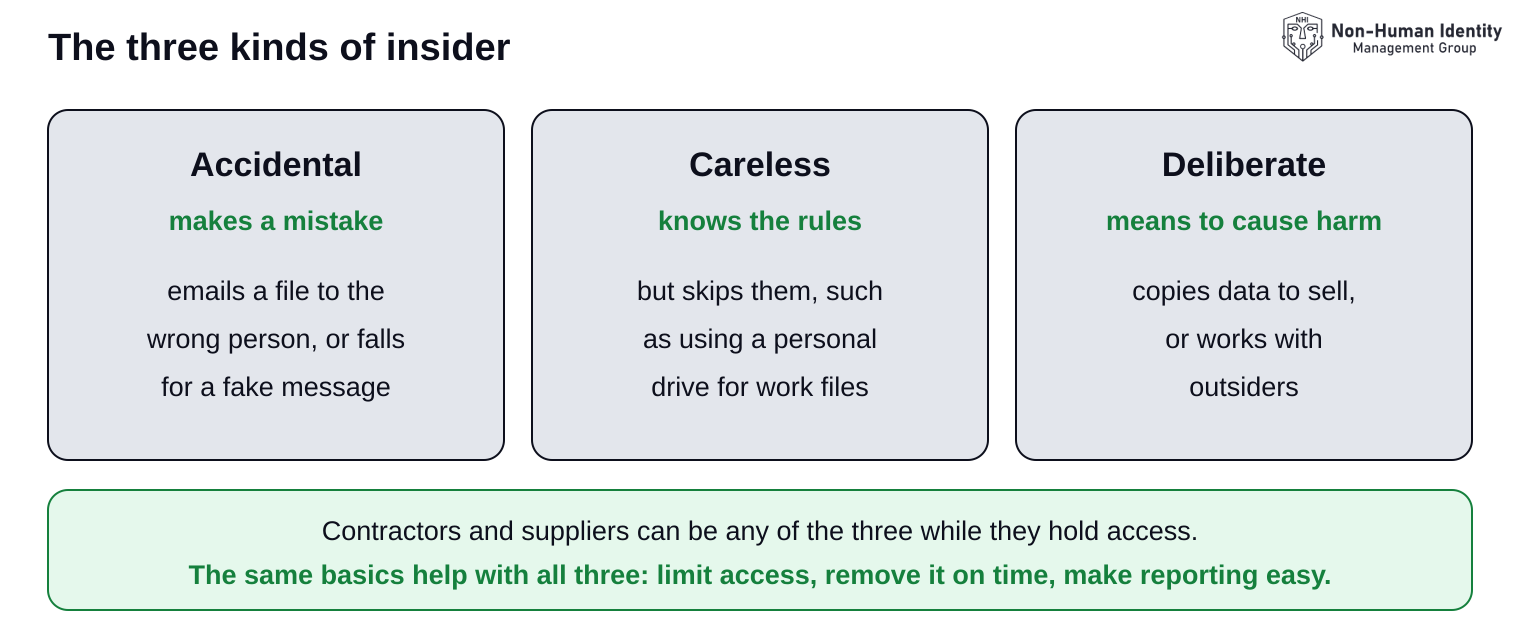
- Many insider events are honest mistakes. Some are careless, and a few are deliberate.
- Insiders do not need to break in. They use access they already have.
- Giving people only the access they need, and removing it when they leave, lowers the risk without singling anyone out.
What you will learn
- Explain what an insider threat is and the main types.
- Spot the everyday gaps that let insider harm happen.
- Check that access is removed when people leave or change jobs.
- Ask for fair controls that protect the organisation and its people.
- Trusted person (insider)
- anyone who has, or used to have, access to an organisation's systems, buildings or information.
- Only what you need (least privilege)
- giving each person only the access their job needs.
- Two people for big jobs (separation of duties)
- splitting a risky task so one person cannot do it all alone.
What is an insider threat?
Think of a shop worker who holds the key to the till. The shop trusts them, so the till opens for them without a fuss. Most workers never misuse that key. But if one makes a mistake, or decides to steal, the lock will not stop them.
An insider threat works the same way. An insider is anyone with trusted access to an organisation, such as staff, former staff, contractors or suppliers. The threat is that they use that access, on purpose or by accident, in a way that causes harm.[1]
The harm can take many forms. Customer data might be sent to the wrong person, files copied before someone leaves, or money moved without the right checks.
Where the comparison stops working: a till holds cash in one place. A worker's computer account can reach many systems at once, and copying files can leave fewer obvious signs than taking cash.
Why does it matter?
Insiders already hold keys, so walls built to keep outsiders out do not stop them. A US government security agency sorts insiders into types. Some are careless, some make mistakes, and some mean harm. Some work with outsiders, and some are contractors.[1]
If you work in an office
What could happen: you email a customer list to the wrong person, or a fake message tricks you into sharing a file.
Check this: read the address line before sending anything with personal data.
If you run a small business
What could happen: a former employee can still sign in to your shared drive months after leaving.
Check this: keep a leavers list and remove every account on the person's last day.
If you manage a team
What could happen: one person can both add a new supplier and approve payments to it, with nobody else checking.
Check this: make sure risky tasks, such as paying money, need a second person.
If you look after IT
What could happen: a contractor's account, or a shared service account used by software, keeps wide access long after the work ends.
Check this: give every account, including software accounts, a named owner and an end date.
What does it look like?
Here is a made-up "Are we exposed?" card. A small team could use one like it to spot gaps.
Example only. All values are made up.
Insider risk quick check: Example Ltd
[ ] Leavers lose all access on their last day       (1)
[ ] People who change jobs lose old access          (2)
[x] Payments over 0000 need a second approver       (3)
[ ] Contractors' accounts have an end date          (4)
[ ] Staff know how to report a mistake quickly      (5)
Result: 1 of 5 in place
- Old accounts are a common way former staff keep access.
- Access that builds up as people move is called privilege creep.
- A second person for big tasks makes misuse harder to hide.
- Third parties are insiders too while they hold access.
- Quick reporting turns a mistake into a small problem, not a big one.
Why this is risky: with only one check in place, one mistake or one bad choice could go unnoticed for a long time.
The safer way: work through the card one line at a time, starting with leavers, and check it again every few months.
How does it work?
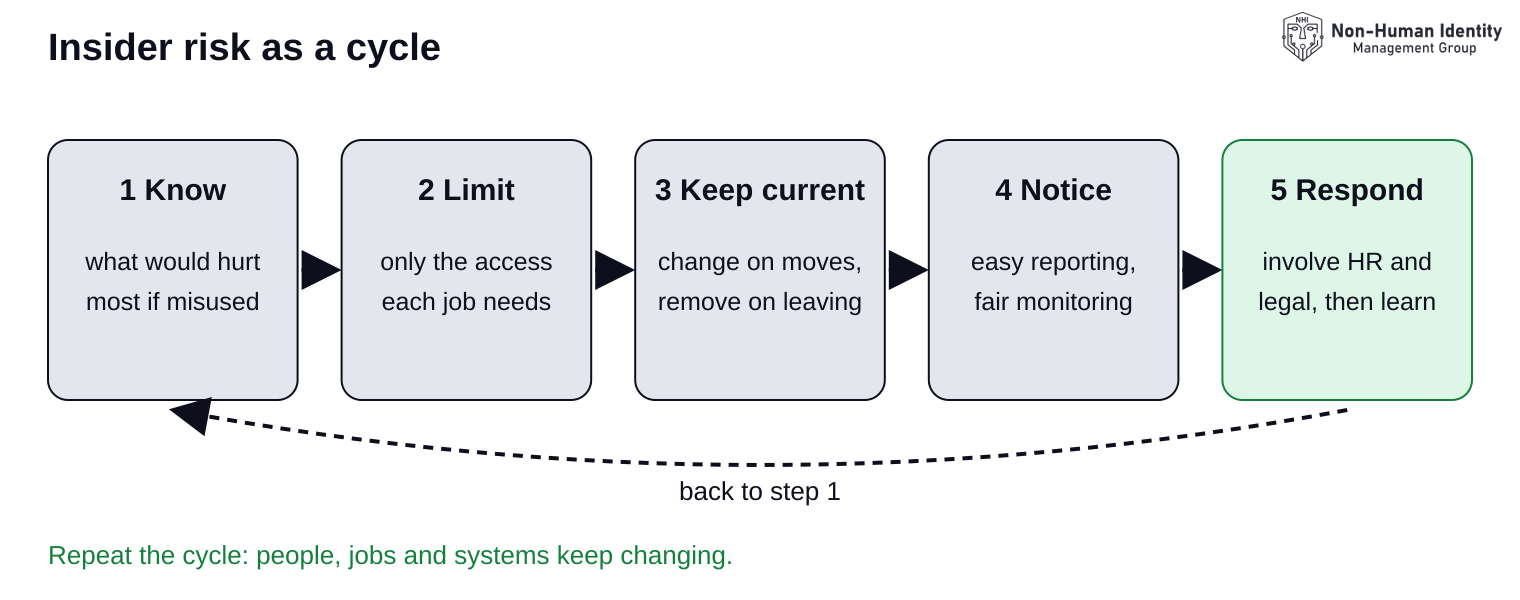
Organisations usually manage insider risk as a cycle, not a one-off project. CISA describes the work as spotting, assessing and managing the risk.[3] In plain words:
- Know what matters most. List the data, money and systems that would hurt most if misused.
- Limit access. Give people only the access their job needs, and split risky tasks between two people.
- Keep access up to date. Change access when people move roles, and remove it when they leave.
- Notice and report. Make it easy to report mistakes and worries, and watch the most sensitive systems in a fair, open way.
- Respond fairly. Look into concerns calmly, involve HR and legal, and learn from each case.
Watching staff is a sensitive step. In the UK, the Information Commissioner's Office publishes guidance for employers on monitoring workers under data protection law.[4] Controls on access protect everyone without treating anyone as a suspect.
A worked example
Benedikt Okonkwo runs a small made-up recruitment agency with twelve staff. Jarrah Ulloa looks after the agency's computers two days a week.
A client calls to say they received a spreadsheet of other clients' candidates. A staff member had picked the wrong name from the address list. It was an honest mistake, but it was still personal data in the wrong hands.
Benedikt asks Jarrah to check for other gaps. Jarrah finds that two people who left last year can still sign in to the shared drive. A temporary worker still has access to the payroll folder. And one person can both add a new supplier and pay it.
They fix the gaps in order of risk. Jarrah removes the old accounts the same day and sets an end date on the temporary worker's access. Benedikt changes the payment process so a second person must approve any new supplier.
For the email mistake, the agency follows its data breach steps and gets advice on whether to report it. Jarrah turns on a warning that asks staff to confirm before emailing files outside the agency.
At the next team meeting, Benedikt explains the changes. He says that reporting a mistake quickly is the right thing to do and will not get anyone into trouble. A month later, a staff member reports a suspicious email straight away. The agency is not risk-free, but its gaps are smaller and its people know what to do.
Real cases can cost far more than our made-up one. In 2025, the crypto exchange Coinbase told US regulators that criminals appeared to have paid some of its support staff or contractors. Coinbase estimated costs of about $180 million to $400 million.[2] You can read more in our write-up of the Coinbase insider breach.
Myths and mistakes
| What people think | What is true |
|---|---|
| Insider threat means spies and saboteurs. | Many insider events are mistakes or shortcuts. Deliberate harm is only one type.[1] |
| We trust our people, so this does not apply to us. | Good controls protect trusted people too, by making mistakes harder and easier to fix. |
| Former staff are no longer insiders. | Anyone who had access counts, especially if their accounts were never removed.[1] |
| The answer is to watch everyone closely. | Heavy monitoring raises legal and trust questions. Start with access limits and fair, open policies. |
| Only people can be insiders. | Software accounts with wide access can be misused by whoever controls them, so they need owners too. |
What can I do this week?
- Check your leavers. Compare the list of people who left this year with the accounts that can still sign in.
- Find one risky task that one person can do alone, such as paying a new supplier, and add a second approver.
- Tell staff how to report a mistake, and make clear that quick reporting is welcome.
- Review contractor access and give each contractor account an end date.
Checklist
- We know which data, money and systems matter most.
- People get only the access their job needs.
- Access changes when people move roles.
- All access is removed when someone leaves.
- Contractor and supplier accounts have owners and end dates.
- Risky tasks, such as payments, need a second person.
- Staff know how to report mistakes and worries.
- Any monitoring is fair, explained to staff and checked against the law.
Common questions
Who counts as an insider?
Anyone who has or had trusted access to a firm's systems, buildings or information.[1] That means staff and former staff. It also means contractors, temps and suppliers. What counts is the access, not the job title.
Are most insider threats deliberate?
No. The US agency's types include careless and accidental insiders as well as deliberate ones.[1] In many organisations, honest mistakes such as sending data to the wrong person are a common kind of insider event. Good habits help with all types.
Is it legal to monitor staff?
Sometimes, within limits that vary by country and by the kind of monitoring. In the UK, the Information Commissioner's Office publishes guidance for employers.[4] Take legal advice before starting any monitoring, and tell staff what is done and why.
What is the single most useful first step?
Remove access on time. Switch off every account when someone leaves. Take away old access when people change jobs. This closes a common gap, costs little and does not single anyone out.
Where next?
Ready for the detail? Read the practitioner guide: Insider Threat Programme Guide. It goes further into setting up an insider risk programme, who should be involved and how to balance detection with privacy.
Also useful:
- Joiner, Mover, Leaver for Beginners
- Least Privilege for Beginners
- Social Engineering for Beginners
- Malicious vs Negligent vs Compromised Insider
- Insider Data Theft Guide
Related NHI Mgmt Group resources: Insider Risk vs Insider Threat · Employee Offboarding Security Guide · Insider NHI Misuse Breaches Lessons Guide
Key terms
- Insider Threat
- The chance that someone with trusted access causes harm, on purpose or by accident.
- Insider Risk
- How likely insider harm is, and how bad it would be.
- Malicious Insider
- An insider who chooses to cause harm, for gain or out of a grievance.
- Negligent Insider
- An insider who knows the rules but ignores them, creating risk.
- Least Privilege
- Each person and program gets only the access it needs, for only as long as needed.
- Separation of Duties
- Splitting a risky task so no single person can complete it alone.
- Offboarding
- Removing access in a controlled way when a person, contractor or system no longer needs it.
Sources and further reading
- Defining Insider Threats. Cybersecurity and Infrastructure Security Agency (CISA). https://www.cisa.gov/topics/physical-security/insider-threat-mitigation/defining-insider-threats, accessed 28 Nov 2026.
- Coinbase Global, Inc. Form 8-K, filed 15 May 2025. US Securities and Exchange Commission. https://www.sec.gov/Archives/edgar/data/1679788/000167978825000094/coin-20250514.htm, accessed 28 Nov 2026.
- Insider Threat Mitigation Guide. Cybersecurity and Infrastructure Security Agency (CISA). https://www.cisa.gov/resources-tools/resources/insider-threat-mitigation-guide, accessed 28 Nov 2026.
- Employment practices and data protection: monitoring workers. Information Commissioner's Office (ICO), UK. https://ico.org.uk/for-organisations/uk-gdpr-guidance-and-resources/employment/monitoring-workers/, accessed 28 Nov 2026.
- Common Sense Guide to Mitigating Insider Threats, Seventh Edition. Software Engineering Institute, Carnegie Mellon University, 7 September 2022. https://www.sei.cmu.edu/library/common-sense-guide-to-mitigating-insider-threats-seventh-edition/, accessed 28 Nov 2026.