ISO 22301 is an international standard for keeping an organisation running through disruption and recovering afterwards.
This guide is for managers, small business owners and anyone asked to "look into ISO 22301". You do not need a technical job to be affected: a flood, a power cut or a cyber attack can stop any business, and customers increasingly ask how you would cope.
In short
- ISO 22301 sets out what a well run business continuity system should include.
- It asks you to find what matters most, plan how to keep it going, practise the plan and keep improving.
- Any type or size of organisation can use it, and an outside auditor can certify you against it.
- The current version is from 2019, with a small 2024 change on climate. A new edition is being drafted.
What you will learn
- Explain what ISO 22301 asks for, in plain words.
- Spot the difference between having a plan and having a continuity system.
- Check whether your business has thought about its most important work.
- Ask sensible questions before deciding whether to seek a certificate.
Status: correct as at 28 November 2026, based on ISO's published pages for ISO 22301:2019 and its 2024 amendment. Standards change; check the official text.
This guide explains the topic in general terms and is not legal advice.
- Keeping going (business continuity)
- carrying on with your most important work when something breaks.
- Impact check (business impact analysis)
- working out which activities matter most and how long you could cope without each one.
- Practice run (exercise)
- testing a plan by walking through a pretend disruption.
What is ISO 22301?
Think of a spare tyre and a breakdown plan. The spare gets you moving again, and the plan says who to call and how you get home.
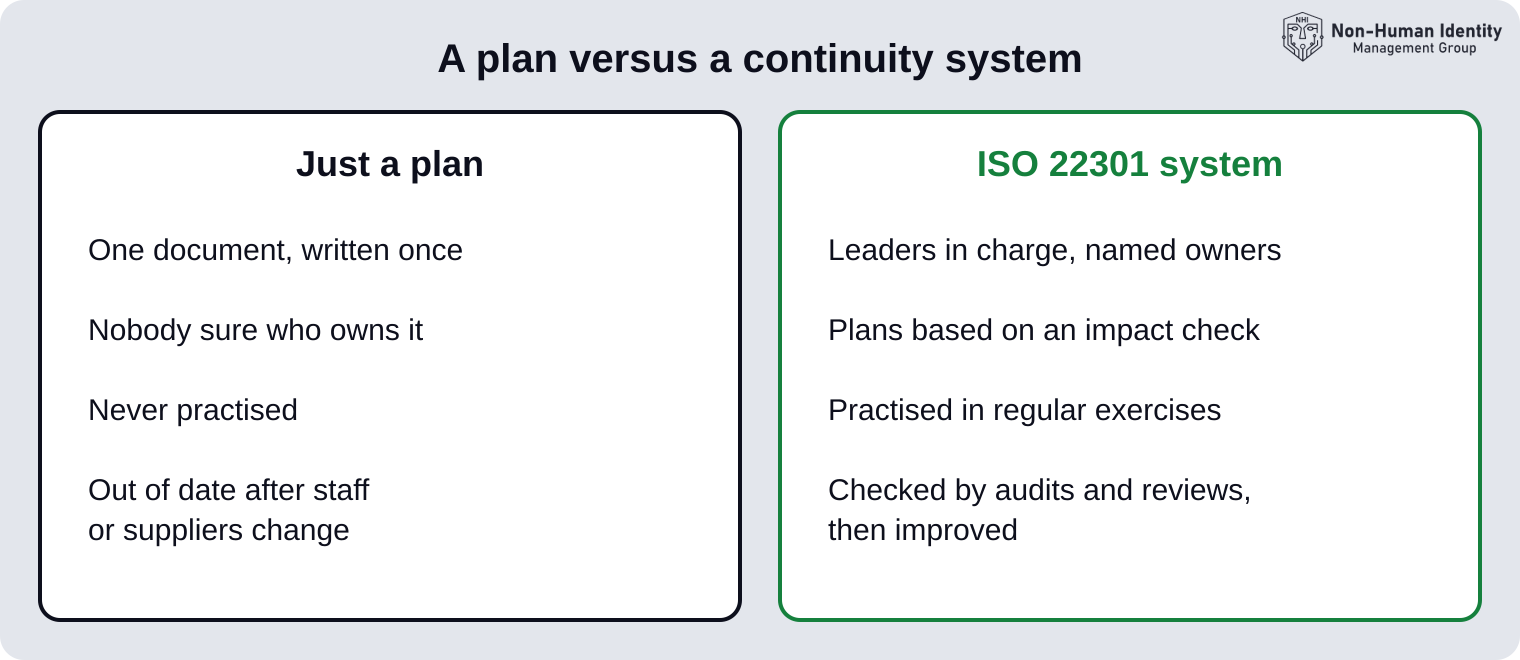
Business continuity is that idea for an organisation. This standard is the agreed rulebook for it. It does not just ask for a plan. It asks for a whole system around the plan, called a business continuity management system. That means people in charge, a clear view of what matters most, plans that are practised, and regular checks.
The standard's own scope sets out the aim. It is to protect against disruption and make it less likely. It is also to prepare for it, respond to it and recover from it.[3]
It is written for any kind of organisation, large or small.[1] You can use it simply as good practice. You can also ask an outside auditor to check you against it and award a certificate.[6]
Where the comparison stops working: a spare tyre fixes one kind of problem. A business can be hit by many kinds at once, such as a cyber attack that also takes out a key supplier.
Why does it matter?
When work stops, customers wait, money stops coming in and staff do not know what to do. A tested plan shortens that confusion. A certificate can also show customers that you take it seriously.
If you own a small business
What could happen: your till system goes down for a day and nobody knows how to keep serving customers.
Check this: pick your two most important activities and write how you would keep them going for a day.
Next: Business Continuity and Disaster Recovery for Beginners
If you are a manager
What could happen: a big customer asks for proof of continuity planning, and all you have is an old document.
Check this: find out when your plan was last tested, and who owns it.
If you are thinking about a career in resilience
What could happen: job adverts ask for knowledge of the standard and you are not sure what it covers.
Check this: learn the main stages: understand, prepare, practise, check and improve.
Next: Business Continuity and Resilience Manager Career Guide
What does it look like?
Here is a made-up page from an impact check. This is often the first real piece of work in a continuity project.
Example only. All values are made up.
Impact check: EXAMPLE Pharmacy Ltd
Activity                  Can cope without it for   Restore order
Handing out prescriptions 4 hours                   1st    (1)
Online repeat orders      1 day                     2nd    (2)
Stock ordering system     2 days                    3rd
Staff rota spreadsheet    1 week                    4th    (3)
Plan last tested:         0000-00-00 (never)               (4)
- In a real file, this line would show the activity that hurts customers most if it stops.
- Each activity gets an honest time limit, agreed with the people who do the work.
- Not everything is urgent. Ranking helps you spend effort where it counts.
- A plan that has never been practised is a guess.
Why this is risky: the pharmacy knows what matters most, but has never tested its plan. On the day, people may find that the backup laptop is missing or the phone list is out of date.
The safer way: use the impact check to write simple plans for the top activities. Then run a short practice, fix what goes wrong and record it. The standard has a section on impact checks and another on practice runs.[4]
How does it work?
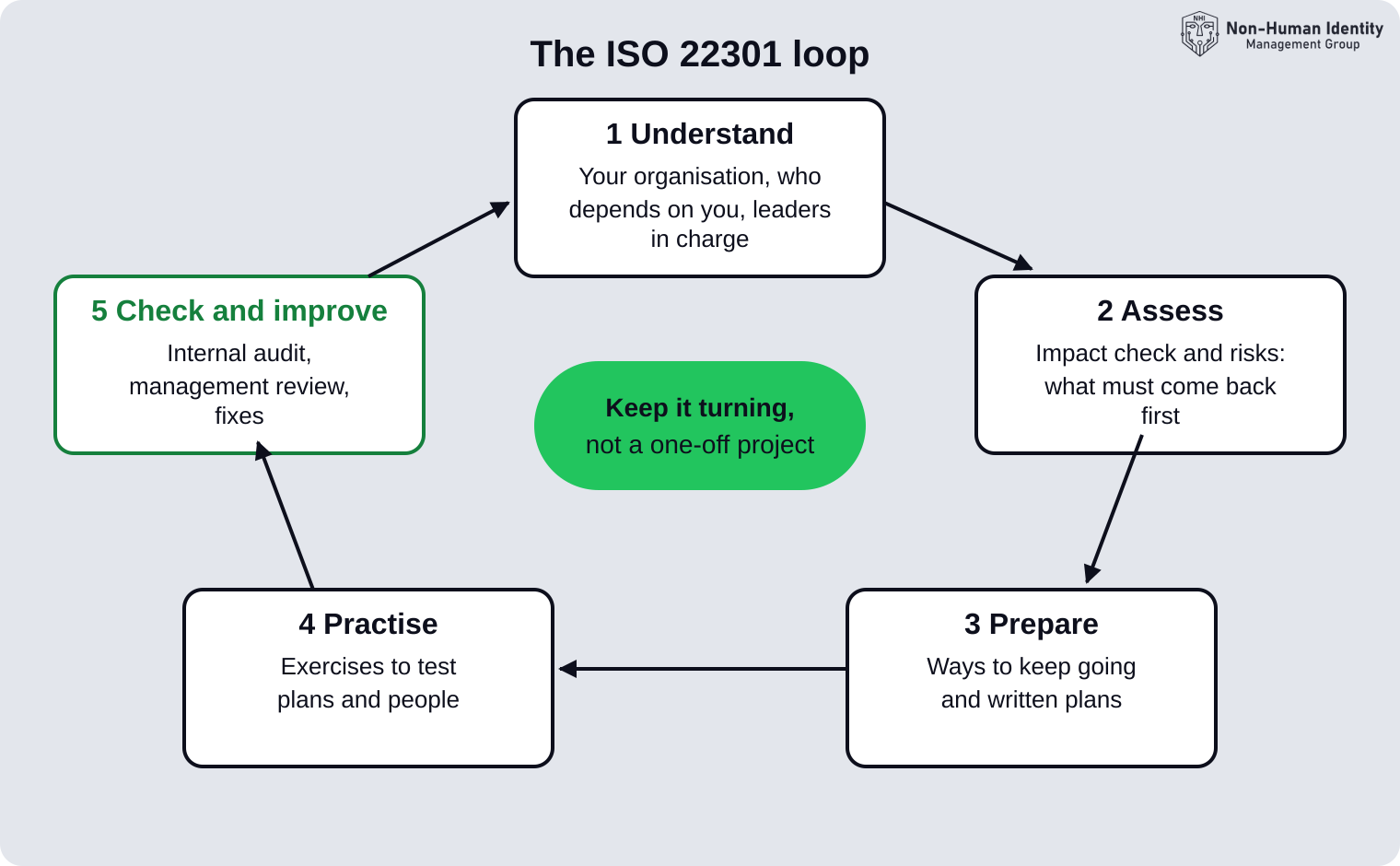
The standard works as a loop that keeps turning, so the work is never really finished. Its main parts cover the following steps, in this order.[4]
- Understand. Look at your organisation, the people who depend on you and what could go wrong. Senior leaders take charge and set the direction for everyone else.
- Assess. Do the impact check and look at the risks to each activity. Then decide which activities must come back first, and how fast they need to return.
- Prepare. Choose ways to keep going, such as a second site or a paper backup. Write plans that say who does what, how people are warned and how you recover.
- Practise. Run exercises to test the plans and the people who will have to use them on a bad day.
- Check and improve. Run internal audits and hold a management review with senior leaders. Then fix the problems you find and get a little better each time.
A professional body, the Business Continuity Institute, publishes practical good practice guidance that helps people put the standard's requirements into action.[5]
A worked example
Talia Fairweather runs Juniper Pharmacy, a fictional chemist with three branches. A care home group wants to sign a big contract, but first asks how the pharmacy would cope with a major disruption.
Talia calls Kaia Ilic, a business continuity adviser. "Do I need a certificate?" Talia asks. "Not straight away," Kaia says. "Start by doing what the standard asks, then decide."
First, they run an impact check with the branch managers. Handing out prescriptions comes top. They agree it should be back within a few hours. The staff rota can wait a week.
Next, they write a short plan for the top activities. It covers who leads, how staff are told, and how to keep serving from another branch if one site is closed.
Then they run a one hour practice, pretending the main branch has a power cut. They find that the spare laptop has not been updated for months, and two phone numbers are wrong. They fix both and record what happened.
Talia sends the care home group a summary of the impact check, the plan and the practice record. The group is satisfied for now.
Six months later, Talia reviews the plan, runs a second practice and starts talking to a certification body.
Myths and mistakes
| What people think | What is true |
|---|---|
| Business continuity just means having a plan. | The standard asks for a whole system: leaders, an impact check, plans, practice, audits and improvement. |
| It is only for big companies. | It is written for organisations of any type or size. |
| It is the same as disaster recovery. | Getting IT back is one part. The standard covers keeping the whole business going, including people, sites and suppliers. |
| Once certified, you are done. | The system has to keep running, with practice, audits and reviews. |
| You must be certified to use it. | Certification is a choice. Many organisations use the standard as good practice. |
What can I do this week?
- List your five most important activities and how long you could cope without each one.
- Find your current plan, if you have one, and check its date and owner.
- Book a one hour practice run with your managers.
- Ask your key suppliers how they would keep serving you through a disruption.
Checklist
- A senior person is in charge of business continuity.
- We know our most important activities and how long we could cope without each.
- We have written plans for the top activities, with named owners.
- Staff know how they will be told what to do in a disruption.
- We practise our plans at least once a year.
- We record what went wrong in each practice and fix it.
- We review the system when the business, sites or suppliers change.
Common questions
Is ISO 22301 a legal requirement?
Not in general. It is a voluntary standard. Some customers or contracts may ask for it, and some regulated sectors have their own continuity rules. Check the rules for your sector and the terms of your contracts.
Can a small business get ISO 22301 certified?
Yes. The standard is written for organisations of any type or size, and certification bodies offer audits against it. A small business usually has a simpler system, but it still needs leaders in charge, an impact check, plans, practice and reviews.
What is the difference between ISO 22301 and ISO 27001?
ISO 22301 is about keeping the whole organisation running through disruption. ISO 27001 is about keeping information secure. They share a similar structure, so many organisations run them side by side. See ISO 27001 for Beginners.
Is ISO 22301 changing?
Yes, slowly. A 2024 amendment added climate action changes to the 2019 version. ISO also lists a new edition at committee draft stage, which will replace the 2019 version once published.[2] Check the ISO page for the latest status.
What is a business impact analysis?
It is a structured look at which activities matter most and how long you could cope without each one. It tells you what to restore first. The standard asks for it as part of planning, alongside an assessment of risks.
Where next?
Ready for the detail? Read the practitioner guide: ISO 22301 Business Continuity Guide. It goes further into the requirements clause by clause, implementation steps, audit evidence and mapping to other frameworks.
Also useful:
- ISO 22301 Lead Implementer
- Business Continuity and Disaster Recovery for Beginners
- Tabletop Exercises for Beginners
- Business Continuity Plan Template
- ISO/IEC 27036 for Beginners
Related NHI Mgmt Group resources: Business Continuity Certifications · Business Impact Analysis vs Cyber Risk Assessment · Operational Resilience vs Business Continuity
Key terms
- Business continuity
- Keeping the most important work going through a disruption, and recovering afterwards.
- Business continuity management system
- The people, plans, practice and checks an organisation uses to run business continuity.
- Business impact analysis
- A check of which activities matter most and how long you could cope without each.
- Business continuity plan
- A written plan for keeping important work going during a disruption.
- Recovery time objective
- The longest acceptable time to get an activity or service back after it stops.
- Business continuity exercise
- A planned practice of a disruption, used to test plans and people.
Sources and further reading
- ISO 22301:2019 Security and resilience, Business continuity management systems, Requirements. ISO. https://www.iso.org/standard/75106.html, accessed 28 Nov 2026.
- ISO 22301:2019/Amd 1:2024 Climate action changes; and ISO/CD 22301 (edition 3, under development). ISO. https://www.iso.org/standard/88412.html and https://www.iso.org/standard/93606.html, accessed 28 Nov 2026.
- ISO 22301:2019 product page (scope). Swedish Institute for Standards (SIS). https://www.sis.se/en/produkter/sociology-services-company-organization/company-organization-and-management/general/iso-223012019/, accessed 28 Nov 2026.
- DIN EN ISO 22301:2019 table of contents. DIN. https://www.din.de/de/mitwirken/normenausschuesse/naorg/veroeffentlichungen/wdc-beuth:din21:316071769/toc-3122157/download, accessed 28 Nov 2026.
- Good Practice Guidelines. Business Continuity Institute. https://www.thebci.org/training-qualifications/good-practice-guidelines.html, accessed 28 Nov 2026.
- Introduction to ISO 22301 (certification services). BSI. https://bsigroup.com/en-ZA/ISO-22301-Business-Continuity/Introduction-to-ISO-22301, accessed 28 Nov 2026.