ISO/IEC 27036 is an international standard on keeping information safe when you work with suppliers.
This guide is for students, people new to risk and compliance work, and anyone who buys or sells services. You do not need a security job to be affected: if your business uses an IT firm, a cloud app or a payroll service, your information is partly in their hands.
In short
- ISO/IEC 27036 is a family of four guides about security between a buyer and its suppliers.
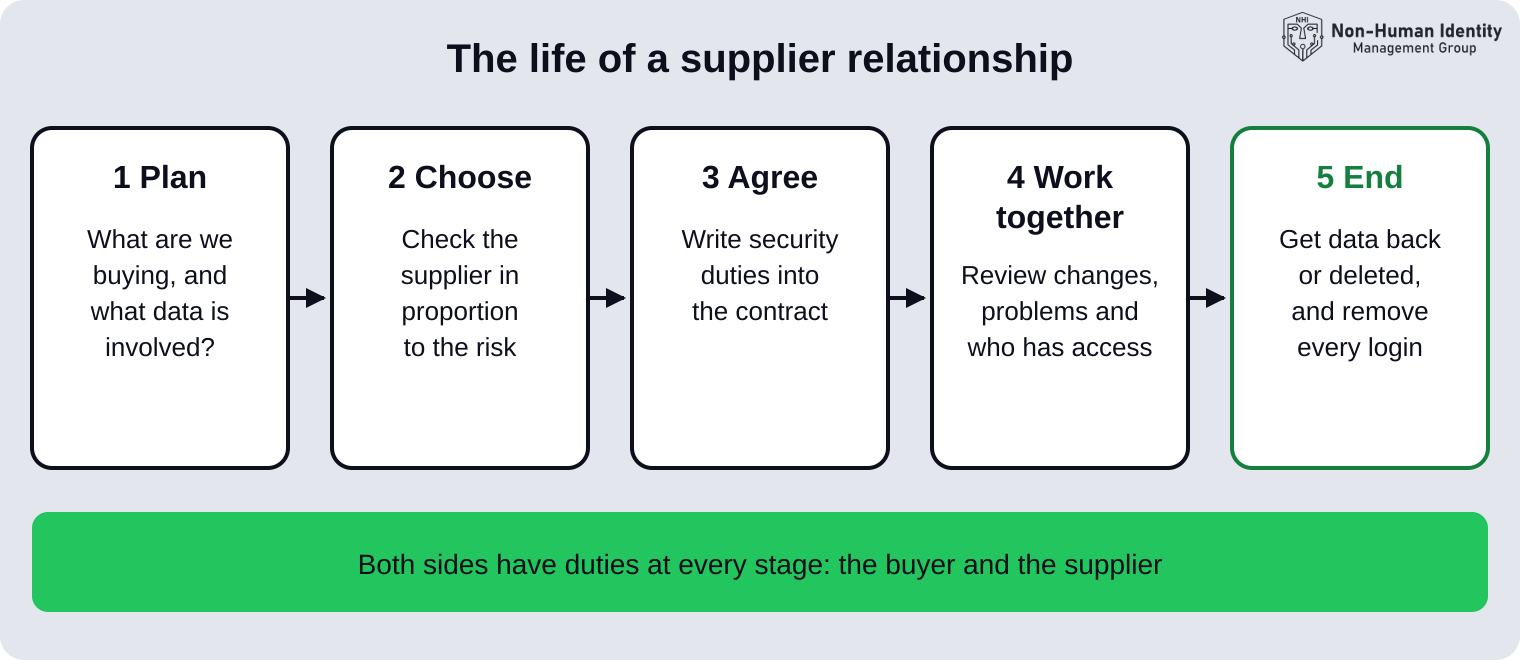
- It covers the whole relationship: planning, choosing, the contract, day to day work and the ending.
- It speaks to both sides, so suppliers can use it as well as buyers.
- Most people meet it alongside ISO 27001, the better known security standard.
What you will learn
- Explain what ISO/IEC 27036 is and what its four parts cover.
- Spot the stages of a supplier relationship where security can slip.
- Check that a supplier contract says who does what for security.
- Ask a supplier sensible first questions, or answer them if you are the supplier.
Status: correct as at 28 November 2026, based on ISO's published pages for the ISO/IEC 27036 parts. Standards change; check the official text.
This guide explains the topic in general terms and is not legal advice.
- Buyer (acquirer)
- the organisation that buys a product or service from someone else.
- Seller (supplier)
- the organisation that provides that product or service.
- Chain of suppliers (supply chain)
- your suppliers, their suppliers, and so on down the line.
What is ISO/IEC 27036?
Think of a tenancy agreement. The landlord and the tenant both have duties, from the first viewing to the day the keys go back. A good agreement writes those duties down before anyone moves in.
This standard does the same for security between a business and its suppliers. It is written for the buyer, which the standard calls the acquirer, and for the supplier. It helps both sides agree how information will be protected while they work together.
It is not one document. It is a series of four parts. The first part is an overview that explains the ideas. The others go into detail for different kinds of supply, such as software, hardware and cloud services.
The series is published by two international standards groups working together. That is why its name carries two sets of letters.
Where the comparison stops working: a flat usually has one landlord. A business may have hundreds of suppliers, and each of those has suppliers of its own. Your information can travel several steps away from you.
Why does it matter?
Suppliers often hold your data. Some can log in to your systems. If their security is weak, a problem at their end can soon become yours.
The UK's cyber security agency suggests understanding the risks, setting controls, checking them and improving over time.[5] This standard gives a shared language for doing that with each supplier.
If you buy services for a small business
What could happen: your IT firm keeps a shared login to your systems, and nobody removes it when the contract ends.
Check this: list who outside the business can log in, and when each contract ends.
If you run a small supplier
What could happen: a big customer sends a long security questionnaire, and you lose the deal because you cannot answer it.
Check this: write down how you protect customer data, who can reach it and how you would tell a customer about a problem.
If you are studying risk and compliance
What could happen: you learn the main security standard but miss how it treats suppliers.
Check this: see how supplier rules in the main standard link to this series.
What does it look like?
Here is a made-up check card. A small business might fill one in before it signs with a new supplier.
Example only. All values are made up.
Supplier check card: EXAMPLE Booking Software Ltd
What they do for us:   online booking and customer list
Our data they hold:    customer names, phone numbers   (1)
Can they log in to us? yes, one support account         (2)
Their own suppliers:   hosted on a cloud service        (3)
Security in contract?  not yet                          (4)
Contract ends:         0000-00-00 (to be agreed)        (5)
- In a real file, this line would list the personal data the supplier keeps.
- Note every way in to your systems, even accounts and keys used by programs.
- Your data may sit with a supplier's supplier. That is one step further away.
- Duties that are not written down are hard to rely on later.
- The end date tells you when to get your data back and remove access.
Why this is risky: the supplier holds customer data and can log in. But the contract says nothing about security. If something goes wrong, nobody has agreed who must act, or how fast.
The safer way: agree the duties in writing before you sign. Say how data is kept safe and who may log in. Say how problems are reported, and what happens to the data at the end. Part 2 of the standard is built around this kind of agreement.[2]
How does it work?
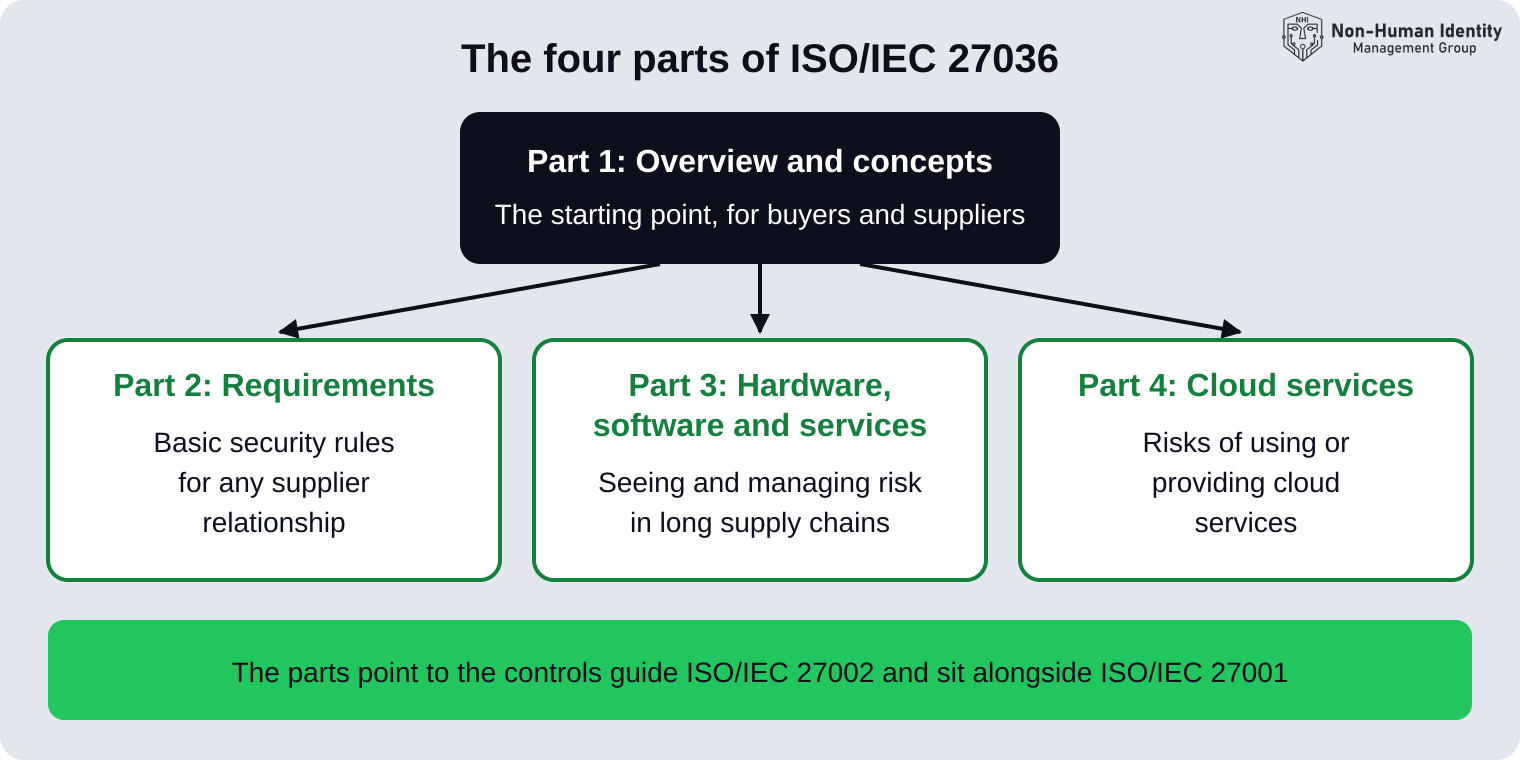
The four parts each have a job.
- Part 1, the overview. It introduces the series and its ideas, for both buyers and suppliers.[1]
- Part 2, the requirements. It sets basic security requirements for setting up, running, checking and improving supplier relationships. It is meant for any type of supply and any size of organisation.[2]
- Part 3, hardware, software and services. It helps you see and manage risk in long supply chains, where products pass through many hands before they reach you.[3]
- Part 4, cloud services. It helps cloud customers and cloud providers understand and manage the risks of using cloud services.[4]
Part 2 talks about relationships that are defined, put in place, run, checked and improved.[2] A simple way to picture that is as five stages, shown below. This picture is our summary, not the standard's own wording.
The parts are guides you buy from ISO or a national standards body. They point to the general security controls in ISO/IEC 27002 rather than repeating them.[3][6]
A worked example
Leila Novak runs Teal Florist, a fictional flower shop with a website and six staff. She wants a new online ordering system.
Kofi Pereira, a friend who works in risk and compliance, suggests she treat it like renting a flat. "Agree the duties before you move in, not after," he says.
First, Leila writes down what the supplier will hold: customer names, addresses and order history. She also notes that the supplier wants a login to her website for support.
Next, she asks the supplier three questions. How do you protect customer data? Who in your team can see it? Which other companies host it for you? The supplier answers clearly and names its cloud provider.
Then Kofi helps her check the contract. It says nothing about telling her if the supplier has a security problem. Leila asks for a line that says they will tell her promptly. She also asks what happens to her data if she leaves.
After launch, Leila puts a reminder in her calendar. Twice a year she checks who can log in and asks the supplier about any changes.
A year later Leila switches to a cheaper supplier. Because the exit was agreed in advance, she gets her order history back as a file. She removes the old support login the same day.
None of this needed a security team. It needed the duties written down and checked at each stage, which is the idea behind the standard.
Myths and mistakes
| What people think | What is true |
|---|---|
| Supplier security is the supplier's problem. | The standard is written for both sides. The buyer still decides what to share and what to ask for. |
| Checking a supplier once, before signing, is enough. | Relationships change. The standard covers running, checking and improving them over time. |
| It only matters for big software deals. | Part 2 is meant for any type of supply and any size of organisation. |
| The contract ending is the end of the risk. | Old logins and copies of your data can remain. Plan the exit on day one. |
| A supplier's certificate answers every question. | A certificate covers a stated scope. Check that it covers the service you are buying. |
What can I do this week?
- List your five most important suppliers and what data or access each one has.
- Find the contract for one of them and look for any security wording.
- Note which suppliers can log in to your systems, including accounts and keys used by their programs.
- Write down what should happen to your data when each contract ends.
Checklist
- We have a list of suppliers, with the data and access each one holds.
- Bigger risks get a closer check before we sign.
- Contracts say how data is protected and how problems are reported.
- Every outside login has a named owner on our side.
- We review important suppliers at least once a year.
- We know which of our suppliers rely on other suppliers, such as cloud hosts.
- Each contract has an agreed exit: data back or deleted, access removed.
Common questions
Is ISO/IEC 27036 the same as ISO 27001?
No. ISO 27001 sets out how to run a security management system across a whole organisation. ISO/IEC 27036 zooms in on one area, supplier relationships, and gives more detailed guidance for it. Many organisations use the two together.
Who is ISO/IEC 27036 for?
It is for both buyers and suppliers. Part 1 says it addresses both sides of the relationship, and Part 2 is written for organisations of any type or size. A small supplier can use it to understand what customers are likely to ask.
Does ISO/IEC 27036 cover cloud services?
Yes, in Part 4. It helps cloud customers see and manage the risks of using cloud services, and helps providers respond to them. It does not explain how a provider should run its own security; ISO points to other standards for that.
Does it cover keeping services running in a crisis?
Not directly. ISO says Parts 3 and 4 do not cover business continuity issues and points to a separate standard for that. For keeping work going through disruption, see ISO 22301 for Beginners.
Where can I read the full text?
You buy the parts from ISO or your national standards body. The ISO website shows a free summary of each part. Read the summary first to decide which part you need, then check the full text before quoting it in an audit or contract.
Where next?
Ready for the detail? Read the practitioner guide: ISO/IEC 27036 Supplier Relationships Guide. It goes further into each lifecycle stage, contract terms for supplier logins and keys, and how to map the series to other frameworks.
Also useful:
- Third Party Risk Management for Beginners
- Third Party Access for Beginners
- ISO 27001 for Beginners
- ISO 27002 for Beginners
- Supplier Security Policy Template
Related NHI Mgmt Group resources: Supplier Security Audit Guide · Answering Security Questionnaires as a Small Supplier · Supply Chain Attacks for Beginners
Key terms
- Acquirer
- The organisation that buys a product or service from a supplier.
- Supplier
- The organisation that provides a product or service to a buyer.
- Supply chain
- The line of suppliers, and their suppliers, behind a product or service.
- Third-party risk management
- The repeatable way an organisation finds, checks, contracts, monitors and leaves suppliers according to their risk.
- Vendor risk assessment
- A check of how likely a supplier is to cause harm, and how bad that harm could be.
- ISO 27001
- The international standard for running a security management system that can be audited and certified.
Sources and further reading
- ISO/IEC 27036-1:2021 Cybersecurity, Supplier relationships, Part 1: Overview and concepts. ISO. https://www.iso.org/standard/82905.html, accessed 28 Nov 2026.
- ISO/IEC 27036-2:2022 Cybersecurity, Supplier relationships, Part 2: Requirements. ISO. https://www.iso.org/standard/82060.html, accessed 28 Nov 2026.
- ISO/IEC 27036-3:2023 Cybersecurity, Supplier relationships, Part 3: Guidelines for hardware, software, and services supply chain security. ISO. https://www.iso.org/standard/82890.html, accessed 28 Nov 2026.
- ISO/IEC 27036-4:2016 Information security for supplier relationships, Part 4: Guidelines for security of cloud services. ISO. https://www.iso.org/standard/59689.html, accessed 28 Nov 2026.
- Principles of supply chain security. National Cyber Security Centre (UK). https://www.ncsc.gov.uk/collection/supply-chain-security/principles-supply-chain-security, accessed 28 Nov 2026.
- ISO/IEC 27002:2022 Information security, cybersecurity and privacy protection, Information security controls. ISO. https://www.iso.org/standard/75652.html, accessed 28 Nov 2026.