ISO/IEC 27001 is the international standard that sets out how an organisation should run an information security management system (ISMS): a managed, repeatable way of finding information risks, choosing controls and improving them over time, which an independent auditor can certify.
This guide is for newcomers, students, career changers and managers who keep seeing "ISO 27001 certified" in tenders and supplier questionnaires and want to know what it really means. It explains the standard in plain English, how an ISMS works step by step, what certification involves and what it does not prove. It covers the current 2022 edition and links deeper guides for each clause and control set.
By the end of this guide you will be able to:
- Explain what ISO 27001 and an ISMS are.
- Describe the main steps of building and running an ISMS.
- Understand what certification involves and who carries it out.
- Identify sensible first steps for a small organisation.
Status: correct as at 27 November 2026, based on ISO's published pages for ISO/IEC 27001:2022 and its 2024 amendment, and the accreditation transition notices from IAF and UKAS. Standards change; check the official text.
This guide explains the topic in general terms and is not legal advice.
Key takeaways
- It is about management, not just technology. ISO 27001 asks you to run security as a managed system with owners, risk decisions, records and reviews.
- Risk drives the controls. You assess your own information risks, then choose controls to treat them, using the 93 controls in Annex A as a reference list.
- ISO does not certify anyone. Independent certification bodies audit organisations; accredited ones are checked by national accreditation bodies.
- Certification is a cycle. An initial two-stage audit is followed by regular surveillance audits and recertification, so the system has to keep working.
- A certificate has a scope. It covers what is written in the scope statement, which may be part of an organisation, not all of it.
What it is, in plain English
ISO/IEC 27001 is published jointly by the International Organization for Standardization (ISO) and the International Electrotechnical Commission (IEC). ISO calls it the world's best-known standard for information security management systems, and says it helps organisations of all sectors and sizes protect the confidentiality, integrity and availability of data.[1] The current edition, ISO/IEC 27001:2022, was published on 25 October 2022.[2] A short amendment on climate action changes was published in 2024.[6]
An information security management system (ISMS) is not a piece of software. It is the set of policies, roles, processes, risk decisions and records an organisation uses to manage information security, and it is what auditors assess. The standard's main requirements sit in clauses 4 to 10, covering context and scope, leadership, planning, support, operation, performance evaluation and improvement. At the back, Annex A lists reference controls. The 2022 edition has 93 Annex A controls, down from 114 in the 2013 edition, grouped into four themes: organisational, people, physical and technological.[4] A companion standard, ISO/IEC 27002:2022, gives guidance on those controls.[5]
A helpful comparison is a restaurant's food safety system. Inspectors do not just taste one meal. They check that the kitchen knows its hazards, has rules to manage them, trains staff, keeps temperature records and fixes problems when they appear. ISO 27001 does the same for information. Where the analogy breaks down: food safety rules are largely set by law, while ISO 27001 lets each organisation decide its own risks and which controls fit, as long as it can justify those choices.
Why it matters to you
- If you run a small business: larger customers often ask suppliers for ISO 27001 certification, or for answers to questions based on it. Understanding it helps you decide whether certification is worth the effort or whether a smaller step fits better for now.
- If you are new to a security job: you are likely to help with risk registers, evidence collection or internal audits. Knowing the vocabulary (scope, Statement of Applicability, nonconformity) makes that work much easier.
- If you are a manager: the standard expects top management to lead the ISMS, set objectives and review it. It is not something the IT team can do alone.
ISO notes that certification is possible but not obligatory.[1] Some organisations follow the standard without certifying, to improve how they manage security; others certify because customers or contracts expect it.
How it works, step by step
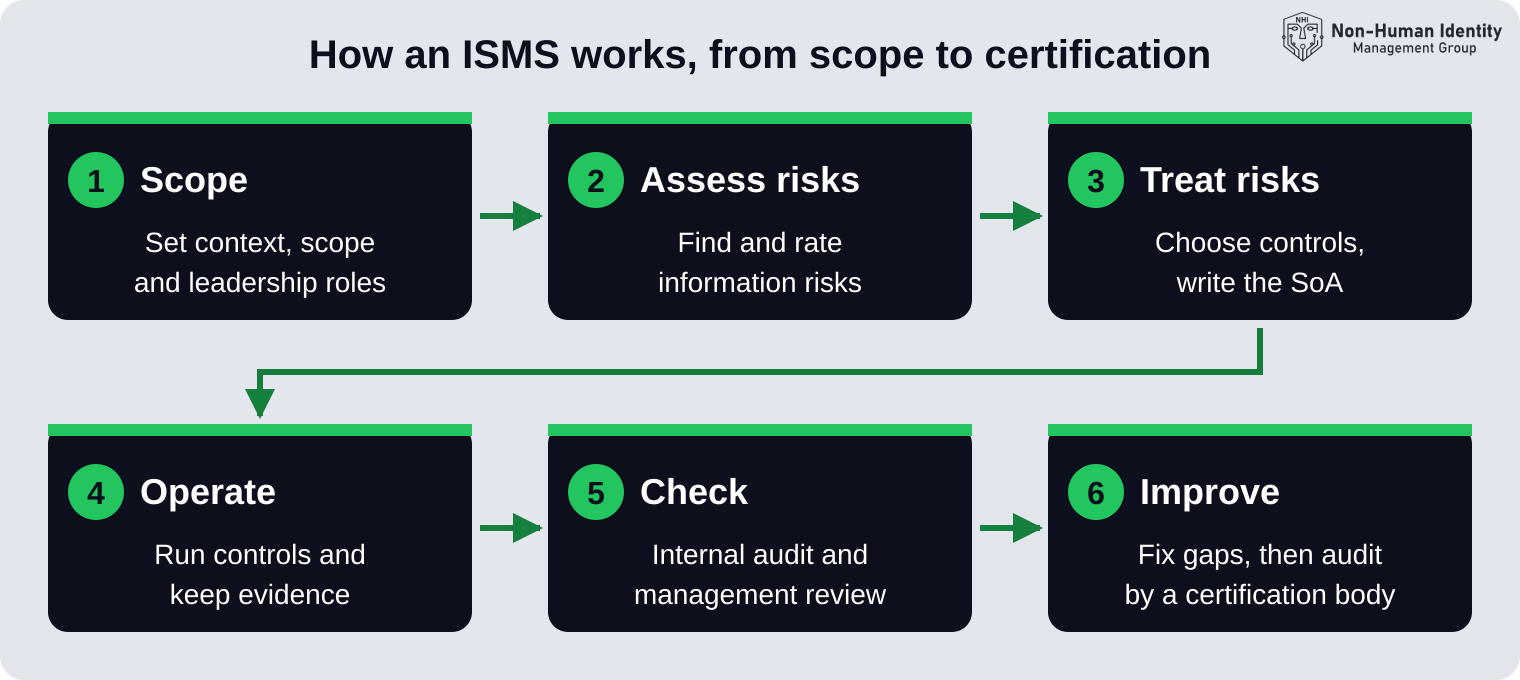
Building and running an ISMS usually follows this order. The detail of each step is in the clause guides linked at the end.
- Set the context and scope. Work out what the organisation does, who cares about its information (customers, regulators, staff) and which parts the ISMS will cover. Write a scope statement.
- Get leadership commitment. Top management approves an information security policy, assigns roles and provides resources.
- Assess risks. List information assets and what could go wrong with them, then rate each risk by likelihood and impact using a method you can repeat.
- Treat risks and choose controls. Decide for each risk whether to reduce, avoid, share or accept it. Compare your chosen controls with Annex A and record the result in a Statement of Applicability (SoA), which lists each control, whether it applies and why.
- Operate the controls and keep evidence. Put the controls in place, train staff and keep records that show they work, such as access reviews, backup tests and incident logs.
- Check. Measure how the ISMS is doing, run internal audits and hold a management review where leaders look at results, risks and changes.
- Improve. Fix problems found (called nonconformities) with corrective action, and keep improving. When ready, invite a certification body to audit.
What certification involves
ISO itself does not perform certification.[1] Independent certification bodies do. An accredited certification body has been assessed by a national accreditation body, such as UKAS in the UK, which checks that it audits competently. The table below shows a typical cycle as described in one certification body's published guidelines, which state that they follow ISO/IEC 17021-1, the international standard for bodies that certify management systems.[7] Details vary between certification bodies.
| Stage | What happens |
|---|---|
| Stage 1 audit | Review of the documented system and readiness for Stage 2, with at least part on site |
| Stage 2 audit | On-site audit of how the system is implemented and how well it works, including internal audits and management review |
| Certification decision | After nonconformities are corrected, the body decides; the certificate shows the standard, scope and start and expiry dates |
| Surveillance audits | At least once per calendar year, the first within 12 months of certification; they sample parts of the system |
| Recertification | A full audit in the third year, because the certificate is valid for three years |
Useful distinctions
- ISO 27001 versus ISO 27002. ISO 27001 holds the requirements you are certified against. ISO 27002 gives guidance on the controls; you are not certified against it.[5]
- Annex A is a reference list, not a checklist. You must consider each control and justify including or excluding it in the SoA, based on your risks.
- 2013 certificates have ended. Under the International Accreditation Forum's transition rules, all certifications to the 2013 edition were to expire or be withdrawn at the end of the transition period.[3] UKAS set 31 October 2025 as the date by which certification bodies had to complete all client transitions.[2]
- Machine accounts count as access too. Access control in an ISMS covers service accounts, API keys and other non-human identities, not only staff logins.
A worked example
Northgate Payroll is a fictional payroll software company with 60 staff. Two large prospects say they need suppliers to hold ISO 27001 certification. The managing director, Helen, asks the operations lead, Dev, to plan it.
- Scope: they scope the ISMS to "the development, hosting and support of the Northgate Payroll service", which is what customers buy. The small marketing team's tools are outside the scope, and they write that down.
- Risks: a workshop finds 30 risks. The highest are a stolen admin password for the hosting platform and a former employee keeping access.
- Treatment and SoA: they add multi-factor sign-in for all admin access, a joiners and leavers process with monthly access reviews, and tested backups. The SoA lists all 93 Annex A controls; a handful, such as some physical controls for a data centre they do not own, are marked not applicable with a reason.
- Check and improve: after three months of running the controls, an internal audit finds that two leavers kept access for a week. Dev records it as a nonconformity and fixes the process.
- Certification: an accredited certification body carries out Stage 1 and Stage 2. It raises one minor finding, which Northgate corrects before the certificate is issued.
Northgate wins one of the two contracts. The certificate shows that it runs a managed system for the scoped service; it does not mean the company cannot be breached, and the first surveillance audit will check that the controls are still working a year later.
Myths and misunderstandings
| What people think | What is true |
|---|---|
| ISO certifies companies. | ISO writes the standard. Independent certification bodies audit and certify, and accreditation bodies check those certification bodies. |
| Certified means secure. | Certification shows a working management system for a defined scope at the time of audit. It does not promise that incidents will not happen. |
| You must implement every Annex A control. | You must consider every control and justify your choice in the Statement of Applicability, based on your risks. |
| It is a one-off project. | Certification is a cycle with yearly surveillance audits and recertification, so the system has to keep running. |
| The certificate covers the whole company. | It covers the scope written on it, which may be one service, site or department. Always read the scope. |
Key terms
- ISO 27001
- An international information security management standard designed to create an auditable and certifiable security programme, with documented scope, controls and evidence.
- Information security management system (ISMS)
- The operating structure an organisation uses to manage security policies, controls, responsibilities and evidence; under ISO 27001, the framework auditors assess.
- Annex A
- The control catalogue in ISO 27001, used as a reference set, with the requirement to justify whether each control is applied or excluded.
- Statement of Applicability (SoA)
- A document listing the controls an organisation has selected, excluded or adapted for its ISMS, with the reasons.
- Risk assessment
- Identifying what could go wrong, how likely it is and how much damage it could cause, so actions can be prioritised.
- Risk treatment
- The planned response to a risk: avoiding, reducing, sharing or accepting it.
- Internal audit
- An independent check inside the organisation of whether the ISMS meets requirements and works in practice.
- Management review
- A required activity in which top management reviews the ISMS at planned intervals, covering audit results, risks, performance and changes.
- Nonconformity
- A gap between a requirement and what the organisation actually does or can prove it does.
- Accredited certification body
- An independent organisation, checked by an accreditation body, that audits against the standard and issues certificates.
- Surveillance audit
- A recurring audit between certification and recertification that confirms controls remain effective.
Common questions
What is ISO 27001 in simple terms?
It is an international rulebook for running information security as a managed system: know your risks, choose controls, keep records, check and improve. An outside auditor can certify that you do this.
Is ISO 27001 a legal requirement?
Not in itself. ISO says certification is possible but not obligatory.[1] Customers, contracts or sector rules may ask for it, so check what applies to you.
How long does a certificate last?
Typically three years, with surveillance audits at least yearly in between and a recertification audit in the third year, as described in certification bodies' published rules.[7]
How many controls are in ISO 27001:2022?
Annex A lists 93 controls in four themes: organisational, people, physical and technological.[4] You decide which apply, based on your risks.
How do I check a supplier's certificate?
We suggest reading the scope on the certificate, checking the expiry date, confirming the edition is 2022 and checking that the certification body is accredited. The ISO 27001 Certification Body Selection guide explains accreditation further.
How is ISO 27001 different from the NIST Cybersecurity Framework?
ISO 27001 is a certifiable standard for a management system. The NIST CSF is a voluntary list of outcomes with no official certificate. See NIST Cybersecurity Framework for Beginners.
First steps
Three things you can do this week:
- Write a draft scope. One or two sentences on which services, sites and teams an ISMS would cover, and why.
- Start a simple risk register. List your ten most important information assets and the worst realistic thing that could happen to each.
- Ask leadership the key question. Do customers or contracts need certification, or is following the standard without certifying enough for now? Agree an owner and a rough timeline.
Checklist
- We have a written ISMS scope that matches what customers rely on.
- Top management has approved an information security policy and named an owner.
- We have a repeatable method for assessing and rating information risks.
- Each significant risk has a treatment decision and an owner.
- We have a Statement of Applicability covering every Annex A control, with reasons.
- We keep evidence that controls are working, such as access reviews and backup tests.
- We run internal audits and a management review at planned intervals.
- Nonconformities are recorded, fixed and checked.
Simple measures that show progress: the number of open high risks, how many nonconformities are closed on time, whether internal audits and management reviews happened as planned, and how many controls in the SoA have current evidence.
Check your understanding
1. Who issues ISO 27001 certificates?
Answer: independent certification bodies, ideally accredited by a national accreditation body. ISO itself does not certify.
2. What is the Statement of Applicability?
Answer: a document listing each Annex A control, whether it applies to your ISMS and why, linked to your risk treatment decisions.
3. Does a certificate cover the whole organisation?
Answer: only if that is its scope. It covers what is written in the scope statement, which may be one service or site.
4. Why is certification described as a cycle?
Answer: after the initial audit there are regular surveillance audits and a recertification audit, so the ISMS must keep working, not just pass once.
Suggested learning pathway
- Start with how governance fits together in Governance, Risk and Compliance for Beginners.
- Learn how risks are found and rated in Cyber Risk Management for Beginners.
- See how standards meet rules in Cyber Security Compliance for Beginners.
- For the full practitioner view of certification, read the ISO 27001 Certification Guide.
- For the risk assessment clause in detail, see ISO 27001 Clause 6.
- To draft your own SoA, use the ISO 27001 Statement of Applicability Template.
- Before the audit, work through the ISO 27001 Certification Readiness Checklist.
Standards and references
- ISO/IEC 27001: Information security management systems. International Organization for Standardization (ISO). https://www.iso.org/isoiec-27001-information-security.html, accessed 27 Nov 2026.
- Technical bulletin: Transition arrangements for ISO/IEC 27001:2022. United Kingdom Accreditation Service (UKAS). https://www.ukas.com/resources/technical-bulletins/transition-arrangements-for-iso-iec-270012022/, accessed 27 Nov 2026.
- IAF MD 26:2022, Transition requirements for ISO/IEC 27001:2022. International Accreditation Forum (IAF), issued 9 August 2022 (copy hosted by the Singapore Accreditation Council). https://sac-accreditation.gov.sg/files/IAF_MD_26_Transition_requirements_for_ISOIEC_27001-2022_09082022.pdf, accessed 27 Nov 2026.
- ISO/IEC 27001:2013 and ISO/IEC 27001:2022 Comparison. American National Standards Institute (ANSI) blog. https://blog.ansi.org/?p=175462, accessed 27 Nov 2026.
- ISO/IEC 27002:2022, Information security, cybersecurity and privacy protection: Information security controls. International Organization for Standardization (ISO), February 2022. https://www.iso.org/standard/75652.html, accessed 27 Nov 2026.
- ISO/IEC 27001:2022/Amd 1:2024, Information security management systems: Requirements, Amendment 1: Climate action changes. International Organization for Standardization (ISO), February 2024. https://www.iso.org/standard/88435.html, accessed 27 Nov 2026.
- Management Systems Certification Guidelines, V2. BM TRADA (NQA), October 2024. https://nqa.com/getmedia/e91c9845-e8d3-453c-a6f8-9be36526db77/Management-Systems-Certification-Guidelines-(V2-October-2024).pdf, accessed 27 Nov 2026.
Related NHI Mgmt Group resources: ISMS Internal Audit and Management Review · Cyber Essentials vs ISO 27001 · ISO 27001 Annex A.8 Technological controls