A tabletop exercise is a meeting where a team talks through a pretend cyber attack to test its plan.
This guide is for anyone asked to join or run one, from office staff to business owners. You do not need technical skills to take part: many of the hardest questions in a real attack are about people, money and who decides.
In short
- A tabletop exercise is a guided discussion, not a technical test. Nothing on your systems is touched.
- A leader reads out a made-up attack in stages, and the team says what it would do at each stage.
- The aim is to find gaps in the plan, such as missing phone numbers or unclear decisions, before a real attack does.
- Free kits from government security agencies make a first exercise easier to run.
What you will learn
- Explain what a tabletop exercise is and why teams run them.
- Describe the main steps, from planning to the follow-up review.
- Spot the kinds of gaps an exercise tends to find.
- Ask for, or plan, a simple first exercise.
- Practice run (tabletop exercise)
- a meeting where a team talks through how it would handle a pretend attack.
- Plot twist (inject)
- a new piece of news added during the exercise to move the story on.
- Follow-up review (after-action review)
- a short meeting after the exercise to agree what worked and what to fix.
What is a tabletop exercise?
Think of a dress rehearsal for a play. The cast walks through every scene before opening night, so missed cues show up while there is still time to fix them.
A tabletop exercise works the same way for a cyber attack. A small group sits around a table, or joins a video call. A leader, called the facilitator, describes a made-up attack that unfolds in stages. At each stage the group talks through what they would do, who they would call and what they would decide.
Nothing real is switched off or tested. It is all discussion. That makes it cheap, safe and suitable for people without technical skills.[1]
Where the comparison stops working: a play follows a fixed script. In a tabletop exercise the team does not know the next twist, and there are no right lines to learn. The point is to find where the plan breaks.
Why does it matter?
An incident response plan is the written guide to what a team does when an attack happens. A plan that has never been tried often fails in small, practical ways. A tabletop exercise finds those weak spots on a quiet afternoon, not in the middle of a crisis.
If you run a small business
What could happen: ransomware locks your files, and you find out nobody knows how to restore the backups or who your insurer is.
Check this: book one hour with your key staff to talk through "our files are locked: what now?"
Next: Ransomware for Beginners
If you are a manager or director
What could happen: in a real attack you must decide fast whether to shut systems down or tell customers, with no practice.
Check this: ask when leaders last joined an exercise and what changed afterwards.
If you are new to IT or security work
What could happen: you are asked to help run an exercise and are not sure where to start.
Check this: look at a free government exercise kit before you write anything from scratch.
Next: Business Continuity and Disaster Recovery for Beginners
What does it look like?
Most exercises use a short scenario card. The facilitator reveals one part at a time. Here is a made-up one.
Example only. All values are made up.
SCENARIO CARD: EXAMPLE Ltd, 60 staff        (1)
Goal: test who decides, and how we tell staff  (2)
Part 1, 08:30 Monday: staff say files will not
  open. A note on screen asks for payment.    (3)
Part 2, 10:00: the email system is down too.
Part 3, 11:30: a reporter calls about a post
  claiming customer data is for sale.         (3)
Questions: Who leads? Who do we call? What
  do we tell staff and customers, and when?   (4)
- The card is about a made-up firm, sized like the team taking part.
- Each exercise tests a few clear goals, not everything at once.
- Each new part is a plot twist (an inject) that adds pressure.
- The questions are written for the people in the room, so everyone has something to answer.
Why this is risky: without practice, a team may first ask these questions during a real attack. By then every hour matters, and normal tools such as email may not work.
The safer way: the team answers them in a calm meeting. Someone writes down every gap, and each gap gets an owner and a date.
How does it work?
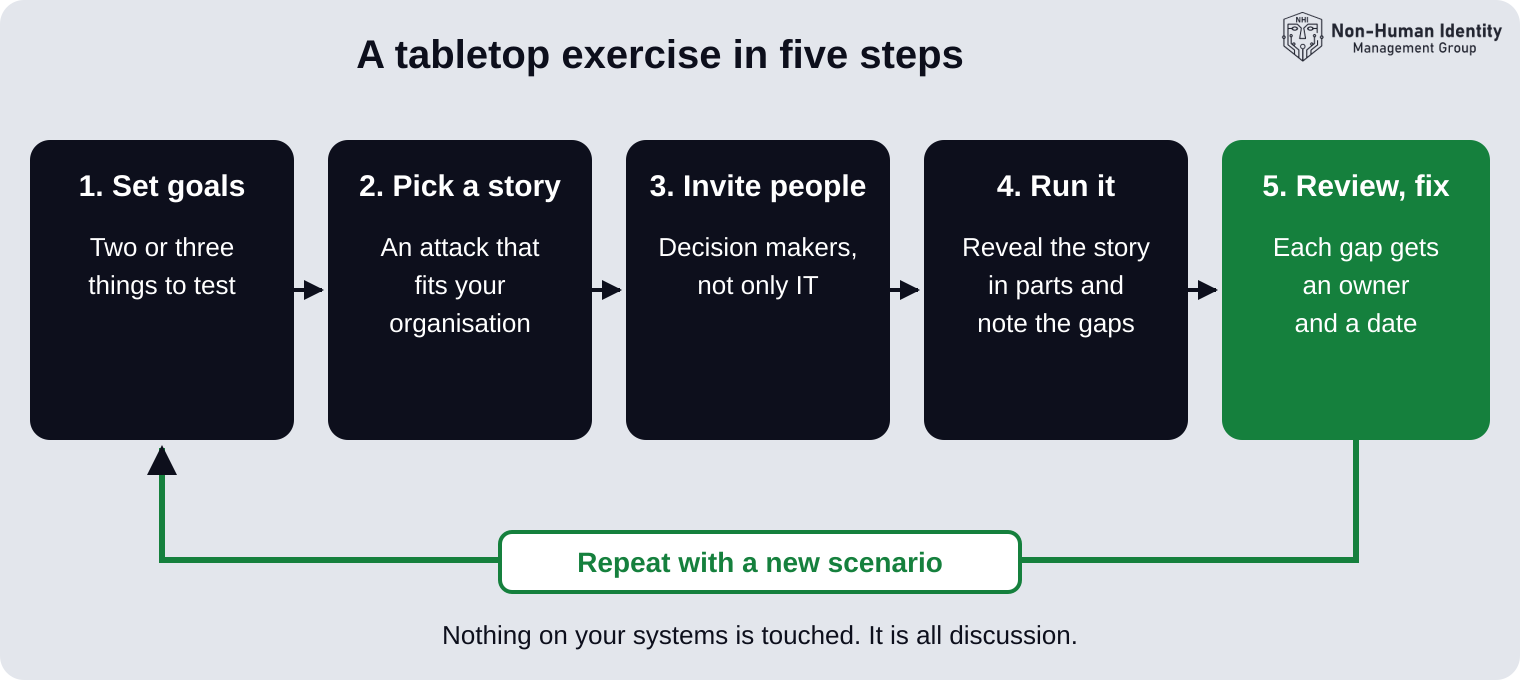
A simple first exercise usually follows these steps.
- Set goals. Choose two or three things to test, such as "Can we reach our IT supplier out of hours?"
- Pick a scenario. Choose an attack that fits your organisation, such as ransomware or a hacked email account. Free kits can help.[2]
- Invite the right people. Include those who would make decisions in a real attack, not only IT staff.
- Run the session. The facilitator reveals the story in parts. The group discusses each part, and a note-taker records answers and gaps.
- Review and fix. Hold a short follow-up review. Agree what worked, what did not and who will fix each gap by when.[2]
You do not have to start from a blank page. The UK's National Cyber Security Centre offers Exercise in a Box, a free online tool built for people without security expertise.[1] The US Cybersecurity and Infrastructure Security Agency publishes free exercise packages. They include scenarios, discussion questions and a template for the follow-up report.[2]
Exercises are one part of a wider habit of testing, training and practice. A US government guide describes how these help staff prepare for IT emergencies and check that plans work.[3]
A worked example
Redwood Robotics is a fictional US maker of warehouse robots, with 80 staff. Its IT lead, Sam Whitaker, has written an incident response plan. Nobody has tried it.
Sam asks Jamal Carter, a colleague from operations, to lead a one-hour tabletop exercise. Jamal uses a free government kit and picks a ransomware story. Emily Novak, the finance director, joins along with the heads of sales and support.
Jamal reads the first part. "It is Monday, 8:30. Staff say their files will not open." Sam explains how he would check the backups. So far, so good.
Then Jamal adds a twist. "Email is down too." The room goes quiet. The plan lists everyone's email addresses, but nobody has a printed list of mobile numbers.
The next twist asks who can decide to shut the factory network down. Sam thought Emily could. Emily thought it was the chief executive, who is not in the room.
Jamal remembers the dress rehearsal idea. This is a missed cue, and it is cheap to find today.
At the follow-up review the group lists four gaps. These are a printed contact list, a named decision maker with a deputy, the cyber insurer's details and a plan for telling customers. Each gets an owner and a date.
Three months later they run a new exercise about a hacked email account, with the chief executive in the room. The contact list works.
Myths and mistakes
| What people think | What is true |
|---|---|
| A tabletop exercise is a technical test of our systems. | It is a discussion. Nothing is switched off or attacked, and non-technical staff are often the most important people there.[1] |
| The goal is to pass. | The goal is to find gaps. An exercise that finds nothing may have been too easy. |
| We need an expensive consultant to run one. | Free kits from government agencies are designed for teams running their own exercises.[1][2] |
| Once we have done one, we are ready. | People, suppliers and attacks change. Running exercises regularly, with new stories, keeps the plan current. |
| The exercise is the main output. | The fixes are the main output. Without owners and dates, the same gaps tend to appear next time. |
What can I do this week?
- Find out whether your organisation has an incident response plan, and when it was last practised.
- Look at a free exercise kit and pick one simple scenario that fits your work.
- Write down who you would call first if email and files were down, and check you can reach them by phone.
- Suggest a one-hour exercise to your manager, with two or three clear goals.
Checklist
- We have a written incident response plan that people can reach even if systems are down.
- Each exercise has two or three clear goals.
- The scenario fits our organisation and the risks we face.
- Decision makers take part, not only IT staff.
- A facilitator leads, and a separate person takes notes.
- Every gap found gets an owner and a target date.
- We check that the fixes were made.
- We run exercises regularly, with a new scenario each time.
Common questions
How long does a tabletop exercise take?
A first exercise can take about one to two hours. That is enough for a short scenario with a few twists and a quick review. Longer sessions suit bigger organisations or more complex stories, but a short, focused session is a good place to start.
Who should take part?
Invite the people who would make decisions or take action in a real attack. That usually means a senior leader, IT, and someone from finance, communications and customer service. Keep the group small enough for everyone to speak, often under a dozen people.
How often should we run one?
Many organisations aim for at least once a year, and again after big changes such as a new IT supplier or a new plan. Each session can use a different scenario, so over time the team practises several kinds of attack.
Is a tabletop exercise the same as a penetration test?
No. A penetration test is a hands-on check where specialists try to break into real systems, with permission. A tabletop exercise touches no systems at all. It tests people, decisions and the plan through discussion. Many organisations use both, for different purposes.
What happens after the exercise?
The team holds a short review and writes up what worked, what did not and what will change. Each gap gets an owner and a date. Checking that the fixes happen is what turns a good meeting into a better response plan.
Where next?
Ready for the detail? Read the practitioner guide: Tabletop Exercise Guide. It goes further into scenario design, writing and timing injects, running executive and technical sessions, and building a full after-action report and improvement plan.
Also useful:
- Incident Response for Beginners
- Business Continuity and Disaster Recovery for Beginners
- Incident Response Plan Template
- Ransomware for Beginners
Related NHI Mgmt Group resources: Data Breach Tabletop Exercise · Deepfake Executive Impersonation Tabletop Scenario · Certificate Expiry Outage Tabletop Scenario
Key terms
- Tabletop exercise
- A guided discussion where a team walks through a pretend incident to test its roles, decisions and plan.
- Inject
- A planned piece of news added during an exercise to move the story on, such as a new alert or a reporter's call.
- After-action review
- A review after an exercise or incident that agrees what worked, what failed and what should change.
- Incident response plan
- A written set of steps for handling a security incident, including who does what and who decides.
- Playbook
- A set of repeatable steps for handling one type of incident, such as ransomware.
- Lessons learned
- The improvements agreed after an exercise or incident, each tracked until it is done.
Sources and further reading
- Exercise in a Box. National Cyber Security Centre (UK). https://www.ncsc.gov.uk/information/exercise-in-a-box, accessed 28 Nov 2026.
- CISA Tabletop Exercise Packages. Cybersecurity and Infrastructure Security Agency (US). https://www.cisa.gov/resources-tools/services/cisa-tabletop-exercise-packages, accessed 28 Nov 2026.
- Guide to Test, Training, and Exercise Programs for IT Plans and Capabilities (SP 800-84). NIST, September 2006. https://csrc.nist.gov/pubs/sp/800/84/final, accessed 28 Nov 2026.