Quantisation shrinks an AI model by storing its numbers with less detail, so it fits on smaller computers.
This guide is for students, hobbyists and anyone who has seen a model file called "Q4" or "Q8" and wondered what it means. It also helps managers who are asked to approve running AI on staff laptops instead of a paid cloud service.
In short
- An AI model is mostly a huge list of numbers. Quantisation rounds those numbers so each one takes less space.
- Labels such as Q8 and Q4 tell you roughly how many bits each number keeps. Lower numbers mean smaller files and some loss of quality.
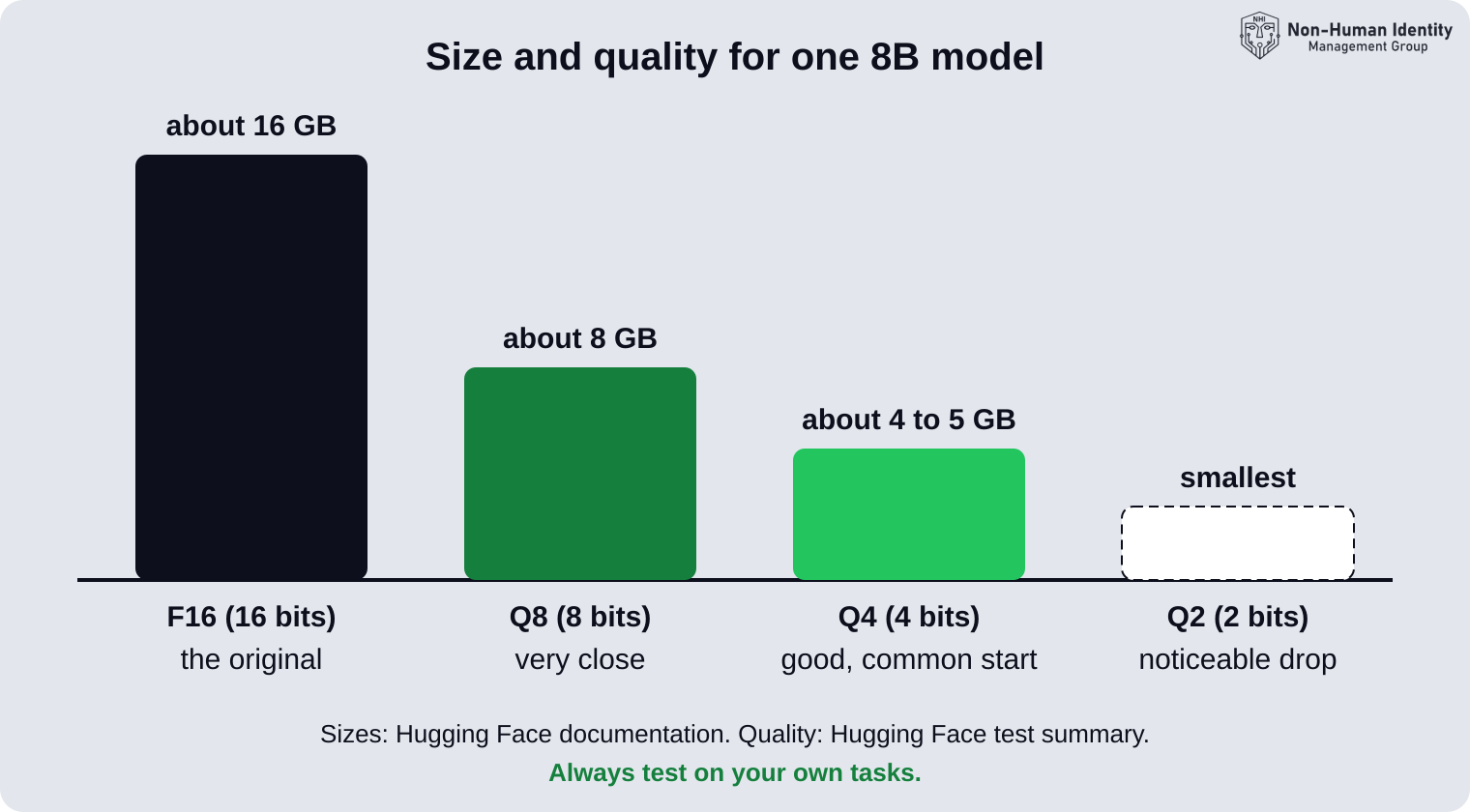
- Published tests suggest 8-bit versions stay very close to the original, 4-bit versions stay good, and below 4 bits quality drops noticeably.
- A shrunk file is a new file, often made by someone else. Get it from a source you trust and test it on your own tasks.
What you will learn
- Explain what quantisation does in one sentence.
- Read a model file name and spot its size label.
- Choose a sensible starting size for the computer you have.
- Check where a shrunk model file came from before you use it.
- The model's numbers (weights)
- the billions of numbers a model learned during training, which decide how it answers.
- Shrinking by rounding (quantisation)
- storing each of those numbers with fewer digits so the whole model takes less memory.
- Size label (Q4, Q8)
- part of a file name that shows roughly how many bits each number keeps.
What is AI model quantisation?
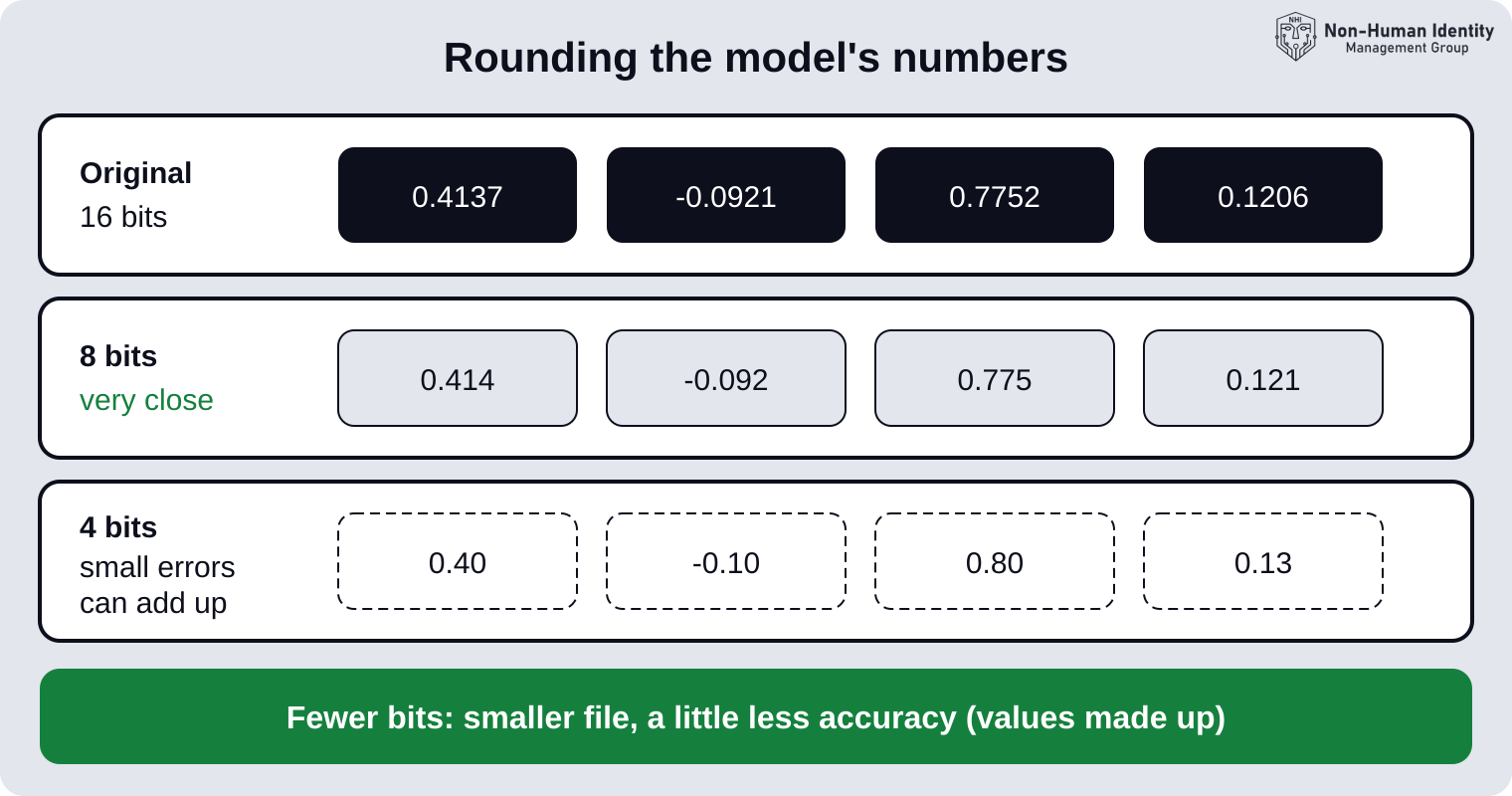
Think of a holiday photo. Your phone saves it at full detail, and the file is large. Save a smaller copy to send by message, and it looks almost the same, but the file is a fraction of the size. Shrink it too far and it turns blocky.
Quantisation does the same thing to an AI model. A large language model, the kind of AI behind chat assistants, is mostly a very long list of numbers called weights. A model with 8 billion of them is called an 8B model.[2]
Normally each weight is stored with a lot of detail, using 16 bits (16 small on or off switches). Quantisation rounds each weight so it fits into fewer bits, such as 8 or 4. The model then needs much less memory, and it can often answer faster.[1]
Where the comparison stops working: you can see a blurry photo straight away. A shrunk model can look fine in a quick chat and still make more mistakes on harder tasks. You only find out by testing it.
Why does it matter?
Quantisation is a big reason people can run capable AI models on a laptop. Their data does not have to go to a cloud service. Hugging Face says an 8B model needs about 16 GB of memory at full size. It needs about 8 GB at 8 bits, and about 4 to 5 GB at 4 bits.[2]
If you are a student or hobbyist
What could happen: you download the smallest file to save space, and the answers are worse than you expected.
Check this: try a 4-bit or 8-bit version first, and only go smaller if it will not fit.
If you manage a team
What could happen: staff run model files from unknown uploaders on work laptops that hold customer data.
Check this: agree which sources and which files staff may use.
If you are new to IT work
What could happen: someone asks you to install "the Q4 version" and you are not sure what it is or whether it is safe.
Check this: find out who made the file, which original model it came from and who approved it.
What does it look like?
Many people meet quantisation as a list of downloads. Local AI tools often use a file type called GGUF. One GGUF file holds the model's numbers and some details about the model.[3] Here is a made-up download list for one model.
Example only. All values are made up.
example-chat-8B-F16.gguf      16 GB   (1)
example-chat-8B-Q8_0.gguf      8 GB   (2)
example-chat-8B-Q4_K_M.gguf    5 GB   (3)
example-chat-8B-Q2_K.gguf      3 GB   (4)
uploaded by: example-user-0000        (5)
- F16 means full detail, 16 bits per number. This is the largest file.
- Q8 keeps about 8 bits per number. It is about half the size.
- Q4 keeps about 4 to 5 bits per number. K and M describe the rounding method. M often means a medium version.
- Q2 keeps about 2 to 3 bits per number. It is small, but quality usually drops the most.
- In a real file list, this line would name who made the files. That may not be the company that made the original model.
Why this is risky: it is easy to pick by size alone and trust any uploader. But a shrunk file is a new file. The original maker may never have tested it.
The safer way: pick the largest version your computer can run well. Prefer files from the original maker or a source your team trusts. Then test that exact file on the tasks you care about.
How does it work?
Here is the idea in plain steps. The real maths is on the practitioner guide.
- Training. The model learns billions of weights, each stored with high detail.
- Grouping. The tool splits the weights into small groups, for example 32 at a time.[3]
- Rounding. Each weight in a group is rounded to one of a small set of allowed values. With 4 bits there are only 16 allowed values.
- Remembering the scale. The tool stores one extra number per group, so it can stretch the rounded values back to roughly the right size when the model runs.[3]
- Running. The model now needs far less memory. Tiny rounding errors add up, which is why answers can get a little worse.[1]
How much quality do you lose? Hugging Face tested two Llama models. It found 8-bit versions very close to the original and 4-bit versions still highly accurate. Below 4 bits there was a noticeable drop, especially at 2 bits. It advises testing on your own task and computer before choosing.[4]
One more thing to know. Researchers have shown that a model can be built to behave well at full size and badly only after common shrinking methods are applied.[5] So a good review of the original model does not prove that a shrunk copy behaves the same.
A worked example
Talia Vance runs a small, fictional translation agency with six staff. She wants an AI model to help draft translations, but her clients do not want their documents sent to an outside service.
Her office manager, Petra Mbeki, finds a popular open model with 8 billion weights. The full-size file is about 16 GB.[2] The office laptops have 16 GB of memory in total, and the laptop needs some of that for itself.
Petra remembers the holiday photo. A smaller copy is fine if it still looks right. She sees Q8, Q4 and Q2 versions on the download page.
First, she checks who made each file. The Q2 file comes from an uploader she has never heard of. The Q8 and Q4 files come from the model maker's own page. She drops the Q2 file.
Next, she runs a test. She picks twenty past translations where she knows the right answer, and runs them through the Q8 and Q4 versions. The Q8 version is a little better on tricky legal phrases, but it is slow on the laptops. The Q4 version is quicker and good enough for first drafts.
Talia agrees to use the Q4 file for drafts, with a person checking every translation before it goes to a client. Petra writes down the file name, where it came from and the date, so the team knows exactly which file they approved.
If the model maker releases a new version, they will run the same twenty tests again before switching.
Myths and mistakes
| What people think | What is true |
|---|---|
| A quantised model is a different, weaker AI. | It is the same model with its numbers rounded. At 8 bits, published tests show results very close to the original.[4] |
| Smaller is always fine. | Below 4 bits, quality drops noticeably in published tests.[4] Start larger and go down only if you must. |
| Q4 means exactly 4 bits per number. | It is roughly 4. The extra scale numbers add a little, so a Q4 file often averages nearer 4.5 to 5 bits.[1] |
| If the original model is safe, every shrunk copy is safe. | A shrunk file is a new file, often made by someone else. Research shows a copy can behave differently.[5] Check the source and test it. |
| Running a model locally means no security work is needed. | Local running keeps data on your computer, but you still need to trust the file and control who can use it. |
What can I do this week?
- Check how much memory your computer or graphics card has, so you know which file sizes can fit.
- Try an 8-bit or 4-bit version of a model before trying anything smaller.
- Write a short test set of ten to twenty tasks with known good answers, and use it to compare versions.
- Note where each model file came from, who made it and when you downloaded it.
Checklist
- I know what F16, Q8 and Q4 mean in a model file name.
- I picked the largest version my computer can run comfortably.
- The file comes from the original model maker or a source my team trusts.
- I tested the exact file I plan to use on my own tasks.
- I recorded the file name, source and download date.
- A person checks important answers before they are used.
- My team has a simple rule on which model files staff may run on work computers.
Common questions
Which is better, Q4 or Q8?
Q8 is usually closer to the original model, and Q4 is about half the size. Published tests show 8-bit versions very close to full quality and 4-bit versions still good. If Q8 fits and runs fast enough, use it. If not, Q4 is a common, sensible choice.
What do the K, M and S in names like Q4_K_M mean?
They describe the rounding method and the size of the version. K marks a newer family of methods that groups numbers more cleverly. S, M and L usually mean small, medium and large versions at the same level. M is a common middle choice.
Does quantisation make a model faster?
Often, yes. A smaller model needs less memory and can run more quickly on the same computer. Speed also depends on your hardware and the tool you use, so a smaller file is not always faster. Test it on the computer you plan to use.
Can I shrink a model myself?
Yes. Free tools can turn a full-size model into Q8 or Q4 files. Making your own copy from the original maker's file means you know exactly where it came from. It needs enough memory and disk space for the full-size model during the process.
Is a quantised model file safe to download?
It can be, if it comes from a source you trust. Treat it like any program from the internet. Prefer the original maker's page or files your team made, check who uploaded it, and test the exact file before using it for real work.
Where next?
Ready for the detail? Read the practitioner guide: LLM Quantisation Explained. It goes further into the main methods, the GGUF size types, measured memory and accuracy figures, and the checks to run before you trust a shrunk model file.
Also useful:
- Open-Weight AI Models for Beginners
- How Large Language Models Work
- AI Supply Chain Security for Beginners
- Open-Weight Model Security Guide
Related NHI Mgmt Group resources: Securing AI Model Weights · Model Supply Chain Guide · Hugging Face Security Guide
Key terms
- Quantisation
- Storing a model's numbers with less detail so it needs less memory and can run faster.
- Model weights
- The numbers a model learned during training, which shape how it turns a question into an answer.
- Large language model
- An AI system trained on large amounts of text to predict and write language.
- GGUF
- A file format for running models locally that holds the model's numbers and details about the model.
- Open-weight model
- A model whose numbers can be downloaded and run on your own computer.
- Inference
- Using a trained model to produce answers from new questions.
Sources and further reading
- quantize tool README. llama.cpp project, ggml-org, GitHub. https://github.com/ggml-org/llama.cpp/blob/master/tools/quantize/README.md, accessed 28 Nov 2026.
- Quantization overview. Hugging Face Transformers documentation, Hugging Face. https://huggingface.co/docs/transformers/main/en/quantization/overview, accessed 28 Nov 2026.
- GGUF. Hugging Face Hub documentation, Hugging Face. https://huggingface.co/docs/hub/gguf, accessed 28 Nov 2026.
- Choose a quantization method. Hugging Face Transformers documentation, Hugging Face. https://huggingface.co/docs/transformers/main/en/quantization/selecting, accessed 28 Nov 2026.
- Egashira K, Vero M, Staab R, He J, Vechev M. Exploiting LLM Quantization. arXiv:2405.18137, May 2024, revised November 2024. https://arxiv.org/abs/2405.18137, accessed 28 Nov 2026.