The NIST AI RMF is a free, voluntary US guide that helps organisations find and reduce the risks of AI.
This guide is for anyone who has heard of the framework and wants to know what it asks for, in plain words. You do not need to build AI to use it: if your organisation buys a chatbot or uses AI features inside everyday software, the framework still applies.
In short
- The AI RMF is guidance, not a law. You choose the parts that fit your organisation.
- It sorts the work into four jobs: Govern, Map, Measure and Manage.
- Govern means owners and rules. It carries on alongside the other three jobs, not just at the start.
- You start small: list your AI, pick one tool, write down what could go wrong and who checks it.
What you will learn
- Explain what the AI RMF is and who it is for.
- Describe the four jobs in plain words.
- Spot the qualities the framework says trustworthy AI should have.
- Check where your own team could take its first step.
Status: correct as at 28 November 2026, based on the National Institute of Standards and Technology (NIST) AI RMF pages. NIST says the framework is being revised; check the official text.
This guide explains the topic in general terms and is not legal advice.
- Something that could go wrong (risk)
- a possible harm, plus how likely and how serious it is.
- Rule book you choose to follow (voluntary framework)
- a guide you can use without any law making you.
- The four jobs (core functions)
- Govern, Map, Measure and Manage, the main parts of the framework.
What is the NIST AI RMF?
Think of a food safety plan in a restaurant kitchen. Someone is in charge. The team lists what could make diners ill, checks the fridges and fixes problems fast.
The AI RMF does the same job for artificial intelligence (AI). RMF stands for Risk Management Framework, and it is a free guide from a US government standards agency.
It helps any organisation that builds, buys or uses AI. It asks four plain questions. Who is in charge? What could go wrong? How big is each problem? What will we do about it?
The guide does not tell you which tools to buy. It gives you a shared way to think and talk about AI risk, so your team, suppliers and auditors use the same words.
Where the comparison stops working: food safety rules are often law, with inspectors who visit. The AI RMF is guidance you choose to use. And AI can change how it behaves in ways that are harder to test than a fridge.
Why does it matter?
AI tools can give wrong answers, treat people unfairly or leak private details. A simple plan makes it more likely that someone spots these problems early.
If you run a small business
What could happen: a chatbot on your website gives customers wrong prices or advice, and nobody is checking it.
Check this: name one person who owns each AI tool and reviews what it says.
If you are a manager
What could happen: a customer or auditor asks how you manage AI risk, and you have no clear answer.
Check this: keep a short list of the AI you use, with an owner and a purpose for each.
If you are new to a security or risk job
What could happen: you sit in an AI review and cannot follow the terms people use.
Check this: learn the four jobs and the trustworthy AI qualities on this page.
What does it look like?
In practice, using the framework often starts with a one-page card for each AI tool. Here is a made-up one.
Example only. All values are made up.
AI tool card: "HelpBot EXAMPLE" (website chatbot)
Owner: J. Sample, operations                        (1)
Purpose: answers questions about opening hours     (2)
Must not: give medical or payment advice            (2)
Who it affects: customers, some elderly             (3)
Top risks: wrong answers; people share card details (3)
Checks: 20 test questions before launch; monthly review  (4)
If it goes wrong: switch off, show phone page FAKE-0000  (5)
- Govern: one named person answers for the tool.
- Map: what the tool is for, and what it must not do.
- Map: who could be harmed, and how.
- Measure: how the team tests and keeps checking.
- Manage: the plan if something goes wrong. In a real file, this line would contain the actual fallback page.
Why this is risky: without a card like this, nobody owns the chatbot, nobody tests it, and nobody knows how to switch it off.
The safer way: keep one short card per AI tool. Review it when the tool changes, and keep the cards where the team can find them.
How does it work?
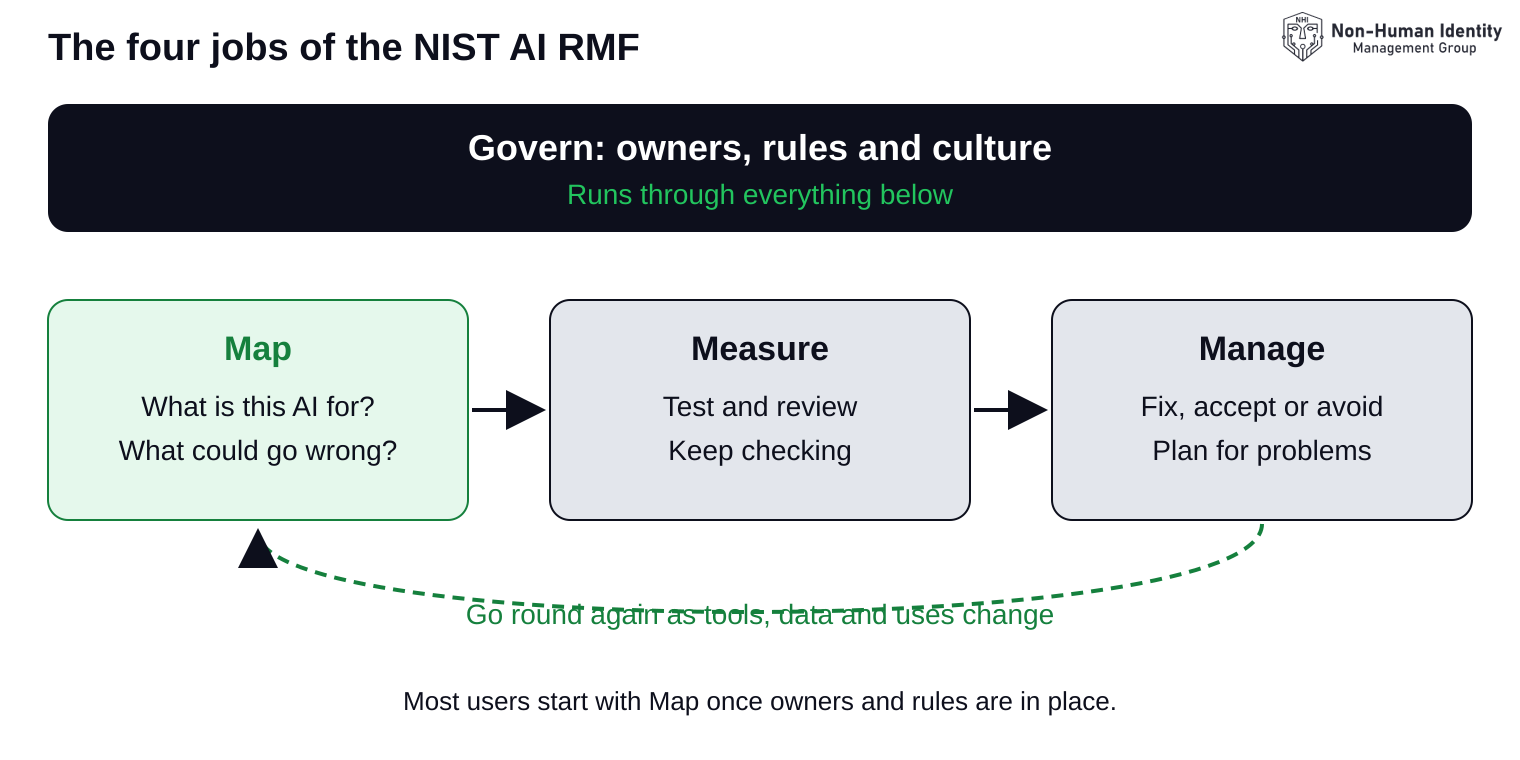
The heart of the framework is called the Core. It has four jobs, called functions, each split into smaller outcomes.[3] A typical first pass looks like this:
- Govern: set up owners and rules. Decide who answers for AI risk and write a short policy. The framework calls Govern a job that runs through all the others.[3]
- Map: understand the setting. For each AI tool, note its purpose, users, data and possible harms. After this, you should know enough to make a first decision on whether to go ahead.[3]
- Measure: check how big the risks are. Use tests, reviews and monitoring, which means regular checking over time.
- Manage: act on what you found. Fix the worst problems first, accept or avoid others, and plan how to respond if things go wrong.
- Go round again. Tools, data and uses change, so the work repeats. The framework says the process should be iterative, which means repeated.[3]
Once governance is in place, the framework says the jobs can be done in any order. It adds that most users start with Map.[3]
The framework also lists seven qualities that trustworthy AI should have.[2] In plain words, the AI should:
- do what it is meant to, again and again (valid and reliable);
- not put people or property in danger (safe);
- resist attacks and recover from problems (secure and resilient);
- be clear about how it is used and who answers for it (accountable and transparent);
- let people understand how it reached a result (explainable and interpretable);
- protect personal information (privacy-enhanced);
- treat people and groups fairly (fair, with harmful bias managed).
Two companion resources help. The Playbook suggests actions for each outcome. NIST says it is neither a checklist nor a set of steps to follow in full.[4] A profile applies the framework to one setting. The Generative AI Profile, released on 26 July 2024, covers tools that create text, images and code.[1][5]
Version 1.0 came out on 26 January 2023 for voluntary use. NIST says it is now being revised as part of the White House AI Action Plan.[1][6]
A worked example
Mabel Ekström manages Tansy Opticians, a small made-up chain of three shops. Her team wants an AI chatbot on the website to answer questions about bookings and opening hours.
Mabel has read about the AI RMF, but she does not try to do everything at once. She takes one simple pass through the four jobs.
Govern. Mabel names herself as the owner of the chatbot. She writes a short rule: no new AI tool goes live without her sign-off.
Map. She writes one page. The bot answers general questions. It must not give advice about eye health or prescriptions. Some customers are elderly and may struggle with chat. The main risks are wrong answers, people typing in health details, and customers who cannot reach a person.
Measure. Before launch, two staff ask the bot 30 typical questions. They count how many answers are right and clear. After launch, Mabel reads a sample of chats each month.
Manage. The team limits the bot to approved help pages. They add a clear "talk to a person" button and a warning not to share health details. Mabel writes down how to switch the bot off.
Two months later, the monthly review shows the bot giving old opening hours for one shop. Because someone is checking and someone owns the tool, Mabel spots it and updates the help pages that week.
The framework did not make the chatbot perfect. It made problems more likely to be found and fixed, by a named person, with a plan.
Myths and mistakes
| What people think | What is true |
|---|---|
| The AI RMF is a legal requirement. | NIST released it for voluntary use. A law or contract may refer to it separately, so check what applies to you.[1] |
| You can be certified against it. | NIST does not offer certification for the AI RMF. Some other AI standards can be certified. |
| It is only for companies that build AI. | It also covers organisations that buy, set up and use AI tools. |
| You must do every action in the Playbook. | NIST says the Playbook is neither a checklist nor a set of steps to follow in full. Use what fits.[4] |
| Govern is done once, at the start. | Govern carries on alongside Map, Measure and Manage.[3] |
What can I do this week?
- List your AI. Write down every AI tool you build, buy or use, including AI features inside software you already have.
- Give each one an owner. One named person per tool is enough to start.
- Write one tool card. Pick your most important AI tool and fill in a card like the sample above.
- Agree an off switch. Write down how you would pause the tool if it caused harm.
Checklist
- Someone is named as answerable for AI risk in our organisation.
- We have a short AI use policy that staff know about.
- We keep a list of the AI tools we use, each with an owner.
- Each important AI tool has a short card covering purpose, users, data and possible harms.
- We test important AI tools before use and check them regularly afterwards.
- We have decided what to fix, accept or avoid for the main risks.
- We know how to switch off an AI tool that causes harm.
- We review our AI risks when tools, data or uses change.
Common questions
Is the NIST AI RMF mandatory?
No. NIST released it for voluntary use by organisations of any size or sector.[1] Some contracts, customer questionnaires or company policies may refer to it, so check whether anything you have signed asks you to follow it.
Which of the four jobs should we start with?
Start with basic governance: a named owner and a short policy. Then Map your most important AI tool. The framework says most users start with Map once governance is in place, then move on to Measure or Manage.[3]
Do we need special software to use it?
No. A small team can start with a spreadsheet and one card per AI tool. Bigger firms sometimes use special software to track many tools. The thinking matters more than the tool, so begin with owners, a list and simple checks.
Is the framework changing?
Yes. NIST says version 1.0 is being changed, and that the Playbook will be updated after that.[1][4] The four jobs are a useful start today. Check the official pages for the current version before you rely on any detail.
How does it relate to security?
Security is one of seven qualities in the framework, called secure and resilient. The framework is wider, also covering safety, fairness, privacy and accountability.[2] Security teams usually help most with testing, attacks and protecting data.
Where next?
Ready for the detail? Read the practitioner guide: NIST AI RMF Guide. It goes further into the categories inside each function, how profiles work and how the framework maps to other standards.
Also useful:
- AI Risk Management for Beginners
- AI Governance for Beginners
- ISO 42001 for Beginners
- EU AI Act for Beginners
- NIST AI 600-1 Generative AI Profile Guide
Related NHI Mgmt Group resources: AI Governance Guide · AI Risk Assessment Guide · NIST AI RMF vs ISO/IEC 42001 · AI Governance vs AI Risk Management
Key terms
- NIST AI Risk Management Framework
- A voluntary US guide that sorts AI risk work into Govern, Map, Measure and Manage.
- Govern Function
- The job that sets owners, rules and culture for AI risk and runs through the other three.
- AI Risk Management
- Finding, judging, dealing with and watching the risks that AI tools create.
- Trustworthy AI
- AI that behaves reliably, safely and fairly, in line with what people intend.
- AI RMF Playbook
- A companion resource that suggests optional actions for each outcome in the framework.
- AI Inventory
- A list of the AI tools in use, each with an owner, a purpose and its risks.
- Risk Tolerance
- How much risk an organisation is willing to accept before it must act.
Sources and further reading
- AI Risk Management Framework. National Institute of Standards and Technology (NIST). https://www.nist.gov/itl/ai-risk-management-framework, accessed 28 Nov 2026.
- AI RMF 1.0, section 3: AI Risks and Trustworthiness. NIST AI Resource Center. https://airc.nist.gov/airmf-resources/airmf/3-sec-characteristics/, accessed 28 Nov 2026.
- AI RMF 1.0, section 5: AI RMF Core. NIST AI Resource Center. https://airc.nist.gov/airmf-resources/airmf/5-sec-core/, accessed 28 Nov 2026.
- NIST AI RMF Playbook. NIST AI Resource Center. https://airc.nist.gov/airmf-resources/playbook/, accessed 28 Nov 2026.
- NIST AI 600-1, Artificial Intelligence Risk Management Framework: Generative Artificial Intelligence Profile. NIST, July 2024. https://www.nist.gov/publications/artificial-intelligence-risk-management-framework-generative-artificial-intelligence.
- NIST AI 100-1, Artificial Intelligence Risk Management Framework (AI RMF 1.0). NIST, January 2023. https://nvlpubs.nist.gov/nistpubs/ai/NIST.AI.100-1.pdf.