A security clearance is official permission to see a government's protected information, given after checks on you.
This guide is for students, career changers and anyone who has seen "SC required" or "active Secret clearance" on a cyber job advert. It explains the idea in plain words, using the UK and US systems. Facts were checked against official UK and US government pages in November 2026.
In short
- A clearance shows a government has checked that you can be trusted with protected information.
- You cannot apply for one on your own. An employer or government body starts it because a job needs it.
- Higher levels mean deeper checks, such as your finances, records and sometimes an interview.
- Honesty matters most. Hiding things can count against you more than the things themselves.
What you will learn
- Explain what a security clearance is in one sentence.
- Spot the main UK and US clearance levels in a job advert.
- Explain who starts the process and what the checks look at.
- Check your own habits so you are a strong candidate later.
- Trust check (vetting)
- the background checks a government runs before giving someone a clearance.
- Backer (sponsor)
- the employer or government body that asks for your clearance because your job needs it.
- Only what the job needs (need to know)
- the rule that you see protected information only when your work requires it.
What is a security clearance?
Think of a backstage pass at a concert. The organisers give it to the crew who need to work backstage. It is not for sale, and fans cannot ask for one.
A security clearance works in a similar way. Governments keep some information protected, because sharing it could harm the country. The UK labels this information OFFICIAL, SECRET or TOP SECRET.[3] The US uses Confidential, Secret and Top Secret.[6]
Before someone can work with that information, the government runs checks on them. This is called vetting (a set of background checks into your history, records and money). If the checks go well, the person gets a clearance for that job.
A clearance is not the only thing you need. In the US, you also need to sign a promise to keep secrets and to have a need to know the information.[6]
Where the comparison stops working: a backstage pass lasts one night. A clearance can last for years, and it is reviewed while you hold it.[1]
Why does it matter?
Many cyber security jobs in government, defence and their suppliers need a clearance. That includes work protecting sensitive networks, testing defence systems and responding to attacks on national services.
If you are a student or career changer
What could happen: you see a dream job that says "clearance required" and assume it is closed to you.
Check this: read whether the employer will sponsor clearance. Many adverts say so.
If you are learning to hack
What could happen: breaking into a system without permission, even "just to learn", can count against you later.
Check this: practise only on labs and systems you have written permission to test.
If you hire for a small supplier
What could happen: you win a government contract, then find you need cleared staff and the checks take time.
Check this: ask the customer early which level each post needs.
What does it look like?
Most people first meet clearances in a job advert. Here is a made-up one.
Example only. All values are made up.
Job: Junior Security Analyst (EXAMPLE)
Employer: Example Defence Systems Ltd
Location: example.invalid office
Clearance: SC required, or willing to undergo SC  (1)
Note: we will sponsor clearance for this post      (2)
You must have lived in the UK for the last 5 years (3)
- SC (Security Check) is a common UK level. "Willing to undergo" means you do not need it already.
- The employer will start the process for you. This is the only way to get one.
- A line like this hints at how far back the checks need to reach. Ask the employer what it means for you.
Why this is risky: people often skip adverts like this, thinking they need a clearance before they apply. Many employers will start the process once they offer you the job.
The safer way: read the clearance line closely. "Must hold" means they want someone already cleared. "Willing to undergo" or "will sponsor" means they will start it for you. The official UK guidance says residency can affect which checks can be done.[1]
How does it work?
The details differ by country and level, but the main steps are similar.
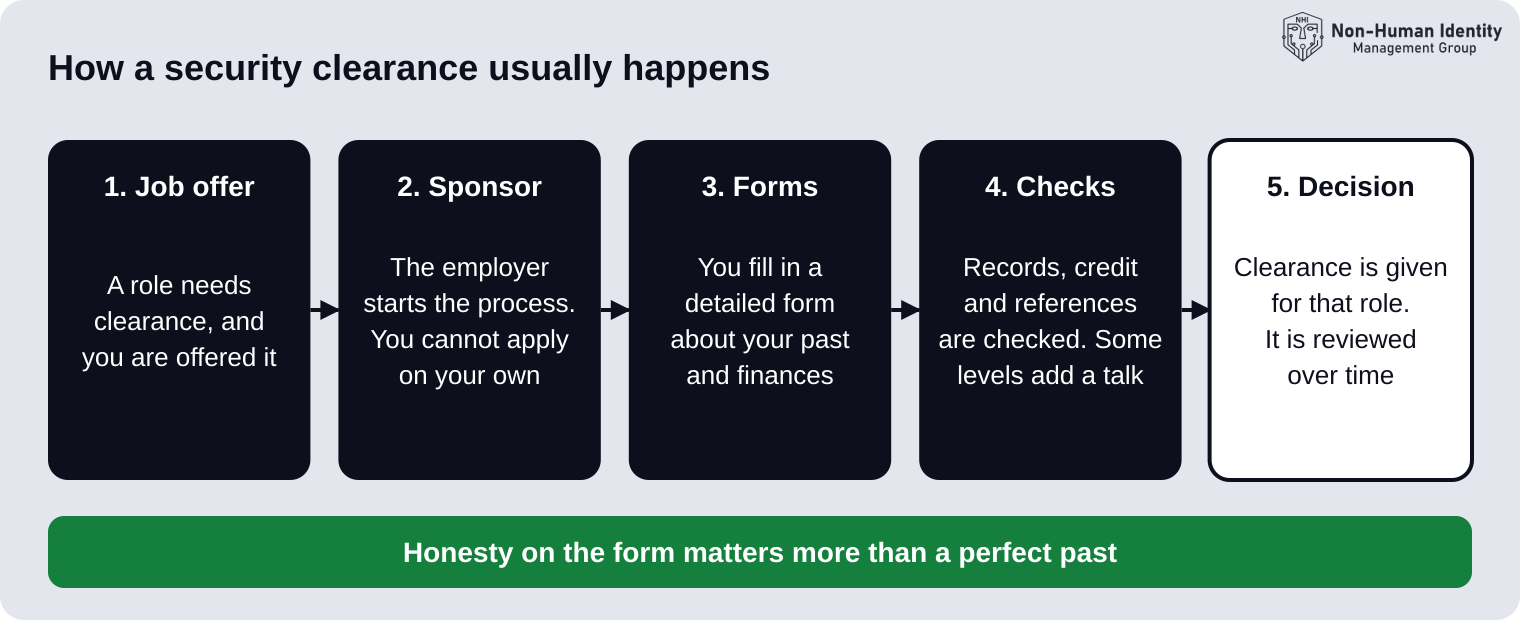
- A job needs it. The level follows the post, not the person. The more protected the information, the higher the level.[1]
- A sponsor starts it. In the UK, your sponsor is usually an HR officer or company security controller. You cannot apply directly.[2] The US agency that handles defence suppliers says the same.[5]
- You fill in a form. It asks about where you have lived, your jobs, your family and your money. The US form asks for 10 years of job history.[5]
- Checks are run. These can include criminal records, credit history and security service records. Higher levels add an interview and talks with people who know you.[1]
- A decision is made. Clearance is not guaranteed. The UK guidance says not to leave your current job until your sponsor confirms clearance and a start date.[2]
- It is kept up to date. UK clearances have set review periods. US defence staff are checked on an ongoing basis, which is called continuous vetting.[1][5]
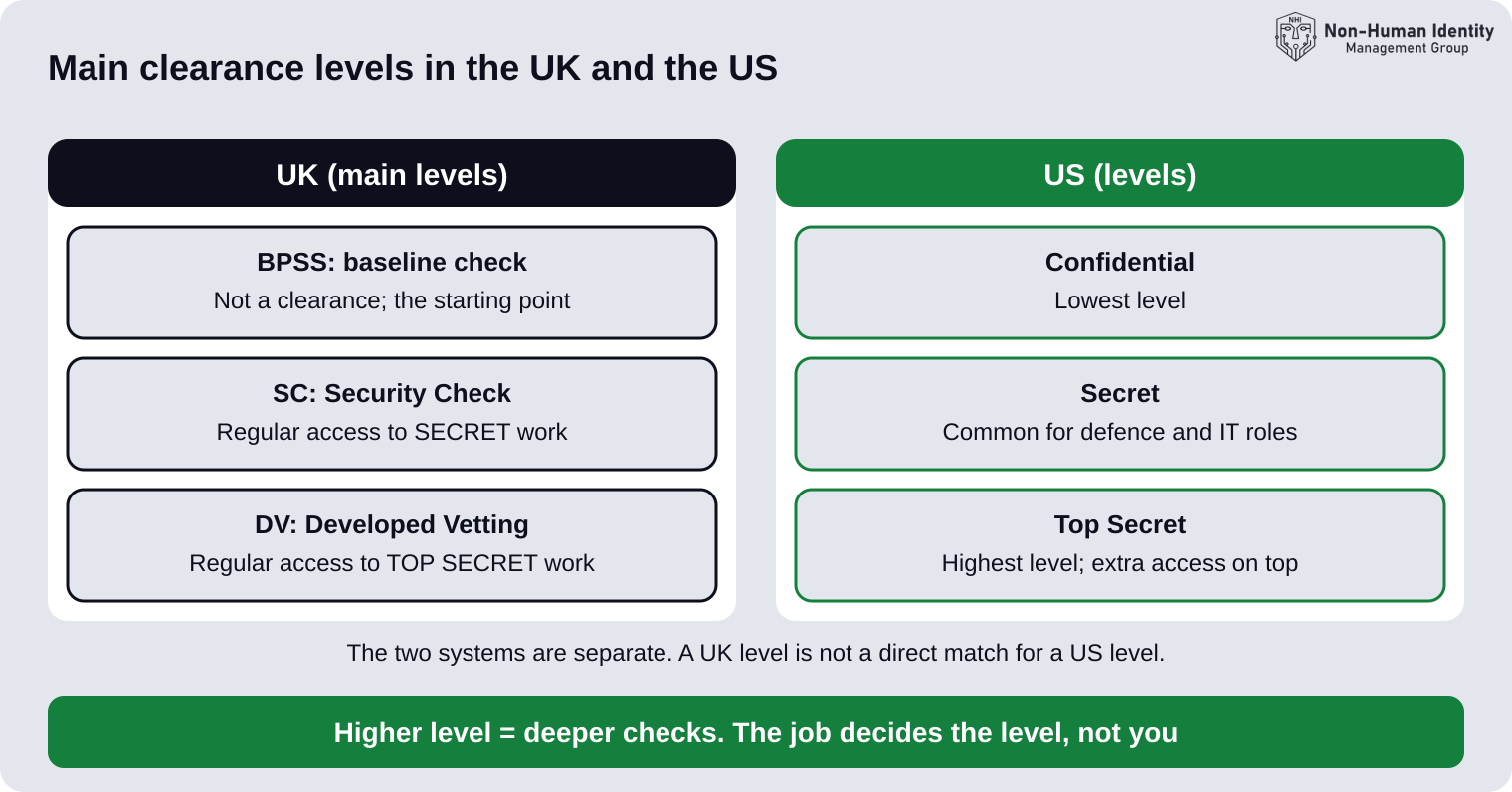
Each country has its own levels. In the UK, the main ones are the baseline check (BPSS), Security Check (SC) and Developed Vetting (DV). BPSS is the starting point and is not a formal clearance. SC fits regular access to SECRET work. DV fits regular access to TOP SECRET work.[1] In the US, the levels are Confidential, Secret and Top Secret. Some work needs extra approval on top of a level.[5]
A worked example
Yusuf Iyer is 23 and has just finished a cyber security degree. He sees a junior analyst job at a fictional defence supplier. The advert says "SC required, or willing to undergo SC".
He nearly skips it. Then he remembers the backstage pass idea. The crew do not buy passes; the organisers hand them out. So he applies.
He gets an offer. Talia Kader, the company's security controller, explains the next step. "I'll sponsor you, and you'll get a link to the form."
The form asks about his addresses, jobs, family and money. Yusuf worries about two things. He had a parking fine he paid late. At university, he once ran a scanning tool against a friend's home router, with the friend's spoken permission.
Talia's advice is simple. "Be completely honest. Leaving things out is what causes problems." The official guidance says the same.[2] He lists the fine and explains the router test.
The checks take some weeks. Yusuf keeps his current part-time job, as the guidance suggests, until Talia confirms the result and a start date.
His clearance comes through. Talia asks him to tell her about big changes in his life, as the company's rules require. His clearance belongs to the company, not to him, and it will be reviewed over time.[2]
From now on, Yusuf practises his hacking skills only on labs built for it, with written rules.
Myths and mistakes
| What people think | What is true |
|---|---|
| I can apply for a clearance myself to improve my CV. | You cannot. A sponsor starts it because a job needs it.[2][5] |
| Any past mistake means I will be refused. | Each case is judged on its own. GCHQ says a criminal record is not always a blocker.[4] |
| It is safer to leave out embarrassing things. | Lying or holding back information can lead to refusal.[2] |
| A clearance lets me see everything at that level. | You also need a need to know for each piece of information.[6] |
| Once I have it, I keep it for life. | Clearances are reviewed, and they belong to the sponsor, not you.[1][2] |
| Hacking for practice does not matter. | US rules list misuse of computer systems, such as getting into one without permission, as a concern.[7] |
What can I do this week?
- Search job sites for "willing to undergo SC" or "will sponsor clearance" to see how common it is.
- Write down your addresses and jobs for the last 10 years, with dates, so you are ready.
- Check that you practise hacking skills only on labs or systems you have written permission to test.
- Read the official UK clearance levels page or the US agency's questions page for your country.
Checklist
- I know a clearance is started by a sponsor, not by me.
- I can name the main levels in my country.
- I keep a record of my addresses, jobs and travel.
- I keep my finances in order, or I can explain any problems honestly.
- I only test systems I have written permission to test.
- I would answer every question on the form honestly and fully.
- I would not leave my current job until clearance and a start date are confirmed.
Common questions
How long does a security clearance take?
There is no fixed time. Each application is different, and higher levels involve more checks. The UK vetting service says it cannot give exact timescales and suggests asking your sponsor for updates. Plan for the process to take a while, and keep your current job until it is done.
Can I get a clearance if I am not a citizen?
Sometimes, but it varies by country. In the US, non-citizens are generally not eligible, with rare exceptions. In the UK, the official guidance says where you have lived can affect which checks can be done. Ask the employer what applies to the post before you apply.
Does debt stop me getting cleared?
Not on its own. Higher levels look at your finances, because money worries can make people open to pressure. Each case is judged as a whole. Being honest about debts, and showing you are managing them, matters more than having no debt at all.
What happens if I am refused?
In the UK, you are told the reasons where possible, and eligible people can appeal, first inside the organisation and then to an independent panel. Some agencies do not give feedback. In every case, a refusal is about that application, not a judgement on your worth.
Is a clearance the same as a background check?
No. Most private employers run background checks, such as confirming your identity and past jobs. A clearance is a government decision about protected information. In the UK, the baseline check is the first step and is not a clearance on its own.
Where next?
Ready for the detail? Read the practitioner guide: Security Clearances for Cyber Security Jobs. It goes further into every UK and US level, the checks and review periods for each, and how clearances move between employers.
Also useful:
- Personnel Security for Beginners
- Insider Threats for Beginners
- Cybersecurity Careers Guide
- Systems Security Officer Career Guide
Related NHI Mgmt Group resources: Personnel Security and Background Screening Guide · Least Privilege for Beginners
Key terms
- Clearance levels
- The steps of trust a government sets, each allowing access to more protected information.
- Vetting
- The background checks run before someone is given a clearance.
- Sponsor
- The employer or government body that asks for a person's clearance because a job needs it.
- Need to know
- The rule that people see protected information only when their work requires it.
- Continuous vetting
- Ongoing checks on people who already hold a clearance, instead of only one check at the start.
- Personnel security
- The checks and rules that help an organisation trust the people it employs.
Sources and further reading
- National Security Vetting clearance levels. United Kingdom Security Vetting, GOV.UK, updated 23 September 2024. https://www.gov.uk/government/publications/united-kingdom-security-vetting-clearance-levels/national-security-vetting-clearance-levels, accessed 28 Nov 2026.
- United Kingdom Security Vetting: applicant. GOV.UK. https://www.gov.uk/guidance/united-kingdom-security-vetting-applicant, accessed 28 Nov 2026.
- Government Security Classifications. Cabinet Office, GOV.UK, updated 5 August 2024. https://www.gov.uk/government/publications/government-security-classifications, accessed 28 Nov 2026.
- Vetting. GCHQ Careers. https://www.gchq.gov.uk/section/careers/vetting, accessed 28 Nov 2026.
- Facility Security Officer frequently asked questions (personnel vetting). Defense Counterintelligence and Security Agency. https://www.dcsa.mil/mc/pv/fso/faqs, accessed 28 Nov 2026.
- Executive Order 13526, Classified National Security Information (sections 1.2 and 4.1). US National Archives, Information Security Oversight Office, 2009. https://www.archives.gov/isoo/policy-documents/cnsi-eo.html, accessed 28 Nov 2026.
- 32 CFR Part 147, Adjudicative guidelines for determining eligibility for access to classified information (Guideline M, misuse of information technology systems). Electronic Code of Federal Regulations. https://www.ecfr.gov/current/title-32/subtitle-A/chapter-I/subchapter-D/part-147, accessed 28 Nov 2026.