Southeast Asia's data protection laws are national rules on how organisations collect, use and protect personal data.
This guide is for students, newcomers and small firms with customers or staff in Indonesia, Malaysia, Thailand or Vietnam. You do not need a legal background. If you sell online across the region, more than one of these laws may apply to you at once.
In short
- Indonesia, Malaysia, Thailand and Vietnam each have their own personal data law and their own rules on who checks it.
- The laws share core ideas: have a valid reason, take extra care with sensitive data, keep data safe and respect people's rights.
- Most of them expect a data leak to be reported to the regulator within about three days, each with its own conditions.
- Several laws changed recently, including Vietnam's new law from 1 January 2026, so older summaries may be out of date.
What you will learn
- Explain the shared ideas behind the four laws.
- Spot the main law in each country and how recent it is.
- Check how fast each country expects a data leak to be reported.
- Ask the right questions before you collect or move data across the region.
Status: correct as at 28 November 2026, based on the law texts and official or professional summaries listed in the sources. Laws change; check the official text.
This guide explains the topic in general terms and is not legal advice.
- Personal details (personal data)
- information about a person who can be identified from it.
- Extra-care details (sensitive data)
- details such as health, religion or fingerprints, which need stronger protection.
- Data watchdog (regulator)
- the public body that checks that organisations follow the law.
What are Southeast Asia's data protection laws?
Think of plug sockets as you travel between countries. The electricity does the same job everywhere, but the socket shape changes at each border. You need the right adapter for each one.
The four laws on this page work in a similar way. Each one aims to give people more control over their personal data. But each country has its own law, its own regulator and its own details. Countries are listed alphabetically.
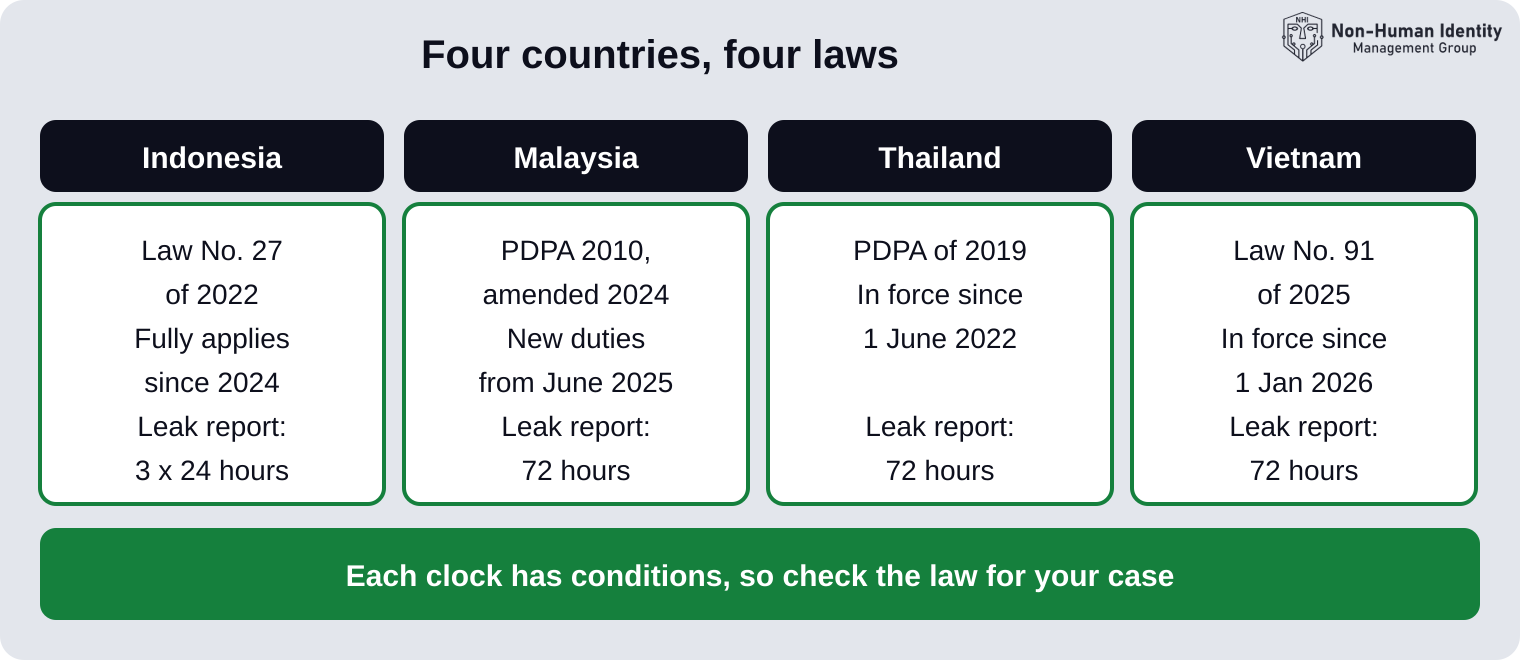
- Indonesia: the Personal Data Protection Law, Law No. 27 of 2022. Its two-year adjustment period has ended, so it now fully applies.[5]
- Malaysia: the Personal Data Protection Act 2010, changed by an amendment in 2024. Its regulator is the Personal Data Protection Commissioner.[3][4]
- Thailand: the Personal Data Protection Act of 2019, which took effect on 1 June 2022 after delays.[1][2]
- Vietnam: the Law on Personal Data Protection, Law No. 91 of 2025. It took effect on 1 January 2026 and replaced an earlier decree from 2023.[7]
Singapore and the Philippines also have their own laws, covered in separate guides linked at the end.
Where the comparison stops working: a travel adapter is a one-off purchase. Privacy laws keep changing, as Malaysia and Vietnam show, so you need to check them again.
Why does it matter?
Many small firms serve customers in several of these countries from one website or app. A process that fits one country's law may fall short in another.
If you run an online shop in the region
What could happen: one sign-up form is used everywhere, but it bundles consent in a way one country does not accept.
Check this: list where your customers live, and read your form as a customer in each country would.
If you work in IT or support
What could happen: a leak is found on a Friday, and nobody knows the regulator expects a report within about three days.
Check this: write down who reports leaks, and each country's deadline.
If you are a student or new to privacy work
What could happen: you learn from an older summary that still describes laws that have since changed.
Check this: look at the date on any summary, and confirm the latest version of each law.
What does it look like?
Here is a made-up "Am I affected?" card. A small firm might fill it in before it speaks to an adviser.
Example only. All values are made up.
Firm: Example Crafts Sdn Bhd (based in Malaysia)
Customers in: [x] Indonesia [x] Malaysia [x] Thailand [ ] Vietnam   (1)
[x] We collect names, emails, delivery addresses                    (2)
[ ] We collect health, religion or fingerprint details             (3)
[x] Our order files are stored by a cloud firm abroad              (4)
[ ] We know who reports a data leak, and by when                    (5)
Privacy notice last checked: 0000-00-00 (fake)
- Each country ticked may bring its own law into play.
- Ordinary personal data. You still need a valid reason and a clear notice.
- Sensitive data would need stronger care, often explicit consent.
- Storing data abroad can count as a transfer, with its own rules in each country.
- An unticked box here is a gap to fix before a leak happens.
Why this is risky: a firm may check only its home country's law and miss the duties of the others.
The safer way: fill in a card like this, then check each official law or ask a qualified adviser.
How does it work?
- Know which laws reach you. Some laws reach firms based abroad. Thailand's law, for example, covers firms outside Thailand that offer goods or services to people there, or monitor their behaviour there.[1]
- Have a valid reason and ask clearly. Consent is a common reason. In Thailand, a request for consent must be clear, separate from other matters and not misleading. A service cannot depend on consent for data it does not need.[1]
- Take extra care with sensitive data. Thailand lists details such as health, religion, criminal records and biometric data, meaning body features like fingerprints or faces. These usually need explicit consent.[1]
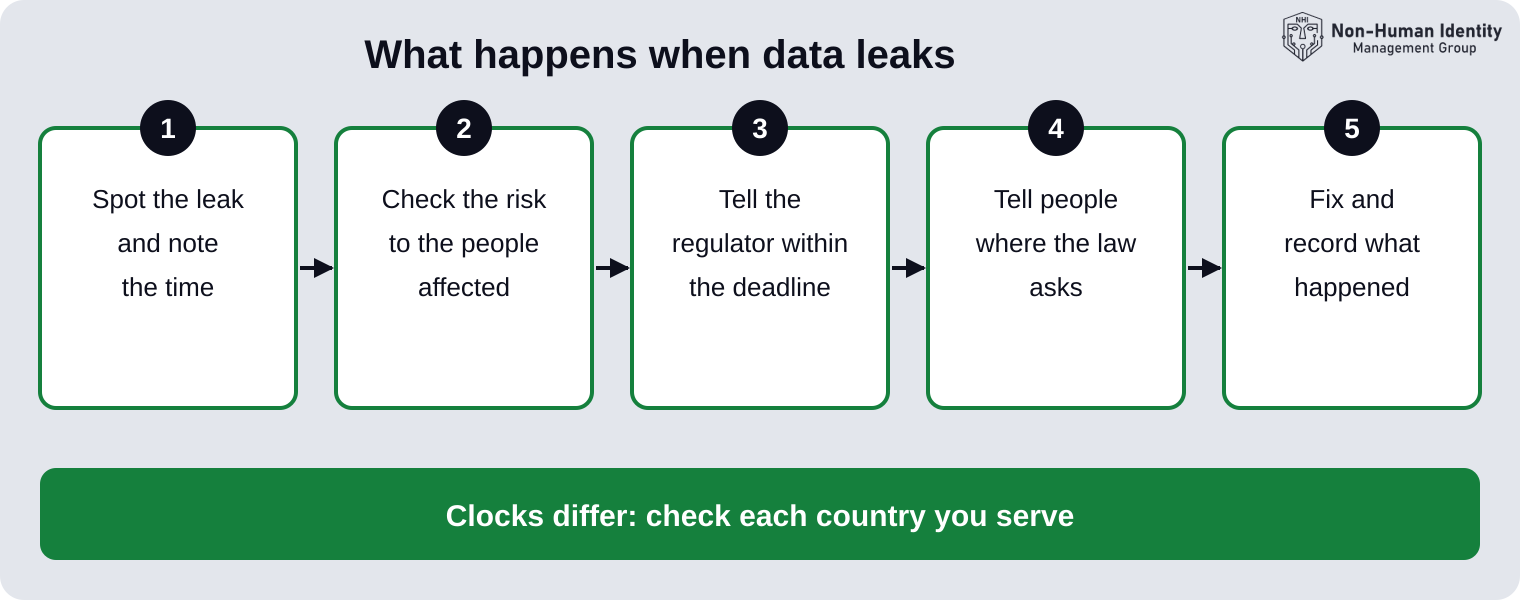
- Keep data safe and report leaks fast. Thailand expects a report to the regulator within 72 hours where feasible, unless the leak is unlikely to put people at risk.[1] Malaysia expects 72 hours, then a message to affected people within seven days.[4] Indonesia's rules say three periods of 24 hours.[5] Vietnam's law counts 72 hours from when the problem is found.[8]
- Check before sending data abroad. Thailand allows transfers to countries with adequate protection, or where an exception applies, such as the person's informed consent.[1] Other countries set their own tests.
A worked example
Calla Abara runs a small online craft shop from Kuala Lumpur. Her customers live in Malaysia, Indonesia and Thailand. Tomas Delmar looks after the website part time.
One Friday evening, Tomas notices that a customer spreadsheet was shared by a public link by mistake. It holds names, emails and delivery addresses. He removes the link straight away and phones Calla.
Calla remembers the travel adapter idea. One leak, three countries, three sets of rules. She writes down the time they found the problem, because the clocks start from discovery or awareness.
Next, they check the risk. No payment or health details were in the file. The sharing records available to them show the link was opened twice, both times from Tomas's own account.
Calla calls her adviser on Saturday morning. Together they go through each country's rules on whether a report is needed, and by when. The adviser points out that Malaysia's rules also set a deadline for telling customers in some cases.[4]
On Monday, Calla makes three changes. Customer files can no longer be shared by public link. She names Tomas as the person who reports leaks, with a one-page list of the deadlines. And she adds a date to review Vietnam's new law, because she plans to sell there next year.
Myths and mistakes
| What people think | What is true |
|---|---|
| Southeast Asia has one shared privacy law. | Each country has its own law and rules. The ideas are similar, but the details differ. |
| Our home country's law is the only one that applies. | Some laws reach firms abroad that sell to people in that country. Thailand's law is one example. |
| Vietnam still works under its 2023 decree. | A full law replaced it on 1 January 2026, with a new decree alongside it. |
| Malaysia's law has no leak reporting duty. | The 2024 changes added leak reporting and data protection officer duties, which started on 1 June 2025. |
| We have a month to report a leak. | The four laws on this page usually expect a report to the regulator within about three days, with conditions. |
What can I do this week?
- List the countries your customers and staff live in.
- Read your privacy notice and sign-up form as a customer in each country would.
- Name one person who reports data leaks, and give them each country's deadline.
- Note where your data is stored, and whether it leaves the country.
- Check the date of any summary you rely on, and look for newer changes.
Checklist
- We know which of the four countries' laws may apply to us.
- Our privacy notice says what we collect, why and who receives it.
- Consent requests are clear, separate and easy to withdraw.
- Sensitive data is listed and gets stronger protection.
- We have a leak plan with each country's reporting deadline.
- We can answer people's requests to see or correct their data on time.
- Transfers abroad are listed and checked against each country's rules.
- We have a date to check each law again for changes.
Common questions
Does Malaysia need a data protection officer?
Often, yes. The duty started on 1 June 2025. A firm needs one if it holds data on more than 20,000 people. The limit is 10,000 people for sensitive or money details. Regular, planned monitoring of people's data also counts. The rule covers firms and the suppliers who handle data for them.[4]
Who enforces Indonesia's law?
For now, a government ministry. The law plans its own data agency. A law firm briefing from August 2026 said it had not yet been set up. The Ministry of Communication and Digital Affairs carries out an interim supervisory role.[6]
How big are the fines in Vietnam?
They can be large. For cross-border transfer breaches, the cap is 5% of the previous year's revenue. For most other breaches, the cap is 3 billion Vietnamese dong. Illegal trading in personal data can lead to fines of up to ten times the money made.[8]
Is Thailand's law like Europe's GDPR?
In many ways, yes. It has a similar reach to firms abroad, similar sensitive data categories and a 72-hour leak report where feasible.[1] But it has its own regulator, rules and wording, so do not assume GDPR compliance covers it.
Where can I read the laws themselves?
Each government publishes its own laws, usually in the national language first. Regulators often publish English guidance too. Start with the regulator's website, such as Malaysia's Personal Data Protection Department, and check the date of any English translation you use.[3]
Where next?
Ready for the detail? Read the practitioner guide: Emerging Asian Data Protection Laws. It goes further into the newer laws of Sri Lanka, Bangladesh, Nepal and Brunei, including their status, rights and transfer rules, and links each country page.
Also useful:
- Indonesia PDP Law Guide
- Malaysia PDPA Guide
- Thailand PDPA Guide
- Vietnam Personal Data Protection Guide
- Singapore PDPA Guide
Related NHI Mgmt Group resources: Global Privacy Regulatory Map · Philippines Data Privacy Act Guide · International Data Transfers for Beginners
Key terms
- Personal data
- Information about a person who can be identified from it.
- Sensitive personal data
- Details such as health, religion or biometric data that need stronger protection.
- Consent
- A person's free, informed and clear agreement to a use of their data.
- Data breach notification
- Telling the regulator, and sometimes the people affected, that personal data has leaked.
- Data protection officer
- The person who oversees how an organisation follows privacy law.
- The public body that oversees a country's privacy law.
- Cross-border transfer
- Moving personal data from one country to people or systems in another.
Sources and further reading
- Personal Data Protection Act, B.E. 2562 (2019) (Thailand), English translation, see sections 5, 19, 26, 28 and 37. King Mongkut's University of Technology Thonburi (unofficial translation). https://cc.kmutt.ac.th/Files/Act%20Eng/personal-data-protection-act-2019-en.pdf, accessed 28 Nov 2026.
- News report: Thailand's Personal Data Protection Act Enters Force. The National Law Review. https://natlawreview.com/article/thailand-s-personal-data-protection-act-enters-force, accessed 28 Nov 2026.
- Jabatan Perlindungan Data Peribadi (Personal Data Protection Department), Malaysia, official website. https://www.pdp.gov.my/, accessed 28 Nov 2026.
- Malaysia: Guidelines issued on data breach notification and data protection officer appointment. DLA Piper Privacy Matters, March 2025. https://privacymatters.dlapiper.com/2025/03/malaysia-guidelines-issued-on-data-breach-notification-and-data-protection-officer-appointment/, accessed 28 Nov 2026.
- Indonesia's Personal Data Protection Law implementing regulation (PP 33/2026), briefing. RSM Indonesia. https://www.rsm.global/indonesia/en/node/439, accessed 28 Nov 2026.
- Awaiting Indonesia's Personal Data Protection Authority: a constitutional push for a hard deadline. HLC, 14 August 2026. https://hlc.com/en/publications/awaiting-indonesias-personal-data-protection-authority-a-constitutional-push-for-a-hard-deadline, accessed 28 Nov 2026.
- The latest Law on Personal Data Protection and the guiding documents (Law No. 91/2025/QH15 and Decree No. 356/2025/ND-CP). LuatVietnam. https://english.luatvietnam.vn/legal-updates/the-latest-law-on-personal-data-protection-and-the-guiding-documents-892-106778-article.html, accessed 28 Nov 2026.
- Vietnam's New Personal Data Protection Law: A Closer Look. Tilleke & Gibbins. https://tilleke.com/insights/vietnams-new-personal-data-protection-law-a-closer-look, accessed 28 Nov 2026.