A subject access request is asking an organisation for a copy of the personal data it holds about you.
This guide is for anyone who wants to ask a company what it knows about them, and for anyone at work who has to answer such a request. Any business that keeps names, emails or records about people may receive one.
In short
- Under UK and EU data protection law, you can ask an organisation for a copy of your personal data.
- You can ask in writing or out loud, and you do not have to use a special form or say why.
- The organisation usually has one month to reply, and in most cases it cannot charge a fee.
- Organisations should check who is asking, so they do not hand your data to someone else.
What you will learn
- Explain what a subject access request is in one sentence.
- Write a clear request for your own data.
- Spot a request when one arrives at work.
- Check the main steps for a safe, on-time reply.
Status: correct as at 28 November 2026, based on the UK regulator's (ICO) subject access guidance and the official text of the GDPR. Laws change; check the official text.
This guide explains the topic in general terms and is not legal advice.
- Personal details (personal data)
- any information that can identify a living person, such as a name, email or account number.
- Asking for your data (subject access request)
- a request to an organisation for a copy of the personal data it holds about you. Often shortened to SAR or DSAR.
- Right to see your data (right of access)
- the legal right that lets you make that request.
What is a subject access request?
Imagine a shop keeps a folder about you behind the counter. It holds your address, what you bought and notes from your calls. You have the right to ask, "Can I see my folder?"
A subject access request works the same way. You ask an organisation for a copy of the personal data it holds about you. The law calls this your right of access.[1]
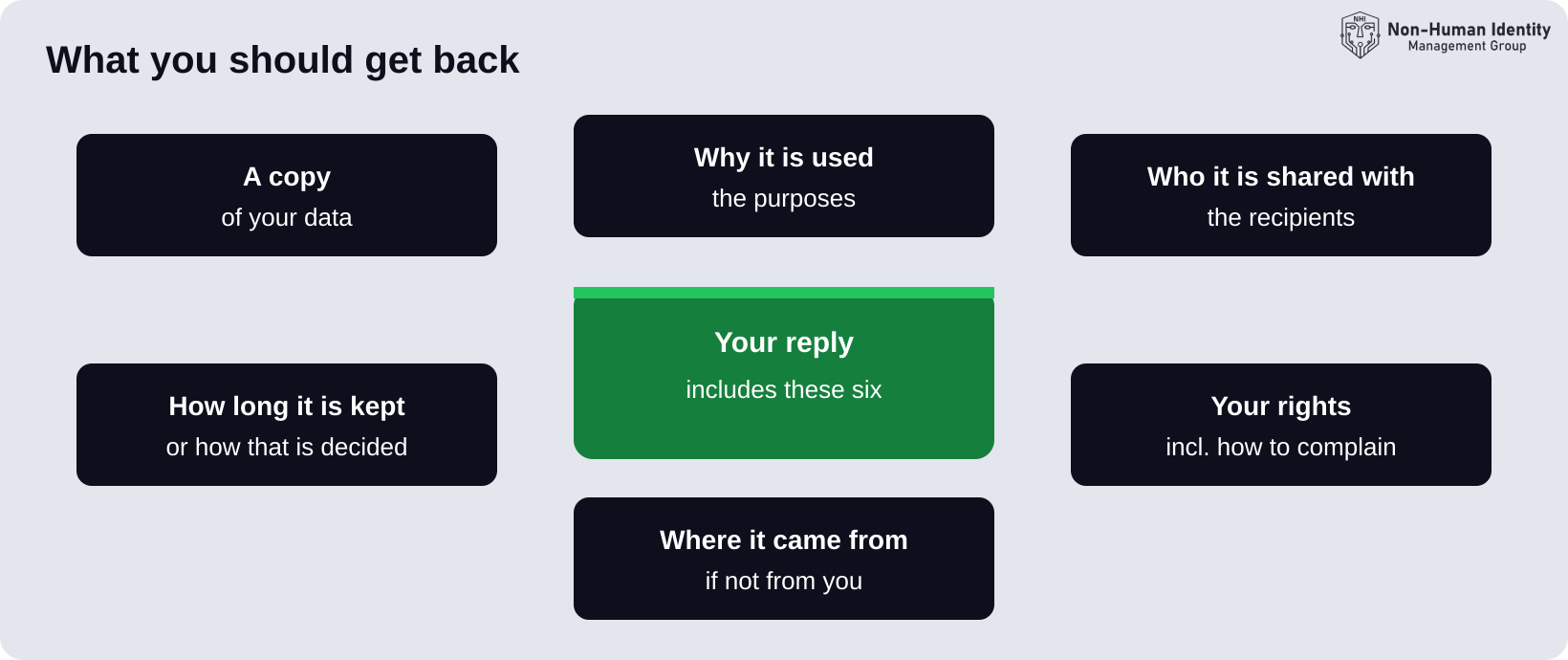
You get more than a copy. The organisation should also tell you why it uses your data, who it shares it with and how long it keeps it. It should also say where the data came from, if not from you.[2]
Where the comparison stops working: a shop folder sits in one place. Your data is often spread across emails, databases, phone recordings and suppliers' systems, so the organisation has to search for it.
Why does it matter?
Access is the first step to using your other data rights, such as asking for a mistake to be fixed.
If you want to see your own data
What could happen: a company makes a decision about you, and you do not know what records it used.
Check this: look in the company's privacy notice for a privacy contact or request form.
If you work in customer service or HR
What could happen: a request arrives by phone or in a complaint email, and nobody spots it. The time limit keeps running.
Check this: find out who you should pass a request to, on the day it arrives.
If you are new to IT or security work
What could happen: someone pretends to be a customer and asks for their data. If nobody checks, the data goes to the wrong person.
Check this: send replies only to contact details you already hold, or through a signed-in account.
What does it look like?
Here is a short request from a made-up customer. A request does not need a form, but a clear one like this helps both sides.
Example only. All values are made up.
To:      [email protected]
Subject: Subject access request               (1)
I am asking for a copy of the personal data
you hold about me, and the details the law
says go with it.                              (2)
Name:    EXAMPLE Customer (FAKE)
Account: 0000-0000                            (3)
Please include emails and call notes
from the last 2 years.                        (4)
- A clear subject line helps staff spot it, but the words "subject access request" are not required.
- This asks for the copy and the extra details, such as who the data is shared with.
- In a real message, this line would contain the customer's own account number, so the firm can find the records.
- Saying what you most want can help you get a faster, more useful reply.
Why this is risky: for the firm, a request like this can sit unread in a shared inbox. For the customer, sending ID scans by plain email can expose more data than needed.
The safer way: log every request on the day it arrives. Ask for ID only when you really need it, and use a secure way to collect it.
How does it work?
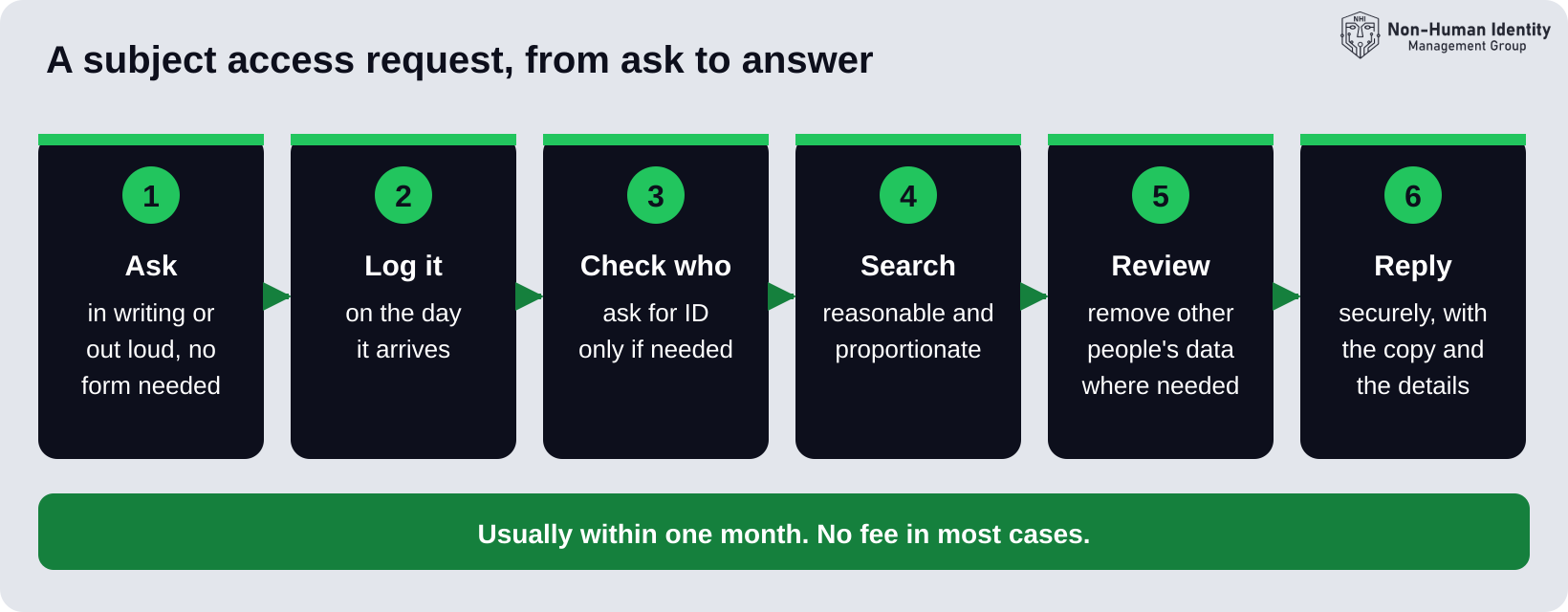
Here is what usually happens, from the request to the reply.
- The person asks. They can ask in writing or out loud, and the UK regulator says this includes social media.[1] You can also ask by post, by phone or face to face.[3]
- The organisation logs it and checks identity. It needs to be sure who is asking, and it should ask for formal ID only if that is necessary.[1]
- The clock runs. The reply is due within one month. In the UK, the month starts when the last needed item arrives, such as ID the firm asked for.[1]
- The organisation searches. It should make a reasonable and proportionate search of its systems.[1]
- It checks what to hold back. Data about other people may need to be removed unless they agree or it is reasonable to share, and some legal exemptions may also apply.[1]
- It replies securely. The reply includes the copy and the extra details, and if the firm refuses any part, it must say why and explain how to complain.[1]
A worked example
Siobhan Walsh buys walking gear from Summit Ridge Outdoor, a made-up shop with a website. She starts getting marketing emails she never signed up for. She wants to know what the shop holds about her and where it got her details.
Siobhan finds the privacy contact in the shop's privacy notice. She sends a short email asking for a copy of her personal data. She asks in particular where her email address came from. She gives her name and her order number, and keeps a copy of the email.
At Summit Ridge, the office manager, Ewan Campbell, sees the word "data" and logs the request that day. The email comes from the address on Siobhan's account, and it matches her order. So Ewan decides he does not need a copy of her passport.
Ewan searches the online shop, the email marketing tool and the customer service inbox. He finds her orders, two support emails and her marketing record. The record shows her email came from a competition entry form.
One support email names another customer. Ewan blacks out that name before sending.
Three weeks after her request, Siobhan gets a reply through a secure download link. It holds her data and a short letter. The letter explains why the shop uses her data, which suppliers see it and how long it is kept. It also says where her email came from and how to complain to the regulator.
Siobhan asks to stop the marketing emails, and the shop removes her from the list.
Myths and mistakes
| What people think | What is true |
|---|---|
| A request must be in writing and use the right words. | It can be in writing or out loud, including on social media. No special words are needed.[1] |
| The company can charge a fee for every request. | In most cases it cannot. A reasonable fee is allowed only in limited cases, such as extra copies.[1] |
| You have to say why you want your data. | You do not have to give a reason. Organisations should not refuse a request just because of why it was made.[4] |
| The safest move is to ask everyone for a passport scan. | Ask for formal ID only if necessary. Collecting extra ID creates more data to protect.[1] |
| Emails do not count, only the main database. | Your data in emails, notes and other systems can count too. The search should be reasonable and proportionate.[1] |
| Sending the reply by any email is fine. | Send it through a secure route to a contact detail you have checked, so it reaches the right person. |
What can I do this week?
- If you want your data, find the privacy contact in one company's privacy notice and send a short request.
- Keep a copy of your request and note the date you sent it.
- At work, ask who handles requests, and add their contact to your team's notes.
- Check whether your organisation keeps one log of all requests and their due dates.
Checklist
- Staff know a request can arrive in any form, not only on a form.
- Every request is logged on the day it arrives, with a due date.
- We check identity in a way that fits the data, and ask for ID only when needed.
- We know where people's data is kept, so we can search it.
- Other people's data is removed or checked before we reply.
- Replies include the copy and the extra details, such as who sees the data.
- Replies go through a secure route to a checked contact detail.
- If we refuse or extend, we explain why and how to complain.
Common questions
How long does the organisation have to reply?
Usually one month. If the request is complex, or the same person sends several, the organisation can take up to two more months. It must tell you within the first month and explain why. If it asks you to clarify your request, the clock pauses until you reply.[1]
Can an organisation refuse my request?
Sometimes. It can refuse all or part of a request only if a legal exemption applies, or if the request is clearly unfounded or excessive. If it refuses, it must tell you why, and tell you that you can complain to it, to the regulator or to the courts.[1]
What can I do if I get no reply?
First, contact the organisation again and remind it of the date you asked. If you are still unhappy, you can complain to the data protection regulator. In the UK that is the ICO. You can also ask the courts to enforce your right.[1]
Can someone else ask on my behalf?
Yes. A friend, relative or solicitor can make a request for you. The organisation will want to be sure they have your permission, so it may ask for proof of that. The month then runs from when it receives that proof.[1]
Is a DSAR the same as a subject access request?
Mostly. DSAR stands for data subject access request, and many people use it to mean the same thing. Some use DSAR more loosely, for any data rights request, such as asking for data to be deleted. Those other rights have their own rules.
Where next?
Ready for the detail? Read the practitioner guide: DSAR Guide: Handling Data Subject Requests. It goes further into the deadlines in different laws, identity checks, searching across systems, exemptions and secure delivery.
Also useful:
- The legal right in more depth: the GDPR right of access guide
- GDPR for Beginners
- DSAR Response Letter Templates
- For knowing where data is kept: Data Mapping and ROPA Guide
Related NHI Mgmt Group resources: Data Subject Request Verification Procedure Template · AI Agents and Data Subject Rights · Data Protection Impact Assessments for Beginners
Key terms
- DSAR
- A request from a person to see the personal data an organisation holds about them.
- Right of access
- A person's legal right to find out if their data is used, and to get a copy of it.
- Personal data
- Information that can identify a living person, directly or indirectly.
- Data subject
- The person the personal data is about.
- Data controller
- The organisation that decides why and how personal data is used, and must answer requests.
- The public regulator that enforces data protection law, such as the ICO in the UK.
Sources and further reading
- A guide to subject access. Information Commissioner's Office (ICO), UK GDPR guidance and resources: verbal and social media requests, fees, one-month limit and when it starts, extension, reasonable and proportionate search, identity, third-party data, refusals and complaint rights. https://ico.org.uk/for-organisations/uk-gdpr-guidance-and-resources/subject-access-requests/a-guide-to-subject-access/, accessed 28 Nov 2026.
- Regulation (EU) 2016/679 (General Data Protection Regulation), Article 15: Right of access by the data subject, 15(1)(a) to (h), 15(3) and 15(4). Text as published at gdpr-info.eu. https://gdpr-info.eu/art-15-gdpr/, accessed 28 Nov 2026.
- Getting copies of your information (subject access request). Information Commissioner's Office (ICO), guidance for the public. https://ico.org.uk/for-the-public/getting-copies-of-your-information-subject-access-request/, accessed 28 Nov 2026.
- Guidelines 01/2022 on data subject rights: Right of access, version 2.0. European Data Protection Board (EDPB), adopted 28 March 2023. https://www.edpb.europa.eu/system/files/2023-04/edpb_guidelines_202201_data_subject_rights_access_v2_en.pdf, accessed 28 Nov 2026.