Risk appetite is how much risk an organisation is willing to take to reach its goals.
This guide is for students, newcomers and anyone who has heard the phrase in a meeting and nodded along. You do not need to work in security to be affected: every time a firm delays a fix, launches a product early or keeps an old system running, someone is deciding how much risk is acceptable.
In short
- Risk appetite is a general statement from the top, such as "we take very little risk with customer data".
- Risk tolerance turns that statement into a limit you can measure, such as "no email outage longer than five minutes".
- Warning signs, called key risk indicators, show when a limit is getting close, so someone can act in time.
- Without an agreed appetite, people guess, and different teams make very different choices about the same risk.
What you will learn
- Explain risk appetite and risk tolerance in plain words.
- Spot the difference between a vague statement and a useful limit.
- Check whether a risk decision fits what leaders agreed.
- Ask who sets the appetite where you work or study.
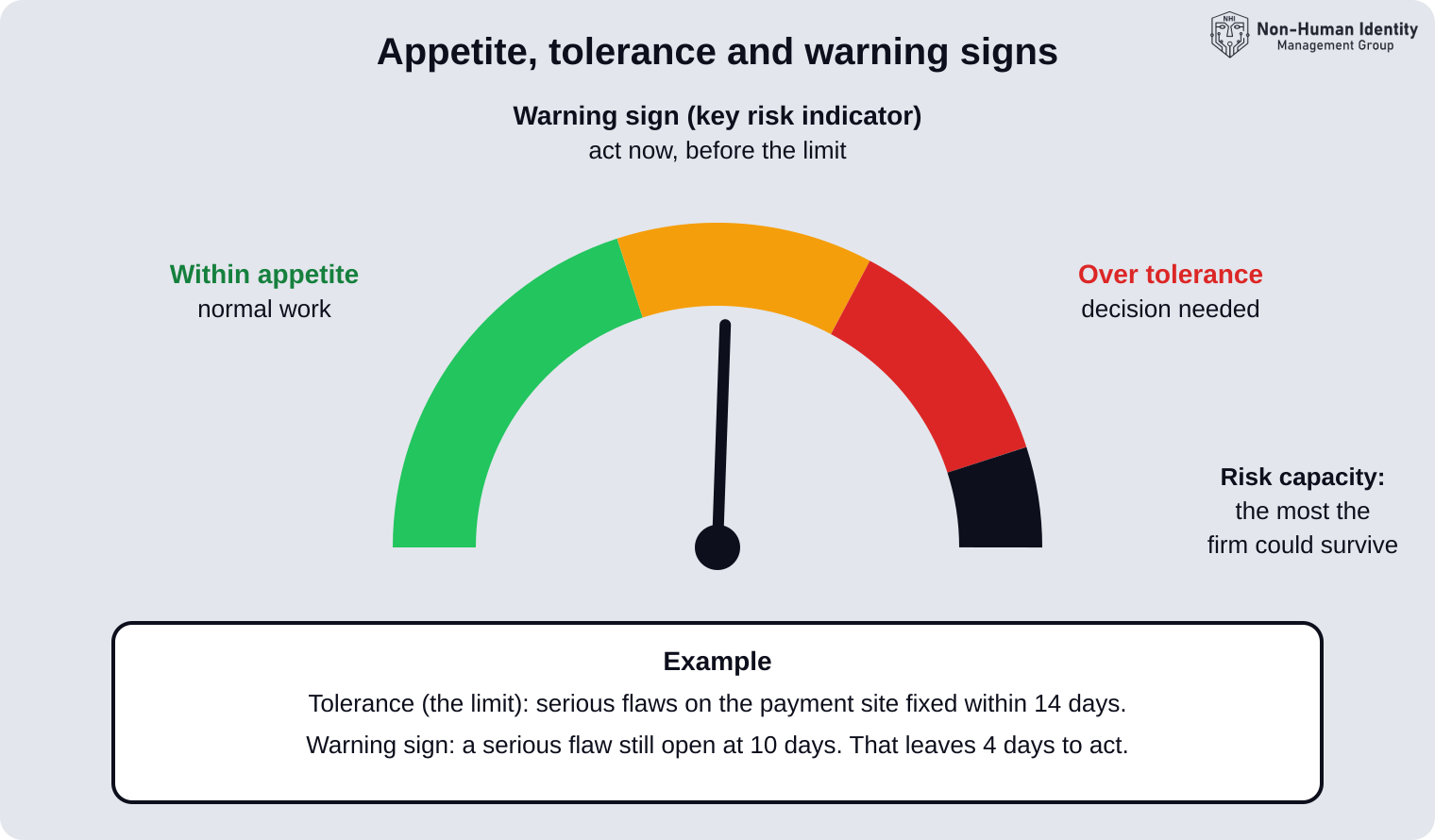
- How much risk we accept (risk appetite)
- a broad statement from senior leaders about the amount and type of risk they will take.
- The hard limit (risk tolerance)
- a specific, measurable line that applies the appetite to one service or goal.
- Early warning sign (key risk indicator)
- a number that rises as a risk gets closer to its limit.
What is risk appetite?
Think of how you drive a car. You might say "I drive carefully". That is your attitude. You also keep to a speed limit, which is a number you can check. And your speedometer warns you before you go over it.
Risk appetite is the attitude part, for a whole organisation. Senior leaders decide how much risk they will accept to get what they want, such as growth, speed or lower costs. A bank might accept some risk to launch a new app quickly, but very little risk of losing customer money.
Risk tolerance is the speed limit. It turns the attitude into a number for one service, so a team knows exactly where the line is. Key risk indicators are the speedometer. They tell people the line is getting close.
Where the comparison stops working: a driver sets their own limits. In an organisation, the appetite comes from the board or senior leaders, and many teams must apply it. Cyber risk is also harder to see than speed, so the warning signs need careful choosing.
Why does it matter?
Every security choice trades risk against something else, such as time, money or ease of use. With an agreed appetite, those choices follow one set of rules, not each person's mood. UK government guidance for boards asks them to define the organisation's cyber risk appetite and communicate it clearly.[2]
If you are studying or new to security
What could happen: you fix the wrong things first, because nobody told you which risks matter most.
Check this: ask whether your team has a written risk appetite, and read it.
If you run a small business
What could happen: you spend heavily on minor risks while a serious one, like losing your only copy of customer records, goes unnoticed.
Check this: write down the two or three things you could not afford to lose.
If you manage a team
What could happen: you accept a risk on the spot that leaders would never have agreed to.
Check this: before you accept a risk, check it against the agreed limits and record who approved it.
What does it look like?
Here is a made-up scenario card for a small online shop. It shows how one broad statement becomes limits and warning signs.
Example only. All values are made up.
Example Shop Ltd: risk appetite card (FAKE)
Appetite:  We accept little risk to customer payment data.     (1)
Tolerance: Serious security flaws on the payment site
           are fixed within 14 days.                           (2)
Warning:   Any serious flaw still open after 10 days
           is reported to the director.                        (3)
Owner:     EXAMPLE Operations Manager                          (4)
Reviewed:  every 12 months (EXAMPLE date 0000-00-00)           (5)
- The appetite: a broad statement in words a director can agree or argue with.
- The tolerance: a number a team can measure and report against.
- The warning sign: it fires before the limit is crossed, leaving four days to act.
- A named person owns the limit and reports on it.
- In a real file, this line would contain the date the card was last agreed.
Why this is risky: many firms stop at line 1. "We accept little risk" sounds sensible. But it does not tell anyone whether to fix a flaw tonight or next month.
The safer way: pair each broad statement with a limit you can measure, a warning sign and an owner. A US government guide gives an email example. The appetite says email should work for most of the day. The tolerance says it should not be down for more than five minutes in core hours.[1]
How does it work?
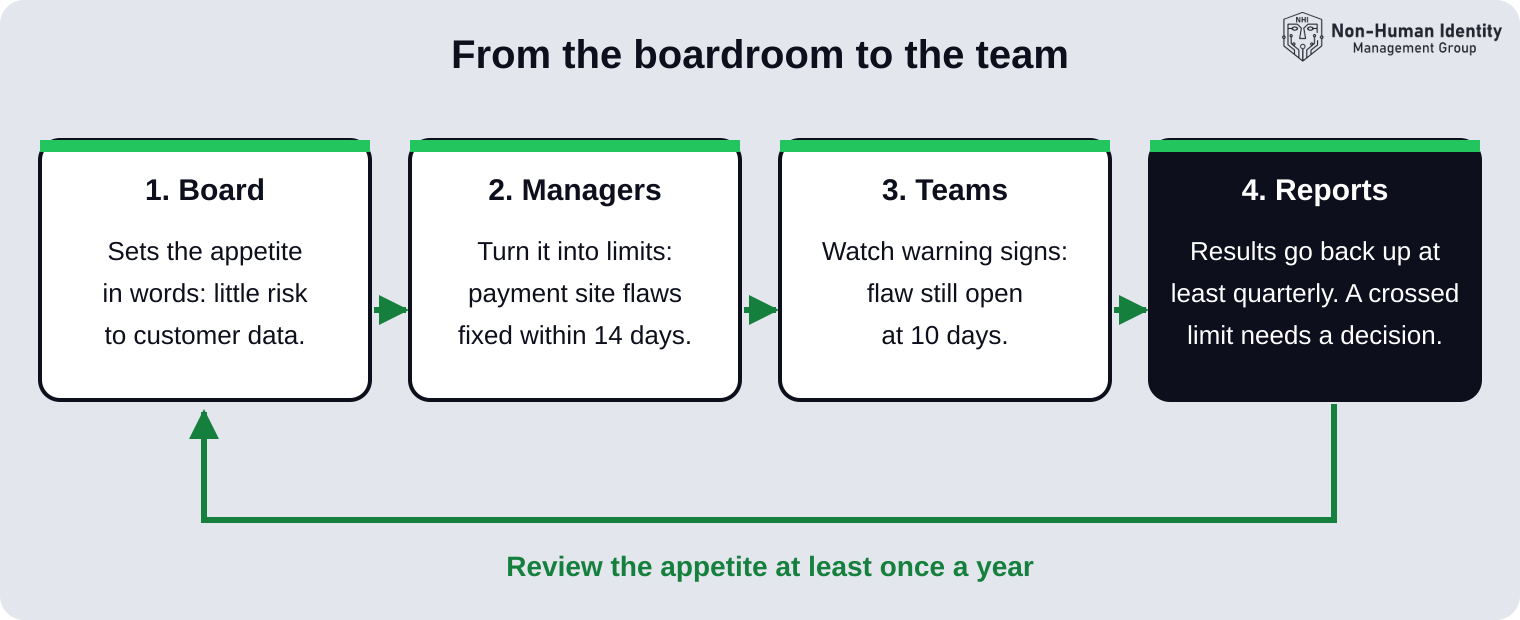
Risk appetite usually flows from the top of an organisation down to the teams doing the work.
- Leaders set the appetite. The board or senior leaders agree how much and what kind of risk they will take to meet their goals.[1]
- The appetite stays inside what the firm can survive. The biggest loss an organisation could absorb is called its risk capacity. The appetite should sit well below it.
- Teams turn it into limits. Each broad statement becomes one or more tolerances: measurable lines for a service, a system or a goal.[1]
- Warning signs watch the limits. Key risk indicators are set inside each limit, so there is time to act before it is crossed.[3]
- People report and decide. Results go back up regularly. UK guidance suggests boards get formal reports at least every quarter, with agreed tolerances for each measure.[2] When a limit is crossed, someone must make a decision: fix it, accept it for a set time, or change the plan.
A worked example
Imani Gallardo is the managing director of a fictional travel booking firm with forty staff. Her board has agreed a short appetite statement: "We accept little risk of customers' payment details being exposed."
Hal Hollis, the IT manager, asks her what that means in practice. Together they write one tolerance. Any serious security flaw on the booking website must be fixed within 14 days. They add a warning sign. If a serious flaw is still open after 10 days, Hal tells Imani straight away.
A month later, a supplier warns of a serious flaw in the booking software. The fix needs the website taken offline for an evening, in the middle of a busy sale.
Jana Rosen, who runs sales, asks Hal to wait until the sale ends in three weeks. Before the appetite existed, Hal would have had to guess. Now he can check. Three weeks is longer than the 14-day limit, so waiting is outside what the board agreed.
Hal takes it to Imani. She could ask the board to accept the risk for a short, recorded period. Instead, she agrees to a short outage late at night, when bookings are quiet. Jana loses a few hours of sales, not a whole evening.
The fix goes in on day six. Hal's next quarterly report shows the flaw closed well inside the limit. The decision took one short meeting, because everyone was working from the same agreed line.
Myths and mistakes
| What people think | What is true |
|---|---|
| Our appetite for cyber risk is zero. | No organisation can work with zero risk. A zero appetite gives teams no help in choosing what to fix first. |
| Appetite and tolerance mean the same thing. | Appetite is the broad statement. Tolerance is the narrower, measurable limit that applies it.[1] |
| Writing the statement is the job done. | A statement helps only when real decisions, such as delays and exceptions, are checked against it. |
| One appetite covers all cyber risk. | Different risks need different limits. Most firms accept more risk with a test system than with customer data. |
| If a limit is crossed, move the limit. | A crossed limit should lead to a decision by the right person. Quietly moving the line hides the problem. |
What can I do this week?
- Ask whether your organisation, or one you study, has a written risk appetite statement.
- Pick one important service and write one measurable limit for it.
- Add one warning sign that would fire before that limit is crossed.
- Find out who is allowed to accept a risk that goes over a limit.
Checklist
- Senior leaders have agreed a risk appetite in plain words.
- The appetite is split by type of risk, such as customer data, outages or money.
- Each important statement has at least one measurable tolerance.
- Each tolerance has a warning sign set early enough to act.
- Each limit has a named owner.
- Anyone accepting a risk over a limit is named, and the decision is recorded and time-limited.
- Results are reported to leaders regularly, at least every quarter.
- The appetite is reviewed at least once a year.
Common questions
What is the difference between risk appetite and risk tolerance?
Risk appetite is the broad amount of risk leaders will take to meet their goals. Risk tolerance is a narrower, measurable limit for one service or goal. Appetite gives the direction, and tolerance shows the exact line a team should not cross.
Who sets the risk appetite?
Usually the board or the most senior leaders. They approve it because it shapes spending, speed and what the firm will put up with. Managers and teams then turn it into limits for their own systems and report back on how they are doing.
What is a risk appetite statement?
It is a short written document that sets out how much risk an organisation will take, broken down by type of risk. Good statements link each line to measurable limits. See the Cyber Risk Appetite Statement Template for an example layout.
Is risk capacity the same as risk appetite?
No. Risk capacity is the most loss or disruption an organisation could survive. Risk appetite is how much it chooses to take. It should sit well below capacity, to leave room for surprises.
Does a small business need a risk appetite?
Yes, though it can be short. A few sentences on what you could not afford to lose, plus one or two limits, already helps. It makes choices about backups, updates and spending easier and more consistent.
Where next?
Ready for the detail? Read the practitioner guide: Risk Appetite and Tolerance for Cyber Guide. It goes further into how the main standards define the terms, how to write statements by risk category and how to report against tolerances to a board.
Also useful:
- Key Risk Indicators for Cyber Risk Guide
- Cyber Risk Appetite Statement Template
- Cyber Risk Management for Beginners
- Risk Treatment Options for Beginners
- Cyber Risk Quantification for Beginners
Related NHI Mgmt Group resources: Security Exception and Risk Acceptance Register Template · Governance, Risk and Compliance for Beginners · Cybersecurity Risk Manager Career Guide
Key terms
- Risk appetite
- The amount and type of risk an organisation is prepared to take to pursue its goals.
- Risk tolerance
- A specific, measurable limit that turns the broad appetite into a line someone must act on.
- Risk capacity
- The most risk an organisation can absorb without threatening its operations or survival.
- Key risk indicator
- A measurable signal that warns of rising exposure before a risk becomes serious.
- Risk acceptance
- A formal, owned decision to live with a risk for now rather than fix it straight away.
- Risk owner
- The named person accountable for a risk and for the decisions made about it.
Sources and further reading
- NIST IR 8286 Rev. 1, Integrating Cybersecurity and Enterprise Risk Management (ERM). National Institute of Standards and Technology, December 2025. https://csrc.nist.gov/pubs/ir/8286/r1/final, accessed 28 Nov 2026.
- Cyber Governance Code of Practice. Department for Science, Innovation and Technology and National Cyber Security Centre, 8 April 2025. https://www.gov.uk/government/publications/cyber-governance-code-of-practice/cyber-governance-code-of-practice, accessed 28 Nov 2026.
- NIST IR 8286C Rev. 1, Staging Cybersecurity Risks for Enterprise Risk Management and Governance Oversight. National Institute of Standards and Technology, December 2025. https://csrc.nist.gov/pubs/ir/8286/c/r1/final, accessed 28 Nov 2026.