US privacy law is a patchwork: there is no single national privacy law, so personal data is protected by a mix of federal laws for particular sectors and a growing set of state laws.
This guide is for newcomers, students, career changers and managers who keep hearing names like HIPAA, CCPA and COPPA and want to know how they fit together. It explains the two layers of the patchwork in plain English, how an organisation works out which laws apply, a worked example and simple first steps. It does not list every law in detail: it points you to deeper guides for that.
By the end of this guide you will be able to:
- Explain why the US has a patchwork of privacy laws rather than one law.
- Identify the main federal sector laws and what kind of data each covers.
- Describe what the state consumer privacy laws, such as California's, give people.
- Understand the basic steps an organisation takes to work out which laws apply.
Status: correct as at 27 November 2026, based on the California Attorney General, Federal Trade Commission, US Department of Health and Human Services, US Department of Education and Code of Virginia official pages. Laws change; check the official text.
This guide explains the topic in general terms and is not legal advice.
Key takeaways
- There is no one US privacy law. Federal laws cover particular sectors or kinds of data, and states add their own consumer privacy and breach laws on top.
- Federal laws follow the type of data. Health records, financial customer data, children's data online, student records and credit reports each have their own law and regulator.
- State laws follow the person. A state law usually protects residents of that state, so a business can be covered by a state's law without being based there.
- Most state laws give similar rights. Typical rights are to know, access, correct and delete personal data, and to opt out of its sale or use for targeted advertising.
- Breach notification is everywhere. Every state has a law requiring businesses to tell people when certain personal information is exposed.
What it is, in plain English
Privacy law sets rules for how organisations collect, use, share, protect and delete personal information: information that identifies a person or can be linked to them, such as a name, email address, location or purchase history.
Many countries have one main privacy law that covers almost everyone, such as the EU's General Data Protection Regulation (GDPR). The US took a different route. Over several decades it passed separate federal laws for specific areas, often called sector laws. Since 2018, individual states have also passed broad consumer privacy laws, starting with California.[1]
A helpful comparison is the rules for driving. Some rules are national, some apply only to lorries or buses, and each state adds its own speed limits and licence rules. A driver crossing the country has to follow the rules of each state they drive through. A business serving customers in many states is in a similar position. Where the analogy breaks down: road rules are fairly alike everywhere, while privacy laws differ in important details such as who is covered, what counts as sensitive data and who can enforce them.
Layer 1: federal sector laws
The table shows the main federal laws a beginner meets. Each covers a kind of organisation or a kind of data, not all personal data.
| Law | What it covers | Main regulator |
|---|---|---|
| HIPAA Privacy Rule (Health Insurance Portability and Accountability Act) | Health information held by health plans, health care clearinghouses and health care providers that carry out certain electronic transactions, and their business associates[3] | HHS Office for Civil Rights[3] |
| Gramm-Leach-Bliley Act (GLBA) | Customer information at financial institutions, such as lenders, insurers and firms giving financial advice; includes the Financial Privacy Rule and the Safeguards Rule[6] | Federal Trade Commission (FTC) for many non-bank firms[6] |
| Children's Online Privacy Protection Act (COPPA) | Personal information collected online from children under 13 by websites and online services aimed at children, or that know they are collecting it[5] | FTC[5] |
| Family Educational Rights and Privacy Act (FERPA) | Student education records and the personally identifiable information in them[7] | US Department of Education[7] |
| Fair Credit Reporting Act (FCRA) | Information in consumer credit reports, including identity theft rules[2] | FTC (with other agencies)[2] |
| FTC Act, Section 5 | Unfair and deceptive practices, which the FTC uses to hold companies to the privacy promises they make[2] | FTC |
Layer 2: state laws
States add three main kinds of rules:
- Comprehensive consumer privacy laws: broad laws giving residents rights over their personal data, such as the California Consumer Privacy Act (CCPA) and the Virginia Consumer Data Protection Act.[1][8]
- Breach notification laws: all 50 states, the District of Columbia, Guam, Puerto Rico and the US Virgin Islands have laws requiring private businesses to notify people of breaches involving personal information.[4]
- Narrower state laws: for example on health data, biometric data or data brokers. The US State Privacy Laws Guide covers these in depth.
Why it matters to you
- If you run a small business: many state consumer privacy laws only apply above a size threshold, but breach notification laws and sector laws such as COPPA or HIPAA can apply to small organisations too. Knowing which apply saves wasted effort and nasty surprises.
- If you are new to a security job: privacy laws often require "reasonable" security, and breach laws decide what happens after an incident. Security teams are usually the ones asked "was personal data exposed, and whose?"
- If you are a manager: customers, partners and regulators increasingly ask how you handle personal data. Enforcement is mostly by regulators such as the FTC and state attorneys general, and some laws allow people to sue in limited cases.[1]
The patchwork also means one database can fall under several laws at once. A clinic's online booking system might hold health information (HIPAA), card payment details, and data about residents of several states. Treating privacy as "one rule" tends to miss something.
How it works, step by step
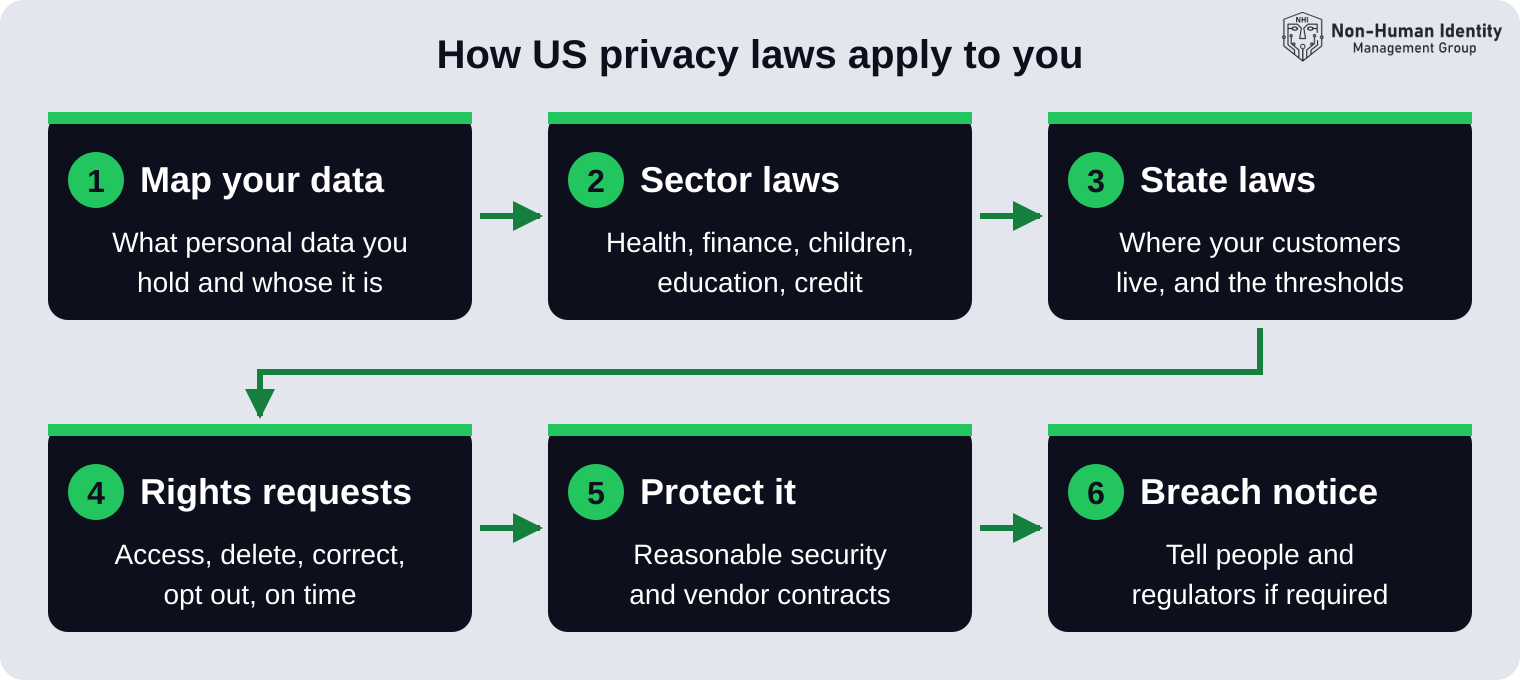
Organisations usually work through the same questions, in roughly this order. This is a sensible approach, not a legal requirement.
- Map your data. List what personal information you collect, where it is stored, who it is about (customers, staff, children, patients) and which states those people live in.
- Check the sector laws. Ask whether you are, for example, a HIPAA covered entity or business associate, a financial institution under GLBA, an online service aimed at children under 13, or a school handling education records.[3][5][6][7]
- Check the state laws. For each state where your customers live, check whether you meet its thresholds. California's law, for example, applies to for-profit businesses doing business in California that meet any one of three tests, such as gross annual revenue above a set amount or handling the personal information of 100,000 or more California residents or households.[1] Many state laws also exempt data already covered by HIPAA or GLBA.[8]
- Be ready for rights requests. Set up a way for people to ask to know, access, correct or delete their data and to opt out, and to answer within the deadline. Virginia's law, for example, gives a business 45 days, with one 45-day extension if the person is told in time.[8]
- Protect the data. Put security controls in place and make sure suppliers who handle the data are bound by contract. The GLBA Safeguards Rule, for instance, requires covered companies to keep an information security programme with administrative, technical and physical safeguards.[6]
- Prepare for breach notification. Know which state and sector rules would require you to tell people or regulators if personal data is exposed, and who decides.[4]
What rights do state laws usually give?
The rights are broadly similar across states, with differences in detail. This table compares California and Virginia, two of the best-known laws.
| Right | California (CCPA, as amended) | Virginia (VCDPA) |
|---|---|---|
| Know or access | Right to know what personal information is collected, used, shared or sold[1] | Confirm processing and access personal data[8] |
| Delete | Right to delete, with exceptions[1] | Delete personal data[8] |
| Correct | Right to correct inaccurate information, added by the California Privacy Rights Act (CPRA) from 1 January 2023[1] | Correct inaccuracies[8] |
| Opt out | Opt out of sale or sharing, including through a browser signal such as Global Privacy Control[1] | Opt out of targeted advertising, sale and certain profiling[8] |
| Sensitive data | Right to limit use of sensitive personal information[1] | Covered in the law's rules on sensitive data; see the Virginia Consumer Data Protection Act (VCDPA) Guide |
| Who enforces | Attorney General and the California Privacy Protection Agency; people can sue only over certain data breaches[1] | Attorney General only; no private right of action[8] |
A worked example
Maple & Thread is a fictional online shop based in Ohio that sells craft kits. It has 25 staff and customers across the US, including many in California and Virginia. Dana, the operations manager, has been asked to work out "which privacy laws we need to worry about".
- Map the data: Dana lists customer names, addresses, emails, order history and marketing preferences. Card payments go through a payment provider, so card numbers are not stored by the shop. Staff records are kept separately.
- Sector laws: Maple & Thread is not a health provider or financial institution. Its kits are aimed at adults and its sign-up form asks for date of birth, so Dana confirms with the web team that it does not knowingly collect data from under-13s, which would bring in COPPA.[5]
- State laws: the shop is well below California's revenue test, so Dana checks the customer numbers. It holds data on about 30,000 California customers and does not sell data, so on her reading it falls under none of California's three tests. She makes a note to recheck every year as the business grows, and asks the company's lawyer to confirm.[1]
- Breach rules: Dana realises that whatever its size, the shop would be covered by state breach notification laws if customer data were exposed.[4] She writes a one-page breach plan that names who decides, who contacts the lawyer and where the customer list by state is kept.
- Good practice anyway: she updates the privacy notice to match what the shop actually does and adds a simple way for customers to ask for their data to be deleted.
The outcome is modest but useful. Dana has not made the shop "compliant with everything", and her reading of the thresholds is a starting point for the lawyer, not a legal opinion. She does know what data the shop holds, which laws are most likely to apply and what to do first if something goes wrong.
Myths and misunderstandings
| What people think | What is true |
|---|---|
| The US has no privacy law. | It has many: federal laws for sectors such as health, finance, children and education, plus state consumer privacy and breach notification laws. |
| HIPAA covers all health data. | HIPAA applies to covered entities and their business associates. Health data held by other organisations may fall under other rules instead, such as the FTC's Health Breach Notification Rule.[2][3] |
| A state's law only applies to businesses based in that state. | State laws generally protect that state's residents, so an out-of-state business serving them can be covered if it meets the thresholds.[1] |
| Small businesses can ignore privacy law. | Many comprehensive state laws have size thresholds, but breach notification laws and sector laws such as COPPA are not limited to large firms. |
| Customers can sue under any state privacy law. | Most of these laws are enforced by regulators. California allows private lawsuits only for certain data breaches, and Virginia's law has no private right of action.[1][8] |
Key terms
- Personal information
- Information about an identifiable individual, whether recorded or not. Each law defines it slightly differently.
- Sensitive personal information
- A category of personal data that needs tighter handling than ordinary personal data, such as precise location, financial records or identification numbers.
- Covered entity
- An organisation that must follow HIPAA because it handles protected health information as a health plan, clearinghouse or provider carrying out certain electronic transactions.
- Protected health information (PHI)
- Health-related data that can identify a person and is covered by HIPAA protections.
- Controller
- The organisation that decides why personal data is collected and how it is used. Several state laws use this word.
- Targeted advertising
- Using data about a person's behaviour or interests to choose which adverts they see. Many state laws let people opt out of it.
- Global Privacy Control (GPC)
- A browser signal that tells websites the person does not want their personal data sold or shared.
- Data broker
- An organisation that collects, combines and sells or shares personal data about people, often without a direct relationship with them.
- Private right of action
- The ability of individuals to sue a company directly for breaking a law, rather than relying on a regulator.
- Cure period
- A set window a regulator gives an organisation to fix a violation before taking action.
- Data breach notification
- Formally telling affected people, regulators and sometimes partners that personal data has been exposed or accessed without permission.
- Privacy notice
- A public statement explaining what personal data an organisation collects, why, how long it keeps it and who receives it.
Common questions
Is there a federal privacy law like GDPR in the US?
No. As of November 2026 there is no single comprehensive federal privacy law. Privacy is covered by federal sector laws and by state laws.
Which state was first to pass a broad consumer privacy law?
California, with the California Consumer Privacy Act of 2018. Voters approved the California Privacy Rights Act in November 2020, which amended it and added new rights from 1 January 2023.[1]
Who enforces US privacy laws?
It depends on the law. The FTC enforces COPPA, parts of GLBA and Section 5 of the FTC Act; HHS's Office for Civil Rights enforces HIPAA; state attorneys general enforce most state laws; and California also has a dedicated agency, the California Privacy Protection Agency.[1][2][3]
Do these laws apply to employee data?
Sometimes. California's law covers California residents, which can include staff; other states' laws treat employee data differently. The Employee Data Privacy Guide explains the differences.
What is the link between privacy and security?
Privacy laws decide what you may do with personal data; security protects it from people who should not have it. Many privacy laws expect reasonable security, and a security failure can become a privacy breach. See Data Privacy vs Data Security.
How do I keep up when laws change?
Check the regulator's own pages and the official text, and review your list of applicable laws at least once a year. We suggest naming one person who owns that review.
First steps
Three things you can do this week:
- Write a one-page data map. List the main kinds of personal information you hold, where it lives and roughly which states the people are in.
- Answer the sector questions. Are you in health care, finance, education, or running an online service children might use? Note any yes answers for a closer look.
- Find your breach contacts. Write down who decides whether a breach must be reported, and which lawyer or adviser you would call.
Checklist
- We know what personal information we collect and where it is stored.
- We know which states most of our customers and staff live in.
- We have checked whether any federal sector law (HIPAA, GLBA, COPPA, FERPA, FCRA) applies to us.
- We have checked the thresholds of the state consumer privacy laws that could apply, and recorded the result and date.
- Our privacy notice matches what we actually do with data.
- People can easily ask to access, correct or delete their data, and requests are tracked to a deadline.
- We have a short breach plan that covers state notification rules.
- Suppliers that handle our personal data are bound by contracts that require them to protect it.
Check your understanding
1. Why is US privacy law called a patchwork?
Answer: because there is no single national law. Federal laws cover particular sectors or kinds of data, and states add their own laws on top.
2. Which federal law covers personal information collected online from children under 13?
Answer: the Children's Online Privacy Protection Act (COPPA), enforced by the FTC.
3. Can a business based in Ohio be covered by California's privacy law?
Answer: yes, if it does business in California and meets one of the law's thresholds, because the law protects California residents.
4. Which kind of state law applies in every US state?
Answer: breach notification law. All 50 states have one.
Suggested learning pathway
- Start with the basics of privacy in Data Privacy for Beginners.
- For health data, read HIPAA for Beginners.
- For what happens after an incident, read Data Breach Notification for Beginners.
- For the federal layer in more depth, see the US Federal Privacy Laws Overview.
- For the state layer in depth, see the US State Privacy Laws Guide.
- For California in detail, see CCPA and CPRA.
- For a quick state-by-state lookup, use the US State Privacy and Security Laws Quick Reference.
Standards and references
- California Consumer Privacy Act (CCPA). State of California Department of Justice, Office of the Attorney General. https://oag.ca.gov/privacy/ccpa, accessed 27 Nov 2026.
- Privacy and Security (business guidance). Federal Trade Commission. https://www.ftc.gov/business-guidance/privacy-security, accessed 27 Nov 2026.
- Summary of the HIPAA Privacy Rule. US Department of Health and Human Services. https://www.hhs.gov/hipaa/for-professionals/privacy/laws-regulations/index.html, accessed 27 Nov 2026.
- Security Breach Notification Laws. National Conference of State Legislatures (NCSL). https://www.ncsl.org/technology-and-communication/security-breach-notification-laws, accessed 27 Nov 2026.
- Children's Online Privacy Protection Rule (COPPA). Federal Trade Commission. https://www.ftc.gov/legal-library/browse/rules/childrens-online-privacy-protection-rule-coppa, accessed 27 Nov 2026.
- Gramm-Leach-Bliley Act. Federal Trade Commission. https://www.ftc.gov/business-guidance/privacy-security/gramm-leach-bliley-act, accessed 27 Nov 2026.
- What is FERPA? Student Privacy Policy Office, US Department of Education. https://studentprivacy.ed.gov/faq/what-ferpa, accessed 27 Nov 2026.
- Code of Virginia, Title 59.1, Chapter 53: Consumer Data Protection Act. Virginia General Assembly. https://law.lis.virginia.gov/vacodefull/title59.1/chapter53/, accessed 27 Nov 2026.
Related NHI Mgmt Group resources: FTC Act Section 5 Data Security Guide · GLBA Safeguards Rule Guide · US State Privacy Enforcement Actions Guide