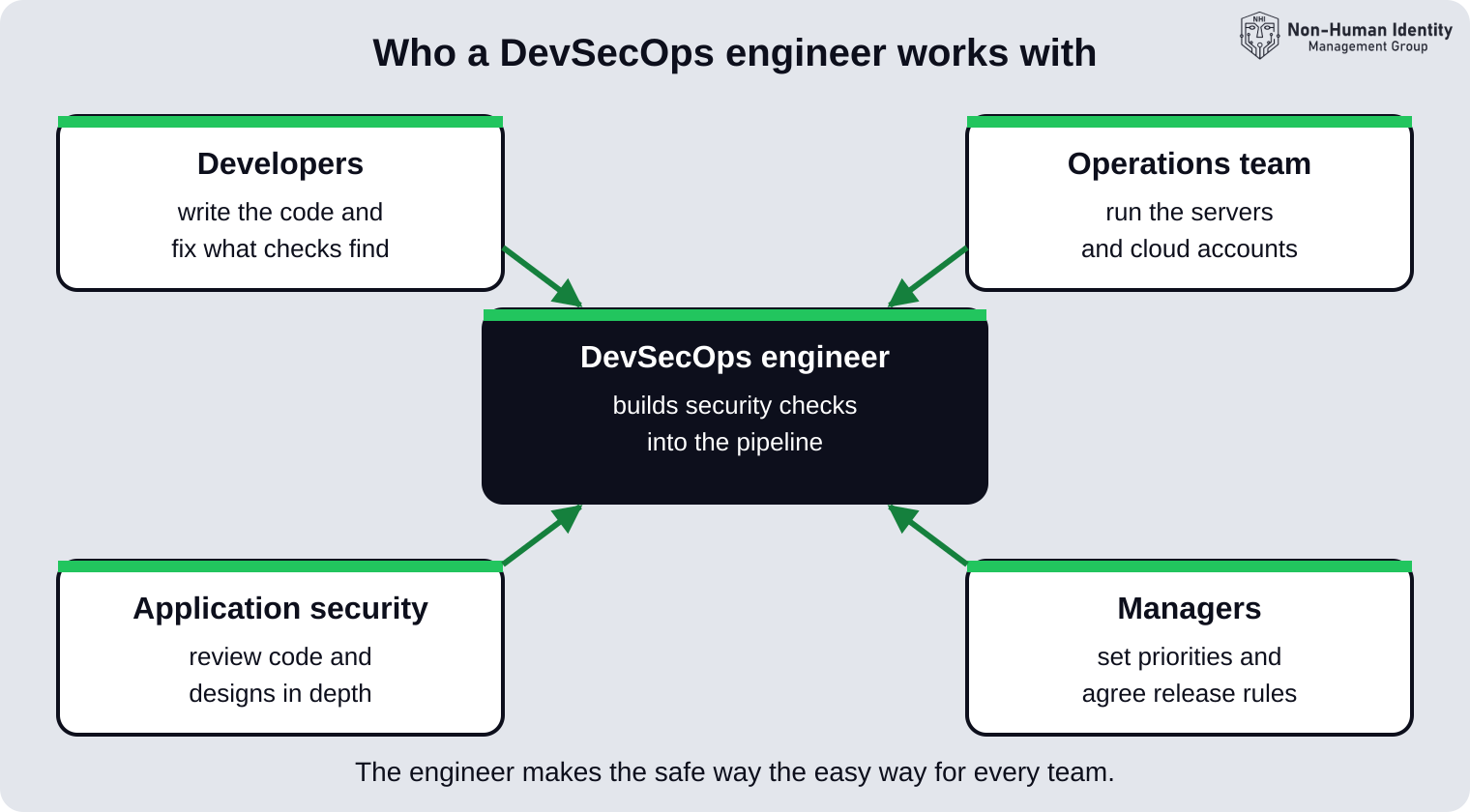
A DevSecOps engineer builds automatic safety checks into the system that turns new code into working software.
This guide is for anyone curious about the job, or anyone who works with software teams and wants to know what this role adds. You do not need to write code to care: if your organisation runs its own apps or website, someone has to keep the route from idea to live app safe.
In short
- A DevSecOps engineer adds security checks to the pipeline, the automatic line of steps that builds, tests and releases software.
- The checks run on every change, so problems show up early, while they are cheaper to fix.
- The job is mostly about the pipeline and its tools. Deep review of the code itself is usually an application security job.
- Many people move in from software development, IT operations or cloud work.
What you will learn
- Explain what a DevSecOps engineer does in one sentence.
- Describe the checks they add at each step of a pipeline.
- Spot how the role differs from an application security engineer.
- Choose a first step if you want to work towards the role.
- Software production line (pipeline)
- the automatic steps that take a code change, build it, test it and release it.
- Shared code store (repository)
- the place where a team keeps its code and every saved change to it.
- Hidden password in code (secret)
- a password or key that a program uses, which should never be written into the code itself.
What is a DevSecOps engineer?
Think of a quality inspector on a factory production line. They do not wait until the end to check the finished product. They put small checks at each station, so a fault is caught where it starts. A DevSecOps engineer does this for software.
The name joins three words. Development means writing software. Operations means running it. Security sits in the middle. Many teams now release changes to their apps often, sometimes many times a day. Each change passes through a pipeline, a set of automatic steps that builds, tests and releases it. The DevSecOps engineer adds security checks to those steps and keeps them working.
The role is about the line, not every product on it. An application security engineer, a specialist who reviews code and app designs for weak spots, looks closely at what is being built. The DevSecOps engineer makes sure the line itself is safe and that checks run on every change.
Where the comparison stops working: a factory makes the same product again and again. Software changes every time. So the checks must be quick and fit into the developers' normal work, or people will try to go round them.
Why does it matter?
The pipeline carries code from a developer's laptop all the way to the live app. A security project that lists the main pipeline risks makes a clear point. It says this route can give attackers an efficient path to an organisation's most valuable systems.[2]
If you are a developer
What could happen: a password you saved in code by mistake ends up in the shared store, where many people can copy it.
Check this: ask whether your team's pipeline scans new changes for passwords and keys.
If you work in IT operations
What could happen: the build system runs with far more access than it needs, so one mistake there reaches everything.
Check this: list what the build system can reach, and remove what it does not use.
If you are thinking about a career change
What could happen: you aim straight for this role without coding or operations basics, and job adverts feel out of reach.
Check this: pick one starter job, such as junior developer or IT support, that builds those basics.
What does it look like?
Much of the work shows up as a report from the pipeline. Here is a made-up summary of the checks on one change.
Example only. All values are made up.
PIPELINE RUN 0000 (EXAMPLE)   app: booking.example.invalid
Step 1  Code review ............ approved by 1 person       (1)
Step 2  Secrets scan ........... 1 possible key found       (2)
Step 3  Parts check ............ 1 add-on with known flaw   (3)
Step 4  Security tests ......... passed
Step 5  Release ................ BLOCKED until 2 and 3 fixed (4)
Owner: FAKE-TEAM
- A second person read the change before it went in.
- A scanner thinks a key was typed into the code. In a real file, this line would name the file and line where the key was found.
- The app uses a ready-made add-on, and a known weak spot has been reported in that version.
- The pipeline stops the release until someone fixes or signs off the two findings.
Why this is risky: without these checks, the key and the flawed add-on could go live without anyone noticing.
The safer way: the DevSecOps engineer sets which findings block a release, and agrees a clear, recorded way to handle exceptions.
How does it work?
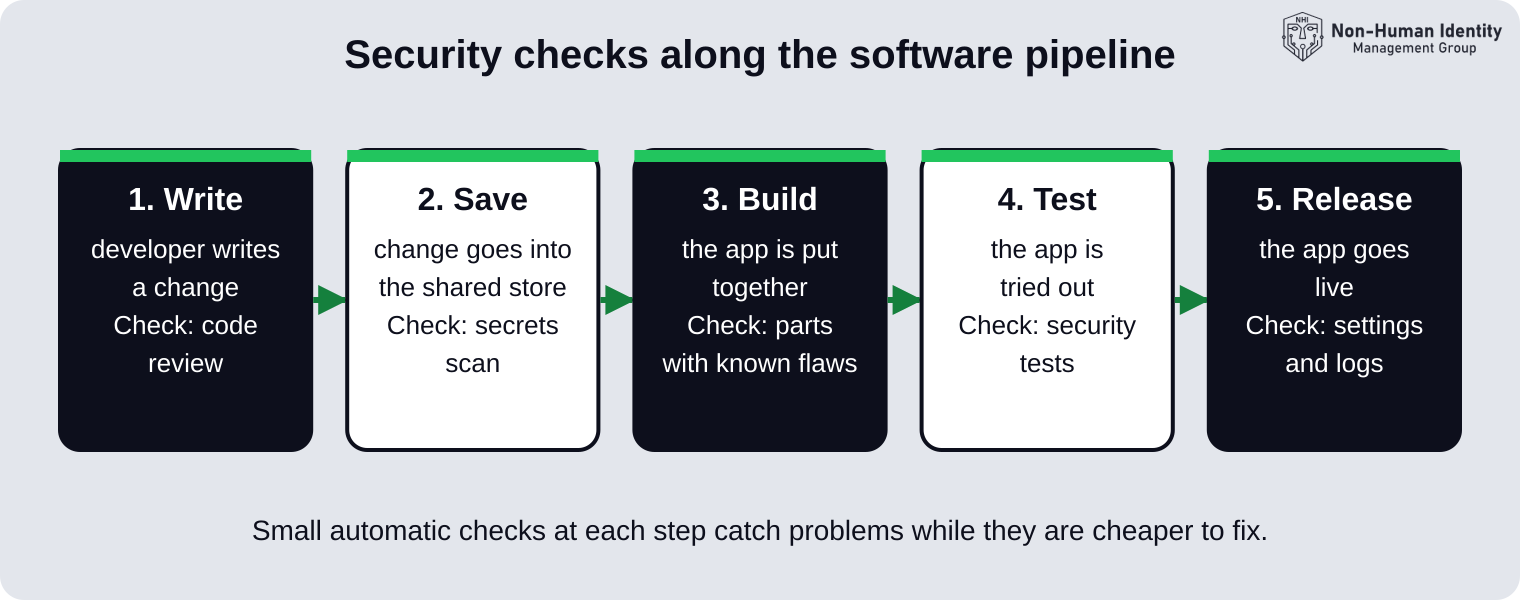
A DevSecOps engineer adds a check to each step a change passes through.
- Write. A developer makes a change. Another person reviews it before it is accepted.
- Save. The change goes into the repository, the shared code store. A secrets scanner, a tool that looks for passwords and keys in code, checks it.
- Build. The app is put together from the team's code and ready-made parts from others. A tool checks those parts for known weak spots.
- Test. Automatic tests try the app, including simple security tests.
- Release. The app goes live. The engineer checks its settings and makes sure activity records, called logs, are kept.
The engineer also protects the pipeline itself. A UK government guide on safe software building has eight main principles. Two are to protect the code store and to secure the build and release pipeline.[3] A US government framework describes a core set of safe building practices that can be added to any way of making software.[1]
Skills and tools
You do not need all of these on day one. Most people build them up over several years.
- How software is built and released. The pipeline is the system you protect, so you need to know each step.
- Basic scripting. Short programs let you set up checks and tune them so they stay quick.
- Pipeline security tools. Secrets scanners look for passwords and keys in code. Parts checkers look for known weak spots in ready-made add-ons.
- Cloud know-how. Many pipelines release apps into cloud services, so checking cloud settings and access is common.
- Clear communication. You agree rules with developers and explain why a release was blocked.
A worked example
This is a made-up day in the life. Duc Nguyen is a DevSecOps engineer at Copperleaf Studio, a small UK firm that builds booking apps.
Duc starts with the overnight pipeline reports. One release was blocked. The secrets scanner found what looks like a payment key in a new file. Duc messages the developer, Chiara. She confirms it was a test key that should not have been there. Together they move it to the firm's password safe for software, and Chiara asks the payment provider to cancel it and issue a new one.
Mid-morning, Duc looks at why developers keep skipping one slow test. It takes twenty minutes. He splits it so the quick part runs on every change and the slow part runs each night. Fewer people now try to skip it.
After lunch, the parts checker flags a known flaw in an add-on used by the main app. A fixed version exists. Duc opens a task for the team and sets a date. He notes that the release stays blocked until it is updated.
Late afternoon, he reviews who can change the pipeline settings. Two people who moved teams still have access. He removes it and records the change.
No alarms went off. Most of Duc's day was about making the safe choice the easy one for everyone else.
Myths and mistakes
| What people think | What is true |
|---|---|
| DevSecOps is just a set of tools. | Tools help, but the job is also about agreeing rules and habits with each team. |
| More checks always mean more safety. | Slow or noisy checks get skipped. Fewer, well-tuned checks often work better. |
| A DevSecOps engineer and an application security engineer do the same job. | They overlap. DevSecOps focuses on the pipeline and platform. Application security focuses on reviewing code and designs. |
| Security slows releases down. | Done well, early checks can save time, because a fault found early is usually quicker to fix. |
| Once the pipeline has checks, the work is done. | Tools, teams and threats change, so checks need tuning and the pipeline needs its own protection. |
What can I do this week?
- Read three DevSecOps engineer job adverts and list the skills that appear in all of them.
- Watch a free short video on how software is built and released.
- Make a free code account and save a small practice project, so you see how a shared code store works.
- Ask a developer you know which automatic checks run when they save a change.
Checklist
- I can explain what a DevSecOps engineer does in one sentence.
- I can name the five steps of a simple pipeline.
- I know one check that fits each step.
- I know how the role differs from an application security engineer.
- I understand why the pipeline itself needs protecting.
- I know at least one route in that fits my background.
- I know where to find the practitioner career guide for more detail.
Common questions
Do I need to be a developer first?
Not always, but it helps a lot. Many DevSecOps engineers start as developers or in IT operations. You need to be comfortable reading code and writing short scripts. You also need to know how software gets built and released, because that is the system you protect.
Is DevSecOps engineer an entry-level job?
Usually not. Most adverts ask for some experience in development, operations or cloud work. A common path is a junior developer or IT role first. People then take on pipeline and security tasks, and grow into the role over time.
How is this different from a DevOps engineer?
A DevOps engineer builds and runs the pipeline so software ships quickly and reliably. A DevSecOps engineer does similar work with security as the main focus. In small teams one person may do both. Our comparison page explains the overlap in more detail.
Which skills matter most?
Three stand out. First, how code is built and released. Second, basic scripting, so you can set up and tune checks. Third, clear communication, because you must agree rules with developers and explain why a release was blocked without causing friction.
Does the role involve cloud work?
Often, yes. Many pipelines build and release apps into cloud services. So DevSecOps engineers frequently check cloud settings and access. If the cloud side is your main interest, the cloud security engineer role may suit you better. Our comparison guide sets the two roles side by side.
Where next?
Ready for the detail? Read the practitioner guide: DevSecOps Engineer Career Guide. It goes further into the tools used, certifications and how the career progresses.
Also useful:
- DevSecOps for Beginners
- DevOps vs DevSecOps
- Cloud Security Engineer vs DevSecOps Engineer
- Application Security Engineer Career Guide
- Software Supply Chain Security for Beginners
Related NHI Mgmt Group resources: Cybersecurity Careers Guide · What does a security engineer do? A beginner's guide · CI/CD Pipeline Identities for Beginners
Key terms
- DevSecOps
- A way of working that builds security checks and ownership into every step of making and releasing software.
- CI/CD
- The automatic pipeline that builds, tests and releases each code change.
- Secrets scanning
- Automatically searching code and files for passwords and keys that should not be there.
- Software composition analysis
- Checking the ready-made parts an app uses for known weak spots.
- Shift left
- Moving security checks earlier in the making of software, where problems are usually cheaper to fix.
- Infrastructure as code
- Setting up servers and cloud services from written files, so the setup can be checked like code.
Sources and further reading
- NIST SP 800-218, Secure Software Development Framework (SSDF) Version 1.1. National Institute of Standards and Technology, February 2022. https://csrc.nist.gov/pubs/sp/800/218/final, accessed 28 Nov 2026.
- OWASP Top 10 CI/CD Security Risks. OWASP Foundation. https://owasp.org/www-project-top-10-ci-cd-security-risks/, accessed 28 Nov 2026.
- Secure development and deployment guidance. National Cyber Security Centre, 22 November 2018. https://www.ncsc.gov.uk/collection/developers-collection, accessed 28 Nov 2026.