A security engineer builds and looks after the safety features that protect an organisation's computers, apps and data.
This guide is for anyone thinking about a job in cyber security, or anyone who works with a security engineer and wants to know what they do. You do not need a technical job to benefit: if your organisation stores customer data, someone has to build the protections around it.
In short
- A security engineer designs, builds and maintains the protections around systems, such as sign-in checks, access rules and logs.
- The work is a repeating loop: plan, build, check for weak spots, then fix and improve.
- Much of the day is spent with developers, IT teams and analysts, not alone at a screen.
- Many people move in from IT support, networking or software jobs, and apprenticeships are another route in the UK.
What you will learn
- Explain what a security engineer does in one sentence.
- Describe a typical working day in the role.
- Spot the skills and tools the job uses.
- Choose a first step if you want to work towards the role.
- Weak spot (vulnerability)
- a flaw in software or settings that someone could use to get in or cause harm.
- Safety feature (security control)
- a lock, check or rule that makes harm less likely or less serious.
- Activity record (log)
- a time-stamped note of what happened on a system, kept so it can be checked later.
What is a security engineer?
Think of the engineer who looks after the security systems in a large office block. They choose the door locks, fit the alarms and cameras, and check that they all still work. A security engineer does the same job for computer systems.
In plain words, they add safety features to the tech a firm uses. That covers how people sign in, who can open which files, and what gets written down. They also keep those features working as things change.
A security engineer is a builder more than a watcher. A SOC analyst is a person who watches alerts in a security team. The analyst spots trouble as it happens. The engineer builds the tools the analyst uses. A US skills list from the government calls this work the safe design, building and testing of systems.[1]
Where the comparison stops working: an office block changes slowly. Computer systems change each week. New apps arrive, staff come and go, and new vulnerabilities (weak spots) are found in software. So the checks keep going.
Why does it matter?
Every organisation that uses computers needs someone to build in protection. In a 2026 UK government study, security engineer roles made up 21% of core cyber security job adverts in 2025.[4]
If you are thinking about a career change
What could happen: you aim straight for this role with no IT background and feel lost in job adverts.
Check this: look at which junior IT or support jobs near you could lead into security work.
If you already work in IT support
What could happen: you already do parts of the job, such as setting up accounts, without seeing it as security work.
Check this: note each task where you limit access or fix a weak setting. These count as experience.
If you manage a team that builds software
What could happen: security is added at the end of a project, when changes cost more and take longer.
Check this: ask whether a security engineer reviews plans before building starts.
What does it look like?
A lot of the work arrives as requests in a shared task list. Here is a made-up week of tasks from one engineer's list.
Example only. All values are made up.
TASK LIST: security engineering (EXAMPLE)
SEC-0001  Review plan for new booking app           (1)
SEC-0002  Turn on two-step sign-in for admin staff  (2)
SEC-0003  Weekly scan found 4 out-of-date servers   (3)
SEC-0004  Send app logs to the alert system         (4)
SEC-0005  Remove access for 3 people who have left  (5)
Owner: FAKE-ENGINEER   Site: portal.example.invalid
- Checking a design before it is built, to spot risks early.
- Adding a second check at sign-in for the most powerful accounts.
- Following up a scan result. In a real system, this line would contain the server names and missing updates.
- Making sure activity records reach the team that watches for attacks.
- Tidying up access that is no longer needed.
Why this is risky: tasks like these can sit untouched for months. Old accounts and missing updates can then give an attacker a way in.
The safer way: each task has an owner and a due date. The engineer checks afterwards that the fix worked.
How does it work?
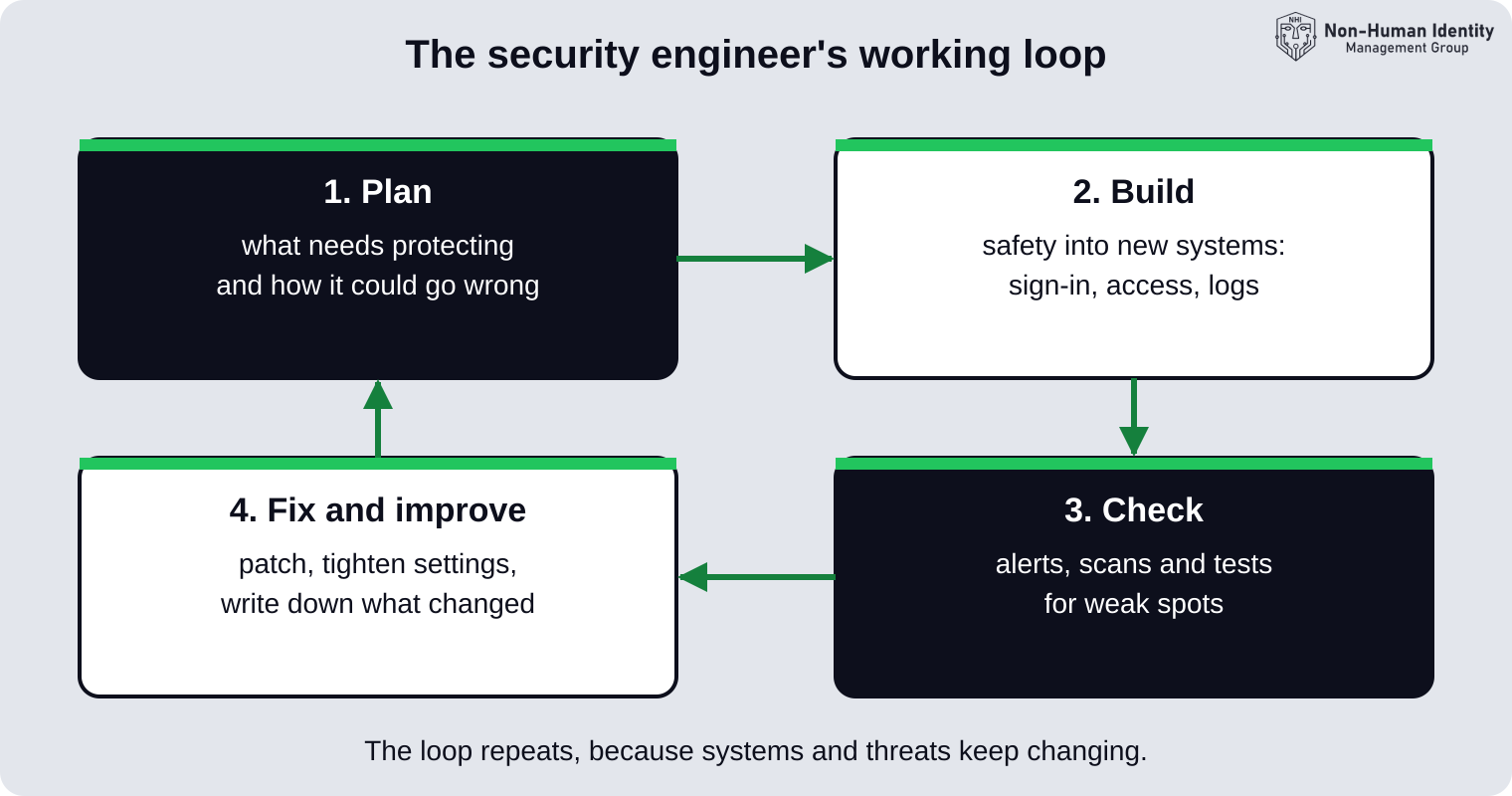
Most security engineering follows a repeating loop.
- Plan. Work out what needs protecting and how it could go wrong. This is called threat modelling (thinking through likely attacks before they happen).
- Build. Add safety features to new or existing systems, such as two-step sign-in, access rules and activity records.
- Check. Run scans and tests, and read alerts from other teams, to find weak spots before an attacker does.
- Fix and improve. Apply software updates, tighten settings and write down what changed and why.
- Repeat. Systems and threats keep changing, so the loop starts again with the next plan.
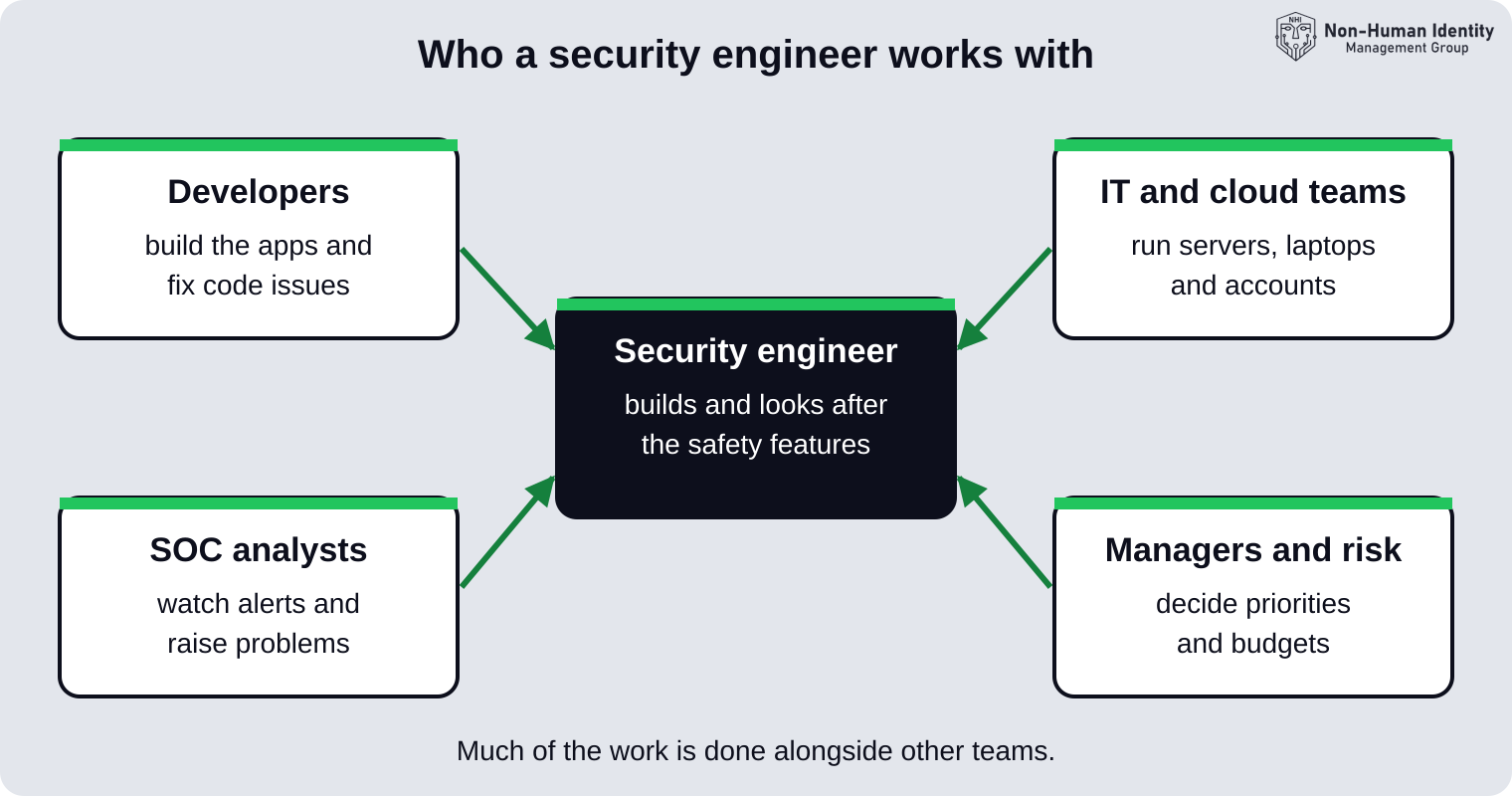
The job is shared with other teams. A US careers handbook lists tasks such as installing security software, scanning for weak spots, writing reports and helping staff use new security tools.[2]
A worked example
This is a made-up day in the life. Arjun Mehta is a security engineer at Lark Rise Travel, a small UK travel firm.
Arjun starts at nine with a short call. The SOC analyst says a staff account tried to sign in forty times overnight. Arjun checks the logs. The attempts came from abroad and all failed. He confirms the account already uses two-step sign-in, then asks IT to reset the password anyway.
At ten, he joins the developers to review plans for a new booking page. He asks where card details will go and who can see them. They agree the page will hand payments to the card provider, so the firm never stores card numbers.
After lunch, he reads the weekly scan. Four servers are missing updates. He checks which ones face the internet and books those for tonight. The other two go into next week's plan.
Late afternoon, he removes access for three people who left last month. He notes each change in the task list. Before he goes home, he writes a short summary for his manager: what was found, what was fixed and what is still open.
Nothing dramatic happened. That is often a sign the job is going well. Most of Arjun's day was steady, careful work with other people.
Myths and mistakes
| What people think | What is true |
|---|---|
| Security engineers spend all day hacking. | Most of the job is building and maintaining defences. Allowed attack testing is usually a separate role, the penetration tester. |
| You need a computer science degree. | A degree is common, but many people enter from IT support, networking or apprenticeships, with certifications and experience. |
| It is a lonely job at a screen. | Much of the day is meetings, reviews and explaining risks to people who are not technical. |
| Once a system is secured, the work is done. | New updates, staff and attacks keep arriving, so checks are repeated. |
| Security engineer and security analyst are the same job. | They overlap. Analysts mainly watch and investigate. Engineers mainly design and build. |
What can I do this week?
- Read three security engineer job adverts and list the skills that appear in all of them.
- Learn the basics of how computers talk over a network, using a free online course.
- Set up two-step sign-in on your own email, and notice each step it asks for.
- Ask someone in your IT team what security tasks they handle each week.
- Write down any IT work you have done that limited access or fixed a weak setting.
Checklist
- I can explain what a security engineer does in one sentence.
- I know how the role differs from a SOC analyst and a penetration tester.
- I can name the four parts of the working loop.
- I know the basic skills: networks, operating systems, sign-in and access, and logs.
- I know at least one route in that fits my background.
- I have read at least two real job adverts for the role.
- I know where to find the practitioner career guide for more detail.
Common questions
Do I need a degree to become a security engineer?
Not always. A US careers handbook says a degree is typical. It also says some people start with training and certificates instead.[2] In the UK, a cyber security technologist apprenticeship has an engineer option.[3]
Is a security engineer an entry-level job?
Usually not. Many employers want some IT experience first, such as support, network or coding work. A common path starts with a junior IT or analyst job. People then move into engineering once they have built and fixed systems for a year or two.
Do security engineers need to write code?
Some coding helps a lot. Many engineers write short scripts that run checks or set up systems for them. You do not need to be a full software developer. But if you can read and change simple scripts, the daily work gets much easier.
How is a security engineer different from a security architect?
The architect draws up the overall plan, and the engineer builds and runs it. An architect decides which protections the whole firm needs. An engineer puts them in place and keeps them working. Many architects started as engineers, so one job often leads to the other.
What certifications help?
A starter security certificate can help you get a first interview. More advanced ones tend to matter later in a career. Which one helps most depends on where you live, your past work and the jobs you want. Our beginner guide to certificates explains the main options in plain words.
Where next?
Ready for the detail? Read the practitioner guide: Security Engineer Career Guide. It goes further into core skills and tools, certifications and progression.
Also useful:
- SOC Analyst vs Security Engineer
- Security Architect vs Security Engineer
- Cloud Security Engineer for Beginners
- Cyber Security Certifications for Beginners
Related NHI Mgmt Group resources: Cybersecurity Careers Guide · SOC Analyst for Beginners · Vulnerability Management for Beginners
Key terms
- Security engineer
- A person who designs, builds and maintains the safety features that protect an organisation's systems.
- Vulnerability
- A flaw or weakness in code, settings or design that someone could abuse.
- Security control
- A safety feature that makes unwanted access, misuse or disruption less likely or less harmful.
- Threat modelling
- Thinking through what you are protecting, who might attack it and how, before it happens.
- Logging
- Recording system and security events so they can be reviewed later.
- Multi-factor authentication
- A sign-in that needs two or more separate checks, so a stolen password alone is less likely to be enough.
Sources and further reading
- NICE Framework work role: Secure Systems Development (DD-WRL-004). NICCS, Cybersecurity and Infrastructure Security Agency. https://niccs.cisa.gov/tools/nice-framework/work-role/secure-systems-development, accessed 28 Nov 2026.
- Information Security Analysts. Occupational Outlook Handbook, US Bureau of Labor Statistics. https://www.bls.gov/ooh/computer-and-information-technology/information-security-analysts.htm, accessed 28 Nov 2026.
- Cyber security technologist (2021), apprenticeship standard ST1021, Cyber Security Engineer option. Skills England. https://skillsengland.education.gov.uk/apprenticeships/st1021-v1-1, accessed 28 Nov 2026.
- Cyber security skills in the UK labour market 2026. Department for Science, Innovation and Technology, 29 September 2026. https://www.gov.uk/government/publications/cyber-security-skills-in-the-uk-labour-market-2026/cyber-security-skills-in-the-uk-labour-market-2026, accessed 28 Nov 2026.