A red teamer plays a realistic attacker, with permission, to test how well an organisation spots and handles attacks.
This guide is for anyone curious about the job, or thinking about it as a career. You do not need a technical background to read it. If your organisation ever runs a red team exercise, your own team is part of what is being tested.
In short
- A red teamer acts like a real attacker who has one goal, such as reaching a payments system.
- The exercise tests people, processes and technology together, not just one system.
- Written permission, agreed limits and a small control group come before anything starts.
- The most useful part is often the debrief, where both sides learn what to improve.
What you will learn
- Explain what a red teamer does in one sentence.
- Spot how a red teamer differs from a penetration tester.
- Explain why permission and a control group matter.
- Ask good questions about the role or a planned exercise.
- The attack team (red team)
- the people who act as the attacker in a test exercise.
- The defence team (blue team)
- the people who watch for and respond to attacks.
- The ground rules (rules of engagement)
- the written agreement on what the red team may and may not do.
What is a red teamer?
Think of a surprise inspection by a rival team. They are invited in, but most staff do not know when they will arrive. They try to reach one agreed target, and the inspection shows whether anyone noticed.
A red teamer does this for an organisation's security. They behave like a real attacker with a clear goal. The goal might be to reach a payments system or a set of customer records.
The test is not only about computers. It checks if staff notice something odd and if alerts go off. It also checks how well the blue team, the defenders, respond.
A red teamer is different from a penetration tester. A tester usually tries to find as many weak spots as they can in a set list of systems. A red teamer quietly follows one goal, the way a real attacker would. The point is to test how well the defenders spot and respond.
Where the comparison stops working: a rival inspection team wants to win. A red team succeeds when the organisation learns and gets better, even if the defenders catch them early.
Why does it matter?
Many organisations have alarms and plans on paper. A red team exercise shows whether they work on a real day, with real people.
If you are thinking about this career
What could happen: you practise on systems you do not own and break the law without meaning to.
Check this: practise only on your own equipment or on legal training sites built for learners.
If you are on the defence team
What could happen: you feel the exercise is a trap, so the lessons get lost in blame.
Check this: ask that the debrief focuses on what to improve, not who missed what.
If you are a manager planning an exercise
What could happen: unclear limits lead to a business system going down, or to real customer data being touched.
Check this: agree goals, limits and a stop plan in writing before work starts.
What does it look like?
Before an exercise starts, both sides agree a short summary of the job. Here is a made-up one in plain words.
Example only. All values are made up.
EXERCISE BRIEF  EXAMPLE-0000
Goal:        show a fake payment could be approved   (1)
Allowed:     emails to staff, office visit, laptops  (2)
Not allowed: harm to systems, real customer data     (3)
Control group: 3 named people, EXAMPLE NAMES        (4)
Stop word:   FAKE-PAUSE-0000                         (5)
Signed by:   Chief Executive, EXAMPLE NAME           (6)
- The single goal the red team works towards. It is a "flag" to reach, not real harm.
- The kinds of methods the team may use.
- Lines the red team must not cross.
- The few people who know about the exercise and can pause it.
- In a real file, this line would contain an agreed word that pauses all activity at once.
- Written permission from someone with the authority to give it.
Why this is risky: acting like an attacker without signed permission can break the law. In the UK, getting into a computer when you know you are not allowed to is a crime.[3]
The safer way: get the goal, limits and permission in writing. Keep the control group informed, and stop when they say stop.
How does it work?
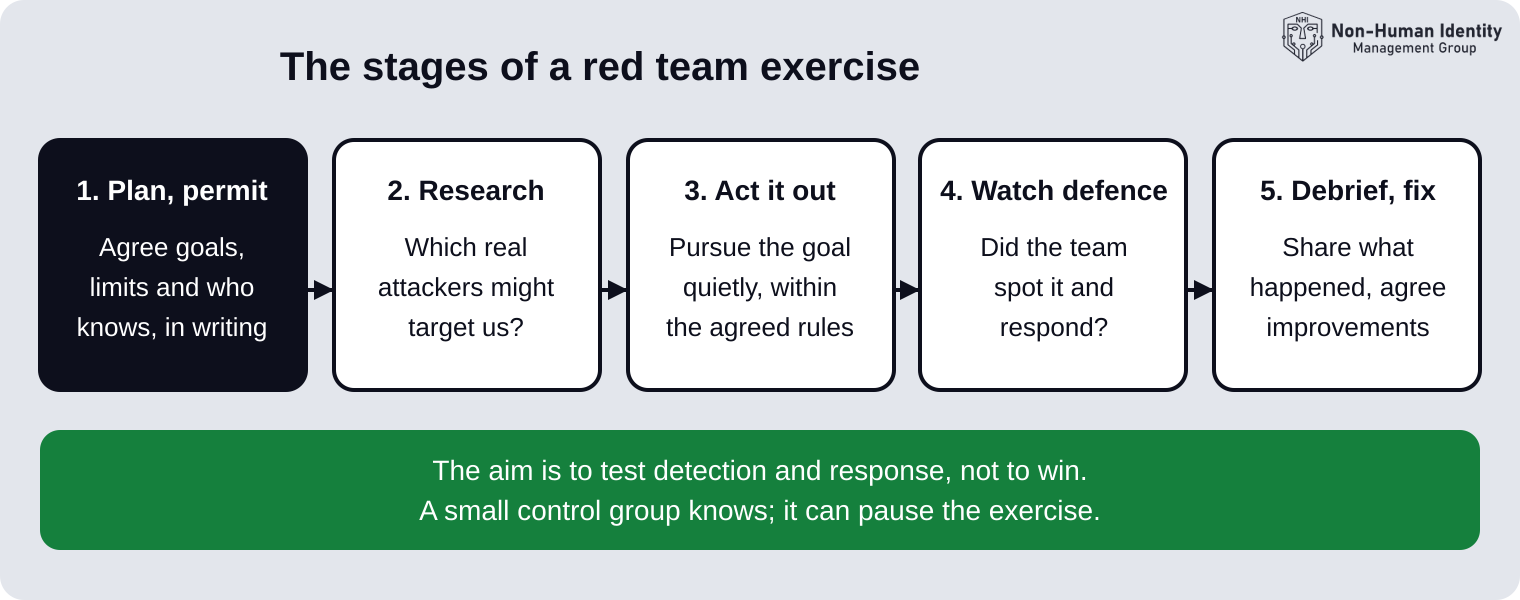
Each firm has its own method, but an exercise usually follows stages like these.
- Plan and permit. The organisation and red team agree the goal, the limits and who will know about it.
- Research. Someone studies which real attackers might target the organisation, and how. In some schemes, a separate threat intelligence firm does this.[1]
- Act it out. The red team works quietly towards the goal, using only the methods that were agreed.
- Watch the defence. The control group notes whether the defenders spotted the activity and how they responded.
- Debrief and fix. Both teams go through what happened, step by step, and agree what to improve.
Some exercises are set by regulators. In the UK, the Bank of England's scheme, called CBEST, uses intelligence-led testing that copies the actions of real attackers against financial firms.[2] The European Central Bank describes a similar European scheme, TIBER-EU, as a framework for ethical red teaming based on threat intelligence.[1]
In those schemes, a small control group inside the firm runs the exercise day to day.[2] The red team tries to capture agreed "flags", which are the goals of the imagined attacker.[2]
Some teams also run "purple team" sessions. Here the red and blue teams work side by side, so the defenders can improve their alarms as they go.
Skills and tools
- Thinking like an attacker. Following one goal quietly, the way a real attacker would.
- Research. Studying which real attackers might target the organisation, and how.[1]
- Knowing how defenders work. The job is to test them, so experience in a defence team helps.
- Rules of engagement. The written limits, control group and stop word that every exercise runs under.
- Planning and careful notes. These take a large share of the work and feed a clear debrief.
A worked example
Marcus Odhiambo is a red teamer at a small, fictional testing firm. His client is Saltire Credit Union, also fictional.
The goal is to show whether a fake payment could get approved. Rosa Martins, the credit union's head of risk, leads a control group of three. Only they know the exercise is running. Marcus thinks of the rival inspection: arrive quietly, aim for one target, and see who notices.
For the first week, Marcus and a colleague study the credit union from the outside. They look at what any attacker could find, such as job adverts and staff roles.
In week two they send a made-up but realistic email to a few staff, as the brief allows. One person reports it to the IT team within the hour. The defenders block the sender. Marcus notes this as a win for the blue team.
Another message gets through, and the team gets a foothold on one laptop. They move slowly towards the payments area. On day four an alert fires, but nobody looks at it until the next morning.
Marcus stops at the agreed point, before any real payment could be made. He tells Rosa at once.
At the debrief, both teams walk through each step. The credit union thanks the person who reported the email. It also changes who checks overnight alerts.
Rosa says the alert that fired but was not read was the most useful finding of all.
Myths and mistakes
| What people think | What is true |
|---|---|
| Red teaming is the same as penetration testing. | A pen test looks for many weak spots. A red team follows one goal to test detection and response. |
| The red team wins if the defenders miss them. | Success means the organisation learns. Being caught early is also a useful result. |
| Red teamers can do whatever a real attacker would. | They stay within written limits and stop when the control group says so. |
| It is all clever hacking. | Planning, careful notes and a clear debrief take a large share of the work. |
| Practising on any company is fine if you mean well. | Getting into systems without permission can be a crime. Use your own kit or legal practice sites. |
What can I do this week?
- Read our Red Teaming for Beginners guide.
- Read our Penetration Tester for Beginners guide to see how the two jobs differ.
- Read two red team job adverts and note the skills they share.
- Find a legal practice platform built for learners, and read its rules first.
Checklist
- I can explain what a red teamer does in one sentence.
- I know how a red team exercise differs from a penetration test.
- I know that written permission and limits come before any exercise.
- I understand what a control group does.
- I practise only on my own equipment or legal training sites.
- I have checked official sources for pay, not just job boards.
- I have a plan for one first learning step.
Common questions
Is red teaming legal?
Yes, when the organisation has given clear written permission and the team stays within it. The same actions without permission can be a crime. In the UK, getting into a computer you know you are not allowed to use is an offence.[3] Always get permission in writing first.
Do I need to be a penetration tester first?
Often, but not always. Many red teamers start in penetration testing, IT support or a security operations team. Experience of how defenders work is useful too, because the job is to test them. See the Red Teamer Career Guide for common routes in.
What is a purple team?
A purple team is when the red and blue teams work together openly. The red team shows a method, and the defenders check whether their alarms catch it. It is a quicker way to improve alarms than a long secret exercise. See Red Team vs Blue Team vs Purple Team.
Where next?
Ready for the detail? Read the practitioner guide: Red Teamer Career Guide. It goes further into core skills and tools, certifications, regulated testing schemes and how red teamers progress.
Also useful:
- Red Teaming for Beginners
- Penetration Tester for Beginners
- Red Team vs Penetration Test vs Vulnerability Scan
- Red Team Operator Interview Questions
- Detection Engineer for Beginners
Related NHI Mgmt Group resources: Cybersecurity Careers Guide · Red Teaming Guide · Red Team Debrief Guide
Key terms
- Red teaming
- A realistic, usually secret exercise that tests how well a whole organisation spots and handles an attack.
- Blue team
- The defenders who watch for attacks and respond to them.
- Purple team
- Red and blue teams working together openly to improve defences.
- Adversary emulation
- Copying the known methods of a real attacker group in a controlled test.
- Rules of engagement
- The written agreement on what testers may and may not do, including scope and timing.
- Penetration testing
- An allowed test that tries to use weak spots the way a real attacker would.
Sources and further reading
- What is TIBER-EU? European Central Bank. https://www.ecb.europa.eu/paym/cyber-resilience/tiber-eu/html/index.en.html, accessed 28 Nov 2026.
- CBEST Threat Intelligence-Led Assessments (Implementation Guide, 2024 edition). Bank of England, page last updated 25 August 2026. https://www.bankofengland.co.uk/financial-stability/operational-resilience-of-the-financial-sector/cbest-threat-intelligence-led-assessments-implementation-guide, accessed 28 Nov 2026.
- Computer Misuse Act 1990, section 1: unauthorised access to computer material. legislation.gov.uk, The National Archives. https://www.legislation.gov.uk/ukpga/1990/18/section/1, accessed 28 Nov 2026.
- Information Security Analysts, Occupational Outlook Handbook. US Bureau of Labor Statistics. https://www.bls.gov/ooh/computer-and-information-technology/information-security-analysts.htm, accessed 28 Nov 2026.
- Explore careers. National Careers Service (England). https://nationalcareers.service.gov.uk/explore-careers, accessed 28 Nov 2026.