A detection engineer builds and tunes the rules that make security tools raise an alarm when an attack happens.
This guide is for anyone curious about the job, or thinking about it as a career. You do not need a technical background to read it. If your organisation has a security team, the alerts they act on were written by someone doing this work.
In short
- A detection engineer writes the rules that turn computer records into security alarms.
- Each rule needs testing, so it goes off for real trouble and stays quiet for normal work.
- The job mixes thinking like an attacker, reading data and writing clear notes.
- People often come in from a security operations team, IT support or software work.
What you will learn
- Explain what a detection engineer does in one sentence.
- Spot the main steps in building a good alert.
- Explain why too many false alarms are a problem.
- Ask good questions about the role or a job advert.
- Computer records (logs)
- notes that systems write about what happened, such as a sign-in.
- An alarm rule (detection rule)
- a written pattern that raises an alert when the records match it.
- A false alarm (false positive)
- an alert that goes off when nothing bad is happening.
What is a detection engineer?
Think of the person who fits and tunes the smoke alarms in a large building. They choose where each alarm goes. They test that it sounds for a real fire and not for burnt toast.
A detection engineer does the same job for computer systems. Systems write logs, which are records of what happened, such as who signed in and when. The engineer writes a detection rule, a pattern that raises an alert when the logs match it.
The alerts go to a security operations team, often called a SOC. Analysts there look into each alert and decide what to do. So the engineer is building the alarms that other people answer.
Some engineers write rules in a shared format called Sigma. It is an open way to write a rule once, so it can be turned into the search language of different tools.[1]
Where the comparison stops working: smoke behaves the same way every time. Attackers change their methods, and normal work keeps changing too, so rules need regular checks.
Why does it matter?
An alarm that never goes off misses the attack. An alarm that goes off all day gets ignored. The detection engineer works to avoid both.
If you are thinking about this career
What could happen: you learn a tool's buttons but not how attacks really work, so your rules miss the point.
Check this: learn how common attacks look in records before you learn any one product.
If you work in a security operations team
What could happen: a noisy rule buries a real attack under hundreds of harmless alerts.
Check this: tell the rule owner when an alert is wrong, with the reason.
If you manage IT for a business
What could happen: you pay for a monitoring tool, but its rules do not cover the systems you rely on most.
Check this: ask which of your key systems send records to the tool, and who reviews the rules.
Next: SIEM for Beginners
What does it look like?
Detection engineers write each rule down with notes, so others can understand and check it. Here is a made-up rule card in plain words.
Example only. All values are made up.
RULE CARD  EXAMPLE-0000
Name:     Many failed sign-ins, then one success      (1)
Data:     sign-in records from the staff portal       (2)
Alert if: 20 or more failures for one account,
          then a success, within 10 minutes            (3)
Not if:   the IT test account FAKE-TEST-01            (4)
Owner:    EXAMPLE NAME, reviewed every 3 months       (5)
- A plain name that says what the rule looks for.
- The records the rule reads. In a real file, this line would name the exact log source.
- The pattern that raises an alert. The numbers here are made up for the example.
- A known, harmless case the rule leaves out, so it does not cause false alarms.
- Who looks after the rule, and how often it is checked.
Why this is risky: a rule with no notes, owner or testing may fire all day or not at all. Then nobody knows why.
The safer way: give each rule a clear purpose, a test, an owner and a review date.
How does it work?
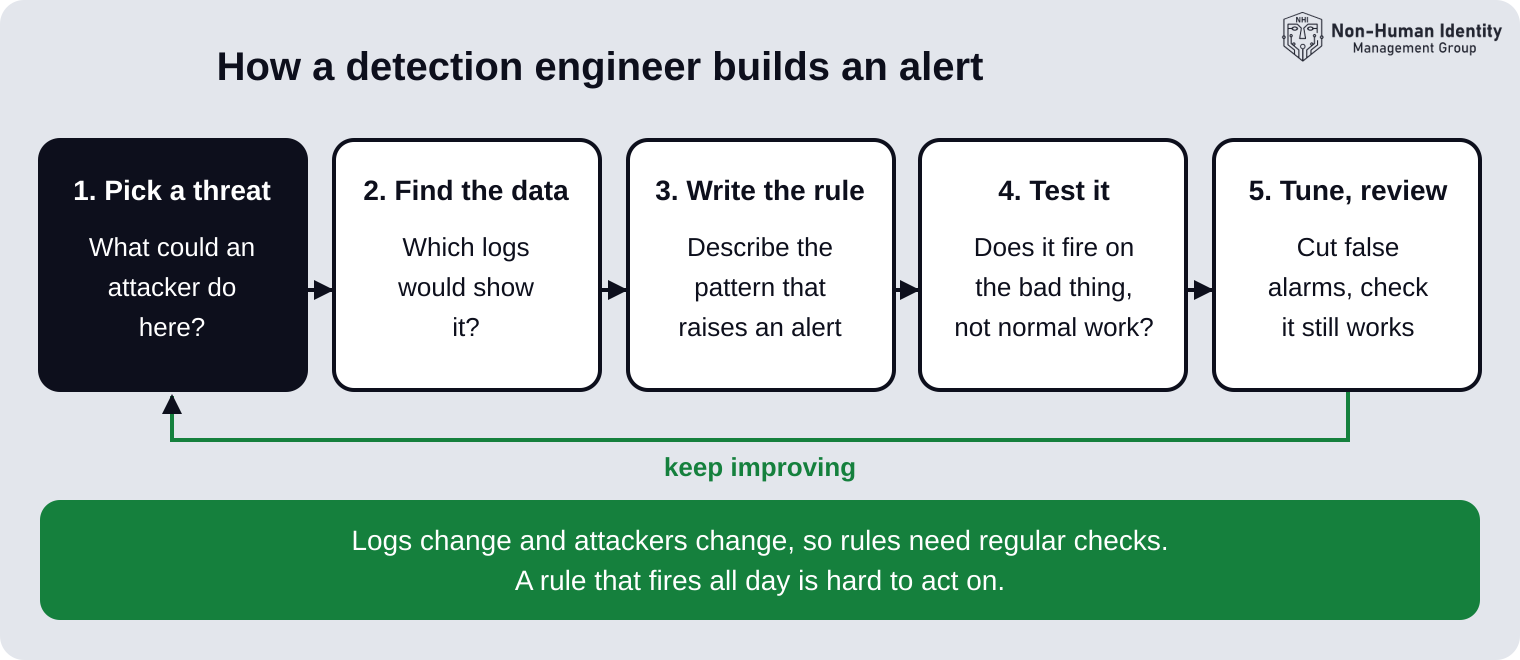
Teams have their own methods, but building a rule often follows steps like these.
- Pick a threat. The engineer chooses an attacker behaviour worth catching, and many teams use MITRE ATT&CK, a public catalogue of real attacker methods, to choose.[2]
- Find the data. They check which logs would show that behaviour, and whether those logs are actually being collected today.
- Write the rule. They describe the pattern in the search language that the team's own tools understand.
- Test it. They check that it fires on a safe copy of the bad behaviour, and stays quiet for normal work.
- Tune and review. They cut false alarms, record what the rule does and check it again later.
A security operations team may use terms like detections, analytics or use cases for this work.[3] The idea is the same: a planned way to spot attacks.
Skills and tools
- Knowing how attacks look in records. This matters more than knowing any one product.
- A SIEM. The tool that gathers logs from many systems in one place, where rules run.
- Sigma. An open format for writing a rule once, so it can be turned into the search language of different tools.[1]
- MITRE ATT&CK. A public catalogue of attacker methods used to choose what to catch.[2]
- Talking to people. They ask system owners which records exist and ask analysts which alerts waste time. They also work with threat hunters.
A worked example
Ingrid Solberg is a detection engineer at Tidemark Logistics, a fictional delivery firm. On Monday, Duc Nguyen from the security operations team sends her a message.
Duc says one alert went off 300 times last week. Every case was harmless. The team has started to skip it.
Ingrid opens the rule. It looks for many failed sign-ins on the staff portal. She finds that most alerts come from one old scanner that retries a saved password. Ingrid thinks of the smoke alarm by the kitchen: it is in the right building, but it keeps sounding for toast.
She does not just switch the rule off. She asks the IT team to fix the scanner's password. Then she adds that one scanner to the rule's "not if" list, with a note and an end date.
Next she tests the rule. With permission, a colleague runs a safe test that copies a burst of failed sign-ins from a test account. The alert fires once, as it should.
On Friday Duc reports that the alert went off twice that week. Both cases were worth a look. Ingrid updates the rule card and sets a review date three months away.
Duc says the best part was not the new rule. It was that he could trust the alert again.
Myths and mistakes
| What people think | What is true |
|---|---|
| More alerts means better security. | Too many alerts can hide the ones that matter. Fewer, well tested rules are often more useful. |
| Once a rule is written, the job is done. | Systems and attacks change, so rules need testing and review over time. |
| A detection engineer just answers alerts. | Mostly they build and improve the rules. Analysts in the security operations team usually answer the alerts. |
| You need to know every security tool. | Knowing how attacks show up in records matters more than any one product. |
| Switching off a noisy rule fixes the problem. | It may also hide real attacks. Find the cause, then tune the rule. |
What can I do this week?
- Read our Detection Engineering for Beginners guide.
- Look at the sign-in history on one of your own accounts and notice what gets recorded.
- Browse the public MITRE ATT&CK site and read about one attacker method.
- Read two detection engineer job adverts and note the skills they share.
Checklist
- I can explain what a detection engineer does in one sentence.
- I know what a log is and why it matters for alerts.
- I can name the main steps in building a rule.
- I understand why false alarms are a problem.
- I know how this role differs from a SOC analyst and a threat hunter.
- I have checked official sources for pay, not just job boards.
- I have a plan for one first learning step.
Common questions
Is a detection engineer the same as a SOC analyst?
No, but the two jobs work closely together. A SOC analyst looks into alerts as they arrive and decides what to do. A detection engineer builds and improves the rules that create those alerts. Many detection engineers started as analysts. See SOC Analyst for Beginners.
Do I need to know how to code?
Some coding helps, but you can start without much of it. Many rules are written in search languages or simple text formats like Sigma.[1] Basic scripting becomes more useful as you grow, for testing rules and handling data.
How is this different from threat hunting?
A threat hunter searches for attackers who may have slipped past the alarms. A detection engineer builds the alarms. A good hunt often ends with a new rule, so the next case is caught on its own. See Threat Hunter for Beginners.
Where next?
Ready for the detail? Read the practitioner guide: Detection Engineer Career Guide. It goes further into core skills and tools, certifications, how to measure your work and how the role progresses.
Also useful:
- Detection Engineering for Beginners
- MITRE ATT&CK for Beginners
- Security Logging for Beginners
- Threat Hunting vs Detection Engineering
- Detection Engineer Interview Questions
Related NHI Mgmt Group resources: Cybersecurity Careers Guide · Detection Engineering Guide · Sigma Rules Guide
Key terms
- Detection engineering
- The work of designing, testing and looking after the rules that spot attacks.
- Detection rule
- A written pattern that turns matching records into a security alert.
- False positive
- An alert that goes off when nothing harmful is happening.
- Alert fatigue
- When a team gets so many alerts that it starts to miss or skip important ones.
- SIEM
- A tool that gathers records from many systems in one place so alerts can be raised.
- Telemetry
- The raw data that systems and sensors send about what they are doing.
- MITRE ATT&CK
- A public catalogue of attacker methods based on real-world observations.
Sources and further reading
- Getting Started, Sigma Detection Format. SigmaHQ. https://sigmahq.io/docs/guide/getting-started.html, accessed 28 Nov 2026.
- MITRE ATT&CK. The MITRE Corporation. https://attack.mitre.org/, accessed 28 Nov 2026.
- Building a Security Operations Centre (SOC): Detection. National Cyber Security Centre (UK). https://www.ncsc.gov.uk/collection/building-a-security-operations-centre/detection, accessed 28 Nov 2026.
- Information Security Analysts, Occupational Outlook Handbook. US Bureau of Labor Statistics. https://www.bls.gov/ooh/computer-and-information-technology/information-security-analysts.htm, accessed 28 Nov 2026.
- Explore careers. National Careers Service (England). https://nationalcareers.service.gov.uk/explore-careers, accessed 28 Nov 2026.