A security architect plans how an organisation's protections fit together, before systems are built or changed.
This guide is for anyone curious about the job, or anyone who works on projects with a security architect. You do not need a technical job to see the value: when security is planned in early, projects tend to avoid costly fixes later.
In short
- A security architect designs the overall plan for protecting systems, data and accounts, then guides others as they build it.
- Much of the job is early in a project: understanding the plan, weighing risks and choosing protections.
- Security engineers build the design. The architect checks that what was built still matches it.
- It is rarely a first job. Most architects have years of experience as engineers or in IT first.
What you will learn
- Explain what a security architect does in one sentence.
- Describe the steps an architect follows on a project.
- Spot how the role differs from a security engineer.
- Choose a first step if you want to work towards the role.
- Overall security plan (security architecture)
- the design of how protections, data and connections fit together across systems.
- Chance of harm (risk)
- how likely something bad is to happen, and how much it would hurt if it did.
- Thinking through attacks (threat modelling)
- working out what could go wrong with a system before it is built.
What is a security architect?
Think of an architect designing a new building. They draw in the fire exits, locks and alarms before any bricks are laid. Builders then follow the plans. A security architect does the same for computer systems.
In plain words, they decide which protections a system needs and where each one goes. That covers how people sign in, how data is kept private and how systems connect. The result is a security architecture, an overall plan for how the protections fit together.
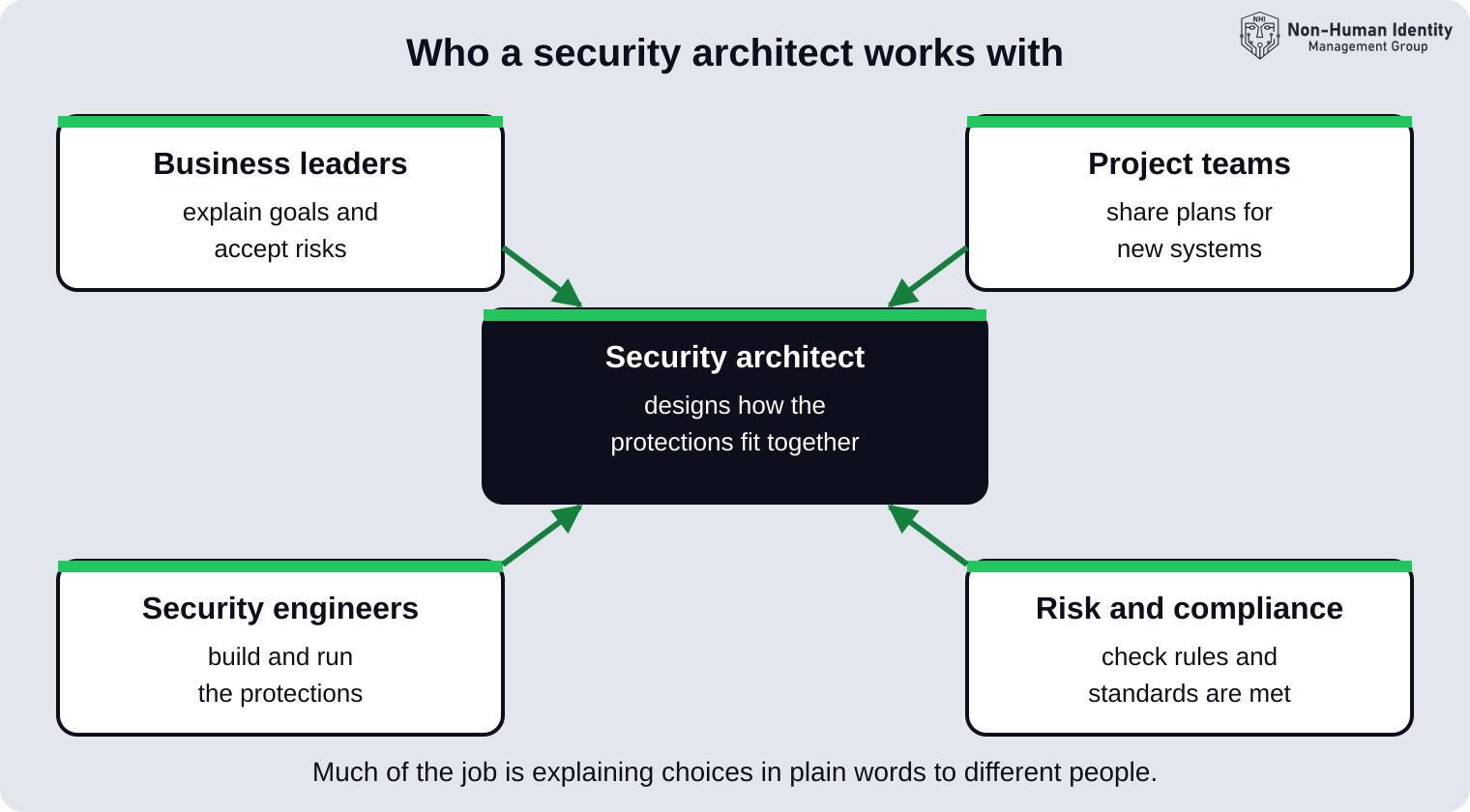
The architect is a planner more than a builder. A security engineer, the person who sets up and runs the protections, builds what the architect designs. The two work closely, and many architects started as engineers.
Where the comparison stops working: a building is finished one day. Computer systems keep changing, with new apps, suppliers and threats. So a security architect returns to the plan again and again, and updates it as things change.
Why does it matter?
Protections added at the end of a project can be harder and dearer to fit. A UK government guide on secure design says the worst outcomes can often be avoided when services are designed with security as a core consideration.[1]
If you manage projects
What could happen: security is checked only just before launch, and late changes cause delays.
Check this: ask for a security design review at the start of each new project.
If you are a security engineer
What could happen: you fix one problem at a time without seeing how the pieces fit, so gaps appear between them.
Check this: for your next task, sketch how it connects to the systems around it.
If you are thinking about a career change
What could happen: you aim straight for an architect job and find that adverts ask for years of hands-on work.
Check this: plan a first step, such as an IT or engineer role, that builds that experience.
What does it look like?
Architects often write a short design note for each project. Here is a made-up note for a new online client portal.
Example only. All values are made up.
SECURITY DESIGN NOTE  SDN-0000 (EXAMPLE)
Project:  client portal, portal.example.invalid
Data:     client tax records (sensitive)          (1)
Risk:     stolen client passwords                 (2)
Decision: two-step sign-in for every client       (3)
Decision: portal kept apart from staff systems    (4)
Owner:    FAKE-ARCHITECT    Review: in 12 months   (5)
- Naming the data first shows how much care the system needs.
- The main thing that could go wrong, written in plain words.
- A protection chosen to lower that risk.
- A design choice that limits harm if the portal is attacked. In a real file, this line would also name which connections are allowed.
- A named owner and a date to look at the design again.
Why this is risky: without a note like this, choices are made in passing, and nobody can later see why.
The safer way: each key decision is written down with its reason, an owner and a review date.
How does it work?
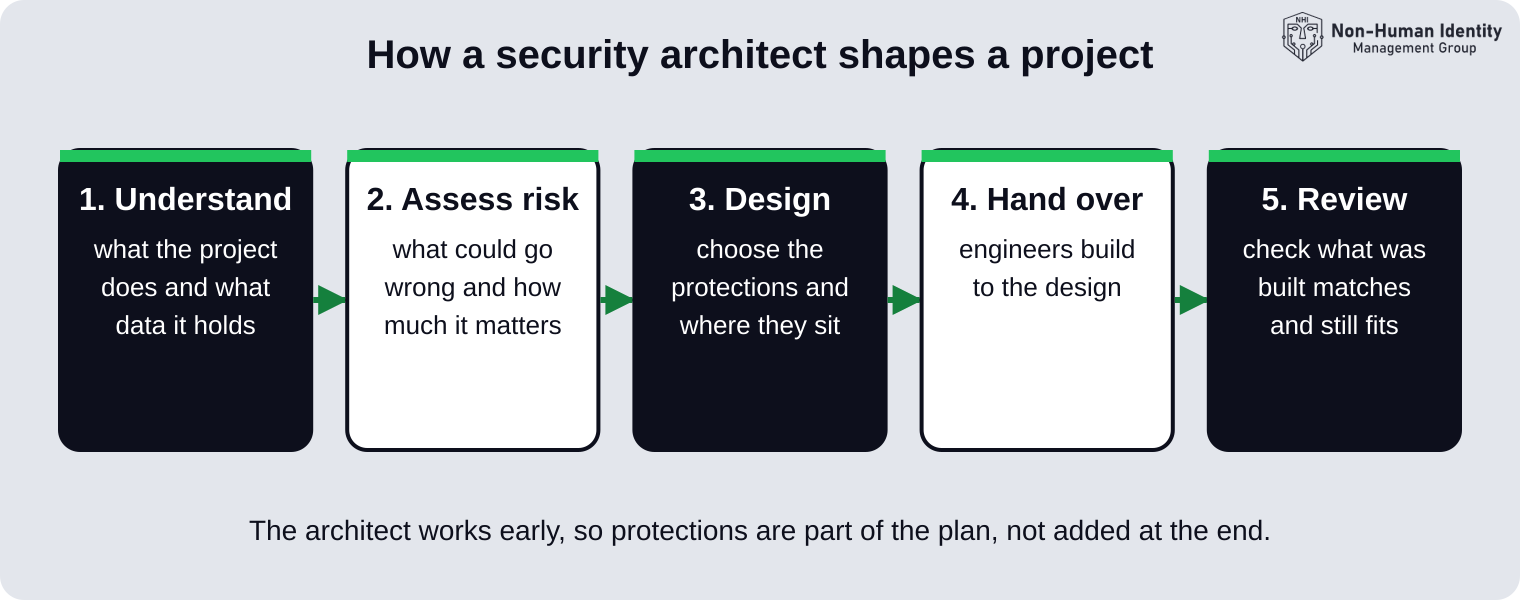
On a typical project, a security architect works through these steps.
- Understand. Learn what the project does, who uses it and what data it holds.
- Assess risk. Work out what could go wrong and how much it would matter. This uses threat modelling, thinking through likely attacks before they happen.
- Design. Choose the protections and decide where each one sits. Good designs use several layers, so one failure does not expose everything.
- Hand over. Explain the design to the engineers who build it, and answer their questions.
- Review. Check that what was built matches the design, and update it as things change.
Architects lean on published design advice. The UK guide groups its advice into five themes. These include making compromise difficult, making attacks easier to spot and reducing the harm if one succeeds.[1] A US government guide sets out how to build security into the wider work of designing systems.[2]
Skills and tools
Architects build these up over years, often first as engineers or developers.
- Broad tech knowledge. Networks, sign-in, cloud and data, so a design is practical.
- Threat modelling. Thinking through likely attacks before they happen.
- Judging risk. Weighing how likely a harm is and how much it would matter.
- Design notes and diagrams. Writing down each key decision with its reason, an owner and a review date.
- Plain explanations. Directors and project leads need to understand the trade-offs.
A worked example
This is a made-up day in the life. Ruben Jansen is a security architect at Kestrel Accountants, a UK accounting firm with offices in four towns.
Ruben starts with the client portal project. The team wants clients to upload tax papers online. He asks what data the portal will hold and who will use it. Tax records are sensitive, so he notes that as the first fact in his design note.
Mid-morning, he runs a short threat modelling session with the developers. They list what could go wrong. Stolen client passwords come top. Ruben suggests two-step sign-in for every client. He also asks for the portal to be kept apart from staff systems.
After lunch, he meets the finance director. She worries two-step sign-in will annoy older clients. Ruben explains the risk in plain words and offers a simple app or a text code. She agrees, and accepts the small remaining risk in writing.
Late afternoon, he reviews a design from last year. The firm now uses a new file-sharing service. Ruben checks how it connects to the old systems and updates the plan. He books a review with the security engineers who will make the changes.
Ruben wrote no code today. Most of his work was asking questions, weighing choices and writing them down clearly.
Myths and mistakes
| What people think | What is true |
|---|---|
| Architects only draw diagrams. | Diagrams help, but much of the job is talking to people and agreeing decisions. |
| A security architect can start straight from school. | It is usually a senior role. Most architects have years of IT or engineering work first. |
| Once the design is done, the architect moves on. | Systems change, so designs are reviewed and updated over time. |
| The architect's job is to say no. | A good architect looks for a safe way to say yes, and explains the trade-offs. |
| Architect and engineer are the same job. | They overlap. The architect plans how protections fit together. The engineer builds and runs them. |
What can I do this week?
- Read three security architect job adverts and list the experience they ask for.
- Draw a simple diagram of a system you use, such as online banking, and mark where you would add checks.
- Read the UK guide on secure design principles listed in the sources below.
- Ask a security engineer or IT lead how new projects get a security review where you work.
Checklist
- I can explain what a security architect does in one sentence.
- I can name the five steps an architect follows on a project.
- I know how the role differs from a security engineer.
- I understand why security is planned early in a project.
- I know why design decisions are written down with an owner.
- I know the role usually needs years of experience first.
- I know where to find the practitioner career guide for more detail.
Common questions
How do people become security architects?
Most grow into the role. A common path runs from IT support or development, to security engineer, then to architect. In the UK, a cyber security apprenticeship lists security architect among its typical job titles.[4]
Is security architect a common job?
It is a smaller group than engineers. In a 2026 UK government study, security architect roles made up 5% of core cyber security job adverts with job titles in 2025.[3] Security engineer roles made up 21% in the same study.
Do security architects need to code?
Not usually as a daily task. But they need to know how systems are built, and many were engineers or developers before. Being able to read code and settings helps. It lets an architect check that a design is practical and was built as planned.
What skills matter most?
Broad tech knowledge comes first: networks, sign-in, cloud and data. Next is judging risk. Just as important is explaining choices in plain words. Directors and project leads need to understand the trade-offs so they can make good decisions.
Are there specialist kinds of security architect?
Yes. Some focus on one area, such as cloud, networks or identity. Identity is about how people and software sign in and get access. An identity architect is one example. Large firms are more likely to have these specialist roles than small ones.
Where next?
Ready for the detail? Read the practitioner guide: Security Architect Career Guide. It goes further into design frameworks, certifications and how the career progresses.
Also useful:
- Security Architect vs Security Engineer
- Security Architecture Review Guide
- Identity Architect Career Guide
- Zero Trust for Beginners
Related NHI Mgmt Group resources: Cybersecurity Careers Guide · What does a security engineer do? A beginner's guide · Security architecture decision records (ADRs)
Key terms
- Security architect
- A person who designs how security protections fit together across an organisation's systems, accounts, data and networks.
- Security architecture
- The planned design of protections, boundaries and data flows that keep systems and accounts safe.
- Threat modelling
- Thinking through what you are protecting, who might attack it and how, before it happens.
- Defence in depth
- Using several separate layers of protection, so one failing does not expose everything.
- Risk assessment
- Judging how likely a harm is and how much it would matter, to decide what to protect first.
- Zero trust
- A security approach that checks every request, rather than trusting it because of where it comes from.
Sources and further reading
- Secure design principles. National Cyber Security Centre, 21 May 2019. https://www.ncsc.gov.uk/collection/cyber-security-design-principles, accessed 28 Nov 2026.
- NIST SP 800-160 Vol. 1 Rev. 1, Engineering Trustworthy Secure Systems. National Institute of Standards and Technology, November 2022. https://csrc.nist.gov/pubs/sp/800/160/v1/r1/final, accessed 28 Nov 2026.
- Cyber security skills in the UK labour market 2026. Department for Science, Innovation and Technology, 29 September 2026. https://www.gov.uk/government/publications/cyber-security-skills-in-the-uk-labour-market-2026/cyber-security-skills-in-the-uk-labour-market-2026, accessed 28 Nov 2026.
- Cyber security technologist (2021), apprenticeship standard ST1021. Skills England. https://skillsengland.education.gov.uk/apprenticeships/st1021-v1-1, accessed 28 Nov 2026.