An IoT security engineer helps make smart, connected devices safe to use, from design until support ends.
This guide is for students and newcomers curious about security work on gadgets, not just office computers. You do not need to build electronics to read it. If you own a smart speaker, doorbell or meter, this job touches your home.
In short
- IoT means the "Internet of Things": everyday objects, such as cameras, meters and machines, that connect to the internet.
- An IoT security engineer builds protections into these devices and checks them before and after they are sold.
- Much of the work is passwords and logins, safe software updates, testing devices and handling reports of security flaws.
- People come in from electronics, embedded software, networking and testing roles.
What you will learn
- Explain what an IoT security engineer does in one sentence.
- Spot the common weak points in a connected device.
- Check which of your skills the job already uses.
- Ask good questions about an IoT security job before you apply.
- Smart, connected devices (Internet of Things, IoT)
- everyday objects with a small computer inside that connect to a network.
- The device's built-in software (firmware)
- the program stored inside a device that makes it work.
- Over-the-air update (OTA)
- a software fix sent to a device across the internet, with no cable needed.
What is an IoT security engineer?
Think of a car safety engineer. They design the seatbelts and airbags before the car is sold. Later, they help with recalls if a fault turns up.
An IoT security engineer does a similar job for connected gadgets. They help decide how a device logs in, how it talks to its app and how it gets fixes. Then they test it, and they keep helping once it is in people's homes.
Most IoT security engineers work for firms that make devices. Some work for firms that buy lots of them, such as hospitals, energy companies or building managers. Others test devices for clients.
Where the comparison stops working: a car has one owner who can take it to a garage. A smart device may sit unwatched on a shelf for years. Its owner may never install an update unless it happens on its own.
Why does it matter?
Connected devices are everywhere, and many are small and cheap. A weak password or a missing update can let a stranger take one over. Laws now set some basic rules. In the UK, since April 2024, most consumer smart products must avoid easy-to-guess default passwords and say how long they will get security updates.[1]
If you are studying electronics or software
What could happen: you learn to build devices, but security is left to the end, when it is hardest to add.
Check this: in your next project, write down how the device logs in and how it would get a fix.
If you work in testing or quality
What could happen: you test that a device works, but nobody tests what an attacker could do with it.
Check this: add one security question to your test plan, such as "can the default password be changed?"
If you run a business that uses smart kit
What could happen: cameras or machines on your network keep old passwords and miss updates for years.
Check this: list your connected devices and when each one stops getting updates.
What does it look like?
Before a device goes on sale, the engineer checks it against a list. Here is a made-up test sheet for a smart washing machine.
Example only. All values are made up.
DEVICE SECURITY CHECK   REF EXAMPLE-0000
Product:   FAKE WashSmart 5000
Login:     same password on every unit: admin0000   (1)
Updates:   fixes need a USB stick                    (2)
Update check: no signature check                     (3)
Report a flaw: no contact listed                     (4)
Support ends: not stated
Result:    NOT READY
- Every machine shares one password. In a real file, this line would contain the login method, not the password itself.
- Owners must plug in a stick to get a fix, so many never will.
- The machine does not check that an update came from the maker.
- A researcher who finds a flaw has nobody to tell.
Why this is risky: one leaked password could open every machine, and fixes may never reach them.
The safer way: give each unit its own password or make the owner set one. Send signed updates over the internet. Publish a way to report flaws and a clear support end date.
How does it work?
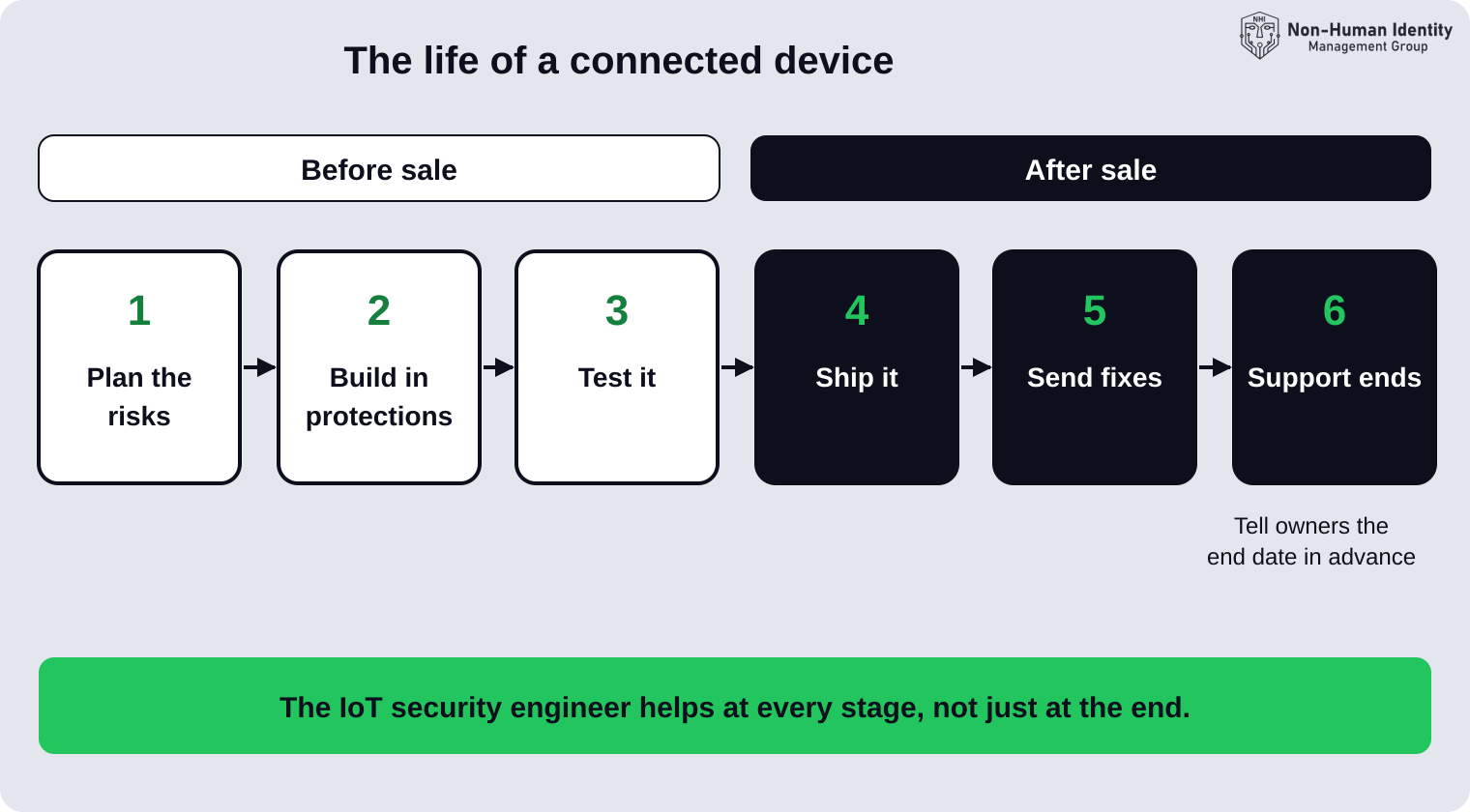
Every company is different, but the work often follows the life of a device.
- Plan the risks. The engineer asks what could go wrong with the device and who might attack it. This is called threat modelling.
- Build in protections. They help design how the device logs in, how it keeps secrets and how it talks to its app. A European standard for consumer devices lists basics such as no shared default passwords and secure updates.[2]
- Test it. They try to break the device, or work with outside testers who do.
- Ship and support. They plan how fixes reach devices and check that each update is signed by the maker.
- Handle reports. They run a process for outsiders to report flaws, and they help fix what comes in.[2]
A US standards body gives makers a similar list of basic tasks to do before they sell a device. Its aim is to cut the security work that buyers must do themselves.[3]
In a bigger team, a junior engineer may run tests, review update plans and check reports from researchers. More experienced engineers design the security of a whole product range and advise managers.
Skills and tools
You do not need all of these on day one. People come in from one side and learn the rest.
- How small devices work. Chips, built-in software and how devices start up.
- Networking basics. How a device talks to its app and to the maker's servers.
- Logins and secrets. Passwords, device certificates and keeping keys safe inside a device.
- Testing. Taking devices apart, safely, to find weak points before attackers do.
- Clear writing. Explaining risks to product managers and writing advice for owners.
A worked example
This story is made up to show what the job can look like.
Idris Haddad is a year into his first IoT security engineer job at a fictional firm that makes smart washing machines for launderettes. Before this, he wrote software for fitness trackers.
On Monday, he runs the security check on a new model. The test sheet looks a lot like the sample above. Every unit shares one password, and updates need a USB stick.
Idris thinks of the car safety engineer. It is far easier to fit the seatbelt before the car leaves the factory. He meets Celia Yeboah, the product manager, on Tuesday.
Celia worries about cost and delay. Idris shows her two cheap changes. The machine can print its own password on a label inside the door. The update system the firm already uses for its dryers can be reused. Celia agrees.
On Wednesday, a researcher emails about a flaw in an older model. Idris thanks them, logs the report and confirms the flaw on a test machine.
By Friday, a fix is ready. One customer, Cedar Laundry, runs 40 of the older machines. Idris checks the update reaches a test unit and installs safely. Then the firm sends it to all machines over the internet.
What made the difference: Idris raised the issues before launch, when they were cheap to fix, and the firm had a way to send updates.
Myths and mistakes
| What people think | What is true |
|---|---|
| Small gadgets are not worth attacking. | Many weak devices together can be useful to attackers, and one device can be a way into a home or office network. |
| Security can be added after launch. | Some things, such as how a device checks updates, are much harder to change once it is sold. |
| You need to be an electronics expert to start. | People come in from software, networking and testing. You learn the hardware side on the job. |
| A device is safe once it passes testing. | New flaws turn up later. The device needs a way to get fixes and a known end date for support.[1] |
| IoT security is the same as OT security. | They overlap. OT usually means big industrial systems. IoT is often smaller, cheaper devices made in large numbers. |
What can I do this week?
- Read three IoT or embedded security job adverts and list the tasks they share.
- Read our IoT Security for Beginners guide.
- Look at a smart device you own. Find out how it gets updates and when support ends.
- Read the UK government's short summary of its product security rules.
Checklist
- I can explain what IoT means, with an example.
- I know why shared default passwords are a problem.
- I know what firmware is and why updates matter.
- I can explain why updates should be signed by the maker.
- I know why makers publish a way to report flaws.
- I have looked at real job adverts for the role.
- I have checked official sources for pay, not just job boards.
Common questions
Do I need an electronics degree?
Not always. Some people come from electronics. Others come from software, networking or testing and learn the hardware side at work. Employers often care more about what you have built or tested. A small home project with a cheap board can help you show that.
What is the difference between IoT and OT security?
They overlap a lot. OT runs big working systems, such as pumps and production lines. IoT usually means smaller connected devices, often made in large numbers. See IoT Security vs OT Security for more.
Is hacking devices part of the job?
Testing is, but only on devices you own or have permission to test. Many engineers try to break their own firm's products before launch. Testing other people's devices without permission can be a crime. Defence is the aim.
How much does an IoT security engineer earn?
Pay varies by country, sector and experience, so we do not quote a figure. Use official career sources for your country, such as the National Careers Service in England. Then compare several real job adverts.[4]
Where can the job lead?
Several paths. Some move into designing security for whole product ranges. Others become device testers, lead product security teams or move into industrial OT work. The skills also suit car, medical device and smart energy firms.
Where next?
Ready for the detail? Read the practitioner guide: IoT Security Guide. It goes further into device identity, secure update design, the main standards and how firms run IoT security programmes.
Also useful:
- Product Security Engineer for Beginners
- OT Security Engineer for Beginners
- ETSI EN 303 645 Consumer IoT Guide
- IoT Secure Firmware Update Guide (SUIT, signed OTA)
Related NHI Mgmt Group resources: Cybersecurity Careers Guide · Device and IoT Identity Guide · IoT and Hardware Penetration Testing Guide
Key terms
- Internet of Things
- Everyday objects with small computers inside that connect to a network or the internet.
- Firmware
- The software stored inside a device that controls how it works.
- Secure boot
- A check at start-up that only trusted software from the maker is allowed to run.
- Threat modelling
- Thinking through what could go wrong with a system, and who might attack it, before it is built.
- Vulnerability disclosure policy
- A public statement telling people how to report a security flaw and what the maker will do next.
- Attack surface
- All the ways an attacker could try to get into a device or system.
Sources and further reading
- The UK Product Security and Telecommunications Infrastructure (Product Security) regime. Department for Science, Innovation and Technology, GOV.UK; regime in effect from 29 April 2024. https://www.gov.uk/government/publications/the-uk-product-security-and-telecommunications-infrastructure-product-security-regime, accessed 28 Nov 2026.
- ETSI EN 303 645 V2.1.1, Cyber Security for Consumer Internet of Things: Baseline Requirements, section 5 (provisions 5.1 and 5.2). ETSI, June 2020. https://www.etsi.org/deliver/etsi_en/303600_303699/303645/02.01.01_60/en_303645v020101p.pdf, accessed 28 Nov 2026.
- NIST IR 8259 Rev. 1, Foundational Cybersecurity Activities for IoT Product Manufacturers. National Institute of Standards and Technology, April 2026. https://csrc.nist.gov/pubs/ir/8259/r1/final, accessed 28 Nov 2026.
- Explore careers. National Careers Service (England). https://nationalcareers.service.gov.uk/explore-careers, accessed 28 Nov 2026.