A product security engineer helps make the things a company sells safe to use, from design to retirement.
This guide is for students, career changers and engineers who build devices or software and are curious about security work. You do not need to work in security today to be affected: if you build a product, its safety is part of your job too.
In short
- Product security engineers protect what a company sells, such as smart devices, car parts, medical kit or apps.
- They check designs, review code and settings, and help fix weaknesses found after the product ships.
- New laws, such as the EU Cyber Resilience Act, make this work a duty for many makers of connected products.
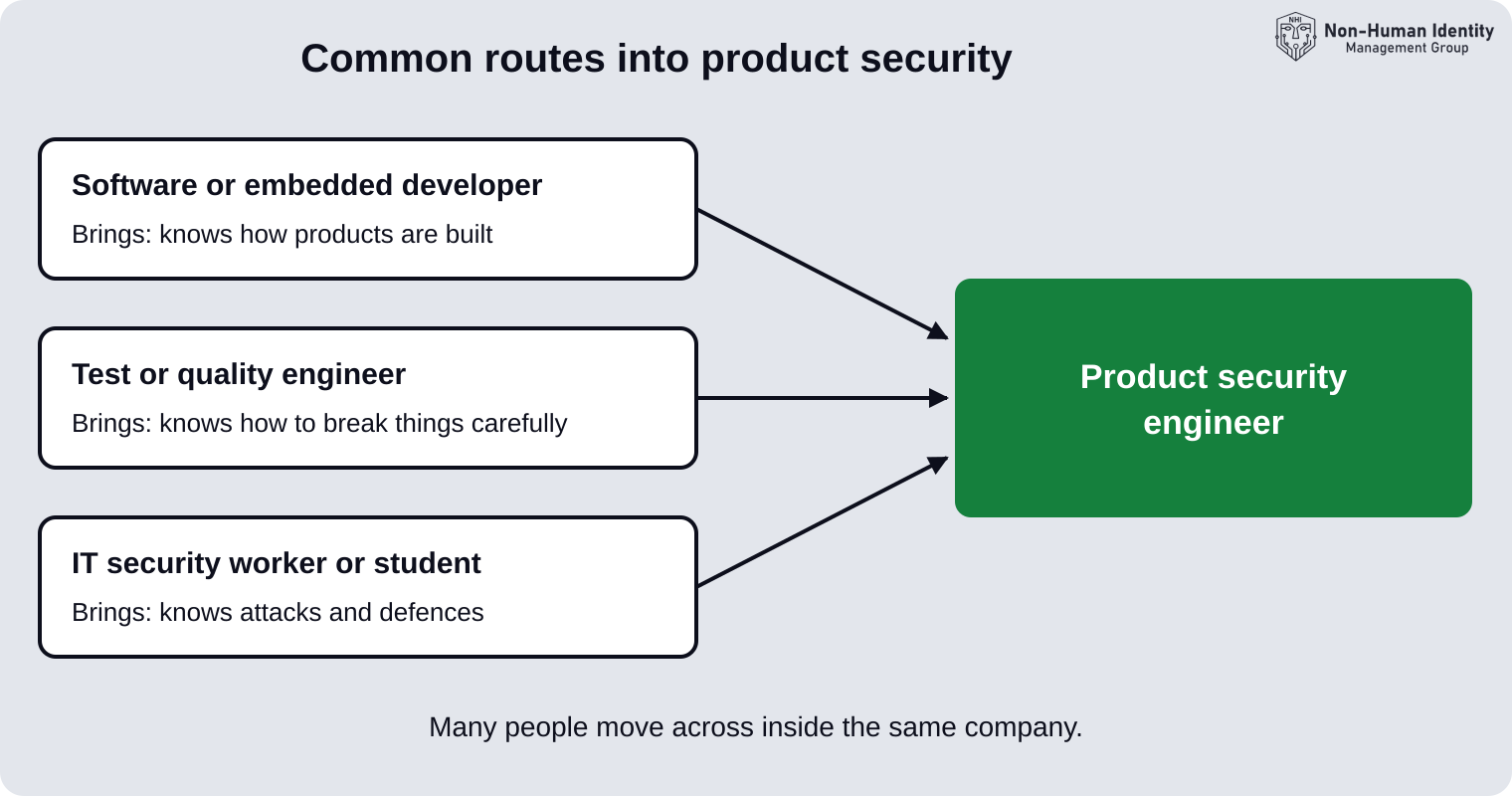
- Many people come in from software, embedded or test engineering, and learn security on the job.
What you will learn
- Explain what a product security engineer does in one sentence.
- Spot the weak points in a simple product design.
- Explain how the role differs from other security jobs.
- Check which skills you already have and which to learn next.
- Spotting risks early (threat modelling)
- looking at a design and asking what could go wrong before it is built.
- Built-in device software (firmware)
- the software that runs inside a device, such as a thermostat or a camera.
- Product incident team (PSIRT)
- the team that takes in reports of weaknesses in a company's products and organises the fixes.
What is a product security engineer?
Think of a fire safety officer for a new building. They check the plans before building starts. They check again before people move in, and they keep checking for as long as the building is used.
A product security engineer does that for a product. The product might be a smart doorbell, a car's control unit, a heart monitor or a phone app. They help the team design it safely, check it before release, and keep it safe once customers use it.
The key word is "product". Many security jobs protect a company's own systems, like its email and laptops. This role protects what the company sells, so a weakness can affect thousands of customers at once.
Where the comparison stops working: a building stays where it is. A connected product can get software updates after it is sold, so the engineer can still help fix problems years later.
Why does it matter?
Connected products are everywhere, and one weak design is copied into every unit sold. Laws are also changing. The EU Cyber Resilience Act requires makers to handle weaknesses in their products throughout the product's life. Its reporting duties apply from 11 September 2026, and its main duties from 11 December 2027.[1]
If you are an embedded or software developer
What could happen: a shortcut you add for testing, like a default password, ships in every device.
Check this: ask whether your team does a security review before each release.
If you are a student choosing a path
What could happen: you miss a growing field because it rarely appears in security course titles.
Check this: look at job adverts for "product security" and note the skills they ask for.
If you manage a product team
What could happen: a weakness is reported after launch, and nobody knows who should handle it.
Check this: make sure someone owns security for each product, and that outsiders know how to report a problem.
What does it look like?
Much of the job is reading plans and asking careful questions. Here is a made-up review note for a smart heating control. The engineer writes notes like this.
Example only. All values are made up.
DESIGN REVIEW  REF EXAMPLE-0000
Product:   FAKE smart thermostat, model T-0000
Feature:   control the heating from a phone app
Login:     same default password on every unit   (1)
Updates:   new firmware is not checked before use (2)
Debug port: left open on the circuit board        (3)
Support:   no end date for security updates       (4)
Decision:  not ready, fix 1 to 4 first
- If one person learns the shared password, they may get into every unit.
- The device does not check where an update came from. A fake one could be put on it.
- A test plug left on the board can let someone with the device get deep inside it.
- Buyers do not know how long fixes will last.
Why this is risky: each issue is copied into every unit sold. One weak spot becomes thousands.
The safer way: give each unit its own password. Make the device check each update. Close the test plug. Say how long fixes will last.
How does it work?
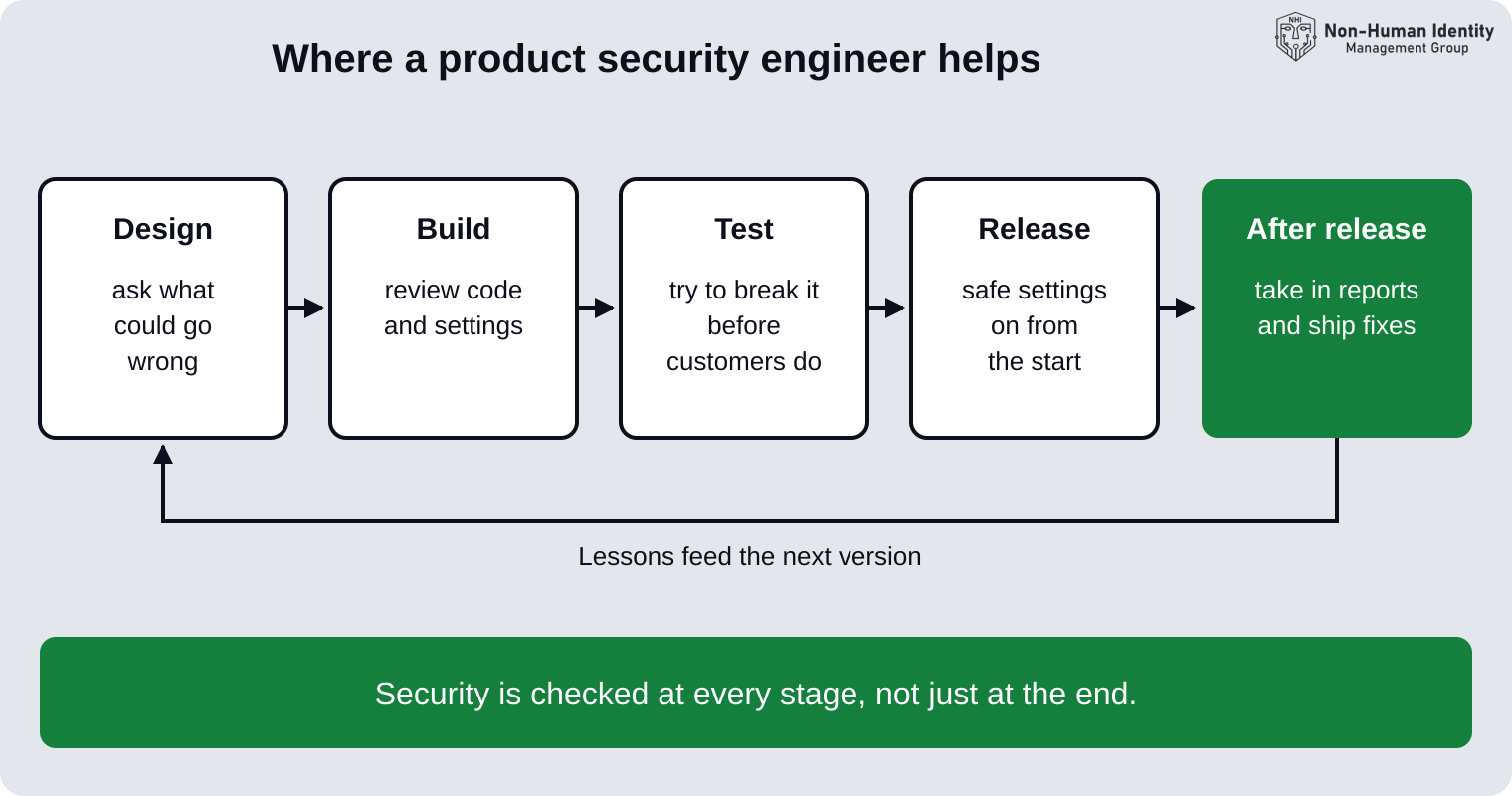
The work follows the life of the product. A common way to describe it is as a secure development lifecycle, which means building security checks into each stage of making a product.[4]
- Design. The engineer runs threat modelling with the team. They ask four simple questions. What are we working on? What can go wrong? What will we do about it? Did we do a good enough job?[3]
- Build. They review code and settings, and help set up tools that check for known weaknesses.
- Test. They test the finished product, or arrange outside testers, before release.
- Release. They check that safe settings are on from the start. A US government agency calls this being secure by default.[5]
- After release. They help the product incident team take in reports, judge how serious each one is and ship fixes.[2]
The type of product changes the detail. A car part may need to meet car industry rules. A medical device has its own safety rules. Industrial control equipment often follows an international standard for secure product development.[4] The core questions stay the same.
Skills and tools
You do not need all of these on day one. Many people bring one strong skill and learn the rest on the job.
- How products are built. Reading code, and for devices, understanding firmware and circuit boards.
- Threat modelling. Drawing a simple picture of a design and asking what could go wrong.
- Testing tools. Tools that scan code for known weak patterns, and tools that test a running product.
- Handling reports. Judging how serious a weakness is, and writing clear advice for customers.
- Working with people. Explaining risks to developers and managers without slowing everyone down.
A worked example
Lina Gallardo is a junior product security engineer at a fictional company that makes smart thermostats. She moved across from the firmware team a year ago. Her lead is Rania Zeller.
At 9am Lina joins the team's morning meeting. A new phone app feature is starting design, so she books a threat modelling session for Thursday.
At 10am she reviews a change to the update code. She checks that the device still refuses any update that the company has not signed. It does, so she approves the change.
At 11am a report arrives through the company's security contact page. An outside researcher says an older model accepts a default password over the home network.
Lina thinks of the fire safety officer who keeps checking after people move in. She tests the claim on a spare unit, and it is true. She writes up how serious it is and passes it to Rania.
After lunch, Rania and Lina meet the firmware team. They agree a fix that makes each owner set their own password on first use. They also agree how to tell customers.
At 4pm Lina thanks the researcher, explains the plan and asks them to wait for the fix before publishing details.
Before leaving, she updates the team's list of open issues. Tomorrow she will help write the advice for customers.
Myths and mistakes
| What people think | What is true |
|---|---|
| Product security is the same as protecting the company's IT. | It protects what the company sells. The company's own systems are usually a different team's job. |
| You must be a hacker to get in. | Many people come from development or testing. Knowing how products are built is just as valuable. |
| Security is checked once, just before launch. | It runs from design to the end of support, including fixes after release. |
| A report from an outsider is an attack. | Most reports come from people trying to help. A clear, friendly reporting route matters. |
| Only big tech firms need this role. | Makers of many connected products now face legal duties, so the work is spreading to smaller firms.[1] |
What can I do this week?
- Pick a device you own and write down three things that could go wrong with it.
- Read the four threat modelling questions and try them on a simple app.
- Look at five "product security engineer" job adverts and list the skills that repeat.
- Find a company's security contact page and read how it asks people to report problems.
Checklist
- I can explain the difference between product security and protecting a company's own IT.
- I know the four threat modelling questions.
- I understand why default passwords and unchecked updates are risky.
- I know what a product incident team does.
- I know that some laws now set security duties for connected products.
- I have a list of skills I already have and skills to learn next.
Common questions
Is a product security engineer the same as an application security engineer?
They overlap a lot. Application security engineers focus on apps and websites. Product security engineers cover what the company sells. That may mean devices, the software inside them and online services, as well as apps. In some firms the two titles mean the same job.
Do I need a degree?
Not always. Many adverts ask for a degree in computing or engineering, or the same level of work skill. Time spent building or testing products often counts as much. Check real adverts near you, because each firm sets its own rules.
How much does a product security engineer earn?
Pay changes a lot from place to place and job to job, so we do not give a figure here. Look at several real job adverts near you. Also check the official careers service in your country for similar security jobs.
Which industries hire product security engineers?
Any firm that sells smart devices or software. That includes makers of smart home kit, cars, medical kit, factory machines, phones and business apps. Each field has its own rules. So many engineers grow into one field over time.
Where can the role lead?
Common next steps are senior or lead engineer, or head of a product incident team. Some people go on to lead security for a whole range of products. Others become experts in one area, such as devices or cars.
Where next?
Ready for the detail? Read the practitioner guide: IEC 62443-4-1 and 4-2 Secure Product Development Guide. It goes further into secure development lifecycle requirements, technical requirements for components and how products are assessed.
Also useful:
- Product Security Engineer Career Guide
- Application Security vs Product Security
- Threat Modelling for Beginners
- OT Security Engineer for Beginners
- EU Cyber Resilience Act for Beginners
Related NHI Mgmt Group resources: PSIRT Guide · Hardware Security Engineer Career Guide · UK PSTI Act Product Security Guide
Key terms
- Threat modelling
- Looking at a design to find what could go wrong, and planning what to do about it.
- Firmware
- The software built into a device that controls how its hardware works.
- Secure by design
- Building security into a product from the start, not adding it at the end.
- Secure boot
- A check at start-up that only lets trusted, signed software run on a device.
- SBOM
- A list of the parts and libraries inside a piece of software, like an ingredients label.
- CVE
- A public reference number given to a known security weakness.
Sources and further reading
- Cyber Resilience Act. Shaping Europe's digital future, European Commission. https://digital-strategy.ec.europa.eu/en/policies/cyber-resilience-act, accessed 28 Nov 2026.
- PSIRT Services Framework, version 1.1. FIRST (Forum of Incident Response and Security Teams). https://www.first.org/standards/frameworks/psirts/psirt_services_framework_v1.1, accessed 28 Nov 2026.
- Threat Modeling Manifesto. Threat Modeling Manifesto working group. https://www.threatmodelingmanifesto.org/, accessed 28 Nov 2026.
- ISA/IEC 62443 Series of Standards. International Society of Automation (ISA). https://www.isa.org/standards-and-publications/isa-standards/isa-iec-62443-series-of-standards, accessed 28 Nov 2026.
- Secure by Design. Cybersecurity and Infrastructure Security Agency (CISA). https://www.cisa.gov/securebydesign, accessed 28 Nov 2026.