An OT security engineer protects the computers that run machines, plants and utilities, while keeping them safe and running.
This guide is for anyone curious about a security job that sits between computers and the physical world. You do not need an engineering degree to read it. If you use tap water, electricity or trains, these systems touch your day.
In short
- OT stands for operational technology: the computers that control physical things such as pumps, valves and production lines.
- An OT security engineer designs and checks protections for those systems. Safety and keeping things running usually come first.
- Much of the work is knowing what equipment exists, keeping networks apart, controlling remote access and planning changes with plant staff.
- People come in from IT and network security, from control and automation engineering, or from equipment suppliers.
What you will learn
- Explain what an OT security engineer does in one sentence.
- Spot why OT security differs from office IT security.
- Check which of your skills the job already uses.
- Ask good questions about an OT security job before you apply.
- Computers that run machines (operational technology, OT)
- the devices and software that watch and control physical processes.
- Machine controller (PLC)
- a small, tough computer that switches motors, pumps and valves on and off.
- Keeping networks apart (segmentation)
- splitting a network into zones, with guarded links between them.
What is an OT security engineer?
Think of a railway signal engineer. They keep the signals safe and working, and they cannot simply switch the line off to fix something. Every change is planned around the trains.
An OT security engineer does a similar job for the computers that run real things. These include water works, power lines, factories and the heating in big buildings. The UK's cyber agency says OT is technology that works with the physical world.[2]
The engineer plans systems and ways of working that keep these sites safe, steady, under control and secure. That covers attacks and accidents.[1] They work with security bosses, plant managers and staff on site.[1]
The big difference from office IT is what comes first. In an office, keeping data private is often the main goal. In OT, safety and keeping things running usually come first. A fault can hurt people or damage kit.[2]
Where the comparison stops working: a railway signal is easy to see. An OT computer may sit in a locked box for many years. Some are linked to networks that nobody has drawn up.
Why does it matter?
When an office laptop fails, someone loses a morning. When a plant's control system fails, the plant may stop, or people nearby may be at risk. OT security engineers help lower that risk. They try not to get in the way of the people who run the site.
If you work in IT or network security
What could happen: you apply office habits, such as restarting a device to patch it, and stop a process by accident.
Check this: before any change, ask the plant team when it is safe to make it.
If you are a control or automation engineer
What could happen: you already know the machines, but security tasks land on you with no training.
Check this: list the remote connections into your site and who uses each one.
If you manage a site or plant
What could happen: nobody owns OT security, so suppliers keep old remote access open for years.
Check this: name one person who looks after OT security and give them time with your engineers.
What does it look like?
A lot of the job is careful checking before anyone touches a live system. Here is a made-up request from a supplier who wants to connect from outside. The engineer reviews forms like this.
Example only. All values are made up.
REMOTE ACCESS REQUEST  REF EXAMPLE-0000
Site:      FAKE Water Works, pump house 2
Who:       Supplier engineer (FAKE NAME)
Account:   shared "support" login           (1)
Target:    pump controller PLC-0000           (2)
When:      any time, no end date              (3)
Reason:    check pump settings
Approved by: (blank)                          (4)
- With a shared login, it is hard to tell who did what.
- The box that runs the pumps. In a real file, this line would contain its name on the site list.
- With no end date, the door stays open after the job is done.
- Nobody on site has said yes. The plant team may not know.
Why this is risky: an open, shared way into the pumps is a way an attacker could try to use too.
The safer way: give the supplier their own login with a second sign-in check. Set a time limit. Get a yes from the plant team, and record the session.
How does it work?
Every site is different, but the work often follows steps like these.
- Know what is there. The engineer builds a list of OT equipment, such as controllers, screens and network links. Taking stock of OT assets is a core task of the role.[1]
- Weigh the risks. They carry out risk checks and join the site's safety reviews, called process hazard analysis, so cyber risks are judged alongside physical dangers.[1]
- Keep networks apart. They design network segmentation, so the office network and the internet cannot reach the machines directly.
- Control who gets in. They set rules for staff and supplier remote access, as in the sample above.
- Plan changes and watch. They write change plans with the plant team and keep an eye on the network for anything unusual.[1]
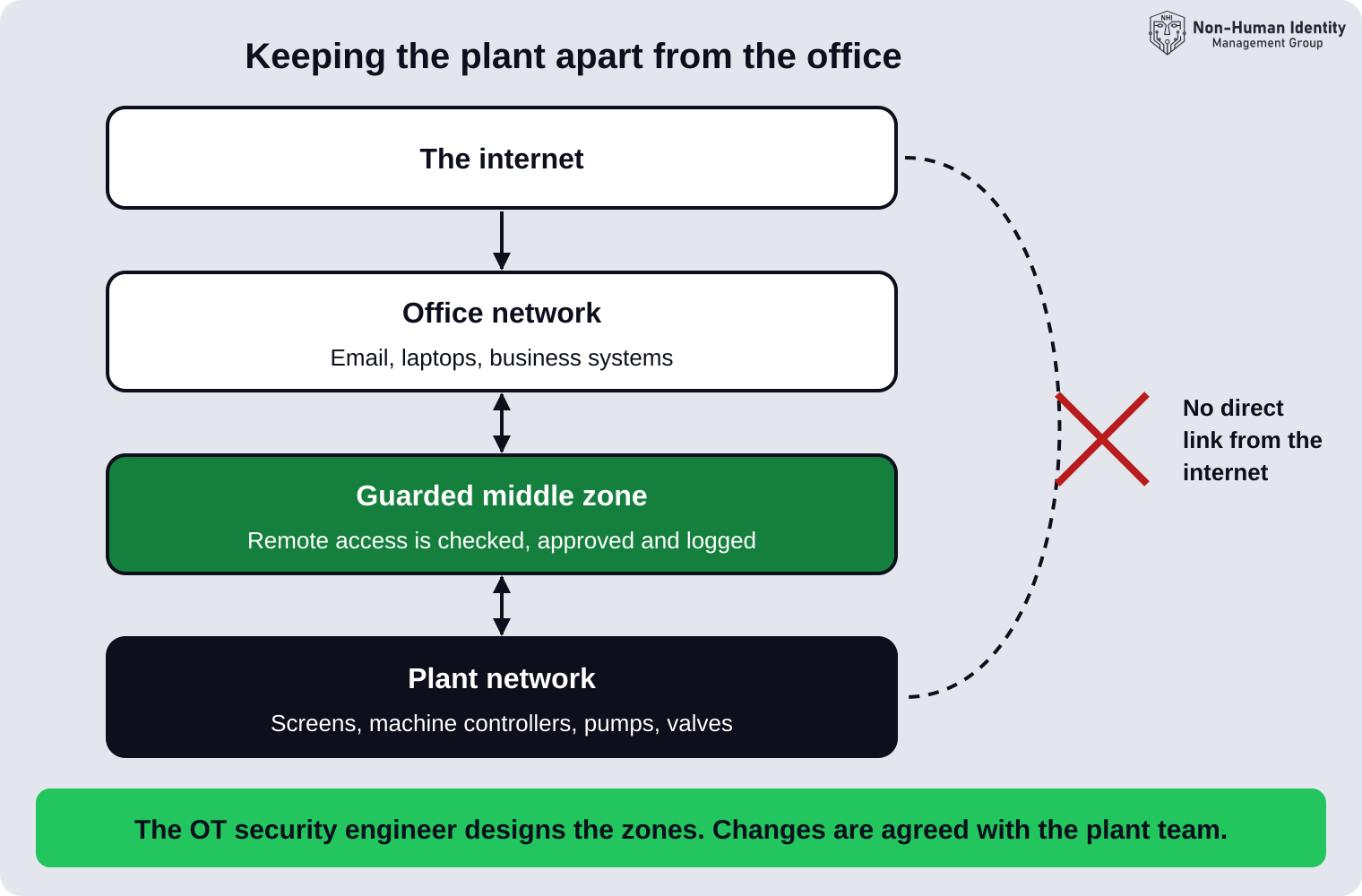
Patching (installing software fixes) works differently in OT. Some machines can only be restarted during a planned shutdown. Then the engineer may add other protections, such as tighter network rules, until a fix can be applied.
In a bigger team, a junior engineer often handles the equipment list, access requests and monitoring. More experienced colleagues design the network zones, lead risk reviews and advise leaders.
Skills and tools
You do not need all of these on day one. People come in from IT, networking or automation and learn the rest on the job.
- OT equipment lists. Knowing what controllers, screens and network links a site has.
- Risk checks with the safety team. Judging cyber risks alongside physical dangers.
- Network segmentation. Keeping the office network and the internet away from the machines.
- Remote access control and monitoring. Named logins, time limits, recorded sessions and watching the network for anything unusual.
- Working with the plant team. Planning every change around when it is safe to make it.
A worked example
This story is made up to show what the job can look like.
Rhys Morgan is a year into his first OT security engineer job at Thistle Energy, a fictional utility. Before this, he looked after office networks for a council.
His Monday starts with the equipment list for a small gas site. He compares it with what the network monitor can see. One controller appears that is not on the list.
Rhys thinks of the railway signal engineer. He does not unplug it. He asks the site technician first. It turns out to be a new flow meter a contractor fitted last month.
The technician adds it to the list. Rhys checks its network link and finds it can talk to the office network. He writes a small change to block that path, and the site manager approves it for Thursday morning, a quiet period.
On Tuesday, a supplier asks for remote access to update a controller. Rhys gives a named account, a second sign-in check and a four-hour window. The session is recorded.
On Thursday, the network change goes in with the technician watching the screens. The process keeps running.
On Friday, Rhys writes a short note for his manager. It covers the new meter, the blocked path and an idea: contractors should tell the OT team before fitting new equipment.
What made the difference: Rhys asked the people on site before acting, so the fix did not stop the gas supply.
Myths and mistakes
| What people think | What is true |
|---|---|
| OT security is just IT security in a factory. | The tools overlap, but the priorities differ. Safety and keeping things running usually come first.[2] |
| Plant systems are not connected, so they are safe. | Many sites have links for suppliers, reports or remote support. Check, rather than assume. |
| You can patch OT the same day, like a laptop. | Some machines only stop during planned shutdowns. Changes are planned with the plant team. |
| You need to be an electrical engineer to start. | People come in from IT, networking and automation. You learn the process side on the job. |
| Security means locking everything down. | A control that stops operators doing their job can create its own safety risk. The aim is safe and secure together. |
What can I do this week?
- Read three OT security job ads and list the tasks they share.
- Read our Operational Technology Security for Beginners guide.
- Read the UK cyber agency's short OT pages.
- Ask someone who works in a plant or factory what happens when a machine stops.
Checklist
- I can explain what operational technology is, with an example.
- I know why safety and keeping things running come first in OT.
- I know what a machine controller (PLC) does.
- I can explain why plant and office networks are kept apart.
- I have looked at real job adverts for the role.
- I have checked official sources for pay, not just job boards.
- I have a plan for one first learning step.
Common questions
Do I need an engineering degree to work in OT security?
Not always. Many start in IT or network security and learn how plants work on the job. Others start as engineers who set up machines, and then learn security. Both halves matter. Expect to keep learning, whichever side you start from.
What is the difference between OT and IoT?
OT runs big working systems, such as pumps, power and production lines. IoT usually means everyday smart gadgets, such as cameras or doorbells. The two overlap a lot. See IoT Security vs OT Security for more.
How much does an OT security engineer earn?
Pay varies a lot by country, sector and experience, so we do not quote a figure here. Use official career sources for your country, such as the National Careers Service in England, and compare several real job adverts.[3]
Is the job mostly on site or at a desk?
Usually both. Much of the planning and watching happens at a desk. Site visits are common, to check kit, trace cables and help with changes. Some jobs need safety training before you can go on site.
Where can an OT security engineer job lead?
Several paths. Some move into designing OT security for whole sites, or into leading a team. Others handle attacks on plants, or join firms that make the kit, to help build safer products. Our practitioner guide covers this in more detail.
Where next?
Ready for the detail? Read the practitioner guide: OT Security Engineer Career Guide. It goes further into the skills and tools employers look for, the three common routes in, certifications and how people progress.
Also useful:
- OT Security Guide
- OT Remote Access Guide
- IEC 62443 for Beginners
- What does a security engineer do? A beginner's guide
Related NHI Mgmt Group resources: Cybersecurity Careers Guide · Career Change into Cyber Security Guide · OT Network Segmentation, Purdue Model and IEC 62443 Zones and Conduits Guide
Key terms
- Operational technology (OT)
- The computers and devices that monitor and control physical things, such as pumps, motors, valves and production lines.
- Industrial control systems (ICS)
- The controllers, sensors and software that run and supervise an industrial process.
- PLC
- A programmable logic controller: a tough computer that runs the control steps for machines such as pumps and motors.
- HMI
- A human machine interface: the screen operators use to watch and control a process.
- Network segmentation
- Splitting a network into zones with controlled links between them, so a problem in one zone is harder to spread.
- Patch management
- Checking, testing and installing software fixes, planned around when a system can safely stop.
Sources and further reading
- NICE Framework work role: Operational Technology (OT) Cybersecurity Engineering (DD-WRL-009), role description and tasks including inventory OT assets, perform a process hazard analysis, perform risk and vulnerability assessments and create a change management plan. CISA National Initiative for Cybersecurity Careers and Studies. https://niccs.cisa.gov/tools/nice-framework/work-role/operational-technology-ot-cybersecurity-engineering, accessed 28 Nov 2026.
- Operational technology (collection). National Cyber Security Centre (UK), published 18 March 2024. https://www.ncsc.gov.uk/collection/operational-technology, accessed 28 Nov 2026.
- Explore careers. National Careers Service (England). https://nationalcareers.service.gov.uk/explore-careers, accessed 28 Nov 2026.