AI and privacy is about what happens to personal information when people type it into AI tools.
This guide is for anyone who uses AI chatbots or assistants at work, or manages people who do. You do not need to be technical to be affected: if your staff paste customer emails into an AI tool, your business is sharing personal data with another company.
In short
- Anything you type or upload into an AI tool goes to the company that runs it, and is usually stored for a while.
- Depending on the terms and settings, it may be read by the provider's staff or used to improve the service.
- Data protection law still applies. Put in only what the task needs, and take out names and details first.
- Agree which AI tools staff may use for work, and write down what must not go into them.
What you will learn
- Explain where a prompt can end up after you send it.
- Spot personal details that should come out of a prompt.
- Explain why a free personal account and a business tool can differ.
- Ask which AI tools your organisation has approved.
Status: correct as at 28 November 2026, based on guidance from the UK Information Commissioner's Office and the UK National Cyber Security Centre. Laws change; check the official text.
This guide explains the topic in general terms and is not legal advice.
- Information about a person (personal data)
- anything that can identify someone, directly or with other details.
- What you type in (prompt)
- the question or instruction you give an AI tool, plus anything you attach.
- Using only what you need (data minimisation)
- putting in only the personal data the task really needs.
What is AI and privacy?
Think of curtains on your windows. You decide who can see into your home, and when. Privacy is the same idea for information about people.
When you type into an AI tool, you open a curtain. Your prompt, which is the question plus anything you attach, travels to the company that runs the tool. If it holds personal data, such as a name, an address or a health detail, that data now sits with someone else too.
The UK data protection regulator, the ICO, says personal data includes things like a name, an ID number, location data and an online identifier.[1] It can also be details that point to a person when put together.
AI and privacy asks simple questions. What goes in? Where is it kept, and for how long? Who can see it? What may it be used for later?
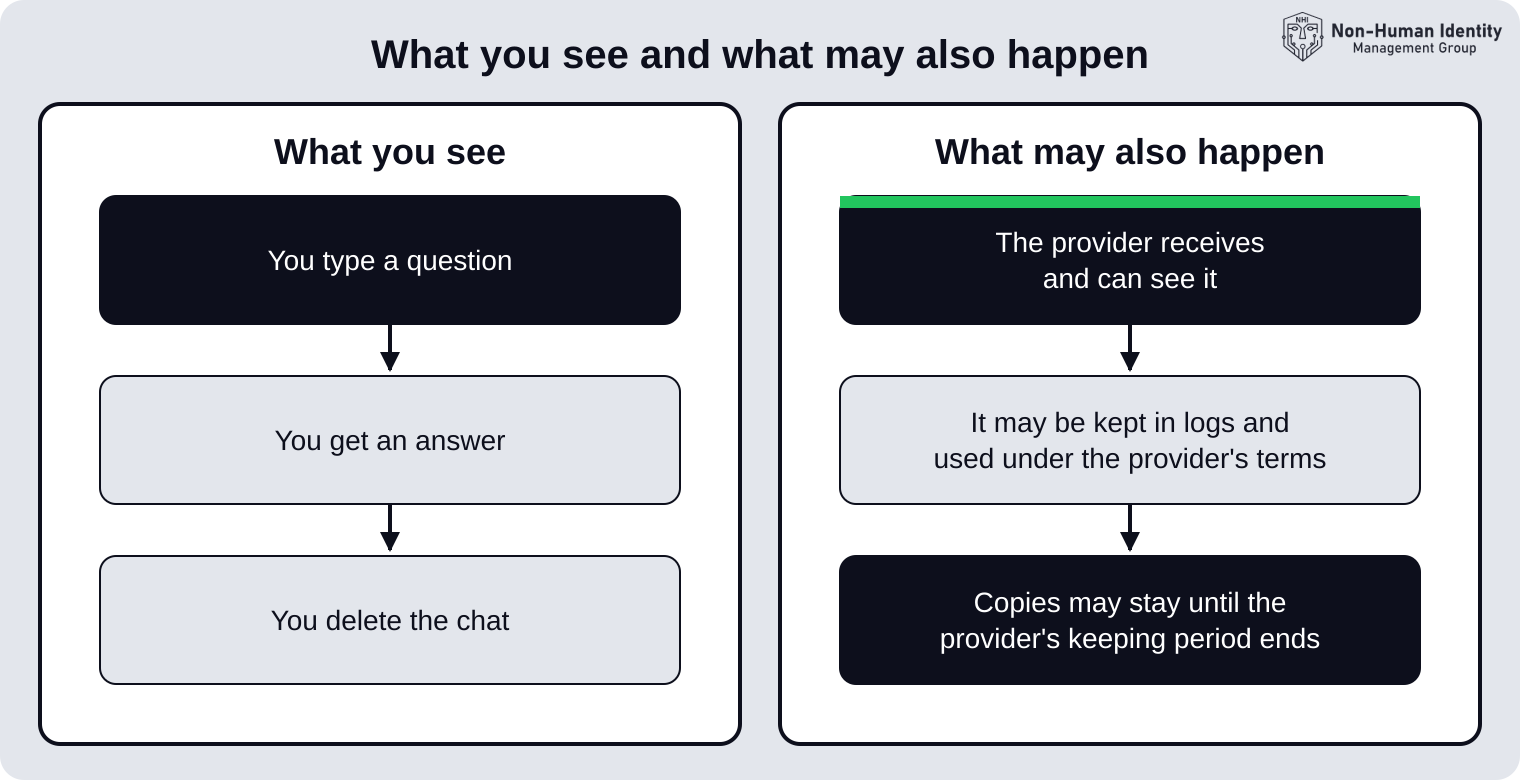
Where the comparison stops working: you can close a curtain again. Once a prompt is sent, you cannot pull it back, and copies may stay with the provider after you delete the chat.
Why does it matter?
The UK's national cyber security body warned that questions typed into public AI chatbots are visible to the provider. It said they will almost certainly be used to develop the service at some point.[2]
If you run a small business
What could happen: a member of staff pastes a customer list into a free chatbot. The data goes to a company you have no deal with.
Check this: pick one approved AI tool and tell staff to use only that one for work.
Next: Shadow AI for Beginners
If you handle customer or patient emails
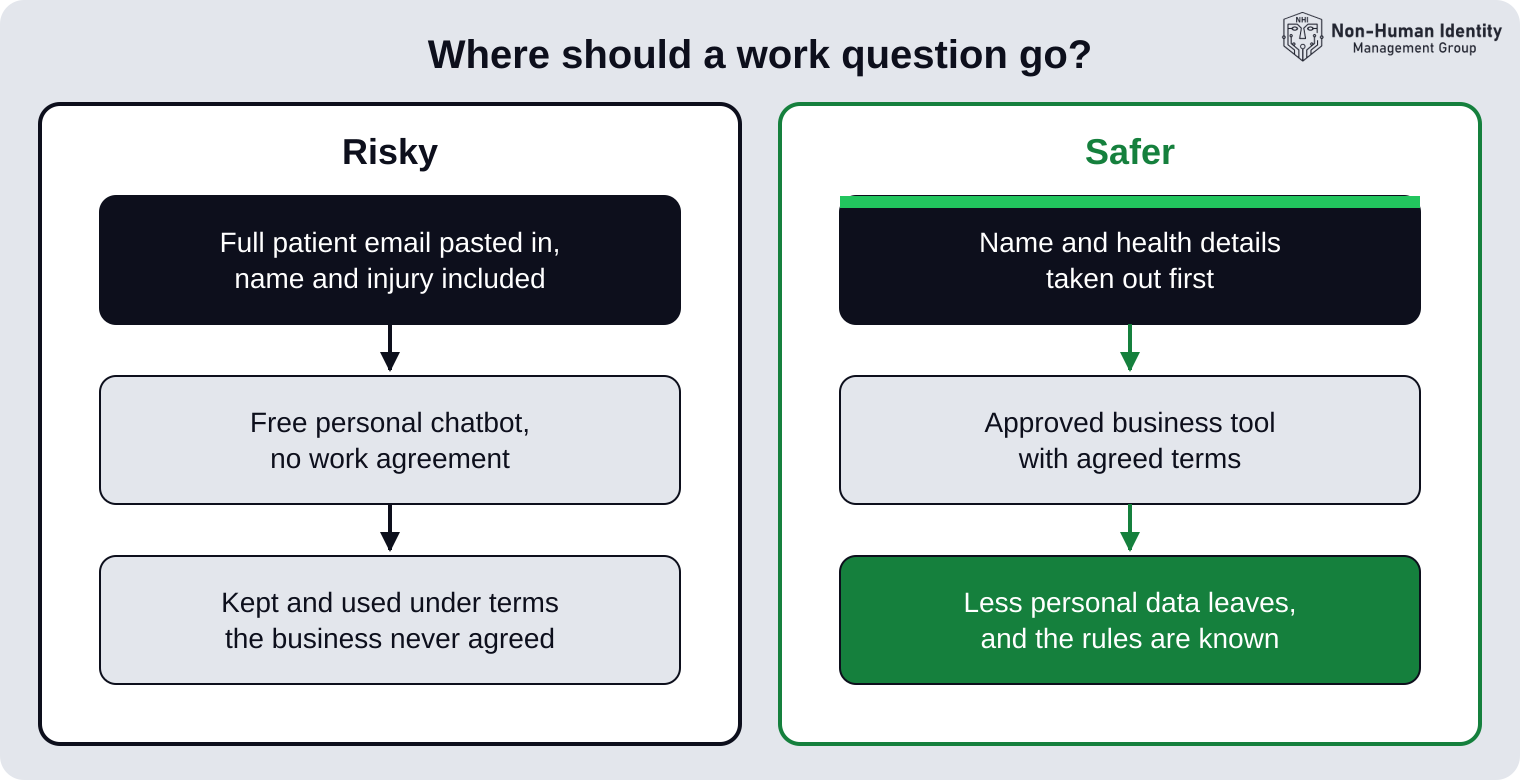
What could happen: you paste a whole email, with names and health details, to get help writing a reply.
Check this: take out names and personal details before you ask, then add them back yourself.
If you manage a team
What could happen: your organisation stays responsible for personal data, even when staff send it to an outside tool.
Check this: write a one-page AI rule that lists what must never be pasted in.
What does it look like?
Here is a made-up prompt a receptionist might type. Notes below show what is wrong.
Example only. All values are made up.
Tool: free chatbot, personal account                (1)
Prompt: Write a polite reply to this complaint:
"Dear clinic, I am EXAMPLE Person, born 01/01/1900,  (2)
of 0 Example Street. My knee injury is worse          (3)
because my appointment was moved twice..."
- A personal account, not a tool the business has approved.
- In a real message, this line would contain the patient's full name and date of birth.
- In a real message, this line would contain a home address and a health detail. The law treats health data as extra sensitive.
Why this is risky: the whole email now sits with an outside firm. The business has no deal with it about how the data is kept or used.
The safer way: use the approved tool. Ask without personal details, for example: "Write a polite apology for a moved appointment." Then add the name yourself.
How does it work?
This is the usual journey of a prompt. Details depend on the provider, the account type and the settings.
- You send it. You type a prompt, upload a file or connect the tool to your email or documents.
- The provider receives it. It travels to the provider's computers, usually encrypted on the way.
- The tool answers. The AI reads the prompt and writes a reply. Tools connected to your files may pull in more data than you typed.
- It is stored. The prompt and answer are usually kept as chat history and in system records, for a period the provider sets.
- It may be used again. Depending on the terms, stored chats may be checked by staff or used to improve the service. The NCSC notes a prompt does not, on its own, become something other users can ask the AI about.[2]
The systems around an AI tool can leak too. Security firm Wiz reported in January 2025 that a DeepSeek database was open with no login. It held over a million lines of records, including chat history and secret keys. Wiz said DeepSeek secured it promptly once told.[3]
Data protection law sets out a few plain rules that still apply to AI. Have a fair reason to use the data. Use it only for that purpose. Put in only what you need. Keep it no longer than needed, and keep it secure.[4]
A worked example
Daisy Olsen runs a small fictional physiotherapy clinic with ten staff. One busy Monday, a receptionist pastes a patient's complaint into a free chatbot on her own phone. The email includes the patient's date of birth and details of a knee injury.
Daisy sees the draft reply and thinks of curtains. Health details are some of the most private things a clinic holds. That curtain is now open to a firm the clinic has no deal with.
She stays calm and takes four steps. First, she asks which tool was used and exactly what was pasted, and writes it down.
Second, the receptionist deletes the chat. Daisy notes that this may not remove copies the provider keeps under its own rules.
Third, she reads the ICO's guidance and asks the clinic's data protection adviser whether the slip needs to be reported.
Fourth, she fixes the cause. The clinic signs up for a business AI service with agreed terms on storage and training. Daisy writes a one-page rule and shows staff how to take out names and health details before asking for help.
The next week, the same receptionist uses the approved tool. She asks for "a polite apology for a late appointment" and adds the name herself. This does not remove every risk, but far less personal data leaves the clinic.
Myths and mistakes
| What people think | What is true |
|---|---|
| Chatting with an AI is private, like talking to myself. | The provider receives your chats and usually stores them. Under its terms, its staff may be able to read them. |
| Deleting a chat removes it everywhere. | Copies may stay in records or backups until the provider's keeping period ends. |
| A popular tool must be fine for work. | Popularity says nothing about whether your organisation has an agreement covering personal data. |
| Privacy law does not cover AI yet. | Existing data protection law already applies to personal data in AI tools, and regulators have published guidance on it.[5] |
| Taking out the name makes it anonymous. | Other details, such as a rare condition and a town, can still point to one person. That is still personal data. |
What can I do this week?
- Ask which AI tools staff already use for work, including free personal accounts.
- Choose one approved tool with business terms on storage, staff access and training.
- Write a one-page rule listing what must never be pasted into AI tools.
- Show staff how to take out names and personal details before asking an AI for help.
Checklist
- We know which AI tools are used for work, and which are approved.
- We have read the approved tools' terms on storage, keeping periods and training.
- Staff know what personal or confidential data must not go into AI tools.
- Staff know how to take out names and details before using AI.
- AI tools connected to email or documents reach only what they need.
- Our privacy notice tells people if their data is used with AI tools.
- Staff know whom to tell if personal data goes into the wrong tool.
Common questions
Can AI providers see what I type?
Often, yes. The NCSC notes that questions typed into public AI chatbots are visible to the company that runs them. Who can read them depends on the provider's terms. Check its privacy notice before you share anything sensitive.
Will my chats be used to train the AI?
Sometimes. It turns on the provider, the type of account and your settings. A business account may follow different rules from a free personal one. Many services explain this in their privacy settings or business terms, so check before you share anything sensitive.
Is it ever fine to put personal data into an AI tool?
Yes, it can be. The organisation needs a fair reason and an approved tool with suitable terms. It should use only the data the task needs. That is the organisation's call, not each person's on a personal account.
What should never go into a public AI chatbot?
We suggest a simple rule. Leave out customer or patient details, passwords and keys, and private business plans. Leave out anything that would cause harm if made public. The NCSC also advises against putting sensitive information into public AI chatbots.
What should I do if I pasted something I should not have?
Tell your manager or data protection contact straight away, and say which tool you used and what you pasted. Delete the chat, but know that copies may remain. Your organisation can then decide whether the slip needs reporting.
Where next?
Ready for the detail? Read the practitioner guide: AI and Privacy Guide. It goes further into training data, lawful reasons for using AI, privacy risk assessments and people's rights over AI decisions.
Also useful:
- Data Privacy for Beginners
- Shadow AI for Beginners
- GDPR for Beginners
- AI Copilots at Work for Beginners
- AI Acceptable Use Policy Template
Related NHI Mgmt Group resources: Generative AI for Beginners · AI Governance for Beginners · Data Loss Prevention for Beginners
Key terms
- Personal data
- Information that can identify a person, directly or with other details, such as a name or location.
- Large language model
- An AI system trained on large amounts of text that writes replies by predicting likely words.
- Training data
- The data used to teach an AI model its patterns and behaviour.
- Data minimisation
- Using and keeping only the personal data needed for a clear purpose.
- Data retention
- Keeping records for a set period. Keeping them longer than needed adds risk.
- Special category data
- Extra-sensitive personal data, such as health details, that the law protects more strongly.
- Shadow AI
- AI tools used at work without the organisation knowing or approving them.
Sources and further reading
- What is personal data? Information Commissioner's Office (ICO). https://ico.org.uk/for-organisations/uk-gdpr-guidance-and-resources/personal-information-what-is-it/what-is-personal-data/what-is-personal-data/, accessed 28 Nov 2026.
- ChatGPT and large language models: what's the risk? National Cyber Security Centre (NCSC), 14 March 2023. https://www.ncsc.gov.uk/blog-post/chatgpt-and-large-language-models-whats-the-risk, accessed 28 Nov 2026.
- Wiz Research Uncovers Exposed DeepSeek Database Leaking Sensitive Information, Including Chat History. Wiz, 29 January 2025. https://www.wiz.io/blog/wiz-research-uncovers-exposed-deepseek-database-leak, accessed 28 Nov 2026.
- A guide to the data protection principles. Information Commissioner's Office (ICO). https://ico.org.uk/for-organisations/uk-gdpr-guidance-and-resources/data-protection-principles/a-guide-to-the-data-protection-principles/, accessed 28 Nov 2026.
- Guidance on AI and data protection. Information Commissioner's Office (ICO), updated 15 March 2023, under review following the Data (Use and Access) Act. https://ico.org.uk/for-organisations/uk-gdpr-guidance-and-resources/artificial-intelligence/guidance-on-ai-and-data-protection/, accessed 28 Nov 2026.