AI in third-party risk management means using AI tools to help check whether suppliers are safe to work with.
This guide is for people new to supplier checks, career changers and managers who keep hearing that AI will speed up vendor reviews. You do not need to know how AI works: if your team buys software or services, AI may already be reading the paperwork your suppliers send.
In short
- AI tools can read supplier documents, fill in first drafts of reviews and point out gaps much faster than a person.
- AI can be confidently wrong, so a trained person still checks the findings and makes the decision.
- Supplier documents are often confidential, so only load them into AI tools your organisation has approved.
- Your organisation stays responsible for its suppliers, whatever tool does the reading.
What you will learn
- Explain what AI does in supplier checks, in plain words.
- Spot the tasks where AI helps and where a person must decide.
- Check an AI finding against the original document.
- Ask the right questions before using an AI tool on supplier paperwork.
- Supplier checks (third-party risk management)
- the work of finding and managing the risks that come from suppliers and partners.
- Confident mistakes (AI hallucination)
- when an AI tool gives an answer that sounds sure but is wrong or made up.
What is AI in third-party risk management?
Think of a sniffer dog at an airport. It checks every bag quickly and points to the ones worth opening. But it is the officer who opens the bag and decides what happens next.
AI in supplier checks works in a similar way. A third party is any outside firm you work with, such as a cloud service, a payroll provider or a cleaning company with building access. Before and during the relationship, teams check these firms. They send questionnaires (lists of security questions), read audit reports and track any problems.
That reading takes a long time. AI tools, often built on a large language model (AI software that reads and writes text), can now do a first pass. Some products on the market read supplier documents and match them to a list of security checks. They then give a pass, fail or confidence score for each check.[4]
Where the comparison stops working: a trained sniffer dog is tested for one job. An AI tool can also invent things that are not in the bag at all, and say so with confidence.
Why does it matter?
Many organisations have hundreds of suppliers and too few people to check them all. UK guidance notes that many companies lose sight of their supply chains.[6] AI can help a small team keep up. But it also brings new ways to get things wrong.
US banking regulators say that using a third party does not reduce a bank's own responsibility to operate safely and follow the law.[1] In the same way, using an AI tool to review a supplier does not hand over the responsibility for the decision.
If you are new to supplier review work
What could happen: you copy an AI summary into a review, and it says a supplier has a control that the report does not mention.
Check this: for every key finding, open the source page and read it yourself.
If you manage a risk or buying team
What could happen: faster reviews look like success, but nobody can explain why a risky supplier was approved.
Check this: make sure a named person signs off each supplier decision, not the tool.
If you are a supplier answering questionnaires
What could happen: your customer's AI tool reads your documents and flags gaps you have already fixed.
Check this: keep your evidence current and clearly dated, and point reviewers to the right page.
What does it look like?
Here is a made-up first-pass summary from an AI review tool, with a reviewer's notes. Real tools look different, but the pattern is similar.
Example only. All values are made up.
AI review draft - supplier: EXAMPLE CLOUD LTD
Documents read: questionnaire.pdf, audit-report-FAKE.pdf
Second check at login for staff   PASS  confidence high   (1)
Backups tested yearly             PASS  confidence medium (2)
Encryption of stored data         PASS  source: none      (3)
Uses other suppliers for hosting  not found               (4)
Overall: low risk                                         (5)
- Easy to check: the reviewer opens the page the tool points to and confirms it.
- "Medium" is a prompt to read the original wording closely.
- A pass with no source is a warning sign. It needs a page reference before anyone relies on it.
- "Not found" does not mean "not true". The supplier may simply not have said, so the reviewer asks.
- The overall rating is a draft. A person decides the risk level and signs it off.
Why this is risky: the summary looks tidy and certain. A busy reviewer could accept it as it stands, including the pass that has no evidence behind it.
The safer way: treat the AI output as a to-do list. Check every finding that affects the decision against the source, follow up gaps with the supplier and record who made the final call.
How does it work?
Supplier checks usually follow a life cycle. You plan, check the supplier before you sign, agree the contract, keep an eye on them and end the relationship.[1] AI can help at several points.
- Sorting suppliers. AI can help group suppliers by how much data or access they have, so the riskiest get the closest look.
- Reading the paperwork. AI reads questionnaires and audit reports and drafts a summary against your list of checks.[4]
- Spotting gaps. It flags missing answers, or answers that do not match the evidence, as questions for the supplier.
- A person checks. A trained reviewer confirms key findings against the source and decides the risk level. Guidance on AI risks says people should check AI output, especially for important decisions.[3]
- Keeping watch. After signing, AI can help track news, renewals and changes, and alert the team to anything worth a closer look.
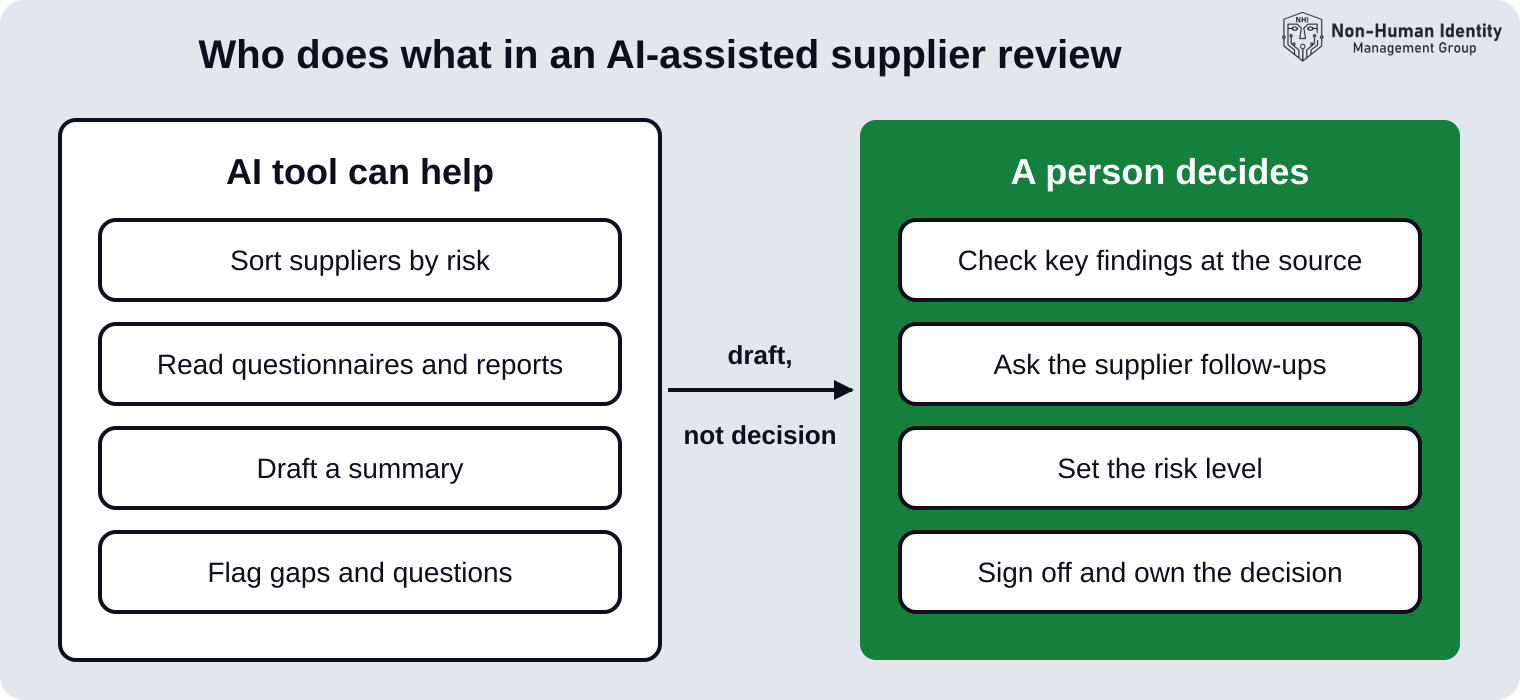
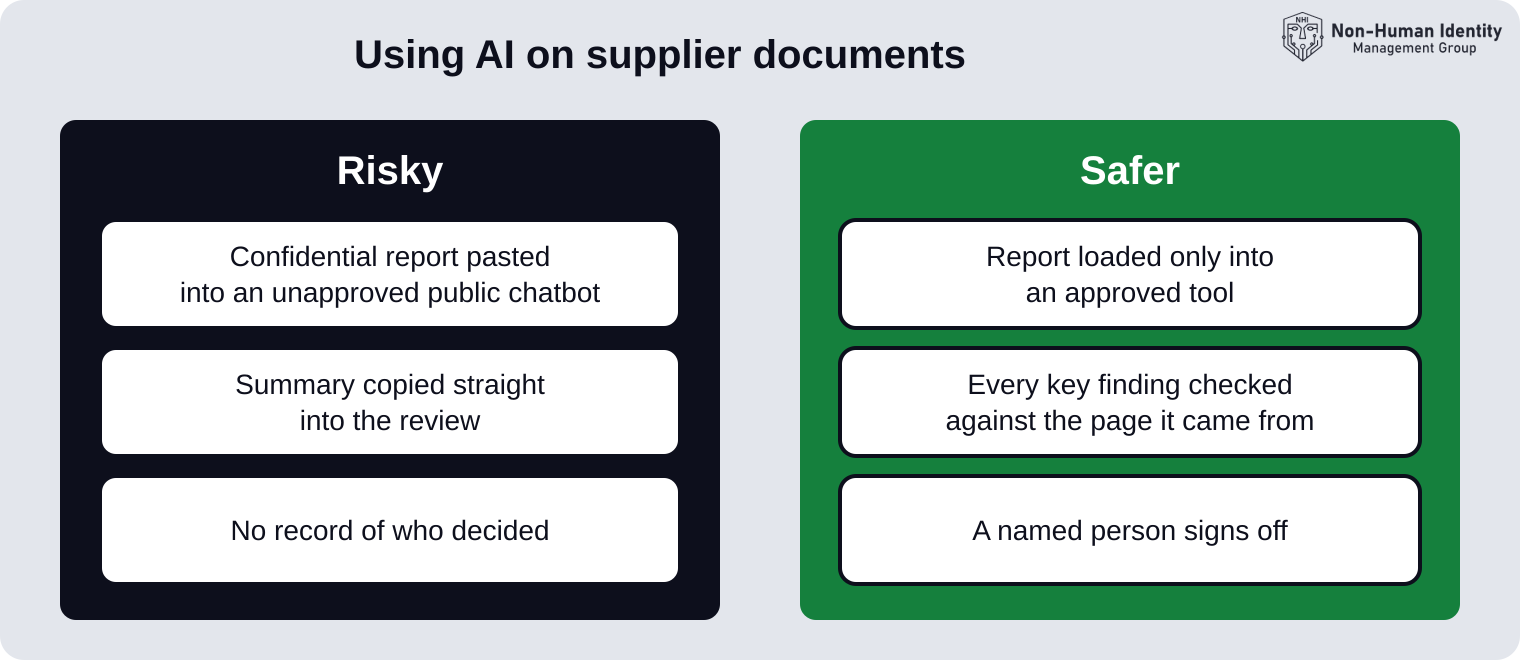
Two risks need special care. First, AI tools can produce confident but false content, which a US standards body calls confabulation.[2] Second, supplier reports are often confidential. Putting sensitive data into an AI tool can expose it, so users need to know what is safe to share.[5] One vendor's own review of four such tools found that each one left the job of catching mistakes to the human reviewer.[4]
A worked example
Birch Studio is a fictional design firm with sixty staff. Sana Haddad has just moved from the finance team into a new role checking suppliers. Her manager is Wren Abara.
The firm wants a new file-sharing service. The supplier sends a long questionnaire and an audit report. Birch Studio has an approved AI review tool, so Sana loads both documents into it.
Soon she has a draft. Most lines say pass. The overall rating is low risk. It is tempting to send it straight to Wren.
Sana remembers the sniffer dog. The tool points; she opens the bag. She checks each finding that matters most for a file-sharing service.
Two lines do not hold up. The tool marked encryption as a pass, but she cannot find a page that says so. And it says nothing about whether the supplier uses another firm to host the files.
Sana writes two questions to the supplier. The answers come back two days later. Files are encrypted, and the service runs on a large cloud provider. She adds both facts, with page references, to the review.
Wren reads the review, asks one question about backups and signs it off. The record shows what the tool drafted, what Sana checked and who made the decision.
Later, Wren notices a colleague pasting a supplier report into a free public chatbot. She reminds the team to use only the approved tool for confidential documents.
Myths and mistakes
| What people think | What is true |
|---|---|
| AI can approve suppliers on its own. | AI drafts and flags. Your organisation stays responsible, so a person decides.[1] |
| If the AI says pass, the control exists. | AI can be confidently wrong. Check key findings against the page they came from.[3] |
| "Not found" means the supplier does not do it. | It may just be missing from the documents. Ask the supplier. |
| Any AI chatbot is fine for summarising a supplier report. | Reports can be confidential. Use only tools your organisation has approved.[5] |
| AI will replace supplier review jobs. | It changes the work. Reviewers spend less time reading and more time checking, asking and deciding. |
What can I do this week?
- Find out which AI tools your organisation has approved for confidential documents.
- Pick one recent AI-assisted review and check three key findings against the source.
- Add a "checked by" and "decided by" line to your review template.
- List the questions AI marked "not found" and send them to the supplier.
Checklist
- Only approved AI tools are used for supplier documents.
- Every key AI finding links to the page it came from.
- A trained person checks key findings before the review is finished.
- Gaps and "not found" items become questions for the supplier.
- A named person signs off each supplier decision.
- The review record shows what the AI drafted and what a person changed.
- Staff know AI tools can give confident but wrong answers.
Common questions
Is it safe to paste a supplier's audit report into a public AI chatbot?
Only if your organisation has approved that tool for confidential documents. Audit reports are often shared under a confidentiality agreement. Free public tools may keep or reuse what you paste in, depending on their terms. Check your organisation's AI rules first, and ask if you are unsure.
Will AI replace third-party risk analysts?
It is more likely to change the job than remove it. AI can take on much of the first reading and drafting. People are still needed to check findings, talk to suppliers, judge the risk and own the decision. Those skills become more valuable, not less.
How do I check whether an AI finding is right?
Go to the source. Ask the tool which page or section supports the finding, then read it yourself. If there is no source, treat the finding as unproven. For the most important checks, read the original wording even when the tool gives a source.
What is the difference between this and third-party AI risk?
This page is about using AI to check suppliers. Third-party AI risk is about the risk when a supplier's own product uses AI, such as a chatbot you buy. The two can meet, because your AI review tool is itself a supplier you should check.
Can AI help with ongoing supplier monitoring?
Yes, it can help watch news, renewals and changes to a supplier's documents, and alert the team. Guidance for banks says monitoring should match the risk of each relationship.[1] Alerts still need a person to judge whether they matter.
Where next?
Ready for the detail? Read the practitioner guide: Third-Party Risk Management Guide. It goes further into supplier tiering, due diligence evidence, contract clauses and continuous monitoring.
Also useful:
- Third Party Risk Management for Beginners
- Third-Party AI Risk Guide
- How to Read a SOC 2 Report Guide
- Buying AI Tools Safely for Beginners
- Shadow AI for Beginners
Related NHI Mgmt Group resources: AI Vendor Security Questionnaire Template · Fourth-Party and Nth-Party Risk Guide · AI Hallucinations for Beginners
Key terms
- Third-party risk management
- Finding and managing the risks that come from suppliers and partners.
- Vendor due diligence
- Checking a supplier's security and reliability before and during the relationship.
- Security questionnaire
- A list of security questions sent to a supplier to answer.
- Large language model
- AI software trained on large amounts of text that predicts and writes words.
- AI hallucination
- An AI answer that sounds sure but is wrong or made up.
- Automation bias
- Trusting a computer's answer too much, even when there are signs it is wrong.
- Continuous monitoring
- Keeping watch on a supplier after the contract starts, not just checking once.
Sources and further reading
- Interagency Guidance on Third-Party Relationships: Risk Management. Board of Governors of the Federal Reserve System, FDIC and OCC, Federal Register, 9 June 2023. https://www.govinfo.gov/content/pkg/FR-2023-06-09/html/2023-12340.htm, accessed 28 Nov 2026.
- NIST AI 600-1, Artificial Intelligence Risk Management Framework: Generative Artificial Intelligence Profile. National Institute of Standards and Technology, July 2024. https://nvlpubs.nist.gov/nistpubs/ai/NIST.AI.600-1.pdf, accessed 28 Nov 2026.
- LLM09:2025 Misinformation. OWASP Top 10 for LLM Applications, OWASP Foundation. https://genai.owasp.org/llmrisk/llm092025-misinformation/, accessed 28 Nov 2026.
- We Researched Four AI Evidence Analysis Tools for TPRM. Here's What We Found. UpGuard (a vendor of a competing product), updated 29 September 2026. https://www.upguard.com/blog/ai-evidence-analysis-tools-for-tprm, accessed 28 Nov 2026.
- LLM02:2025 Sensitive Information Disclosure. OWASP Top 10 for LLM Applications, OWASP Foundation. https://genai.owasp.org/llmrisk/llm022025-sensitive-information-disclosure/, accessed 28 Nov 2026.
- Supply chain security guidance. National Cyber Security Centre. https://www.ncsc.gov.uk/collection/supply-chain-security, accessed 28 Nov 2026.