Vulnerability disclosure is the process by which someone who finds a security flaw reports it privately to the organisation responsible so it can be fixed, and a bug bounty is a programme that rewards people, often with money, for reporting such flaws under agreed rules.
This guide is for newcomers, students, career changers and managers who are not security specialists. It explains in plain English how reporting a security flaw should work, the difference between a vulnerability disclosure policy and a bug bounty, what a good report and a good response look like, and simple steps any organisation can take so that people who find problems know how to tell them. It covers authorised, good-faith reporting only. It is not legal advice, and it does not describe how to test systems.
By the end of this guide you will be able to:
- Explain what vulnerability disclosure and bug bounties are.
- Describe the steps from finding a flaw to public disclosure.
- Understand the difference between a disclosure policy and a bug bounty programme.
- Identify simple first steps to make your organisation easy to report to.
Key takeaways
- People will find flaws in your systems. Customers, students and professional researchers regularly spot security problems; what matters is whether they can tell you safely.
- A disclosure policy comes first. A clear, public way to report problems, with rules on scope and what to expect, is the foundation. A paid bug bounty is an optional extra on top.
- Coordinated disclosure balances speed and safety. The finder reports privately, the organisation fixes the flaw and details are published once users can protect themselves.
- Rules protect both sides. Researchers stay within scope and avoid harming data; organisations respond promptly, keep the finder updated and do not threaten good-faith reporters.
- A small file helps a lot. A security.txt file on your website tells researchers where to send reports.
What it is, in plain English
A vulnerability is a flaw or weakness in software, a website or a device that someone could abuse. Sometimes the person who notices it is not an attacker but a curious customer, a student or a professional security researcher. Vulnerability disclosure is the agreed way for that person to tell the organisation, and for the organisation to fix the problem and tell its users.
The international standard ISO/IEC 29147:2018 gives vendors requirements and recommendations for receiving vulnerability reports and publishing information about fixes; the related standard ISO/IEC 30111:2019 covers the work of handling and fixing reported flaws in between.[3][4]
Two things often get mixed up:
- Vulnerability disclosure policy (VDP): a public page that explains how to report a flaw, what is in and out of scope and what the finder can expect. The UK National Cyber Security Centre (NCSC) lists a clear policy, an easy-to-find contact route and a security.txt file as the three parts of its vulnerability disclosure toolkit.[2]
- Bug bounty programme: a programme that adds rewards, usually money, for valid reports that meet its rules. OWASP, the open web application security community, advises organisations to run a bug bounty only once they have a mature disclosure process and the resources to handle reports.[5]
A helpful comparison is a lost property office with a reward notice. Every shop should have a clear place to hand in something you have found (the disclosure policy). Some also put up a reward notice for certain items (the bug bounty). Where the analogy breaks down: a security flaw is not handed over and finished with. It has to be checked, fixed and often announced, and the finder usually stays in contact throughout.
Why it matters to you
- If you run a small business: without a clear contact route, someone who spots a problem on your website may give up or post about it publicly. A simple policy and contact point costs little and gives you a chance to fix it first.
- If you are new to a security job: you may be asked to read incoming reports, check whether they are real and pass them to the right team. Knowing the process makes that much easier.
- If you are a manager: how your organisation responds to a researcher shapes its reputation. The NCSC advises responding promptly, thanking the finder and not requiring them to sign documents such as non-disclosure agreements.[2]
Disclosure also matters beyond one organisation. When several vendors share a flaw, coordination matters most, as ISO/IEC 29147 notes.[3] In the United States, the Cybersecurity and Infrastructure Security Agency (CISA) runs a coordinated vulnerability disclosure programme that sits between reporters and vendors, aiming for the vendor, the reporter and CISA to publish at the same time.[6]
How it works, step by step
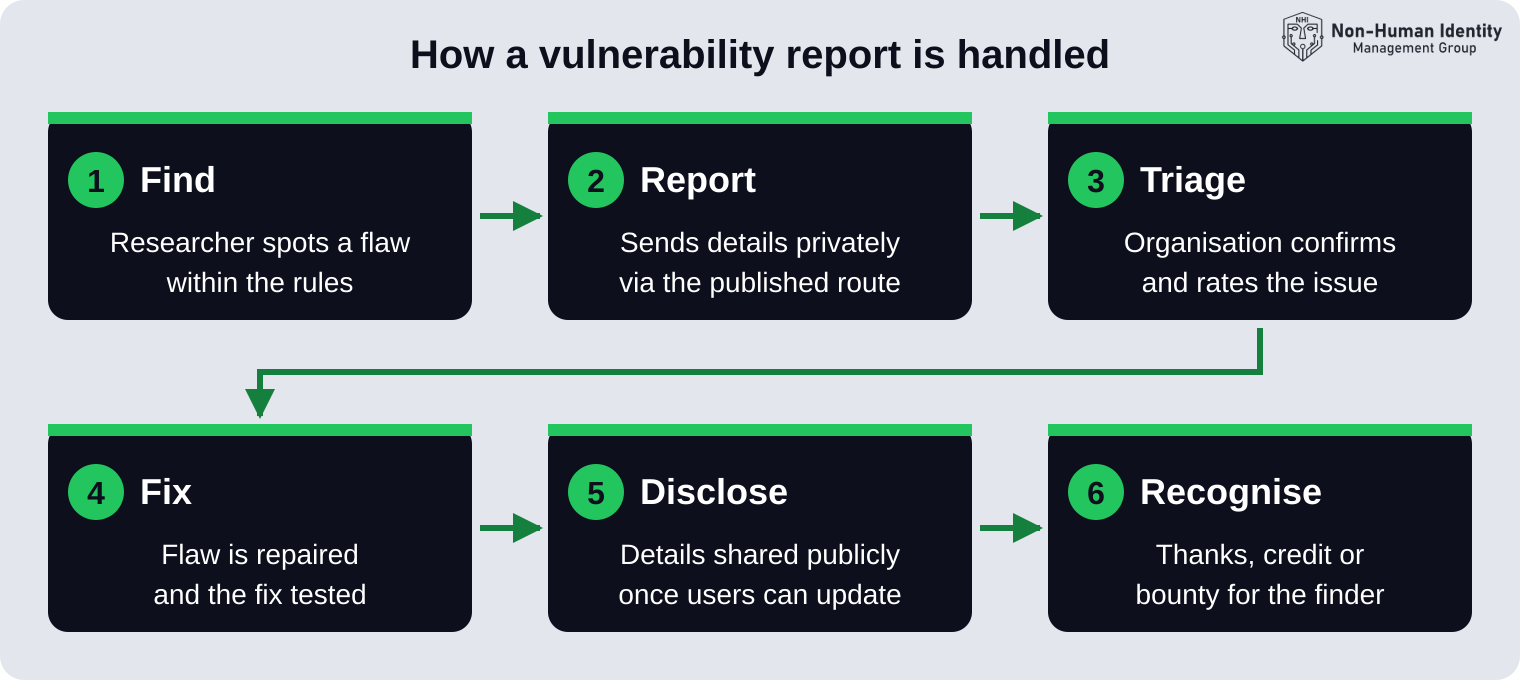
Programmes differ, but a good disclosure follows a similar path.
- Find, within the rules. A researcher notices a flaw, either by chance or while testing systems that a programme's rules allow. OWASP advises researchers to make sure their testing is legal and authorised, to stay within scope and to respect other people's privacy.[5]
- Report privately. The researcher uses the organisation's published route, such as a web form or bug bounty platform, and gives enough detail for the issue to be checked, with personal data removed.[5]
- Triage. The organisation acknowledges the report, confirms whether the flaw is real and decides how serious it is. The NCSC suggests passing the report to whoever is responsible for the affected service, including any outside provider.[2]
- Fix. The flaw is repaired and the fix tested. If this takes time, the organisation sends the finder periodic updates and tells them when it is resolved, so they may be able to check the fix.[2]
- Disclose. Once users can protect themselves, details are published, often as a security advisory. Publicly known flaws are commonly given a CVE identifier so that everyone refers to the same issue; OWASP suggests organisations request CVE IDs where appropriate.[5]
- Recognise. The finder is thanked and, if they wish, credited publicly. In a bug bounty, a valid report that meets the rules also earns a reward.
The table compares the common ways of publishing a flaw, as OWASP describes them.[5]
| Model | What happens | Main risk |
|---|---|---|
| Private disclosure | The researcher reports privately and the organisation decides whether to publish | An unwilling or unresponsive organisation may never tell its users |
| Coordinated (often called responsible) disclosure | Private report first; details published after a fix is available, often to an agreed deadline | Deadlines can be missed, causing friction |
| Full disclosure | Details are published straight away, before a fix | Attackers learn about the flaw at the same time as defenders; OWASP treats it as a last resort |
The next table compares a disclosure policy with a bug bounty.
| Feature | Vulnerability disclosure policy | Bug bounty programme |
|---|---|---|
| Purpose | Give anyone a safe way to report a flaw | Encourage more testing by offering rewards |
| Rewards | Usually thanks or public credit | Usually money, set by severity and programme rules |
| Who can take part | Anyone who finds a problem | Often anyone, sometimes invited researchers only |
| Effort for the organisation | Low to moderate | Higher: triage capacity, budget and clear rules |
| Best for | Every organisation with an online presence | Organisations with a mature disclosure process |
Useful distinctions
- A bug bounty is not a penetration test. A penetration test is a contracted, time-boxed assessment by a chosen team. A bug bounty is open-ended and pays per valid finding. See Bug Bounty vs Penetration Testing.
- Safe harbour is a promise, not a law. Many policies say the organisation will not take legal action against good-faith research that follows the rules. OWASP recommends organisations take legal advice on such provisions.[5] Laws on computer access differ between countries, so researchers should read each programme's rules carefully.
- Asking for payment outside a programme is a red line. OWASP warns researchers not to demand payment before revealing details or outside a bug bounty, as demanding payment for silence may amount to extortion.[5]
- security.txt is a standard file. RFC 9116 (an Informational RFC, April 2022) places it at /.well-known/security.txt on a website; the Contact and Expires fields are required.[1] The NCSC suggests an expiry date less than a year ahead.[2]
- Deadlines vary. OWASP cites Google Project Zero's policy as an example of a coordinated deadline: about 90 days for a fix, then technical details 30 days after the patch.[5] CISA may publish as early as 45 days after first contact if a vendor is unresponsive or will not commit to a reasonable fix timeframe.[6]
A worked example
Brightwell Books is a fictional online bookshop with 25 staff. Its IT lead, Grace, publishes a short vulnerability disclosure policy and a security.txt file that points to a secure web form.
A few months later, a university student, Kofi, notices while using his own account that the order confirmation page shows a different customer's name when he refreshes it quickly. He stops, does not try to see more data, and checks the bookshop's website for a way to report it.
- Report: Kofi finds the security.txt file, follows the link to the form and describes what he saw, when and in which browser, without including the other customer's details.
- Acknowledge: Grace replies the next working day, thanks him and says the web developer is looking into it.
- Triage and fix: the developer confirms a caching fault that sometimes showed one customer's order page to another. They fix it within a week and Grace tells Kofi, who confirms he can no longer see the problem.
- Follow-up: Brightwell checks its logs to see whether other customers were affected and takes advice on whether anyone needs to be told.
- Recognise: with Kofi's permission, Brightwell thanks him by name on its security page. It does not run a paid bug bounty, and its policy said so clearly.
The process did not make Brightwell's website flawless, but it turned a chance discovery into a quick fix, without public embarrassment for the shop or legal worry for the student.
Myths and misunderstandings
| What people think | What is true |
|---|---|
| Anyone reporting a flaw is an attacker. | Many reports come from customers and researchers acting in good faith. The NCSC advises that a report is not necessarily an attack.[2] |
| Every company needs a paid bug bounty. | A disclosure policy is the starting point. OWASP advises running a bounty only with a mature process and the resources to triage reports.[5] |
| A bug bounty means anyone may test anything. | Programmes set scope and rules. Testing outside them can break the rules and, depending on the country, the law. |
| Researchers should publish straight away to force a fix. | Publishing before a fix exposes users. Coordinated disclosure gives the organisation time while still setting a deadline.[5] |
| Asking finders to sign an NDA protects the company. | The NCSC advises against requiring finders to sign documents such as non-disclosure agreements.[2] |
Key terms
- Vulnerability
- A flaw or weakness in code, logic, settings or system design that can be abused. By itself it indicates risk, not compromise.
- Vulnerability disclosure policy
- The public process for receiving security reports from anyone who finds a problem, setting expectations for safe reporting and response.
- Bug bounty
- A controlled programme that invites security researchers to report vulnerabilities in exchange for a reward.
- Coordinated vulnerability disclosure
- A process in which researchers notify a vendor privately and allow time for a fix before details are made public.
- Full disclosure
- Publishing vulnerability details before a fix is available, which gives attackers the same information as defenders.
- Security.txt
- A standardised file that tells outside researchers how to contact an organisation about security issues.
- Safe harbour
- An organisation's assurance that good-faith research within defined rules will not lead to legal action from that organisation.
- Scope
- The boundary of what an activity covers; in a programme, the systems and issue types researchers may test and report.
- Triage
- Quickly sorting reports by urgency and likely impact, and confirming whether they are real, so teams act on what matters first.
- CVE
- Common Vulnerabilities and Exposures: a standard identifier for a publicly known vulnerability. It does not measure severity on its own.
Common questions
What is a bug bounty?
A programme where an organisation rewards people, usually with money, for reporting security flaws that meet its rules and scope.
What is the difference between a bug bounty and a vulnerability disclosure policy?
A disclosure policy gives anyone a safe way to report a flaw, usually without payment. A bug bounty adds rewards and normally has stricter rules and a bigger budget.
Do small organisations need a bug bounty?
Usually not at first. We suggest starting with a short disclosure policy, a contact form and a security.txt file, and considering a bounty only once you can handle reports quickly.
I found a flaw on a website by accident. What should I do?
Stop, do not look further or access other people's data, and look for the organisation's disclosure policy or security.txt file. Report what you saw privately and clearly, without demanding anything in return.[5]
How long does an organisation have to fix a reported flaw?
There is no single rule. Programmes set their own timelines, and coordinators such as CISA weigh factors like whether the flaw is already public and how quickly a fix can be applied.[6]
Is bug bounty hunting a real career?
Some people do it full time and many more part time. It needs strong technical skills and a careful approach to rules. See the Bug Bounty Hunter Career guide.
First steps
Three things you can do this week:
- Choose a contact route. Set up a secure web form or dedicated reporting route that reaches someone who checks it regularly.
- Write a one-page policy. Say how to report, what information to include, what is in and out of scope, what finders can expect and that you will not take action against good-faith reports that follow the rules (with legal advice on the wording).
- Publish a security.txt file at /.well-known/security.txt on your main website, with a Contact line, a link to your policy and an Expires date less than a year ahead.[1][2]
Checklist
- We have a published vulnerability disclosure policy that is easy to find.
- Reports reach a named person or team who checks them regularly.
- Our main websites have a current security.txt file with a future expiry date.
- We acknowledge reports promptly and thank the finder.
- We know who owns each service, including those run by suppliers, so reports reach the right people.
- We keep finders updated and tell them when the issue is fixed.
- We do not require finders to sign non-disclosure agreements.
- We only consider a paid bug bounty once our disclosure process runs smoothly.
Simple measures that show progress: time to acknowledge a report, time to fix confirmed issues, the share of reports that turn out to be valid, and whether security.txt is in date on every main website.
Check your understanding
1. What is the difference between a vulnerability disclosure policy and a bug bounty?
Answer: a policy gives anyone a safe way to report flaws; a bug bounty adds rewards, usually money, under stricter rules.
2. Why is coordinated disclosure usually preferred to full disclosure?
Answer: it gives the organisation time to fix the flaw before details are public, so attackers do not learn about it before users can protect themselves.
3. Where does a security.txt file go, and which two fields must it contain?
Answer: at /.well-known/security.txt on the website, with the Contact and Expires fields.
4. What should you do if you find a flaw by accident?
Answer: stop, avoid accessing more data, and report it privately through the organisation's published route without demanding payment.
Suggested learning pathway
- Start with the wider testing picture in Penetration Testing for Beginners.
- Learn how reported flaws get named and scored in CVE and CVSS for Beginners.
- See what happens to flaws after they are fixed in Vulnerability Management for Beginners.
- Understand flaws found before a fix exists in Zero Day Vulnerabilities for Beginners.
- For the full practitioner view, see the Bug Bounty and Vulnerability Disclosure Guide.
- For the international standards in depth, see the ISO/IEC 29147 and 30111 Vulnerability Disclosure and Handling Guide.
- To write your own policy, use the Vulnerability Disclosure Policy Template.
Standards and references
- RFC 9116, A File Format to Aid in Security Vulnerability Disclosure. E. Foudil and Y. Shafranovich, IETF (Informational), April 2022. https://www.rfc-editor.org/rfc/rfc9116.
- Vulnerability Disclosure Toolkit. National Cyber Security Centre (NCSC). https://www.ncsc.gov.uk/information/vulnerability-disclosure-toolkit, accessed 27 Nov 2026.
- ISO/IEC 29147:2018, Information technology, Security techniques, Vulnerability disclosure. International Organization for Standardization (ISO) and IEC, October 2018. https://www.iso.org/standard/72311.html, accessed 27 Nov 2026.
- ISO/IEC 30111:2019, Information technology, Security techniques, Vulnerability handling processes. ISO and IEC, October 2019. https://www.iso.org/standard/69725.html, accessed 27 Nov 2026.
- Vulnerability Disclosure Cheat Sheet. OWASP Cheat Sheet Series, OWASP Foundation. https://cheatsheetseries.owasp.org/cheatsheets/Vulnerability_Disclosure_Cheat_Sheet.html, accessed 27 Nov 2026.
- Coordinated Vulnerability Disclosure Process. Cybersecurity and Infrastructure Security Agency (CISA). https://www.cisa.gov/coordinated-vulnerability-disclosure-process, accessed 27 Nov 2026.
Related NHI Mgmt Group resources: Bug Bounty Triage Operations Guide · Vulnerability Disclosure Maturity Model · AI Bug Bounty Programmes Guide