Buying a penetration test means hiring skilled testers to attack your own systems, with permission, for an agreed time.
This guide is for small business owners, managers and anyone asked to "get a pen test done". You do not need a technical background. If a customer, insurer or auditor wants proof of testing, you will be the one choosing and paying the provider.
In short
- You are mostly buying skilled people's time, usually priced in tester days.
- Write down why you want the test and what is in and out before you ask for quotes.
- Compare quotes on days, named testers, a sample report and whether a retest is included, not on price alone.
- Check any accreditation claim on the scheme's own list, and sign written permission before testing starts.
What you will learn
- Explain what you are paying for in a penetration test.
- Spot the gaps when two quotes look alike.
- Check a provider's accreditation for yourself.
- Ask the right questions before you sign.
- What is being tested (scope)
- the list of systems, addresses and dates that are in, and out, of the test.
- Testing time (tester days)
- the number of working days the testers will spend, which drives most of the price.
- Check after fixing (retest)
- a second, shorter test to confirm that the problems found have really been fixed.
What is buying a penetration test?
Think of getting quotes from builders for a house extension. The cheapest quote may leave out the windows. You compare what each builder will actually do, check they are registered, and look at work they have done before.
Buying a penetration test works the same way. A penetration test, or pen test, is a hired, allowed attack on your own systems to find weak spots. What you buy is a team's skill and time, a written report, and often a check that your fixes worked.
The UK's national cyber security agency says the quality of a test depends heavily on the skill of the people doing it.[1] So the people matter more than the logo on the proposal.
Where the comparison stops working: you can see a finished extension. A pen test report can look impressive and still miss things. You judge it by how clear, honest and repeatable it is.
Why does it matter?
A poorly bought test can cost real money and still leave you unsure whether you are safe. A well-bought one gives you a clear list of problems and what to fix first.
If you run a small business
What could happen: you pick the cheapest quote and get a report that is mostly automatic scan output.
Check this: ask how many of the days are hands-on testing by a person.
If a customer or insurer asked for a test
What could happen: the test covers the wrong systems, so it does not answer their question.
Check this: ask them in writing what the test must cover and which report they need.
If you are a manager in the public sector
What could happen: you hire a provider your organisation's rules do not accept.
Check this: ask whether you need a provider from the UK government's CHECK scheme.
What does it look like?
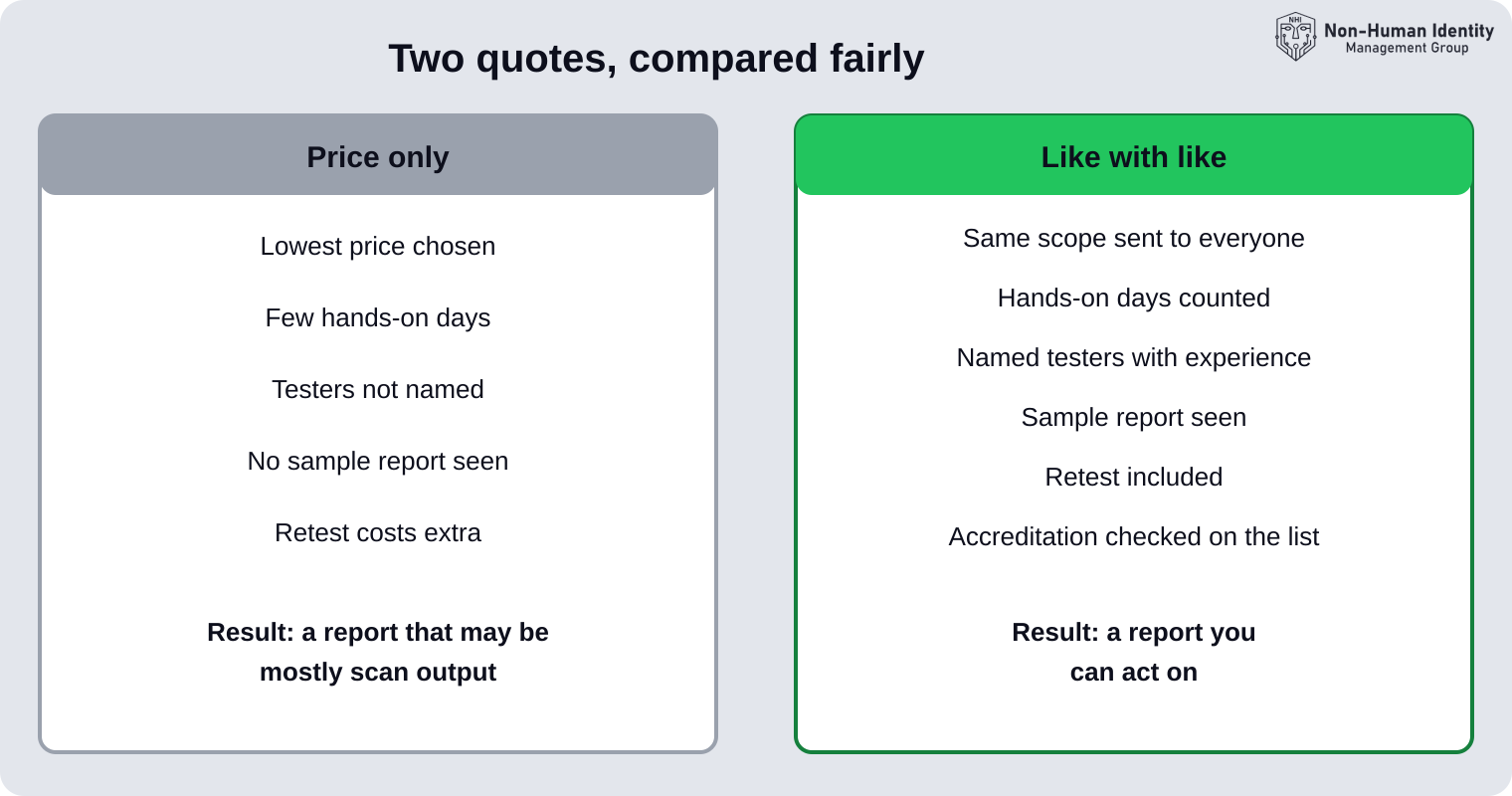
Here are two made-up quotes for the same small online shop. At first glance, B looks like a bargain.
Example only. All values are made up.
                       Quote A               Quote B
Price                  FAKE 0000 (higher)    FAKE 000 (lower)       (1)
Tester days            5 (4 hands-on)        2 (mostly scanning)    (2)
Named testers          Yes, CVs attached     "Our expert team"      (3)
Sample report          Yes, redacted         No                     (4)
Retest included        Yes, within 3 months  Extra charge           (5)
Accreditation          Listed on scheme site "Accredited" (no link) (6)
- Price on its own tells you little. Look at what each price buys.
- Fewer days often means more automatic scanning and less hands-on testing.
- You want to know who will actually test, not just who wrote the bid.
- A sample report shows what you will get. Ask for one with private details removed.
- Without a retest, you pay again to prove your fixes worked.
- In a real file, this line would name the scheme. Check the listing on the scheme's own website.
Why this is risky: if you compare on price alone, you may buy a scan dressed up as a test.
The safer way: send every provider the same written scope. Then compare like with like: days, people, report and retest.
How does it work?
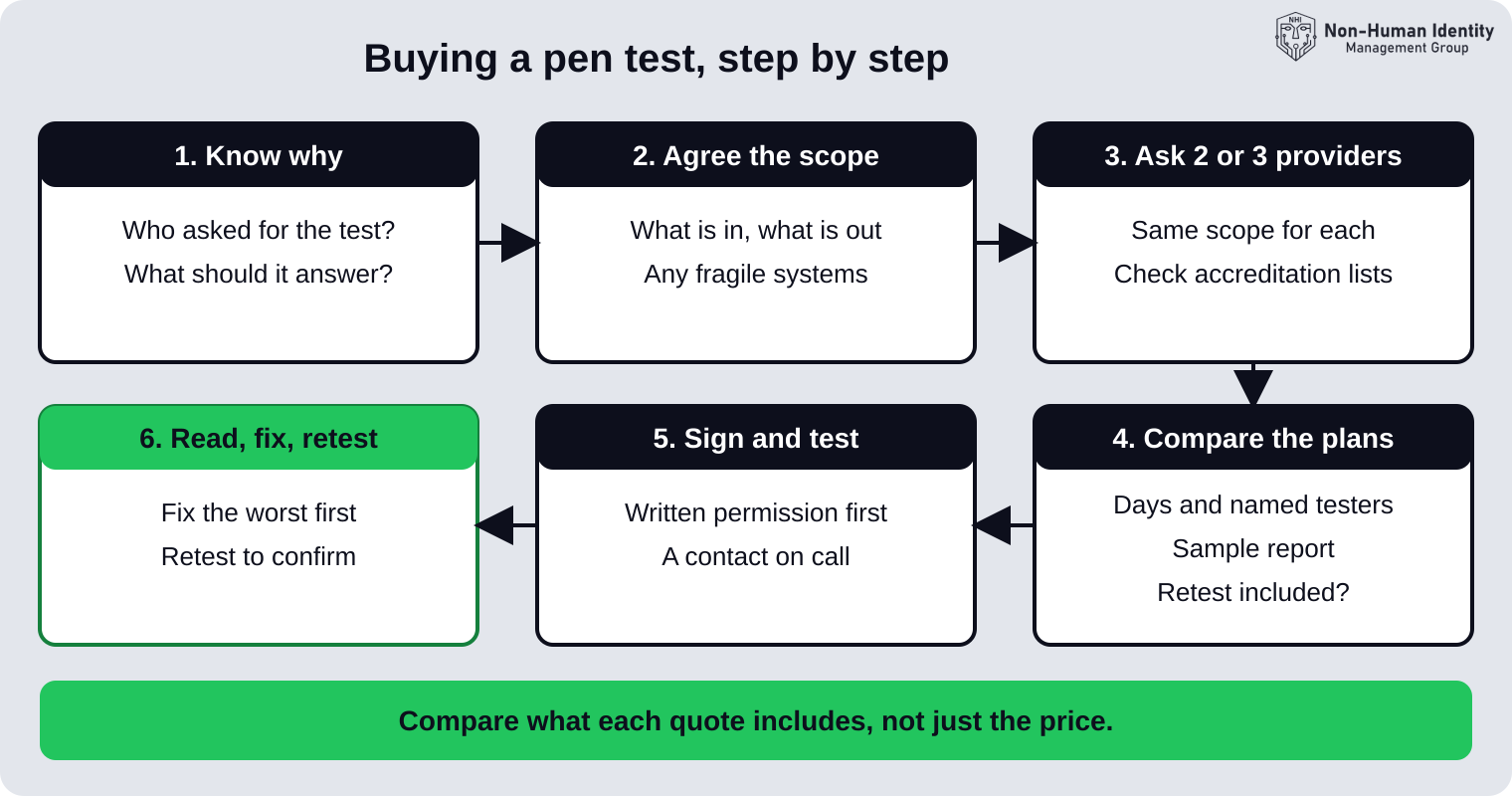
Most purchases follow the same path, from the first question to the retest.
- Know why. Write down what the test should answer, and who asked for it. CREST, an industry body, suggests starting with the problem you are trying to solve.[4]
- Agree the scope. The UK's National Cyber Security Centre (NCSC) gives advice on this. It suggests risk owners, staff who know the systems and the testers set the scope together.[1] List what is in, what is out and any fragile systems.
- Ask two or three providers. Give each the same scope. Check any accreditation on the scheme's own site, such as the CREST Marketplace, a directory of CREST-accredited firms.[3]
- Compare the plans. The NCSC says a scope plan should cover the effort, usually in days, and what the testers need from you, such as test accounts.[1]
- Sign and test. Sign written permission and the test rules. Keep a contact free during testing in case the testers find something serious.[1]
- Read, fix, retest. The report should list the issues, the risk of each and a way to fix them.[1] Fix the worst first, then ask for the retest.
A test also creates things you must tidy up. Testers often get test accounts to reach your systems. Some tests also need keys or tokens, which are non-human identities (NHIs) used by software. Switch all of them off when the test ends.
A worked example
Celia Jovanovic runs Larkfield Print Studio, a made-up printing firm with an online ordering site. A large new customer asks for a recent pen test of the site before signing a contract.
Celia has never bought one. She remembers the builders' quotes: compare what each one will actually do.
First she asks the customer what the test must cover. Their answer is short: the ordering site and its sign-in page. Celia's IT contractor, Vik Fairweather, adds what he knows. The payment page is run by a separate payment company, so it is out of scope.
Vik writes a one-page scope. Celia sends it to three providers. Two reply with clear plans. The third sends a single price with no breakdown.
The two clear quotes differ a lot in price. Celia asks both how many days are hands-on testing and who will do it. The cheaper one admits most of its time is automatic scanning. The other names two testers, sends a sample report with private details removed, and includes a retest.
Celia checks that provider's accreditation on the CREST Marketplace herself, rather than trusting the logo on the proposal. She signs the permission letter and the test rules. Vik sets up two test accounts that expire on the last test day.
The report finds one serious problem: one customer could see another's orders. Vik fixes it, and the retest confirms the fix. Celia sends the customer a summary and the retest letter.
What made the difference: Celia sent the same scope to everyone and compared what each quote included, not just its price.
Myths and mistakes
| What people think | What is true |
|---|---|
| All pen tests are the same, so pick the cheapest. | Quotes differ in days, people and depth. A low price often means fewer hands-on days. |
| A logo on the proposal proves accreditation. | Check the provider on the scheme's own list, for the service you are buying.[3] |
| Every organisation needs a CHECK provider. | CHECK was built for UK government, the public sector and critical national infrastructure. The NCSC says testing can be done by any organisation.[2] |
| A clean report means we are secure. | A test is a snapshot of the agreed scope on the test dates. The NCSC calls it assurance, not your main way to find weak spots.[1] |
| The provider decides what to fix. | You own the risk decisions. The NCSC advises against accepting every suggested fix without thinking about other options.[1] |
What can I do this week?
- Write one sentence on why you want a test and who asked for it.
- List the systems in scope, the ones out of scope, and who owns each.
- Prepare the same set of questions for every provider you contact.
- Look up each provider on the accreditation scheme's own website.
- Ask each provider for a sample report with private details removed.
Checklist
- We know why we want the test and what question it should answer.
- A written scope lists what is in, what is out and the test dates.
- Every provider received the same scope.
- Quotes show tester days, named testers and what is included.
- We have seen a sample report from the provider we chose.
- A retest is included, or its price is agreed up front.
- Accreditation was checked on the scheme's own list.
- Written permission was signed before any testing started.
- Test accounts and keys are switched off when the test ends.
Common questions
How much does a penetration test cost?
The price is set mostly by how many tester days the scope needs. More systems, more user types, out-of-hours work and a retest all add days. There is no fixed price, so send every provider the same written scope and compare the days and what is included.
Do I need a CREST or CHECK provider?
Only if your contract, regulator or sector requires it. CHECK is the NCSC scheme built for UK government, public bodies and critical national infrastructure. CREST accredits firms in many countries. Accreditation is one good sign, but still check the named testers and a sample report.
Is a vulnerability scan the same as a pen test?
No. A scan is an automatic check for known weak spots. A pen test adds skilled people who try to use those weak spots, and others a scanner may miss. A quote that is mostly scanning should be priced and described as a scan. See Penetration Testing for Beginners.
How often should we buy a test?
There is no single answer. Your customers, insurer or industry rules may set the timing, so ask them first. The NCSC notes that gaps of a year or more between tests are common, and that weak spots can go unnoticed in between. Keep checking for problems between tests.
What should I ask before I sign?
Ask who will test, how many days are hands-on, what the report will contain and whether a retest is included. Ask how they will store and delete your data, and what happens if they find something serious. Get the scope and permission in writing.
Where next?
Ready for the detail? Read the practitioner guide: Penetration Testing Provider Buyer's Guide. It goes further into evaluation criteria and weightings, contract terms, data handling, red flags and running a paid pilot.
Also useful:
- Penetration Testing for Beginners
- How to Read a Penetration Test Report
- Bug Bounties for Beginners
- Red Teaming for Beginners
Related NHI Mgmt Group resources: Penetration Test Remediation Tracker Template · Cyber Essentials for Beginners · Non-Human Identities for Beginners
Key terms
- Penetration testing
- An allowed test attack that tries to use weak spots the way a real attacker would.
- Scope
- The boundary of a test: which systems, addresses and dates are in and out.
- Rules of engagement
- The written agreement on what testers may and may not do, when, and who to call.
- Retest
- A repeat test, after a fix, to confirm the problem is really closed.
- Vulnerability scan
- An automatic check for known weak spots, with no person trying to use them.
- CREST
- A not-for-profit body that accredits cyber security firms and certifies individual testers.
- CHECK
- The UK NCSC scheme for assured firms testing government, public sector and critical national infrastructure systems.
Sources and further reading
- Penetration testing. National Cyber Security Centre (NCSC), UK. https://www.ncsc.gov.uk/guidance/penetration-testing, accessed 28 Nov 2026.
- CHECK penetration testing. National Cyber Security Centre (NCSC), UK. https://www.ncsc.gov.uk/information/check-penetration-testing, accessed 28 Nov 2026.
- CREST Marketplace FAQs. CREST. https://www.crest-approved.org/marketplace-faqs/, accessed 28 Nov 2026.
- What cyber security service do I need? CREST. https://www.crest-approved.org/buying-building-cyber-services/what-cyber-security-service-do-i-need/, accessed 28 Nov 2026.