Canada's privacy laws set rules for how organisations collect, use and protect facts about people.
This guide is for business owners, students and anyone new to Canadian privacy rules. If your business keeps customer names, emails or orders from people in Canada, at least one of these laws is likely to apply to you.
In short
- The main national law for businesses is PIPEDA. It is still the law today, because a planned replacement did not pass.
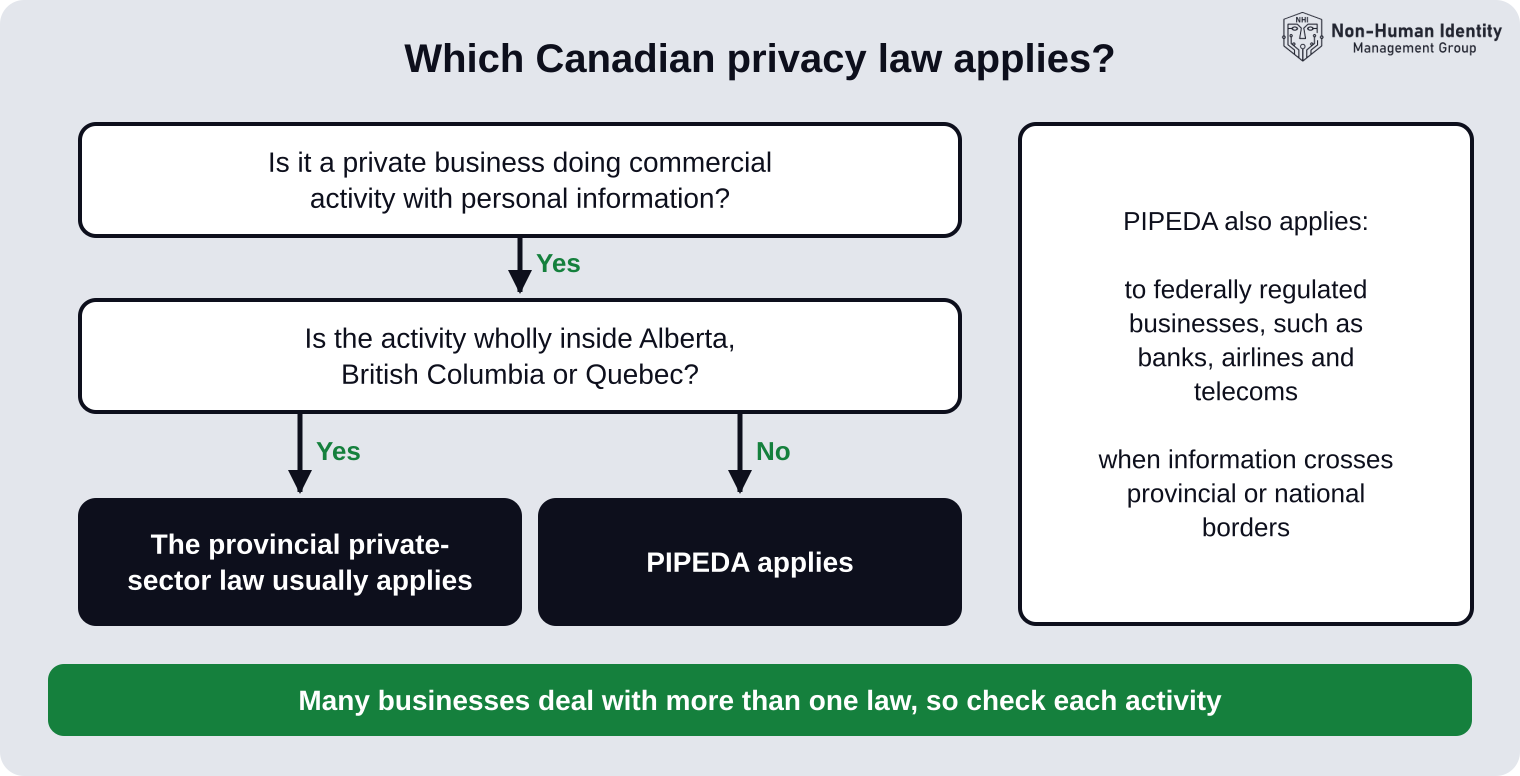
- Alberta, British Columbia and Quebec have their own private-sector privacy laws, which apply instead of PIPEDA for many activities inside those provinces.
- Under PIPEDA, a breach that creates a real risk of significant harm must be reported, and every breach must be recorded for two years.
- A new national bill was introduced in June 2026, but as at late November 2026 it had not passed.
What you will learn
- Explain which Canadian privacy law is likely to apply to a business.
- Spot when a data breach must be reported under PIPEDA.
- Check what is different in Quebec.
- Ask the right questions about what may change next.
Status: correct as at 28 November 2026, based on pages from the Office of the Privacy Commissioner of Canada, the Parliament of Canada (LEGISinfo) and the Government of Quebec. Laws change; check the official text.
This guide explains the topic in general terms and is not legal advice.
- Facts about a person (personal information)
- any information about a person who can be identified, such as a name, an ID number or a medical record.
- Privacy watchdog (Privacy Commissioner)
- the official body that oversees a privacy law and handles complaints.
- Breach report
- telling the watchdog, and the people affected, that their information has been exposed.
What are Canada's privacy laws?
Think of a shared house with one rulebook on the fridge. Everyone follows it. But three rooms have their own rulebooks, and inside those rooms you follow the room's rules instead.
Canada works in a similar way. The main rulebook for businesses is a national law called PIPEDA. The letters stand for the Personal Information Protection and Electronic Documents Act. It covers firms that use personal information in their trade. That means facts about a person who can be named.[1]
Alberta, British Columbia and Quebec have their own private-sector privacy laws. They are seen as close enough to PIPEDA. So for most work inside those provinces, the local law applies instead.[1] Some provinces also have laws just for health records.
Where the comparison stops working: in a house you are in one room at a time. A business can be in several "rooms" at once. For example, PIPEDA still applies when data about people crosses a border, wherever the firm is based.[1]
Why does it matter?
Most businesses hold some personal information, even if it is only a customer list. Knowing which law applies tells you what to do when things go wrong.
If you run a small business in Canada
What could happen: a laptop with customer files is stolen, and you do not know whether you must report it.
Check this: which law covers you, and who in the business decides on breach reports.
If your business is outside Canada
What could happen: you sell online to people in Canada and assume Canadian law is not your concern.
Check this: whether you collect personal information from people in Canada, and ask a privacy adviser.
If you are a student or new to privacy work
What could happen: you read old articles that say a new law has replaced PIPEDA, and you learn the wrong rules.
Check this: the date on anything you read, and the bill's status on the Parliament of Canada website.
Next: GDPR for Beginners
What does it look like?
Here is a made-up "Am I affected?" card that a small business could fill in. It is a starting point, not a legal test.
Example only. All values are made up.
AM I AFFECTED? (EXAMPLE) - Example Moving Co.
Do we sell goods or services?            YES   (1)
Do we keep facts about customers?        YES   (2)
Where do we work?   Ontario + Quebec           (3)
Does data cross provincial borders?      YES   (4)
Who decides on breach reports?   [ name ]      (5)
Where is our breach record kept? [ file ]      (6)
- Commercial activity is what brings a private business under PIPEDA.
- Names, phone numbers, addresses and payment notes all count as personal information.
- Work inside Quebec, Alberta or British Columbia may fall under that province's own law instead.
- Information that crosses provincial or national borders brings PIPEDA back in.
- In a real file, this line would name the person who decides whether a breach must be reported.
- In a real file, this line would point to the place where every breach is written down.
Why this is risky: many small firms leave lines 5 and 6 blank. When a breach happens, nobody knows who decides or where to write it down.
The safer way: fill in the card now, name one person, and set up a simple breach record before you need it.
How does it work?
Here is how the rules usually work for a business, step by step.
- Find your law. Most private firms that buy and sell fall under PIPEDA. Banks, airlines and phone firms are always covered, even for staff records.[1] Work done only inside Alberta, British Columbia or Quebec may fall under the local law.
- Follow the ten principles. PIPEDA is built on ten fairness rules. They include saying why you collect data and getting consent. Others are to collect only what you need, keep it safe, and let people see what you hold.[1]
- Protect the information. One rule is about safeguards. Security should match how private the data is.[1]
- If there is a breach, judge the risk. Some breaches must be reported to the Privacy Commissioner. The test is whether the breach could cause a real risk of significant harm. If so, you also tell the people affected. Harm includes identity theft, money loss and shame.[2]
- Write every breach down. Keep a record of all breaches for two years. That includes small ones you did not report.[2]
What is different in Quebec?
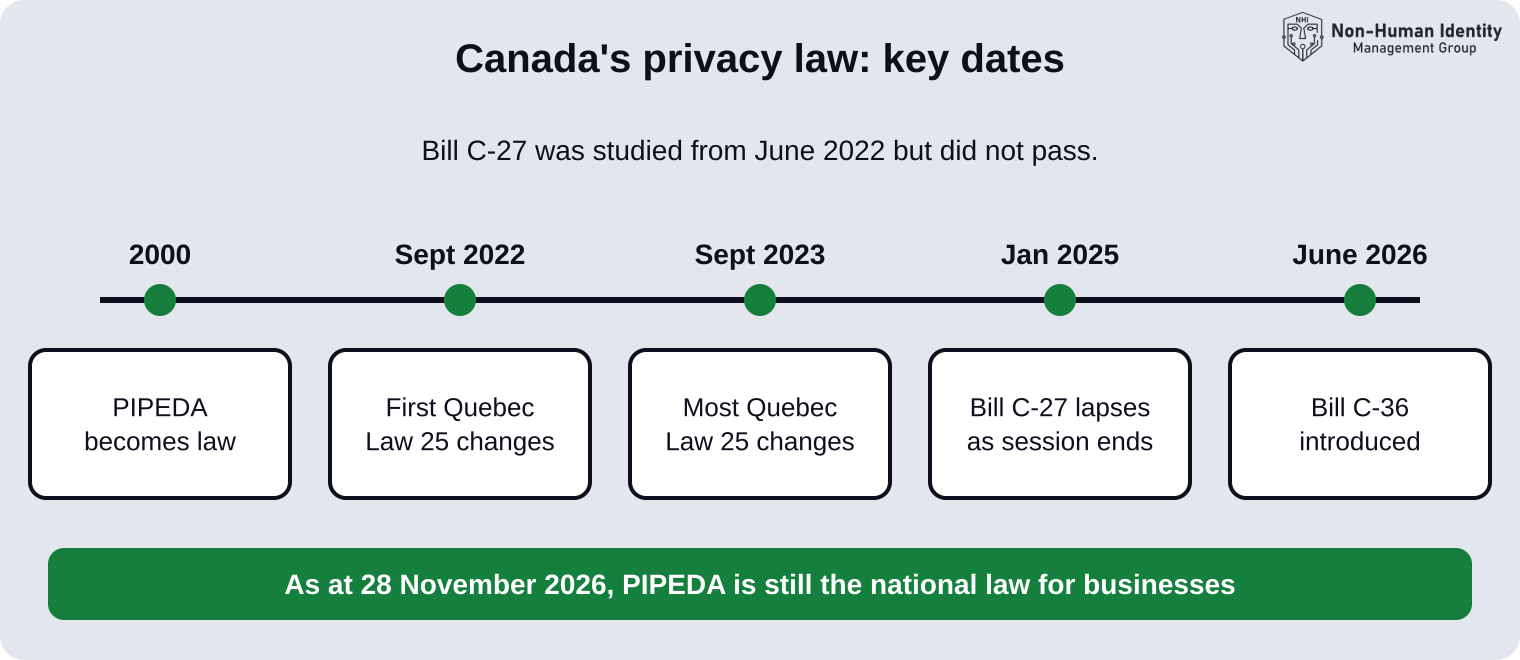
Quebec updated its private-sector privacy law with a law known as Law 25. Its changes came in stages over three years, from September 2022.[3]
- From September 2022, firms had to name a person in charge of privacy. Their job title and contact details go on the firm's website.[3]
- Firms must also keep a list of all privacy incidents. If an incident could cause serious harm, they tell the Quebec watchdog and the people affected.[3]
- Most other changes took effect in September 2023. One is the privacy impact assessment, a check of privacy risks before a new system is built. Others are stricter consent rules and fines of up to $10 million or 2% of worldwide turnover, whichever is higher.[4]
What is changing?
For years, a bill called Bill C-27 was expected to replace part of PIPEDA. A committee was still studying it when the session of Parliament ended in January 2025. So it did not become law.[5]
A new bill, Bill C-36, was introduced on 15 June 2026. Its name is the Protecting Privacy and Consumer Data Act. On 28 November 2026, the Parliament website showed only its first reading as done.[6] Bills can change or stall, so PIPEDA remains the rulebook for now.
A worked example
Kaia Pereira runs Juniper Removals, a fictional moving firm with offices in Ottawa and Gatineau, just across the river in Quebec. The firm keeps customer names, addresses, phone numbers and inventory lists of what each family owns.
One Friday, a staff member reports that a work tablet was left in a van that was broken into. The tablet held the week's bookings for about forty families.
Kaia remembers the shared house. Her Ottawa work sits under the main rulebook, PIPEDA. Her Gatineau work sits in the Quebec "room". The booking list has customers from both sides of the river.
She calls her bookkeeper, Umar Quist, who also acts as the firm's privacy lead. Together they ask three questions. Was the tablet locked and encrypted? What information was on it? Could it be used to harm people?
The tablet had a passcode, but the files were not encrypted. The lists show home addresses and moving dates, which tell a thief when a house will be empty. Umar judges that this could create a real risk of significant harm.
Kaia gets advice from a privacy lawyer. With that advice, the firm reports the breach to the federal Privacy Commissioner and, for the Quebec customers, to the Quebec watchdog. It tells the families and suggests they keep an eye on their homes on moving day.
Umar writes the incident into the firm's breach record and its Quebec incident register. Kaia turns on encryption for every tablet and makes sure bookings are deleted from devices once a job is done.
Nothing in this needed deep legal knowledge. It needed a named person, a record, and a quick look at which rules applied.
Myths and mistakes
| What people think | What is true |
|---|---|
| A new law has already replaced PIPEDA. | Bill C-27 did not pass. As at 28 November 2026, Bill C-36 had only completed first reading, so PIPEDA still applies.[6] |
| We are small, so the privacy law does not apply. | PIPEDA covers commercial activity, not just large firms. Size is not the test.[1] |
| We only need to keep a note of breaches we report. | Under PIPEDA, every breach must be recorded for two years, reported or not.[2] |
| Quebec follows the same rules as the rest of Canada. | Quebec has its own private-sector law, updated by Law 25, with extra duties and its own watchdog. |
| Business email addresses are always covered. | PIPEDA generally does not cover business contact details used only to contact someone about their job.[1] |
What can I do this week?
- List the kinds of personal information your business keeps, and where it is stored.
- Write down which provinces you work in, and whether information crosses borders.
- Name one person to decide on breach reports, and tell your staff who it is.
- Set up a simple breach record, such as a locked spreadsheet with date, what happened and what you did.
- Bookmark the Privacy Commissioner's guidance on breaches so you can find it quickly.
Checklist
- We know which privacy law or laws apply to each part of our business.
- We know what personal information we keep and why.
- A named person is responsible for privacy and breach decisions.
- We keep a record of every breach for at least two years.
- Staff know how to report a lost device or a suspected breach.
- Laptops, phones and tablets with customer data are protected with encryption.
- If we work in Quebec, our privacy contact is published on our website.
- We check the status of new privacy bills at least once a year.
Common questions
Is PIPEDA still the law in Canada?
Yes. As at 28 November 2026, PIPEDA is still the national privacy law for private firms. Bill C-27 did not pass. The bill that follows it, Bill C-36, had only had its first reading.
Does PIPEDA apply to charities?
Usually not. The Privacy Commissioner says charities are not normally covered. The exception is when they sell things that are not central to their main purpose. Local laws may still apply, so check the rules where you are.[1]
How quickly must a breach be reported?
As soon as you can, once you decide the breach could cause real harm. PIPEDA does not set a number of hours. Write down when you found the breach and when you decided. Then you can show your timeline.
What happens if a business ignores the breach rules?
It can lead to fines. Knowingly breaking the breach rules is a crime under PIPEDA. The Privacy Commissioner does not fine firms itself. But it can pass cases to the Attorney General of Canada.[2]
Does PIPEDA cover government departments?
No. National government bodies follow a different law, the Privacy Act. Provincial governments follow local laws, and so do most schools and hospitals. PIPEDA is mainly for private firms that buy and sell.[1]
Where next?
Ready for the detail? Read the practitioner guide: Canada PIPEDA and Bill C-27 Guide. It goes further into the legal sections behind each duty, what a breach report must contain, and how Bill C-36 differs from Bill C-27.
Also useful:
- Data Breach Notification for Beginners
- Data Privacy for Beginners
- US Privacy Laws for Beginners
- Canada Provincial Health Privacy and Public Sector Cyber
- Canada AI Regulation Guide (post-AIDA)
Related NHI Mgmt Group resources: GDPR for Beginners · CyberSecure Canada · Canada Bill C-8 Guide
Key terms
- PIPEDA
- Canada's national privacy law for private businesses that handle personal information in commercial activity.
- Personal information
- Any information about a person who can be identified.
- Privacy breach
- When personal information is lost, stolen, or seen or used by someone who should not have it.
- Breach notification
- Telling a regulator and the people affected that their information has been exposed.
- Privacy impact assessment
- A check of privacy risks before a new system or project goes ahead.
- Real risk of significant harm
- The test under PIPEDA for when a breach must be reported and people told.
Sources and further reading
- PIPEDA in brief. Office of the Privacy Commissioner of Canada, last modified 1 May 2024. https://www.priv.gc.ca/en/privacy-topics/privacy-laws-in-canada/the-personal-information-protection-and-electronic-documents-act-pipeda/pipeda_brief/, accessed 28 Nov 2026.
- What you need to know about mandatory reporting of breaches of security safeguards. Office of the Privacy Commissioner of Canada. https://www.priv.gc.ca/en/privacy-topics/business-privacy/breaches-and-safeguards/privacy-breaches-at-your-business/gd_pb_201810/, accessed 28 Nov 2026.
- Loi 25: nouvelles dispositions protégeant la vie privée des Québécois (Law 25: new provisions protecting Quebecers' privacy), Government of Quebec news release, 22 September 2022. https://www.quebec.ca/nouvelles/actualites/details/loi-25-nouvelles-dispositions-protegeant-la-vie-privee-des-quebecois-certaines-dispositions-entrent-en-vigueur-aujourdhui-43212, accessed 28 Nov 2026.
- Loi 25 sur la protection des renseignements personnels: entrée en vigueur de nouvelles dispositions (Law 25: new provisions in force), Government of Quebec news release, 22 September 2023. https://www.quebec.ca/nouvelles/actualites/details/loi-25-sur-la-protection-des-renseignements-personnels-des-citoyens-du-quebec-entree-en-vigueur-de-nouvelles-dispositions-qui-font-du-quebec-un-chef-de-file-mondial-50726, accessed 28 Nov 2026.
- C-27 (44th Parliament, 1st session): Digital Charter Implementation Act, 2022. LEGISinfo, Parliament of Canada. https://www.parl.ca/legisinfo/en/bill/44-1/c-27, accessed 28 Nov 2026.
- C-36 (45th Parliament, 1st session): Protecting Privacy and Consumer Data Act. LEGISinfo, Parliament of Canada. https://www.parl.ca/legisinfo/en/bill/45-1/c-36, accessed 28 Nov 2026.