The CISA KEV catalogue is a free public list of software flaws known to be used in real attacks.
This guide is for new IT staff, small business owners and anyone who looks after computers and wants to know which updates matter most. You do not need to be a security expert: if you run a website, a router or office software, some of it may be on this list.
In short
- Thousands of software flaws are published each year, but only some are known to be used by attackers.
- A US cyber agency, CISA, keeps a free list of those flaws, called the KEV catalogue.
- Each entry names the product, says what to do and gives a date to do it by.
- Check the list against what you own, and fix any matches first, starting with anything that faces the internet.
What you will learn
- Explain what the KEV catalogue is and who runs it.
- Read a KEV entry and know what each part means.
- Check whether your own products appear on the list.
- Explain why "on the KEV list" can matter more than a high severity score.
- Software flaw (vulnerability)
- a mistake in software that an attacker may be able to use to get in or cause harm.
- Fix (patch)
- an update from the maker that closes a flaw.
- Flaw ID (CVE)
- a unique number given to a publicly known flaw, so everyone can talk about the same one.
What is the CISA KEV catalogue?
Think of a warning list of door locks that burglars are already opening on your street. Some locks have faults that nobody has used yet. The ones on the list are being picked right now, so you change those first.
The KEV catalogue works the same way for software. KEV stands for Known Exploited Vulnerabilities. A vulnerability is a flaw in software. "Exploited" means attackers have used it. So the list holds flaws that are known to have been used in real attacks.
The list is kept by CISA, the US government's cyber security agency. Each flaw on it has a CVE number, which is a public ID for that flaw. Each entry also says what action to take, such as applying the maker's update.[2]
Anyone can download the list for free, as a spreadsheet file or a data file.[1] On 27 November 2026 it held 1,808 entries.[2]
Where the comparison stops working: a burglar has to visit your street. An attacker can scan the whole internet for a weak product in a short time, so distance gives little protection.
Why does it matter?
Most teams cannot fix every flaw at once. The KEV list helps you pick the ones attackers are already using. US federal agencies must fix these by set dates. CISA says its approach also offers practical tools for any organisation.[3]
If you run a small business
What could happen: your router or website software is on the list, and an attacker gets in before you update it.
Check this: ask your IT supplier whether they check the KEV list, and how fast they fix matches.
If you are new to IT work
What could happen: you work through a long list of updates in the wrong order and miss the one being attacked.
Check this: compare your update list with the KEV list each week, and move matches to the top.
If you manage an IT team
What could happen: your team chases high scores while a lower-scored flaw on the KEV list stays open.
Check this: set a target time for fixing KEV matches, and ask for a monthly count of open ones.
What does it look like?
Each entry on the list is one short record. Here is a made-up one, laid out the way the data file stores it.
Example only. All values are made up.
Flaw ID:          FAKE-ID-0000 (EXAMPLE)            (1)
Maker / product:  Example Corp / FakeRouter 2000    (2)
Date added:       2026-01-05
Action needed:    Apply the maker's update          (3)
Due date:         2026-01-08                        (4)
Ransomware use:   Known                             (5)
- In a real file, this line would contain the flaw's public ID number.
- The maker and product name, which you match against what you own.
- What to do. Sometimes it also says to stop using a product, or to check whether it was already broken into.
- The date US federal agencies must act by. Others can use it as a guide.
- "Known" means the flaw has been used in ransomware attacks. "Unknown" means CISA has not confirmed it, not that it is safe.
Why this is risky: if you own FakeRouter 2000 and have not updated it, attackers already know how to use this flaw.
The safer way: keep a list of what you own, check it against new KEV entries, and fix matches before the due date.
How does it work?
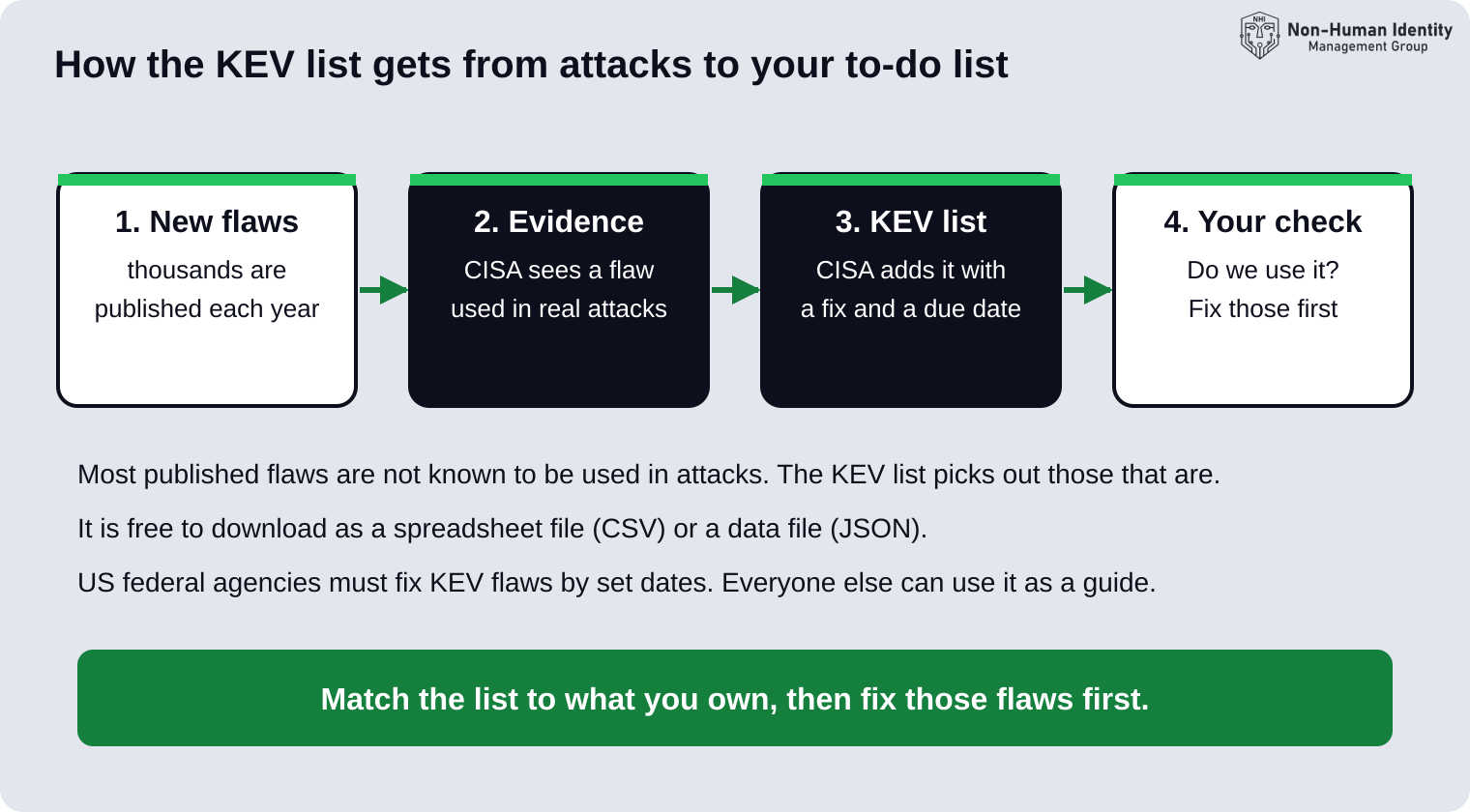
Here is how a flaw ends up on the list and then on your to-do list.
- A flaw is found. A software maker or researcher finds a flaw, and it gets a CVE number.
- Attacks are seen. CISA gets evidence that attackers have used the flaw in the real world.
- It is added. CISA adds it to the list with an action and a due date. Recent entries mention a newer US rule for agencies, issued in June 2026.[2][3]
- The data updates. The free data files are updated whenever the list changes.[1]
- You check. You, your IT supplier or your scanning tool compare the list with your own devices and software.
- You fix. You apply the update, or follow the action, and record when it was done.
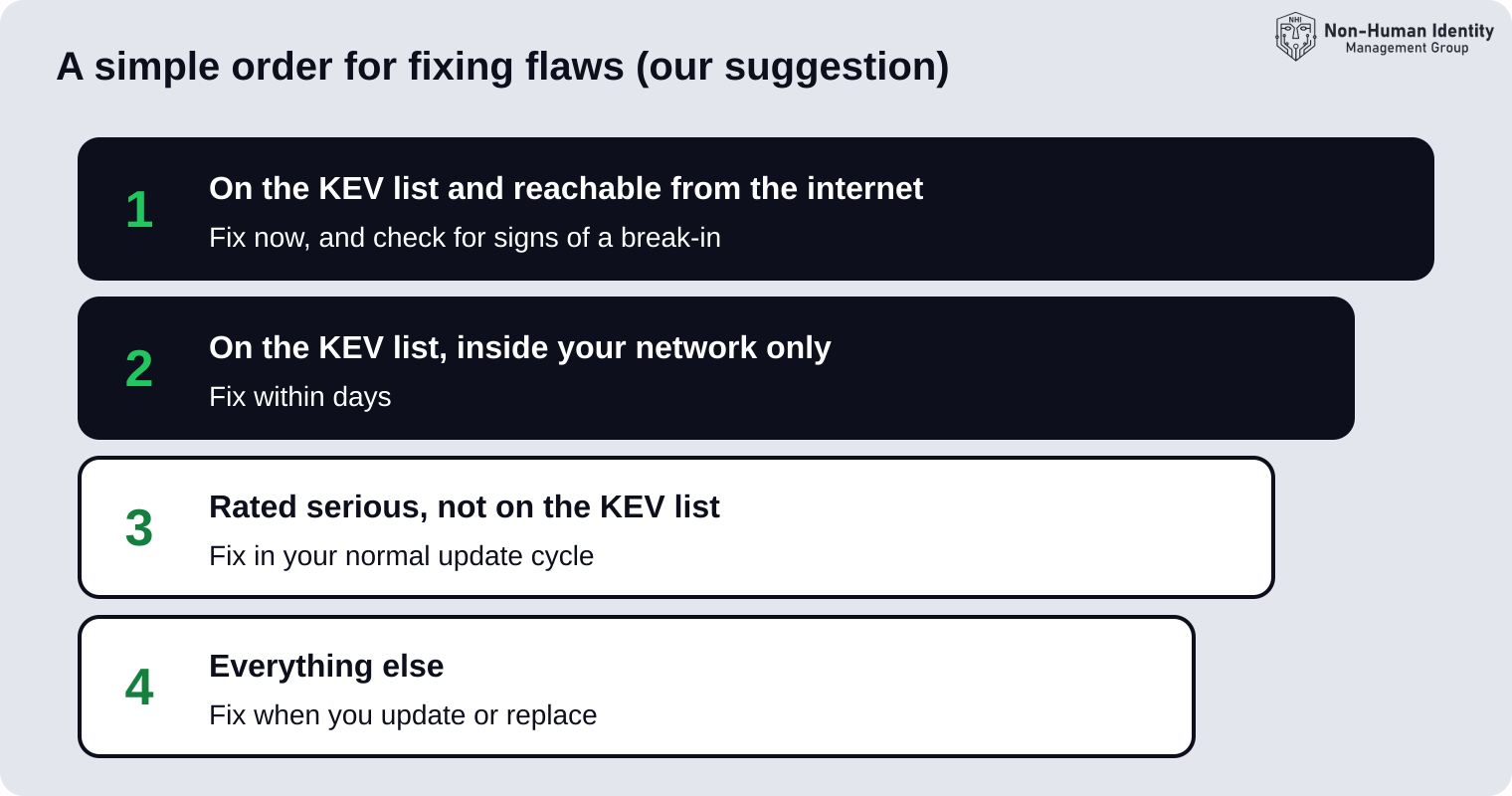
Under the June 2026 rule, US agencies must fix the riskiest flaws fastest. Some KEV flaws give an attacker full control of a system. For those, the deadline is three days. Agencies must also check whether they were already broken into.[4] You do not have to follow these dates, but they show how urgent some flaws are.
A worked example
Yusuf Grover runs Slate Tutors, a fictional tutoring firm with six staff and a booking website. Juno Jovanovic looks after its computers two days a week.
On Monday, Juno opens the KEV list and filters it to entries added in the last week. She compares them with her short list of what the firm owns: the office router, the laptops, the website and its add-ons.
One new entry names the brand and model of the office router. The action says to apply the maker's update. Juno remembers the warning list of locks. This one is being picked right now, and the router faces the internet.
She tells Yusuf the router needs an update that evening, which means ten minutes without internet. Yusuf agrees, and they move it ahead of the other updates on her list.
After the update, Juno checks the router's version number against the maker's notice. She also looks at the router's list of admin logins. She sees no logins she does not recognise in the records it keeps, and changes the admin password to be safe.
Last, she adds a weekly reminder to check new KEV entries. She also asks the website company whether they do the same for the booking system. They say yes, and send her their target fix times.
Myths and mistakes
| What people think | What is true |
|---|---|
| The KEV list is only for the US government. | Only US federal agencies must follow its dates, but anyone can use it for free. |
| Only flaws with a "critical" score matter. | A flaw being used by attackers can matter more than its score. The list is chosen by evidence of attacks, not by score. |
| If a flaw is not on the list, nobody is using it. | The list includes only flaws CISA has evidence for. Attacks can happen before a flaw is added. |
| "Unknown" ransomware use means it is safe. | It means CISA has not confirmed ransomware use. Fix it anyway. |
| Installing the update is always the end of the job. | For some flaws, the action also says to check whether the system was broken into before the fix. |
What can I do this week?
- Write a short list of the devices and software you own, with makers and models.
- Open the KEV list and search for each maker on your list.
- Update anything that matches, starting with things that face the internet.
- Ask your IT supplier how they use the KEV list and how fast they fix matches.
- Set a weekly reminder to check new entries.
Checklist
- We keep an up-to-date list of our devices and software.
- Someone checks new KEV entries at least once a week.
- KEV matches go to the top of the update list.
- Internet-facing devices on the list are fixed first.
- We read the full action text, not just "apply update".
- Where the action says so, we check for signs of a break-in as well as fixing.
- Suppliers who run systems for us tell us how they handle KEV matches.
Common questions
Do I have to follow the KEV due dates?
No, unless you are a US federal agency, or a contract or rule you follow says so. The dates are binding on federal agencies. For everyone else they are a useful guide to how urgent a flaw is. Many firms set their own target times for KEV matches.
How often is the KEV list updated?
It is updated whenever CISA adds new flaws. The free data files on CISA's code page are updated shortly after the main list changes.[1] We suggest checking at least once a week as a start for a small team.
Is the KEV list the same as CVE?
No. CVE is the system that gives every publicly known flaw an ID number. The KEV list is a much smaller set of those flaws, chosen because there is evidence attackers have used them. Every KEV entry has a CVE number, but most CVEs are not on the list.
What if the maker has no update for my product?
Follow the action text, which may suggest other steps or stopping use of the product. Older products the maker no longer supports may never get a fix. In that case, plan to replace the product, and keep it off the internet until you do.
Does my scanning tool already use the KEV list?
Some do. Some security scanning tools can mark or filter results that are on the KEV list. Ask your supplier or check the tool's settings. If yours does not, you can still compare its results with the free list yourself, by maker and product name.
Where next?
Ready for the detail? Read the practitioner guide: CISA KEV Catalogue Guide. It goes further into every field in the data, the US federal deadlines and how to load the feed into your own tools automatically.
Also useful:
- CVE and CVSS for Beginners
- Vulnerability Management for Beginners
- Zero-Day Vulnerabilities for Beginners
- EPSS Guide
Related NHI Mgmt Group resources: Zero-Day and Exploited Vulnerabilities Guide · Risk-Based Vulnerability Management Guide · SSVC Guide
Key terms
- Vulnerability
- A weakness in software or a system that an attacker may be able to use.
- CVE
- A unique ID number given to a publicly known software flaw.
- Known exploited vulnerability
- A flaw with confirmed evidence that attackers have used it in real attacks.
- CVSS
- A common way to score how severe a flaw is, from 0 to 10.
- Patch
- An update from the maker that fixes a flaw.
- Binding operational directive
- A rule from CISA that US federal agencies must follow.
Sources and further reading
- kev-data: Known Exploited Vulnerabilities catalog data files (CSV, JSON and schema, CC0 licence). CISA, GitHub. https://github.com/cisagov/kev-data, accessed 28 Nov 2026.
- Known Exploited Vulnerabilities catalog, JSON feed, catalog version 2026.11.27 (1,808 entries). CISA. https://raw.githubusercontent.com/cisagov/kev-data/develop/known_exploited_vulnerabilities.json, accessed 28 Nov 2026.
- CISA Releases Binding Operational Directive 26-04 on Prioritizing Security Updates Based on Risk. CISA bulletin, 10 June 2026. https://content.govdelivery.com/accounts/USDHSCISA/bulletins/41b445a, accessed 28 Nov 2026.
- Robert Huber. CISA BOD 26-04 FAQ: vulnerability remediation impact. Tenable blog, 11 June 2026 (one vendor's summary of the directive's timelines). https://www.tenable.com/blog/cisa-bod-26-04-FAQ-vulnerability-remediation-impact, accessed 28 Nov 2026.