A CISO is the senior leader who is responsible for an organisation's information and cyber security.
This guide is for anyone curious about the job, or anyone who works with a CISO. You do not need a security job to be affected: the CISO's choices shape the rules, tools and training everyone at work lives with.
In short
- CISO stands for chief information security officer. The CISO leads the security team and sets its plan.
- Most of the job is about deciding which risks matter most and explaining them to leaders in plain words.
- The CISO is rarely the person fixing computers. Teams of engineers and analysts do that work.
- It is a senior job. Most CISOs spend many years in IT, security or risk work first.
What you will learn
- Explain what a CISO does in one sentence.
- Describe a typical week in the role.
- Spot the skills that matter most for the job.
- Choose a first step if you want to work towards it.
- Chance of harm (risk)
- how likely something bad is to happen, and how much it would hurt if it did.
- Top leadership group (board)
- the directors who oversee how an organisation is run and answer for it.
- How decisions get made (governance)
- the rules, roles and checks that decide who makes which choices.
What is a CISO?
Think of the head coach of a football club. The coach does not play in the match. They pick the team, set the game plan and answer to the club's owners. A CISO plays that part for security.
In plain words, the CISO decides how the organisation protects its information, systems and people. They lead the security team, set the security plan and agree a budget. They also report to the top leaders on how safe the organisation is.
A big part of the job is risk, meaning how likely a bad event is and how much it would hurt. No organisation can block every threat. So the CISO helps leaders choose which risks to reduce first and which ones they will accept.
Where the comparison stops working: a coach can see the whole match. A CISO often cannot see every system, supplier or app in use. Much of the job is finding out what exists before deciding how to protect it.
Why does it matter?
Security is now treated as a top business risk, like money or a good name. In 2024, a widely used US government security guide added a new part on how leaders make and carry out security decisions.[1]
If you are a director or business owner
What could happen: nobody owns security, so problems are found late and nobody can explain them to you.
Check this: ask who reports to you on security, and how often.
If you work in a security team
What could happen: you fix problems well but cannot explain why they matter, so the work is not funded.
Check this: describe your last fix in one line a manager would understand.
If you are planning a career
What could happen: you aim straight for the top job and find adverts ask for many years of experience.
Check this: pick a first role, such as IT support or risk work, that builds towards it.
What does it look like?
CISOs often send leaders a short report on the top risks. Here is a made-up one-page summary for a chain of shops.
Example only. All values are made up.
SECURITY REPORT TO THE BOARD   EXAMPLE-0000
Period:   last quarter
Top risk: staff tricked into sharing passwords   (1)
Trend:    rising                                 (2)
Plan:     two-step sign-in for all staff         (3)
Cost:     FAKE-BUDGET-0000, approval needed      (4)
Accepted: old till software until next year      (5)
Owner:    FAKE-CISO     Next review: 3 months
- The main risk, in words a director can follow.
- Whether the risk is getting better or worse.
- What the CISO proposes to do about it.
- What the CISO needs from the board. In a real file, this line would show the actual cost.
- A risk leaders have chosen to live with for now, written down so it is not forgotten.
Why this is risky: a report full of technical jargon can leave directors unable to make a choice.
The safer way: each risk is written in plain words, with a plan, a cost, an owner and a date to look again.
How does it work?
The job varies by organisation, but a CISO's work usually runs in a cycle.
- Understand the business. Learn what the organisation does, what data it holds and what would hurt most if it stopped.
- Find the risks. Work with the team to spot the biggest threats and gaps.
- Set the plan. Choose what to fix first, write the rules and agree a budget with leaders.
- Lead the team. Hire people, pick suppliers and make sure the plan gets done.
- Prepare for the bad day. Make sure there is a tested plan for handling attacks, called incident response.
- Report and repeat. Tell the board how things stand, then review the risks again.
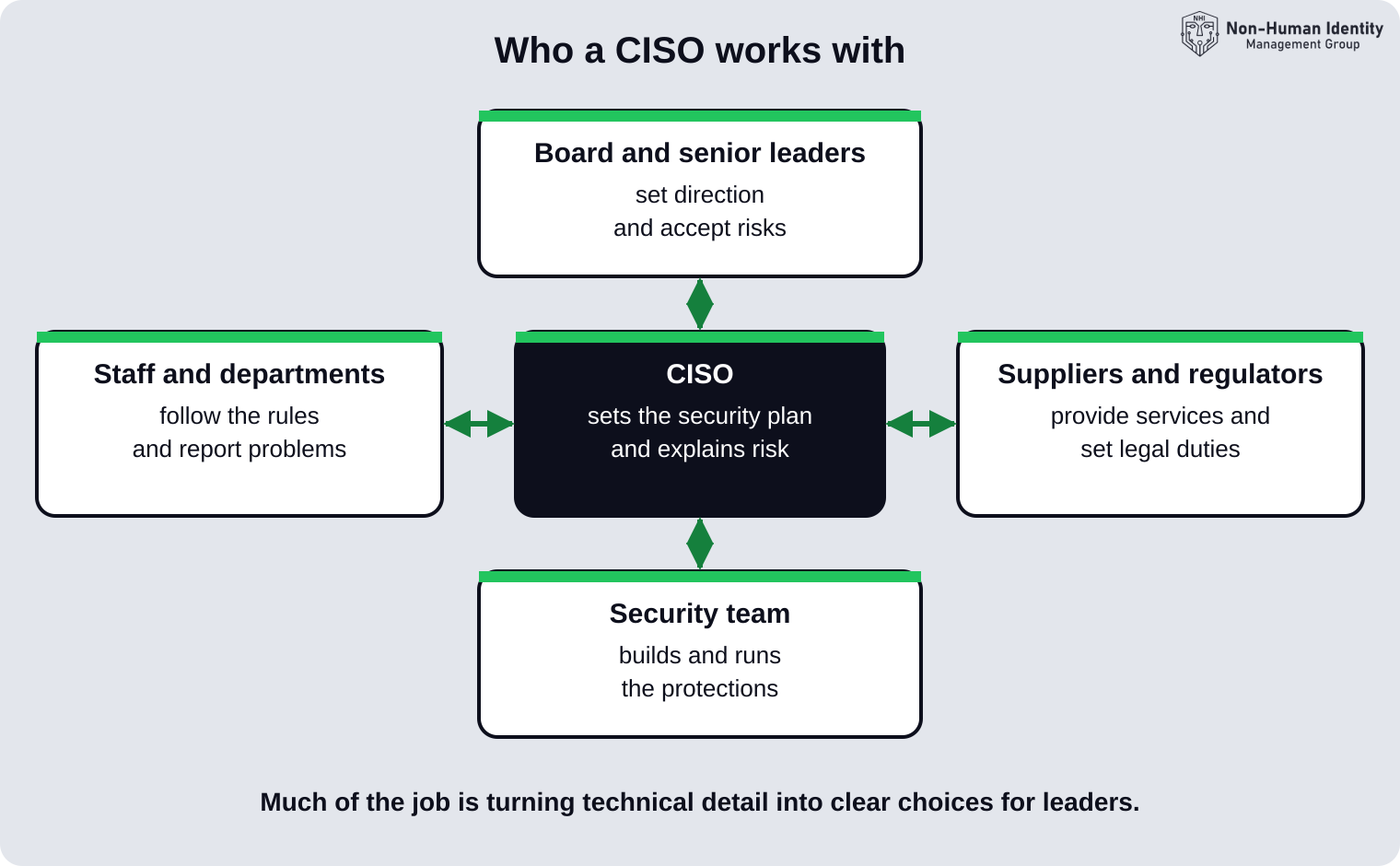
In some places, the law now expects leaders to take this seriously. In the US, listed companies must describe in their yearly report how management assesses and handles cyber risk, and how the board oversees it.[2] The UK cyber agency publishes a toolkit to help boards govern cyber risk.[3]
Skills and tools
- Explaining clearly. Turning technical problems into business choices that leaders can act on.
- Judging risk. Weighing how likely a threat is against how much it would cost.
- Broad technical knowledge. Enough about networks, cloud, sign-in and data to ask the right questions.
- Leading people. Hiring, building and keeping a team.
- Everyday tools. A risk register (a list of risks with owners), security policies, budget plans and reports. Published security frameworks act as checklists.
Routes in
There is no single path. Many CISOs start in IT support, networks or software. Others come from audit, risk or compliance work. Most move up through roles like security analyst, engineer, architect or security manager. Smaller firms may share a part-time CISO, often called a virtual CISO. Pay varies widely by country and sector, so check official job market data for your area.
A worked example
This is a made-up week in the life. Grace Kim is the CISO at Maple Street Pharmacy, a US chain of 40 pharmacies.
On Monday, Grace meets her team of five. A security analyst reports more fake emails asking staff for their passwords. Grace asks how many people clicked. Two did, and both reset their passwords quickly.
On Tuesday, she meets the finance director. Grace wants money for two-step sign-in for all staff. She explains it in plain words: one stolen password could expose patient records. The director asks what it costs and how long it takes. Grace has both answers ready.
On Wednesday, a supplier wants to connect to the prescription system. Grace asks her team to check the supplier's security before saying yes.
On Thursday, she runs a practice drill. The team pretends the tills have stopped working because of an attack. They find that nobody knows who should call the insurer. Grace adds that step to the plan.
On Friday, she writes her report to the board. It has three top risks, one request for money and one risk the leaders have agreed to accept for now.
Grace changed no settings this week. Her work was asking questions, making choices and explaining them.
Myths and mistakes
| What people think | What is true |
|---|---|
| The CISO is the most technical person in the team. | CISOs need good technical knowledge, but the main skills are leading, judging risk and explaining. |
| The CISO's job is to stop every attack. | No one can block every attack. The CISO lowers the most important risks and prepares for the rest. |
| Security is the CISO's problem alone. | Leaders own the business risk. Every member of staff plays a part. |
| Only big companies need a CISO. | Smaller firms still need someone in charge of security. That may be a part-time or shared CISO. |
| A certificate is enough to become a CISO. | Certificates help, but employers usually look for years of hands-on and leadership experience. |
What can I do this week?
- Find out who leads security where you work, and who they report to.
- Read three CISO job adverts and list the experience they ask for.
- Pick one risk at your workplace and explain it in two plain sentences.
- Read the UK board toolkit listed in the sources below.
Checklist
- I can explain what a CISO does in one sentence.
- I know the CISO leads the plan and the team, not every fix.
- I understand why risk is at the heart of the job.
- I can name three groups a CISO works with.
- I know why reports to leaders use plain words.
- I know the role usually needs many years of experience.
- I know where to find the practitioner career guide.
Common questions
Who does a CISO report to?
It varies. Many report to the chief executive, the head of IT or the head of risk. Some also talk to the board directly. Who the CISO reports to can affect how much say they have, so it is a common topic in the role.
Is a CISO the same as a CIO?
No. A CIO, or chief information officer, runs the organisation's IT so that it works well. A CISO focuses on keeping information and systems safe. They work closely together, and in some firms the CISO reports to the CIO.
How long does it take to become a CISO?
Usually many years. Most CISOs have worked in several IT, security or risk jobs first, and have led a team before. The time varies a lot by person, sector and size of organisation, so there is no fixed number.
What is a virtual CISO?
A virtual CISO is an experienced security leader who works part time or on contract, often for several firms. Smaller organisations use them when they need senior security advice but cannot fund a full-time role.
Does a CISO need to code?
Not usually. Coding can help a CISO understand how systems are built, but it is rarely part of the day. Being able to ask good technical questions and judge the answers matters more than writing code.
Where next?
Ready for the detail? Read the practitioner guide: Path to CISO Career Guide. It goes further into career stages, certifications and the leadership experience employers look for.
Also useful:
- CISO vs CSO vs CIO
- Where Should the CISO Report
- vCISO Guide
- GRC Analyst for Beginners
- Incident Response for Beginners
Related NHI Mgmt Group resources: CISO Guide: First 90 Days · Cybersecurity Careers Guide · Board Cyber Risk Reporting Guide
Key terms
- Chief information security officer (CISO)
- The senior leader responsible for an organisation's security strategy, risk and governance.
- Cyber risk
- The chance of harm to an organisation from attacks on, or failures of, its computers and data.
- Risk appetite
- How much and what kind of risk an organisation is prepared to take to reach its goals.
- Risk register
- A list of known risks, each with an owner, a rating and a plan.
- Incident response
- The steps used to spot, contain, investigate and recover from a security problem.
- Risk assessment
- Judging how likely a harm is and how much it would matter, to decide what to protect first.
Sources and further reading
- NIST Releases Version 2.0 of Landmark Cybersecurity Framework (Cybersecurity Framework 2.0, with the new Govern function). National Institute of Standards and Technology, 26 February 2024. https://www.nist.gov/news-events/news/2024/02/nist-releases-version-20-landmark-cybersecurity-framework, accessed 28 Nov 2026.
- SEC Adopts Rules on Cybersecurity Risk Management, Strategy, Governance, and Incident Disclosure by Public Companies (press release 2023-139; Regulation S-K Item 106). US Securities and Exchange Commission, 26 July 2023. https://www.sec.gov/newsroom/press-releases/2023-139, accessed 28 Nov 2026.
- Cyber Security Toolkit for Boards (version 3.0). National Cyber Security Centre, published 30 March 2023, reviewed 8 April 2025. https://www.ncsc.gov.uk/collection/board-toolkit, accessed 28 Nov 2026.